Wisconsin
Cluster 5: High-Complexity Transition States
Wisconsin designed its own path to universal coverage: BadgerCare Plus covers adults up to 100% of the federal poverty level while marketplace subsidies cover everyone above. The arrangement cost Wisconsin $1.9 billion per biennium in forgone federal matching funds but eliminated the coverage gap that plagues other non-expansion states. Now federal policy closes that path behind it. Work requirements arrive for the population Wisconsin already covers. Marketplace subsidies expire in 2026. Wisconsin receives $203.7 million for rural health transformation in a state where two hospitals and 19 clinics closed in a single month in 2024.
State Context#
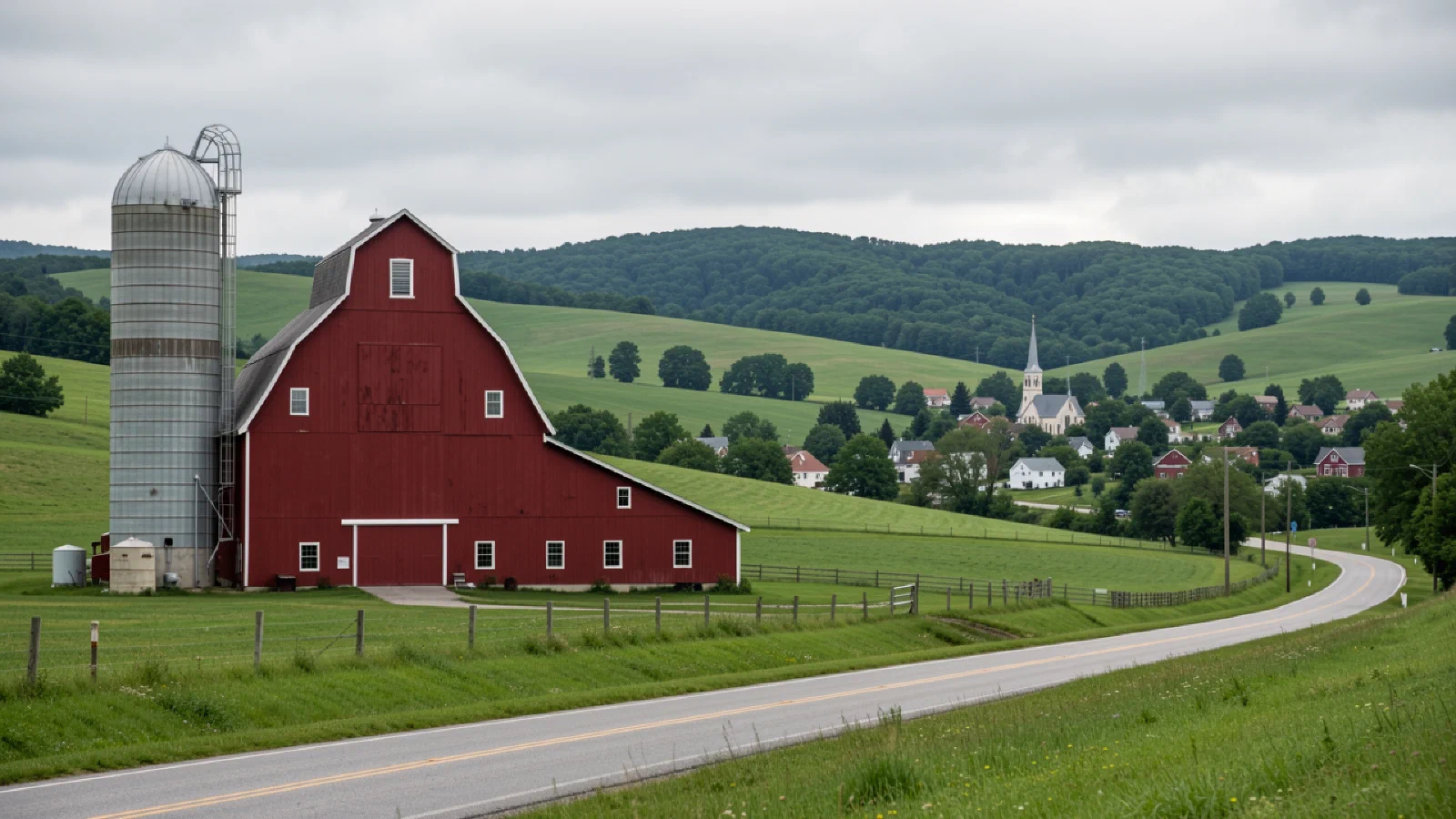
Wisconsin has approximately 1.39 million rural residents across 55 counties classified as rural or semi-rural, representing more than one-third of the state’s population. The geography runs from the dairy farms of the Driftless Region in the southwest through the central sand counties to the remote forests of the Northwoods, where some communities sit 90 minutes from the nearest hospital. The rural population is aging faster than the state average, with 65-and-older residents comprising nearly 20% of rural counties compared to 17% statewide.
The provider landscape includes 60 Critical Access Hospitals, 217 Rural Health Clinics, and 280 FQHC service delivery sites. Wisconsin’s CAHs rank among the top 10 nationally for HRSA MBQIP quality performance, and 65% of Wisconsin hospitals have earned CMS four or five-star ratings compared to 36% nationally. This quality foundation distinguishes Wisconsin from high-complexity transition peers where infrastructure deficits compound policy constraints.
Yet that infrastructure is financially fragile. Hospital System Sacred Heart and St. Joseph (HSHS) closed Sacred Heart Hospital in Eau Claire and St. Joseph’s Hospital in Chippewa Falls in January 2024, along with 19 clinics across western Wisconsin. The closures eliminated 1,300 jobs and left communities that had fought to preserve local care suddenly driving 30 to 45 minutes for services they previously accessed in town. Eric Borgerding, CEO of the Wisconsin Hospital Association, characterized the state’s hospital finances as “the worst situation that I’ve seen in 20 years” during a September 2025 interview, noting that HSHS received $15 million in emergency state funding yet still could not sustain operations where two-thirds of patients relied on government programs reimbursing below cost.
Out of Wisconsin’s 72 counties, 40 are federally designated mental health professional shortage areas, 37 as primary care shortage areas, and 34 as dental care shortage areas. These designations concentrate in the rural north and central counties that form the RHTP target geography.
Governor Tony Evers (D) faces election in November 2026. Four consecutive gubernatorial budget proposals for Medicaid expansion have failed in the Republican-controlled legislature. The 2026 election represents significant political discontinuity risk because a Republican successor would inherit RHTP implementation authority with different policy priorities. DHS Secretary Kirsten Johnson has positioned the application around workforce, technology, and partnerships rather than coverage expansion, creating implementation architecture that could survive leadership transition.
Wisconsin’s Medicaid structure is nationally unique among non-expansion states. BadgerCare Plus covers adults up to 100% of the federal poverty level rather than the lower thresholds in other non-expansion states that create coverage gaps. The arrangement means Wisconsin has no one in the coverage gap according to KFF, with an uninsured rate of 4.9% in 2023 that is lower than most expansion states. However, Wisconsin pays 60.1% federal matching (FMAP) for childless adults under the BadgerCare waiver compared to 90% if the state expanded. The $1.9 billion per biennium in forgone federal matching represents resources unavailable for provider investment, workforce recruitment, or facility sustainability.
RHTP Application and Award#
Wisconsin received $203,670,005 for FY2026 with a projected five-year total of approximately $1.02 billion. The award places Wisconsin 23rd among the 50 states in total allocation and at approximately $147 per rural resident annually, below the national average of $164. The application requested $1 billion; the award exceeded the request by approximately $18 million based on CMS formula mechanics. Minnesota, Wisconsin’s regional peer and an expansion state, received $210.5 million for a smaller rural population (1.15 million), producing a per-capita allocation of $183, 25% higher than Wisconsin despite similar geography and healthcare infrastructure.
The Wisconsin Department of Health Services (DHS) serves as lead agency, with the Office of Grants Management (OGM) designated for implementation oversight. OGM is recruiting a dedicated team including a program director, grant administrators, and technical support staff. The administrative placement represents low-to-moderate institutional separation because DHS holds both Medicaid and public health functions, though the Office of Grants Management focus creates some distance from clinical and coverage policy decisions.
The application organized around three initiatives reflecting distinct transformation pathways:
Initiative 1: Rural Talent Recruitment and Retention ($337 million). The largest initiative addresses workforce through multiple mechanisms. Career pathway grants will fund training programs at community colleges and technical schools. Recruitment and retention incentives will support loan repayment, signing bonuses, and rural practice support. Simulation training centers will provide skills development without requiring travel to urban academic centers. The initiative includes specific attention to behavioral health workforce, though the $5 million behavioral health allocation appears modest relative to the 40-county shortage designation.
Community Health Worker Integration ($60 million) represents the initiative’s sustainability anchor. Wisconsin will establish a pilot project during the first two RHTP years, then pursue Medicaid State Plan Amendment (SPA) to establish permanent coverage for CHW services by 2028. Other states including Arizona, Minnesota, New Mexico, and Texas already cover CHWs through Medicaid. Wisconsin’s phased approach uses RHTP funds to demonstrate effectiveness before seeking ongoing Medicaid reimbursement, creating a transition pathway from grant to sustainable billing.
Initiative 2: Interoperability Infrastructure and Modernization ($329 million). The Rural Health Care Collaborative ($85 million) will establish shared technology infrastructure for smaller providers operating with systems one administrator described as held together by “bubble gum and duct tape.” WISHIN serves as the state-designated health information exchange. The initiative will integrate 211 social service referral data through partnerships with United Way and deploy closed-loop referral systems connecting clinical care to community resources.
Technology investments include telehealth expansion, remote patient monitoring, and EHR upgrades for rural facilities. The application emphasizes that smaller providers cannot individually afford modern systems, so shared infrastructure creates economies of scale unavailable through facility-by-facility investment. Vendor procurement for the Collaborative represents a significant implementation risk; the application projects adding 20-40 providers every six months through 2031, assuming procurement proceeds on schedule.
Initiative 3: Population Health Infrastructure ($279 million). Care Coordination Grants ($230 million) will fund competitive awards to Wisconsin’s seven regions for developing coordinated care systems. Each region has unique challenges and strengths; the application explicitly structures around local flexibility rather than statewide standardization. Multi-sector partnerships must demonstrate clear paths to sustainability as grant conditions.
Additional allocations include dental technology grants to enable clinics to adopt ultrasonic scalers and laser cleaning technology that increase patient throughput without requiring additional providers, and behavioral health study funding to assess Certified Community Behavioral Health Clinic (CCBHC) feasibility in Wisconsin.
Administration and evaluation receive $55 million across the five-year period.
The application lists 11 Tribal Nations as direct partners, each receiving $500,000 annually for culturally appropriate health programming. Partners across all initiatives include the Wisconsin Hospital Association, Rural Wisconsin Health Cooperative, University of Wisconsin, Wisconsin Primary Care Association, and county health departments.
The Medicaid Math#
Wisconsin faces $6.7 billion in projected federal Medicaid spending reductions over ten years, representing approximately 8% of baseline spending. The 6.6:1 RHTP-to-Medicaid-cut ratio means the state loses $6.60 in Medicaid federal funding for every dollar it receives through RHTP. This places Wisconsin in the Moderate-Severe Gap category among high-complexity transition states. Iowa, Wisconsin’s regional neighbor with a different coverage structure, faces a 5.8:1 ratio reflecting smaller proportional cut exposure, while Michigan’s 11.5:1 ratio demonstrates the range within the Upper Midwest.
The primary cut mechanisms are work requirements and provider tax restrictions in roughly equal measure. Work requirements effective December 31, 2026, will require BadgerCare Plus members ages 19 through 64 without children to report 80 hours per month of work, training, or volunteering. Wisconsin has approximately 190,000 childless adults enrolled in BadgerCare, though DHS analysis indicates roughly 64% already work but lack employer coverage, with another 25-30% in school or caregiving. Perhaps 6-8% of the population faces genuine compliance challenges.
Six-month eligibility redeterminations replace annual reviews starting December 2026, doubling administrative burden. Provider tax restrictions phase down allowable rates, threatening the hospital tax mechanism Wisconsin expanded in 2025 to generate over $1.1 billion annually in federal matching. The timing created a narrow window where Wisconsin secured the tax increase before OBBBA restrictions took effect.
DHS analysis projects the One Big Beautiful Bill Act will cause 270,000 Wisconsinites to lose health insurance through combined Medicaid cuts and marketplace subsidy expirations. The unique BadgerCare structure that eliminated the coverage gap now exposes Wisconsin to coverage losses from both directions: work requirements removing people from BadgerCare at 100% FPL, and subsidy expiration making marketplace coverage unaffordable for those above 100% FPL.
The OBBBA also closes the pathway to Medicaid expansion by sunsetting the one-time $1.3 billion federal incentive payment on January 1, 2026. Wisconsin would have needed to enact expansion and enroll members by fall 2025 to receive that payment. The political window closed.
Implementation Assessment#
Strengths#
Provider Infrastructure. Wisconsin’s 60 CAHs, 217 RHCs, and 280 FQHCs provide implementation platforms that states lacking provider density cannot replicate. Wisconsin can reach rural populations through existing access points rather than building from scratch. The quality performance rankings suggest organizational capacity to adopt new care models.
CHW Medicaid SPA Pathway. The explicit two-year pilot followed by State Plan Amendment represents the clearest post-RHTP sustainability mechanism across all high-complexity transition state analyses. If Wisconsin achieves 2028 Medicaid coverage for CHW services, the model demonstrates how federal transformation investment can create permanent coverage categories rather than temporary programs. The approach is replicable: grant-funded demonstration, evidence development, Medicaid coverage proposal, ongoing reimbursement.
Technology Consortium Model. The Rural Health Care Collaborative addresses the fundamental interoperability gap preventing coordinated rural care. Individual rural facilities cannot afford modern health IT systems. Shared infrastructure creates economies of scale while maintaining local operational control. The model could serve as a template for other states facing similar small-provider technology constraints.
Coverage Structure. Wisconsin’s unique non-expansion design means RHTP investments serve populations who can actually access care. Unlike Texas or Georgia, where significant uninsured populations cannot benefit from transformation investments, Wisconsin’s rural residents have coverage through BadgerCare or marketplace plans. This coverage foundation enables care delivery transformation rather than coverage expansion as the primary challenge.
State Budget Commitment. The 2025 state budget increased the hospital tax from 1.8% to 6%, generating approximately $1 billion in additional federal matching funds annually for hospitals across the state. The timing, secured before OBBBA restrictions, demonstrates willingness to invest state resources in healthcare sustainability.
Architecture Trajectory#
Wisconsin’s application does not explicitly engage alternative architecture concepts, but several elements create foundation for architecture evolution if political and implementation conditions align.
The Rural Health Care Collaborative points toward shared infrastructure models. Rather than each rural facility maintaining independent technology systems, the Collaborative creates economies of scale through unified platforms. This infrastructure-sharing principle extends naturally to clinical services, workforce deployment, and purchasing. The question is whether technology collaboration evolves into operational collaboration or remains limited to IT.
The CHW integration initiative builds toward local workforce models. Community health workers provide care navigation, chronic disease management, and social determinant interventions without requiring physician supervision for every encounter. Wisconsin’s explicit Medicaid SPA pathway creates permanent billing infrastructure that transforms CHWs from grant-funded positions to sustainable roles. If the 2028 SPA succeeds, Wisconsin demonstrates how RHTP can create workforce categories that outlast the grant period.
The Rural Wisconsin Health Cooperative represents existing alternative governance infrastructure. RWHC operates as a member-owned cooperative providing shared services to rural hospitals and clinics across the state. The cooperative model enables risk pooling, coordinated purchasing, workforce sharing, and collective bargaining that independent facilities cannot achieve. RWHC’s existence provides organizational infrastructure for alternative architecture that states lacking cooperative traditions must build from scratch.
However, Wisconsin’s regulatory environment and political constraints limit architecture trajectory. The state maintains reduced NP practice authority, requiring collaborative agreements with physicians. This constraint prevents the workforce flexibility that alternative delivery models require. Unlike Minnesota, which grants full NP practice authority, Wisconsin cannot deploy nurse practitioners as independent primary care providers in communities where physicians will not locate. Architecture models assuming workforce flexibility face regulatory barriers that RHTP cannot change and state politics have not addressed.
The HSHS closure precedent illuminates architecture limits. Two hospitals and 19 clinics closed despite quality ratings, community support, and emergency state funding. The closures demonstrate that transformation investment cannot overcome fundamental economics where two-thirds of patients rely on government programs reimbursing below cost. Alternative architecture that depends on existing facilities remaining open to transform faces the reality that facilities may close regardless of RHTP investment. Architecture planning must account for the possibility that subawardee facilities will not survive the transformation period.
Vulnerabilities#
SDOH Specificity Gap. The application lacks explicit social determinants of health screening requirements at the provider level. Social care integration depends on care coordination grantee implementation rather than systematic mandates. CHW services are the vehicle, but screening infrastructure receives limited attention beyond technology connectivity.
Vendor Procurement Risk. The Rural Health Care Collaborative requires vendor selection for complex shared infrastructure. Implementation timelines projecting 20-40 providers added every six months through 2031 assume procurement proceeds smoothly. Large IT projects rarely do. Delays in technology deployment cascade through care coordination and interoperability goals.
Behavioral Health Capacity Lag. The CCBHC study is prudent but delays action. While Wisconsin studies how to structure Certified Community Behavioral Health Clinics, the behavioral health provider shortage persists across 40 counties. The $5 million behavioral health allocation seems modest relative to documented crisis scope. The application does not specify interim behavioral health capacity investments during the study period.
Hospital Closure Precedent. The 2024 HSHS closures demonstrated that even $15 million in emergency state funding could not sustain facilities with challenging payor mix. RHTP investment cannot solve fundamental hospital economics where two-thirds of patients rely on government programs reimbursing below cost. Technology upgrades and workforce programs do not change revenue-to-expense ratios for facilities serving predominantly Medicare and Medicaid populations.
Political Discontinuity. Governor Evers’ 2026 election creates leadership transition risk during Year 1 implementation. A Republican successor would inherit RHTP authority with potential to redirect priorities, pause procurement, or restructure partnerships. The application’s emphasis on workforce and technology rather than coverage expansion partially mitigates this risk, but implementation continuity depends on administrative commitment that extends beyond any single governor.
Risk Assessment#
Wisconsin sits in the High-Complexity Transition category with a High risk tier designation. The classification reflects the state’s unique position: nominally non-expansion but functionally without coverage gap, facing work requirement impacts on already-covered populations rather than coverage erosion from baseline exclusions.
Primary risk pattern: Political Discontinuity. The 2026 gubernatorial election creates Year 1 implementation uncertainty that no state agency planning can fully mitigate. Leadership transition during program launch affects procurement timelines, partnership relationships, and strategic direction.
Secondary risk pattern: Sustainability Fiction. The 6.6:1 RHTP-to-Medicaid-cut ratio means transformation investment cannot offset coverage losses. The CHW Medicaid SPA pathway represents genuine sustainability planning, but technology and workforce investments depend on facilities remaining operational to deploy them. Hospital closure trajectories continue regardless of RHTP allocations.
Compound factors. Wisconsin’s position is paradoxical. The state invests substantial RHTP resources while simultaneously forgoing larger federal Medicaid investment. The hospital tax increase demonstrates willingness to fund healthcare, yet the same political structure that enabled the tax blocks expansion that would reduce state costs. RHTP cannot substitute for Medicaid expansion economics. The $1 billion RHTP investment over five years represents roughly half the biennial savings expansion would generate.
Extender economy exposure is significant. The marketplace subsidies completing Wisconsin’s coverage architecture expire without congressional action. Work requirements take effect December 2026 regardless of state preference. Provider tax restrictions phase in over three years regardless of state hospital investment.
Honest Assessment#
Wisconsin’s $203.7 million FY2026 award validates an application built on genuine infrastructure strengths. The three-initiative architecture addresses workforce, technology, and care delivery through interconnected investments rather than isolated programs. The provider landscape offers implementation platforms that states lacking CAH density cannot replicate.
What Wisconsin does well. The CHW Medicaid SPA pathway demonstrates sustainability thinking from Year 1 rather than Year 4. The Rural Health Care Collaborative addresses technology gaps through shared infrastructure rather than facility-by-facility investment. The regional care coordination structure builds on Wisconsin’s tradition of local flexibility within state frameworks. The tribal partnerships are specific and funded rather than aspirational. The Rural Wisconsin Health Cooperative provides existing cooperative governance infrastructure that other states lack. The hospital tax increase demonstrates state commitment to healthcare investment even within non-expansion constraints.
Where the plan meets reality. The 2024 HSHS closures demonstrated that well-intentioned state investment cannot overcome fundamental hospital economics. Facilities serving predominantly Medicare and Medicaid populations cannot survive under current reimbursement structures regardless of technology upgrades or workforce programs. The application’s transformation investments strengthen capacity, but capacity serves populations only if facilities remain open to deploy it. Reduced NP practice authority constrains workforce flexibility that alternative delivery models require. The 2026 gubernatorial election creates leadership transition risk that institutional infrastructure cannot fully mitigate.
Wisconsin’s political trajectory affects transformation prospects more than RHTP investments themselves. Four consecutive gubernatorial proposals for Medicaid expansion have failed. The state forgoes billions in federal matching while investing hundreds of millions in RHTP. This represents fiscal choice, not fiscal necessity, with implications for provider sustainability that transformation investment cannot resolve.
What would change the assessment. Medicaid expansion would shift the fundamental math. A 2026 election outcome maintaining current leadership would provide implementation continuity. Successful CHW Medicaid SPA approval in 2028 would demonstrate permanent program creation. Technology deployment on schedule without procurement delays would enable care coordination at projected scale. Scope of practice reform enabling NPs to practice independently would unlock workforce flexibility transformation requires.
For Wisconsin’s 1.39 million rural residents, RHTP represents unprecedented investment in a healthcare infrastructure that recent experience proves fragile. The question is whether workforce, technology, and care coordination investments can strengthen the economic foundation, or whether they build capacity atop financial instability that claims another hospital before 2030.
Wisconsin has a plan. Whether Wisconsin’s political context permits the plan to succeed is another question entirely.
How this article connects to others in Blue Gray Matters.
Sources cited in this article.
- Centers for Medicare and Medicaid Services. "CMS Announces $50 Billion in Awards to Strengthen Rural Health in All 50 States." CMS Newsroom, 29 Dec. 2025, www.cms.gov/newsroom/press-releases/cms-announces-50-billion-awards-strengthen-rural-health-all-50-states.
- Chief Healthcare Executive. "Wisconsin Hospital Association CEO Discusses Hospital Closures and Financial Woes." Chief Healthcare Executive, Sept. 2025, www.chiefhealthcareexecutive.com/view/wisconsin-hospital-association-president-discusses-hospital-closures-financial-woes-and-more.
- Evers Administration. "Impact of Federal Budget Reconciliation Bill on Wisconsinites." Wisconsin Governor's Office, Aug. 2025, content.govdelivery.com/attachments/WIGOV/2025/08/28/file_attachments/3369630/Evers%20Administration_BBB%20Impacts%20to%20Wisconsinites.pdf.
- Kaiser Family Foundation. "Status of State Medicaid Expansion Decisions." KFF, Jan. 2026, www.kff.org/medicaid/issue-brief/status-of-state-medicaid-expansion-decisions.
- Public Health Watch. "Amid Potential Cuts, Push for Medicaid Expansion in Wisconsin Continues." Public Health Watch, 29 May 2025, publichealthwatch.org/2025/05/29/amid-potential-cuts-push-for-medicaid-expansion-in-wisconsin-continues/.
- Wisconsin Department of Health Services. "DHS Applies for $1 Billion in Federal Funding to Expand Access to High Quality Health Services in Rural Wisconsin." DHS News, Nov. 2025, www.dhs.wisconsin.gov/news/releases/110625.htm.
- Wisconsin Department of Health Services. "Harnessing Innovation and Strengthening Partnerships: Building a Healthier Future for Rural Wisconsin." DHS RHTP Application, Nov. 2025, www.dhs.wisconsin.gov/business/dhs-rhtp-application-narrative.pdf.
- Wisconsin Department of Health Services. "Rural Health Transformation Program." DHS, Jan. 2026, www.dhs.wisconsin.gov/business/rhtp.htm.
- Wisconsin Department of Health Services. "Wisconsin Receives $203 Million in Federal Funding to Support Health Care Innovation and Partnerships in Rural Wisconsin." DHS News, 30 Dec. 2025, www.dhs.wisconsin.gov/news/releases/123025.htm.
- Wisconsin Hospital Association. "CMS Awards Wisconsin $203 Million in Rural Health Transformation Funds for 2026." WHA Newsletter, 30 Dec. 2025, www.wha.org/news/newsletters/2025/12-30-2025/1.
- Wisconsin Independent. "Rural Communities in Western Wisconsin Face Closure of 2 Hospitals, 19 Clinics." Wisconsin Independent, Jan. 2024, wisconsinindependent.com/politics/rural-communities-western-wisconsin-closure-hospitals-clinics/.
- Wisconsin Public Radio. "What to Know About How Medicaid Cuts Will Affect Health Care Coverage in Wisconsin." WPR, 9 July 2025, www.wpr.org/news/how-medicaid-cuts-affect-health-care-coverage-wisconsin.