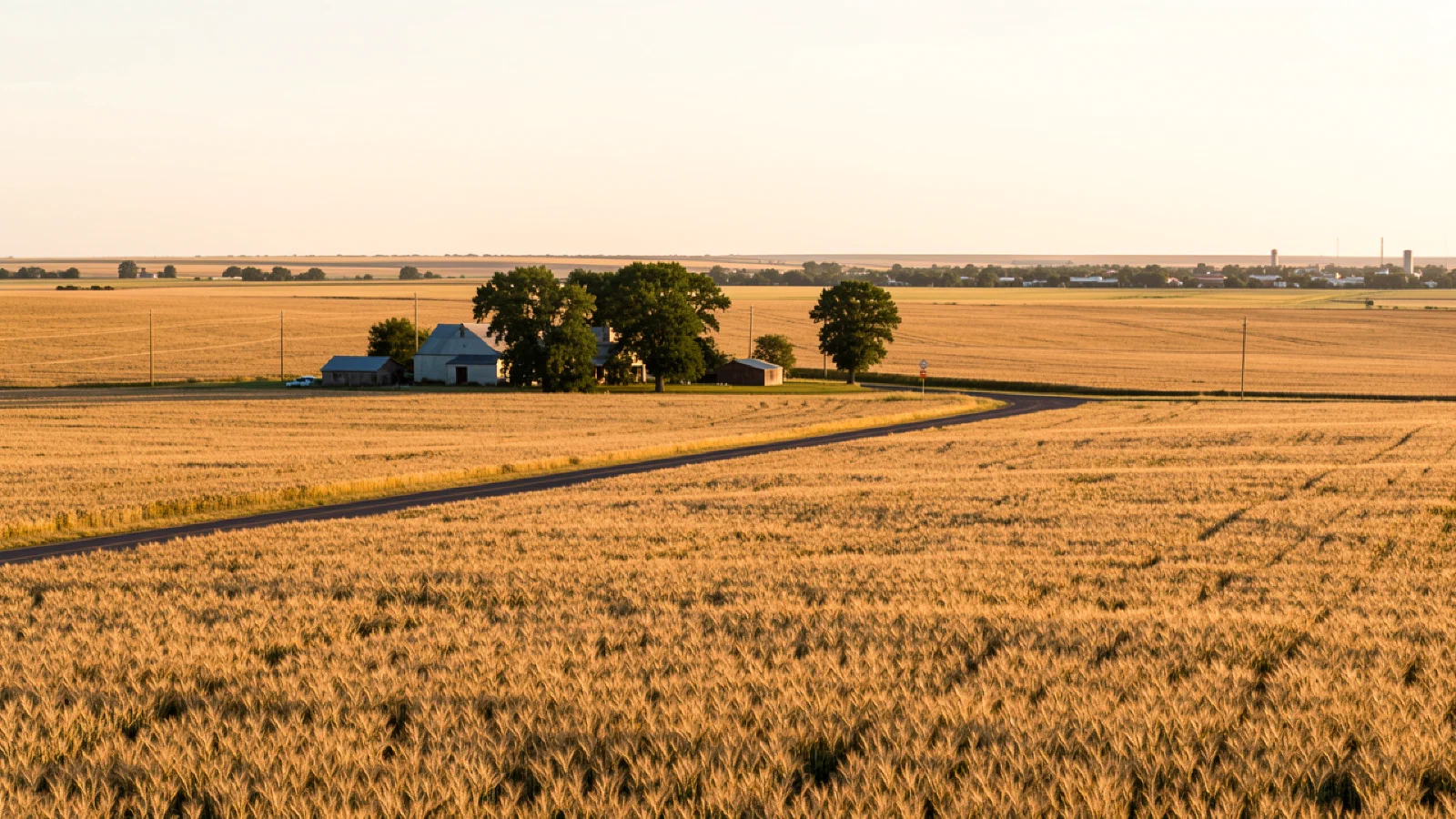
Kansas
Cluster 4: Non-Expansion High-Burden States
Kansas has the most favorable Medicaid Math ratio among non-expansion high-burden states, the highest per-capita allocation, the strongest institutional architecture, and the most ambitious transformation target. It also has more rural hospitals at immediate risk of closure than any state in the program. The disconnect between fiscal metrics and operational reality is Kansas’s defining analytical tension.
The state’s 3.0:1 ratio, $256 per-capita allocation, and three-layer implementation structure would place Kansas among low-constraint expansion states or frontier states if expansion status were not a factor. Non-expansion holds Kansas among non-expansion high-burden states, where it serves as the boundary case demonstrating what transformation capacity looks like when everything except coverage policy aligns.
State Context#
Kansas has approximately 867,000 rural residents spread across a state where 80 of 105 counties lost population between 2010 and 2020. The state’s rural geography divides into three distinct zones: the western High Plains and frontier counties where population density drops below six persons per square mile, the central agricultural corridor running through the wheat belt, and the southeastern counties sharing economic characteristics with the Ozarks and eastern Oklahoma. Kansas is the second most rural state by hospital count in the nation, with 100 rural hospitals trailing only Texas. Of these, 82 are Critical Access Hospitals with 25 beds or fewer, creating a provider landscape defined by very small independent facilities operating on thin margins in low-volume environments.
The provider crisis in Kansas is the most severe of any state in the program. The Center for Healthcare Quality and Payment Reform identified 68 Kansas rural hospitals at risk of closing, including 30 at immediate risk, the highest count nationally. Arkansas’s 50% at-risk rate is severe. Kansas’s ground-level crisis is worse because the raw numbers are higher in a state with fewer resources to absorb closures. The Kansas Hospital Association reported that 87% of rural hospitals operated at a loss on patient services. Six hospitals closed between 2019 and 2023, including Herington Hospital’s abrupt 2023 closure after 104 years, leaving residents 27 minutes from the nearest emergency room. Kansas also lost 17 rural obstetric units, the third highest loss nationally behind Iowa and Minnesota.
Governor Laura Kelly is term-limited and cannot seek reelection in 2026. The primary is August 4, 2026, and the general election November 3. A crowded Republican field includes former Governor Jeff Colyer, Senate President Ty Masterson, Insurance Commissioner Vicki Schmidt, and Secretary of State Scott Schwab. Democrats are running State Senators Ethan Corson and Cindy Holscher. Republicans hold supermajorities in both chambers (88-37 House, 31-9 Senate), sufficient to override any gubernatorial veto.
Kansas has not expanded Medicaid. Kelly proposed the Healthcare Access for Working Kansans (HAWK) Act every year of her tenure, including a work requirement compromise, and was blocked by Republican leadership each session. Unlike Georgia’s Pathways experiment or Arkansas’s work requirement history, Kansas has never implemented a partial expansion alternative. Parents qualify for KanCare only at 38% of the federal poverty level. Childless adults have no eligibility pathway. An estimated 248,000 Kansans are uninsured (8.5%), with approximately 42,000 adults trapped in the coverage gap. Every state bordering Kansas has expanded Medicaid. Kelly has estimated that Kansas left $7.6 billion in federal funding in Washington over the past decade by refusing expansion.
The physician workforce reflects the same rural crisis. Rural Kansas counties have 0.8 physicians per 1,000 residents compared to 1.5 in urban counties. Most rural areas carry federal Health Professional Shortage Area designations across primary care, dental, and mental health.
RHTP Application and Award#
Kansas received $221.9 million for FY2026 ($1.11 billion over five years), translating to $256 per rural resident annually. This is the sixth highest award nationally and the second highest per-capita allocation among non-expansion high-burden states behind Florida’s $317. Tennessee receives $86, Alabama $97, Mississippi $51. The disparity is dramatic: Kansas receives nearly five times Mississippi’s per-capita allocation and three times Tennessee’s, creating resource density that no other non-expansion state approaches.
The Kansas Department of Health and Environment (KDHE) leads the application through an interagency team with the Kansas Department for Aging and Disability Services (KDADS). This dual-agency structure is led by Secretary Janet Stanek (KDHE) and Secretary Laura Howard (KDADS). Unlike Alabama’s ADECA economic development agency or Tennessee’s DOH-TennCare authority gap, Kansas consolidated health policy and aging services leadership under a single implementation structure.
The application development team partnered with the University of Kansas Health System Care Collaborative for technical support and the Kansas Rural Health Innovation Alliance (KRHIA), a governor-created stakeholder body that served as the primary engagement vehicle during application development.
The application identifies five priorities:
Expand primary and secondary prevention programs to reduce chronic disease rates through preventive screenings, behavioral health services, and nutrition counseling. Increase local access to primary care for rural Kansans. Build a sustainable rural health workforce targeting primary care, dental, and behavioral health providers. Increase to 100% the number of rural Medicare and Medicaid beneficiaries in accountable care relationships by 2031. Harness data and technology to expand telehealth, remote monitoring, consumer-facing technologies, and support data sharing.
The KRHIA model is distinctive among non-expansion states. Rather than relying on pre-designated subawardees or procurement-based distribution like Florida’s RFA process, Kansas created a governor-appointed stakeholder alliance that provided direct input on initiative design before submission. This front-loaded engagement process means implementation begins with stakeholder buy-in already established rather than needing to build it post-award.
The Medicaid Math#
Kansas faces a $3.4 billion ten-year Medicaid cut representing 9% of baseline spending, with a 3.0:1 Medicaid ratio that is the most favorable among non-expansion high-burden states by a significant margin. Tennessee’s 6.5:1 is the next closest. Alabama faces 4.1:1, South Carolina 5.1:1, Mississippi 4.2:1, Florida 12.9:1. Kansas’s ratio would place it comfortably among low-constraint or frontier states if expansion status were not a factor.
The favorable ratio reflects Kansas’s relatively small Medicaid program in a non-expansion state. With only 358,000 enrollees and strict eligibility limits, there is less Medicaid spending to cut. The all-states cut mechanisms include provider tax phase-downs and enhanced FMAP reductions, but the absolute dollar amount is modest compared to expansion states because Kansas never accepted the 90% federal match for expansion populations.
This favorable ratio is misleading without context. Kansas’s Medicaid program is small precisely because it excludes the population that most needs coverage. The 42,000 adults in the coverage gap and the 248,000 total uninsured represent demand that already exists but generates no Medicaid revenue. Rural hospitals absorb this demand as uncompensated care, which is why 87% operate at a loss despite having a Medicaid program that is technically less exposed to federal cuts. The ratio measures fiscal exposure to cuts, not the adequacy of the coverage system. Kansas’s low ratio reflects a structurally insufficient program, not a healthy one.
A 15% reduction in rural Medicaid hospital reimbursement is projected under H.R. 1. CMS approved Kansas’s 2025 provider tax increase, and the legislature approved extending the tax to all Kansas hospitals serving Medicaid patients beginning in 2026. This provider tax expansion partially offsets federal cuts but does not address the underlying coverage gap.
Implementation Assessment#
Kansas’s five-priority structure is the broadest among non-expansion high-burden states and the only application that includes an explicit accountable care target. The 100% accountable care by 2031 goal is the most ambitious quantitative commitment in the cluster, potentially in the entire program. It transforms RHTP from a grant-funded initiative into a system redesign instrument by tying every rural Medicare and Medicaid beneficiary to value-based payment relationships within five years.
The institutional architecture behind Kansas’s application is its primary analytical distinction from other non-expansion high-burden states. The KDHE-KDADS interagency team, KRHIA stakeholder alliance, and KU Care Collaborative create a three-layer implementation structure that no other non-expansion state matches. Alabama relies on ADECA, a non-health agency. South Carolina’s DHEC has a high authority gap. Tennessee’s DOH operates separately from TennCare. Mississippi’s MSDH has limited subawardee infrastructure. Florida’s AHCA has institutional advantages but uses a slower RFA procurement model. Kansas assembled its implementation architecture before submitting the application rather than planning to build it after award.
The $256 per-capita allocation provides meaningful resource depth. Combined with the 3.0:1 ratio, Kansas has the most favorable resource-to-cut ratio among non-expansion high-burden states, meaning each RHTP dollar operates in a less hostile fiscal environment than in any peer state.
Architecture Trajectory Assessment#
Kansas’s 100% accountable care target represents the clearest alignment to alternative architecture frameworks of any non-expansion high-burden state, though implementation pathways remain underdeveloped.
The accountable care commitment directly enables the payment model transformation that inverse hub architecture requires. The inverse hub model positions expertise traveling to patients virtually while local facilitators provide hands-on care. Global budgets and shared savings arrangements create financial structures where hospitals can invest in virtual-first specialty delivery, community-based care coordination, and population health management without losing revenue for each prevented hospitalization. If Kansas achieves even partial progress toward 100% accountable care enrollment, it creates infrastructure that survives the grant period because value-based payment relationships are embedded in Medicare and Medicaid billing systems rather than dependent on annual appropriations.
Service center potential exists in the prevention and primary care access priorities but is not explicitly described. Service centers are right-sized facilities that bring comprehensive care to communities at lower cost than full hospital infrastructure. The telehealth and remote monitoring investments could support distributed care delivery if configured for comprehensive service delivery rather than supplemental consultation. Kansas’s 82 Critical Access Hospitals are too small to transform individually but could anchor service center networks if RHTP investment builds toward that architecture.
Local workforce development is partially addressed through the workforce priority targeting primary care, dental, and behavioral health. The local workforce model builds careers for community members without requiring relocation for credentialing. However, the application emphasizes professional recruitment and retention over community-based career pathway development. Kansas lacks the CHW infrastructure and Medicaid billing pathways that would create sustainable local employment models. The KU Care Collaborative provides academic medical center capacity but does not describe CHW career ladders or community health worker cooperative structures.
Kansas’s NP practice authority is full, providing the regulatory foundation for independent practice essential for rural care delivery. Unlike Tennessee, Arkansas, or Georgia, Kansas does not face scope of practice barriers limiting what the workforce it trains can actually do.
Technology infrastructure in the data and telehealth priority could support AI coordination platforms if implementation moves beyond conventional EHR connectivity. The application’s emphasis on “consumer-facing technologies” suggests patient engagement tools but does not describe the care coordination platforms that would enable service integration across the 100-hospital network.
The architecture trajectory gap is that Kansas has the institutional capacity and regulatory environment to pursue alternative architecture but has not explicitly committed to it. The 100% accountable care target creates payment infrastructure; the question is whether implementation builds care delivery transformation on that foundation or treats accountable care as a billing arrangement overlaid on conventional delivery models.
Risk Assessment#
The primary risk is Sustainability Fiction, shared across non-expansion states but operating through a different mechanism in Kansas. In most non-expansion states, the sustainability question is whether RHTP investments can survive when the coverage gap persists after the grant period ends. In Kansas, the sustainability question is whether a system in which 87% of rural hospitals already lose money can meaningfully transform during the grant period. The 100% accountable care target is a sustainability mechanism, but achieving it requires converting 100 rural hospitals that mostly operate at a loss into value-based care participants within five years. Hospitals struggling to meet payroll may lack capacity to invest in the care coordination infrastructure that accountable care arrangements require.
The secondary risk is Political Discontinuity. Kelly’s departure in January 2027 creates a Year 2 organizational transition. KDHE Secretary Stanek and KDADS Secretary Howard are gubernatorial appointees. The KRHIA is a governor-created body without legislative authorization. A Republican successor with supermajority legislative support could restructure the interagency team, replace agency leadership, and redefine the KRHIA’s role without legislative constraint. Unlike Georgia, where DCH has statutory permanence regardless of gubernatorial transition, Kansas’s institutional architecture is entirely executive-branch-created, meaning it is entirely executive-branch-removable.
The expansion question compounds both risks. Kelly has pursued expansion every year and been blocked. Every neighboring state has expanded. A Republican governor with supermajority support is unlikely to prioritize expansion. But the RHTP’s own sustainability depends on resolving the coverage gap that generates the uncompensated care losses driving hospitals toward closure. Without expansion, RHTP investments improve services for a population that still lacks coverage to pay for those services after the grant period ends. The 100% accountable care target applies to Medicare and Medicaid beneficiaries only, which in a non-expansion state excludes the working-age adults in the coverage gap who generate the highest uncompensated care burden.
Honest Assessment#
What Kansas does well. Kansas is the non-expansion high-burden state with the strongest implementation architecture, most favorable fiscal position, and most ambitious transformation commitment. The 3.0:1 ratio, $256 per-capita allocation, three-layer implementation structure, and 100% accountable care target create conditions no other non-expansion state approaches. The KRHIA model front-loaded stakeholder engagement rather than deferring it to post-award procurement. The interagency KDHE-KDADS team eliminates the cross-agency coordination failures that hobble Alabama, South Carolina, and Tennessee. Full NP practice authority removes the scope barriers that limit workforce deployment in Georgia and Arkansas. If any non-expansion state can demonstrate that transformation is possible despite non-expansion, Kansas has the best chance.
Where the plan meets reality. Kansas has more rural hospitals at immediate risk of closure than any state in the program. Hospitals operating at median losses of negative 12.7% cannot wait for five-year transformation timelines. The crisis is happening now: Herington closed after 104 years, and 30 more face the same trajectory. The gubernatorial transition is the critical variable. Kelly’s KRHIA, interagency team, and expansion advocacy defined the application. A Republican successor inherits RHTP implementation without inheriting the governance framework or policy preferences that shaped it. The KRHIA has no legislative charter. The interagency structure is executive order, not statute. Kansas’s application is the product of a Democratic governor who believed in Medicaid expansion operating in a Republican state that refused it. The successor will be a Republican governor who opposed expansion in a state that still refuses it.
What would change the assessment. Four developments would shift the trajectory. First, securing legislative authorization for the KRHIA to survive gubernatorial transitions. Second, establishing the interagency KDHE-KDADS structure through statute rather than executive order. Third, prioritizing Year 1 investment in hospitals at immediate closure risk before pursuing broader system transformation. Fourth, designing the accountable care initiative so that early participating hospitals demonstrate financial improvement that builds political support for continuation regardless of which party controls the governor’s office. Medicaid expansion would transform Kansas more dramatically than any other non-expansion state because the institutional architecture is already built for it. Without expansion, that architecture serves a population too small to sustain 100 rural hospitals.
How this article connects to others in Blue Gray Matters.
Sources cited in this article.
- Center for Healthcare Quality and Payment Reform. "Rural Hospital Closures and Risk of Closure." CHQPR, 2025, chqpr.org/downloads/Rural_Hospitals_at_Risk_of_Closing.pdf.
- Centers for Medicare and Medicaid Services. "CMS Announces $50 Billion in Awards to Strengthen Rural Health in All 50 States." CMS Newsroom, 29 Dec. 2025, cms.gov/newsroom/press-releases/cms-announces-50-billion-awards-strengthen-rural-health-all-50-states.
- Chartis. "2025 Rural Health State of the State." Chartis, 10 Feb. 2025, chartis.com/insights/2025-rural-health-state-state.
- Kansas Department of Health and Environment. "Rural Health Transformation Program." KDHE, 2025, kdhe.ks.gov/2361/Rural-Health-Transformation-Program.
- Kansas Health Institute. "2020 Census Data Reveal a Changing Kansas." KHI, Nov. 2022, khi.org/articles/2021-2020-census-data-reveal-a-changing-kansas/.
- Kansas Health Institute. "Exploring Federal Priorities in the Rural Health Transformation Program." KHI, 2 Oct. 2025, khi.org/articles/exploring-federal-priorities-in-the-rural-health-transformation-program/.
- Kansas Health Institute. "Insurance Coverage by Kansas Congressional District 2025." KHI, 13 Nov. 2025, khi.org/articles/insurance-coverage-by-kansas-congressional-district-2025/.
- Kansas Health Institute. "Medicaid Expansion in Kansas: Impacts of Federal Policy Options Under Consideration and Updated Estimates." KHI, 4 June 2025, khi.org/articles/medicaid-expansion-in-kansas-impacts-of-federal-policy-options-under-consideration-and-updated-estimates/.
- Kansas Reflector. "Kansas Rural Hospitals Brace for Impact of $4 Billion Funding Loss Under Mega-Bill." Kansas Reflector, 24 June 2025, kansasreflector.com/2025/06/24/kansas-rural-hospitals-brace-for-impact-of-4-billion-funding-loss-under-mega-bill/.
- Kansas Reflector. "Kansas Secures $221 Million Federal Grant to Boost Rural Health as Federal Cuts Hit." Kansas Reflector, 30 Dec. 2025, kansasreflector.com/2025/12/30/kansas-secures-221-million-federal-grant-to-boost-rural-health-as-federal-cuts-hit/.
- KCUR. "Kansas Governor 2026: A Guide to the Candidates So Far." KCUR, 24 July 2025, kcur.org/politics-elections-and-government/2025-07-24/kansas-governor-race-2026-election-candidates.
- KCUR. "Medicaid Cuts Are a Ticking Time Bomb for Rural Kansas Hospitals. One Change May Help." KCUR, 14 Oct. 2025, kcur.org/health/2025-10-14/medicaid-cuts-are-a-ticking-time-bomb-for-rural-kansas-hospitals-one-change-may-help.
- Office of the Governor of Kansas. "Governor Kelly Announces $221 Million for Kansas Rural Health Transformation Plan." Governor's Newsroom, 29 Dec. 2025, governor.ks.gov/Home/Components/News/News/876/55.
- Office of the Governor of Kansas. "Governor Kelly Announces Kansas Rural Health Transformation Plan Priorities." Governor's Newsroom, Nov. 2025, governor.ks.gov/Home/Components/News/News/828/55.
- The Beacon. "Why 30 Rural Hospitals in Kansas and 12 in Missouri Are at Risk." The Beacon, 8 Jan. 2026, thebeaconnews.org/stories/2026/01/08/why-30-rural-hospitals-in-kansas-and-12-in-missouri-are-at-risk/.