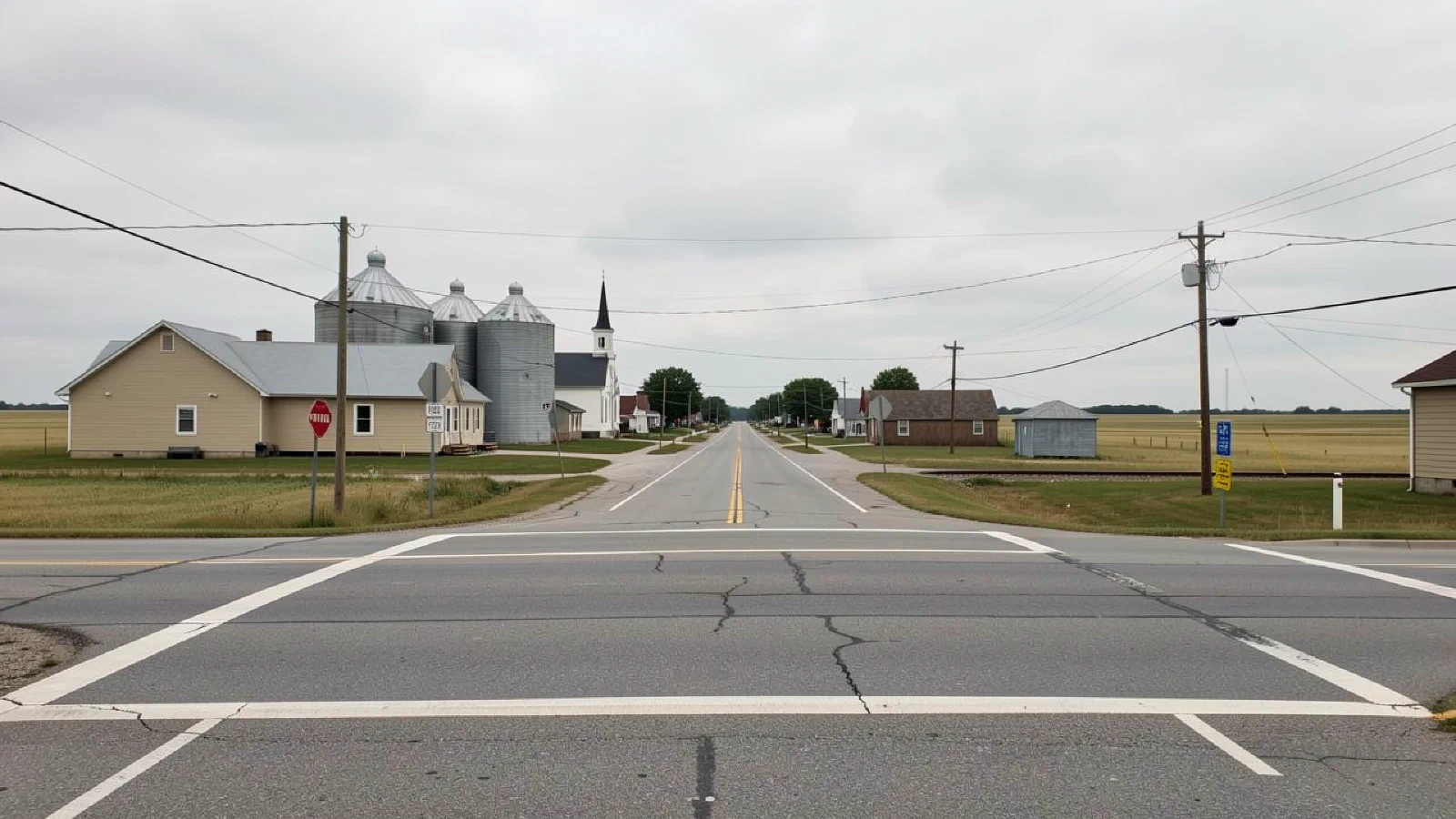
Illinois
Cluster 2: High Medicaid Exposure States
Illinois presents one of the most mathematically stark cases in the RHTP portfolio. The state received the third-largest award nationally at $193.4 million for FY2026, yet faces projected Medicaid cuts that dwarf this investment by a factor of 47 to 1. For every dollar Illinois invests through RHTP, the state loses $47.10 in federal Medicaid support over the transformation period. This ratio places Illinois among the most exposed states in the nation, creating what state officials openly characterize as a transformation mandate that cannot mathematically offset the coverage erosion accompanying it.
The concentration of closure risk in Southern Illinois reveals a state that is effectively two healthcare systems: the Chicago metropolitan area with its robust hospital networks and academic medical centers, and the downstate region that shares more with Kentucky and Missouri than with the urban North. Nine hospitals identified at immediate closure risk all lie south of I-70, a geographic distribution that makes RHTP less a statewide program than an emergency intervention for communities already losing access.
State Context#
The state’s rural footprint encompasses approximately 1.9 million residents across 85 of 102 counties with rural census tracts, representing roughly 15 percent of the total population. These communities depend on 85 small and rural hospitals, including 51-55 Critical Access Hospitals, that serve as both healthcare access points and economic anchors. Nearly 30 percent of these facilities already operate at deficits before OBBBA implementation begins eroding their Medicaid revenue base.
Illinois expanded Medicaid under the Affordable Care Act and has subsequently built substantial healthcare infrastructure dependent on this coverage architecture. The state’s Hospital Assessment Program generates $3.8 billion in Medicaid funding for hospital and healthcare services through a provider tax mechanism that OBBBA froze on July 4, 2025, and will progressively cap through hold harmless threshold reductions beginning in October 2027. This program represents a significant portion of the state’s ability to maintain Medicaid reimbursement rates that keep hospitals operational.
The Department of Public Health has identified nine rural hospitals at immediate closure risk should Medicaid cuts proceed as legislated. These facilities represent over 500 inpatient beds and approximately 2,532 full-time equivalent jobs. The hospitals span southern and central Illinois: OSF Sacred Heart Medical Center in Danville, Hoopeston Community Memorial Hospital, Crawford Memorial Hospital in Robinson, Richland Memorial Hospital in Olney, Harrisburg Medical Center, Franklin Hospital in Benton, Massac Memorial Hospital in Metropolis, Hardin County General Hospital in Rosiclare, and Katherine Shaw Bethea Hospital.
Governor JB Pritzker has been among the most vocal state executives regarding OBBBA’s impact on healthcare infrastructure. In August 2025, he convened healthcare leaders at Marshall Browning Critical Access Hospital in Du Quoin to discuss federal impacts, stating: “Rural hospitals are a critical lifeline for communities across Illinois. Not only are they one of the only providers of life-saving medical care for miles, they are often the backbone of rural economies.”
The Department of Healthcare and Family Services estimates 270,000 or more Illinois residents will lose Medicaid coverage under work requirements and other eligibility restrictions, with rural Medicaid spending projected to decrease by $6.36 billion. This coverage loss will convert covered patients into uncompensated care, further straining hospital finances precisely as transformation initiatives attempt to modernize care delivery.
RHTP Application and Award#
The Illinois Department of Healthcare and Family Services submitted the state’s RHTP application on November 5, 2025, following what HFS characterized as one of the most extensive stakeholder engagement processes in the state’s recent healthcare policy history. The department conducted more than 38 stakeholder meetings, held a public listening session with nearly 300 attendees, received over 120 written comments and proposals, and conducted 46 follow-up meetings with interested parties.
CMS awarded Illinois $193,418,216 for calendar year 2026, with subsequent program year funding to be determined annually. The state had requested $200 million per year for five years, totaling $1 billion. The award represents approximately $88-$102 per rural resident annually depending on calculation methodology, placing Illinois in the middle tier nationally on a per-capita basis despite the large absolute award.
Lead Agency: Illinois Department of Healthcare and Family Services (HFS), the state’s Medicaid agency
HFS holds direct authority over Medicaid payment rates, managed care contracting, and healthcare transformation initiatives. This positioning provides substantial implementation leverage for RHTP initiatives that intersect with Medicaid payment reform, value-based care, and provider network development. The authority gap is rated Moderate to High because effective implementation requires coordination with the Illinois Department of Public Health (IDPH) for workforce programs, emergency medical services, and public health infrastructure investments that fall outside HFS’s direct authority.
Director Elizabeth M. Whitehorn leads HFS and has been clear-eyed about the mathematical limitations: “We know that the newly enacted federal Medicaid cuts will be devastating for rural communities and for the Medicaid customers who rely on these hospitals for critical healthcare services. Our top priority is mitigating the harm that will most certainly be caused by these changes.”
Three-Initiative Architecture#
Illinois structured its application around three initiative categories aligned with CMS strategic goals:
Category 1: Transforming Rural Healthcare
- Hospital transformation grants building on existing Healthcare Transformation Collaboratives
- Primary care and behavioral health integration
- Value-based payment initiatives and practice transformation
- Team-based care models in partnership with hospitals and primary care practices
Category 2: Overcoming Geographic Barriers to Care
- Infrastructure investments in emergency medical services
- Mobile health clinics and mobile crisis units
- Telehealth and technological innovation expansion
- Chronic disease prevention programming
Category 3: Building a Resilient Rural Workforce
- Scholarships and university program expansion
- Regional training and certification programs
- Community college programming expansion
- High school community outreach programs
HFS Director Whitehorn emphasized the integration of these categories: “An investment in our rural healthcare system is an investment in a more equitable future for Illinois. This funding will support innovative and sustainable transformations to the rural health system and drive improved health outcomes for rural community residents in our state.”
The application specifically identified workforce and technology as the two primary concerns raised by stakeholders. Jordan Powell, Senior Vice President of Health Policy and Finance for the Illinois Health and Hospital Association, confirmed: “Workforce and technology were two of the main things that we heard from our members. I think the state wants to emphasize better partnerships and collaboration between providers.”
The Medicaid Math#
Illinois faces the most severe Medicaid math in the RHTP portfolio by absolute dollar exposure, though several smaller states face worse per-capita ratios. The state’s 47.1:1 ratio means that for every $1 of RHTP investment over the program period, Illinois loses $47.10 in federal Medicaid support. This places the state firmly in the Severe Gap category where transformation investments cannot mathematically offset coverage erosion.
Ten-Year Cut Projection#
Multiple authoritative sources project Illinois Medicaid losses in overlapping but consistent ranges:
YAML Extract: $45.5 billion ten-year cut estimate, representing 19% of baseline
Illinois Department of Healthcare and Family Services: $26-$51 billion in federal funding reductions from 2026 through 2034, or approximately $2.7-$4.3 billion annually
Civic Federation Analysis: $24-$39 billion in funding losses under provider tax caps, with additional losses from coverage reductions
The variation reflects different modeling assumptions regarding implementation timing, state responses, and which OBBBA provisions are included. The YAML figure of $45.5 billion represents a mid-range estimate across these projections.
Provider Tax Exposure#
Illinois has among the highest provider tax exposure in the nation. The Hospital Assessment Program and related provider taxes generate approximately $4.1 billion annually in state revenue that draws federal matching funds. OBBBA’s immediate freeze and subsequent caps will systematically reduce this funding stream:
- July 4, 2025: Provider taxes frozen at current levels; no new taxes permitted
- October 2027: Hold harmless threshold phase-down begins
- January 2028: State-directed payments capped at 100% of Medicare rates
- FY2031: Provider tax reductions projected to reduce total Medicaid funding by $4.5 billion annually
HFS projects Illinois will lose nearly $5 billion in federal dollars in the first five years of provider tax implementation alone.
Coverage Loss Projections#
Work requirements represent the primary coverage erosion mechanism for Illinois:
HFS Estimate: 190,000 to 360,000 Medicaid recipients at risk of losing coverage due to work requirements beginning January 1, 2027
Governor’s Office Estimate: 270,000+ residents projected to lose coverage, with rural Medicaid spending decreasing by $6.36 billion
Cook County Health Impact: Over 100,000 Cook County residents on CountyCare managed care could lose coverage, shifting approximately $200 million in healthcare spending to uncompensated charity care
These projections assume full implementation without delays. CMS regulatory guidance on work requirements is not due until June 2026, leaving only six months before the December 31, 2026 implementation deadline. Illinois has not indicated plans to request a two-year delay.
Ratio Context#
The 47.1:1 ratio reflects Illinois’s combination of large rural population, extensive Medicaid enrollment, and high provider tax utilization. The state’s early ACA expansion created substantial coverage gains that are now mathematically vulnerable. The ratio means:
- Five-year RHTP investment: $967 million
- Concurrent Medicaid losses: Approximately $45.5 billion over comparable period
- Net fiscal impact: Severe negative exposure regardless of RHTP effectiveness
Jordan Powell of the Illinois Health and Hospital Association captured this reality: “These funds are good, and we’re going to put them to good use, but it’s not a solution. It’s not going to mitigate the impact of the significant Medicaid cuts that are coming our way.”
This ratio severity distinguishes Illinois from its high Medicaid exposure peers. Indiana faces a 26.6:1 ratio, exposing the HIP 2.0 waiver population to work requirements under somewhat different conditions. Ohio’s 19.7:1 ratio reflects lower provider tax utilization despite similar expansion enrollment. Illinois built the most extensive provider tax infrastructure among Midwestern expansion states, maximizing federal matching during the expansion years at the cost of maximum exposure when that infrastructure became the target.
Implementation Assessment#
Illinois enters RHTP implementation with significant organizational capacity and prior transformation experience, though the scale of concurrent Medicaid erosion creates structural constraints that administrative competence alone cannot overcome.
Organizational Readiness#
HFS Capacity: The department has demonstrated sophisticated stakeholder engagement, conducting the extensive consultation process that informed the application. HFS Director Whitehorn has been transparent about challenges while maintaining operational focus on achievable objectives.
Healthcare Transformation Collaboratives: Illinois has existing infrastructure for hospital transformation grants through the Healthcare Transformation Collaboratives program. HFS explicitly identified expanding this model to rural areas as a primary RHTP deployment strategy. This represents meaningful prior experience with the types of transformation activities RHTP requires.
Multi-Agency Coordination: IDPH Director Dr. Sameer Vohra has publicly aligned with HFS priorities, stating: “Illinois is fortunate to have innovative rural leaders working to improve the health of their communities. This federal funding will help support the health of residents across the state by investing in programs that expand partnerships, strengthen technological innovation, and build a more resilient health workforce.”
Subawardee Landscape#
Illinois has a relatively robust rural healthcare provider network compared to other high Medicaid exposure states, though vulnerability levels vary significantly:
Critical Access Hospitals: 51-55 facilities depending on source (recent CAH designation changes affect count)
Rural Health Clinics: Approximately 217 facilities statewide
Federally Qualified Health Centers: 280+ FQHC delivery sites providing primary care access
Community Mental Health Centers: Active statewide network, with the Community Behavioral Healthcare Association engaged in RHTP planning
Identified Risks#
Hospital Financial Fragility: With 30% of rural hospitals already operating at deficits and 9 facilities at immediate closure risk, the subawardee pool faces fundamental capacity constraints. Chartis identified Illinois as experiencing $10.6 million in bad debt reimbursement cuts, the third-highest nationally, further eroding financial stability.
Workforce Development Timeline: The application’s emphasis on scholarship programs, university expansion, and community college programming addresses real needs but represents long-cycle investments that cannot produce workforce gains within the five-year RHTP window.
Value-Based Care Transition: Moving from fee-for-service to value-based payment requires sustained payment reform that OBBBA’s provider tax restrictions and Medicaid cuts directly undermine. Illinois cannot simultaneously transform payment models while the underlying payment pool shrinks.
Implementation Advantages#
Political Stability: Governor Pritzker won reelection in 2022 and faces no gubernatorial election until 2026’s legislative midterms. This provides implementation continuity uncommon among states.
Existing State Investment: Illinois has demonstrated willingness to use General Revenue funds to support healthcare infrastructure, including waiving $240 million in hospital assessments during COVID-19 recovery. This suggests potential state capacity to partially offset federal losses, though the scale of OBBBA cuts exceeds plausible state replacement.
Stakeholder Alignment: The Illinois Health and Hospital Association, Illinois Critical Access Hospital Network, Illinois Primary Health Care Association, and Community Behavioral Healthcare Association have publicly engaged in RHTP planning. This alignment reduces implementation friction from provider opposition.
Architecture Trajectory#
Illinois’s RHTP approach builds toward conventional transformation rather than alternative architecture. The Healthcare Transformation Collaboratives model, team-based care initiatives, and hospital-centric investment strategy assume that existing facilities will survive with sufficient support. The nine hospitals at immediate closure risk suggest this assumption may not hold.
The state possesses enabling conditions that could support alternative approaches. Illinois granted full nurse practitioner practice authority, creating scope flexibility that restricted states lack. Community colleges operate CHW certification programs that could expand local workforce pathways without requiring professional relocation. The state’s community behavioral health infrastructure provides a foundation that could integrate with service center models.
Yet the RHTP application does not engage these possibilities. The workforce initiative emphasizes scholarships and university expansion, a long-cycle investment that extracts workers for education rather than bringing education to workers. The technology initiative focuses on telehealth infrastructure without exploring robot integration or AI deployment for service center configurations. The transformation approach reinforces the hospital-centric model that cannot achieve sustainability in communities of 5,000 to 10,000 residents.
The Southern Illinois corridor presents the sharpest test case. Communities facing hospital closures need alternatives that can function when 25-bed hospitals become financially impossible. Service centers of 2,000 square feet at $500,000 capital cost could replace facilities of 20,000 square feet at $15 million capital cost, but Illinois’s RHTP plan does not contemplate this transition. The initiative assumes hospital survival through transformation rather than transformation to post-hospital configurations.
HFS’s institutional capacity could execute alternative architecture if directed. The question is whether state leadership recognizes that competent execution of conventional transformation cannot overcome mathematical impossibility. At a 47.1:1 ratio, the most effective hospital transformation grants in the nation cannot offset the coverage erosion that makes those hospitals unviable. Illinois may be learning this lesson during RHTP implementation rather than before it.
Risk Assessment#
Illinois faces High risk across multiple dimensions, with the Medicaid math creating structural constraints that effective implementation cannot fully address.
Primary Risk: Medicaid Coverage Erosion Overwhelming Transformation#
The 47.1:1 ratio means RHTP investments occur in a context where the patient population these investments serve is simultaneously shrinking. Hospitals cannot transform into sustainable models while losing the covered patient base that generates revenue to fund operations. This creates a fundamental logical contradiction at the heart of Illinois’s RHTP implementation.
Secondary Risk: Provider Tax Revenue Collapse#
Illinois built its Medicaid financing architecture around provider taxes that OBBBA systematically dismantles. The Hospital Assessment Program’s $3.8 billion in funding represents infrastructure that cannot be replaced through RHTP’s $193 million annual allocation. As provider tax revenue declines through hold harmless threshold reductions, hospitals will face payment rate cuts that compound the coverage losses from work requirements.
Tertiary Risk: Hospital Closure Cascade#
The nine hospitals identified at immediate closure risk represent the leading edge of a potential cascade. As these facilities close, remaining hospitals in adjacent service areas face increased utilization from displaced patients without corresponding revenue increases. This stress can push additional facilities past financial viability thresholds, creating a self-reinforcing closure pattern.
Maternal and Behavioral Health Exposure#
Maternity Care Deserts: 43.1% of Illinois counties are classified as maternity care deserts, with an additional 10.8% having only low or moderate access. The state’s 2025 Maternal Mortality Report documents rising pregnancy-related deaths, with rural areas facing particular barriers to substance use disorder treatment, mental health services, and specialty care.
Behavioral Health Workforce: Illinois’s Community Behavioral Health Care Professional Loan Repayment Program and other workforce initiatives attempt to address shortages, but the HPSA designation patterns show persistent mental health workforce gaps in rural areas.
Political Risk: Limited#
Governor Pritzker and the Democratic-controlled legislature have demonstrated unified opposition to OBBBA’s healthcare provisions. This political alignment reduces risk of state-level policy changes undermining RHTP implementation. However, state political alignment cannot override federal policy structure.
Honest Assessment#
Illinois approaches RHTP implementation with clear-eyed realism about what transformation funding can and cannot accomplish. State officials have not claimed the $193 million annual allocation will solve rural healthcare challenges; they have explicitly stated the opposite.
What the state does well. Illinois brings institutional sophistication that most states cannot match. HFS has the organizational capacity to execute complex multi-stakeholder programs. The Healthcare Transformation Collaboratives provide tested infrastructure for hospital transformation grants. The stakeholder engagement process produced genuine input rather than theater. Political leadership from the Governor’s office down through agency directors aligns around achievable objectives without pretending impossible objectives are reachable. The application’s three-initiative architecture reflects stakeholder priorities (workforce and technology) rather than bureaucratic preferences.
Where the plan meets reality. The 47.1:1 ratio creates constraints that no implementation strategy can overcome. Illinois cannot transform rural healthcare into sustainability while simultaneously losing 270,000+ covered patients and $45.5 billion in Medicaid support. The nine hospitals at immediate closure risk will face financial pressures that RHTP cannot offset. The workforce pipeline investments extend beyond RHTP timelines: scholarship recipients in 2026 will not complete training until 2030 or later, after RHTP evaluation windows close. The value-based care transition assumes payment pools that provider tax caps will shrink. The application competently addresses CMS requirements without pretending those requirements address the underlying mathematical problem.
What would change the assessment. Three conditions would elevate Illinois from competent damage mitigation to meaningful transformation. First, congressional modification of provider tax provisions that currently drive the largest projected losses would preserve the financing infrastructure Illinois built. Second, work requirement implementation delays or exemption expansions would reduce coverage erosion and preserve the patient base that hospital transformation assumes. Third, state legislative action on alternative capital formation could provide resources beyond RHTP’s federal allocation. None of these conditions appears likely in the current political environment.
Illinois’s high dependence on provider taxes creates particular vulnerability to OBBBA provisions that specifically target this financing mechanism. States that built less provider tax infrastructure face smaller losses; states like Illinois that maximized this approach face proportionally larger exposure. Whether this represents poor planning or appropriate use of available tools is debatable. What is not debatable is that Illinois will experience among the largest absolute dollar losses from provider tax restrictions.
Strategic Positioning:
Illinois has positioned itself as a test case for whether large, well-resourced states can mitigate OBBBA impacts through competent administration and existing infrastructure. If Illinois, with its third-largest allocation, experienced agencies, and sophisticated provider networks, cannot achieve transformation goals while managing concurrent Medicaid erosion, smaller states with less capacity will face worse outcomes.
The honest assessment is that Illinois will implement RHTP activities effectively, report programmatic successes appropriately, and still experience net deterioration in rural healthcare access and hospital viability over the five-year program period. The question is not whether Illinois can succeed at transformation; it is whether transformation success matters when the patient base and payment infrastructure are being dismantled simultaneously.
U.S. Representative Nikki Budzinski, D-Illinois, captured this tension: “This funding is a welcome and necessary stopgap, but it is simply not enough to address the strain rural health care providers are facing. I will continue fighting for a health care system that allows our rural communities not just to survive, but to thrive.”
Survival and thriving are different objectives. Illinois has positioned itself for the former while acknowledging the latter remains beyond reach under current federal policy.
How this article connects to others in Blue Gray Matters.
Sources cited in this article.
- Chartis. "Rural Hospital Closures & Care-Access Crisis: 2025 State of the State." Chartis, February 2025, www.chartis.com/insights/2025-rural-health-state-state.
- Civic Federation. "Medicaid in Illinois: What Federal Cuts to Medicaid Funding Could Mean for Illinoisans." Civic Federation Blog, 2025, www.civicfed.org/blog/medicaid-illinois-what-federal-cuts-medicaid-funding-could-mean-illinoisans.
- Durbin, Dick. "Durbin, Lankford Introduce Bipartisan Bill to Support Rural Hospitals." U.S. Senator Dick Durbin, 2025, www.durbin.senate.gov/newsroom/press-releases/durbin-lankford-introduce-bipartisan-bill-to-support-rural-hospitals-2025.
- HFMA. "Hospitals Brace for Looming Federal Cuts in Medicaid and Elsewhere." Healthcare Financial Management Association, October 2025, www.hfma.org/finance-and-business-strategy/hospitals-brace-for-looming-federal-cuts-in-medicaid-and-elsewhere/.
- Illinois Department of Healthcare and Family Services. "FAQS: How Will Federal Changes Impact Medicaid." HFS Illinois, 2026, hfs.illinois.gov/info/fedresctr/faqshowwillfedchimpactmedicaid.html.
- Illinois Department of Healthcare and Family Services. "Rural Health Transformation Program." HFS Illinois, 2026, hfs.illinois.gov/info/fedresctr/ruralhealthtp.html.
- Illinois Department of Public Health. "Gov. Pritzker Joins Southern Illinois Healthcare Leaders to Discuss Federal Impacts on Rural Hospitals." IDPH News Release, August 22, 2025, dph.illinois.gov/resource-center/news/2025/august/release-20250822-1.html.
- Illinois Department of Public Health. "Illinois Maternal Mortality Data Report 2025." IDPH, January 2026.
- March of Dimes. "Maternity Care Desert: Illinois, 2024 Report." PeriStats, www.marchofdimes.org/peristats/data?reg=99&top=23&stop=641&lev=1&slev=4&obj=18&sreg=17.
- NPR Illinois. "Providers Say Feds' New Rural Health Care Grants to Illinois Won't Cover Medicaid Cuts." NPR Illinois, January 26, 2026, www.nprillinois.org/illinois/2026-01-26/providers-say-feds-new-rural-health-care-grants-to-illinois-wont-cover-medicaid-cuts.
- Sun-Times. "Trump Tax Bill Could Close Nine Illinois Hospitals, Health Care Advocates Warn." Chicago Sun-Times, July 3, 2025.
- WMIX. "Illinois Awarded $193M to Expand Healthcare Access in Rural Areas." WMIX, January 2, 2026, www.wmix94.com/2026/01/02/illinois-awarded-193m-to-expand-healthcare-access-in-rural-areas.