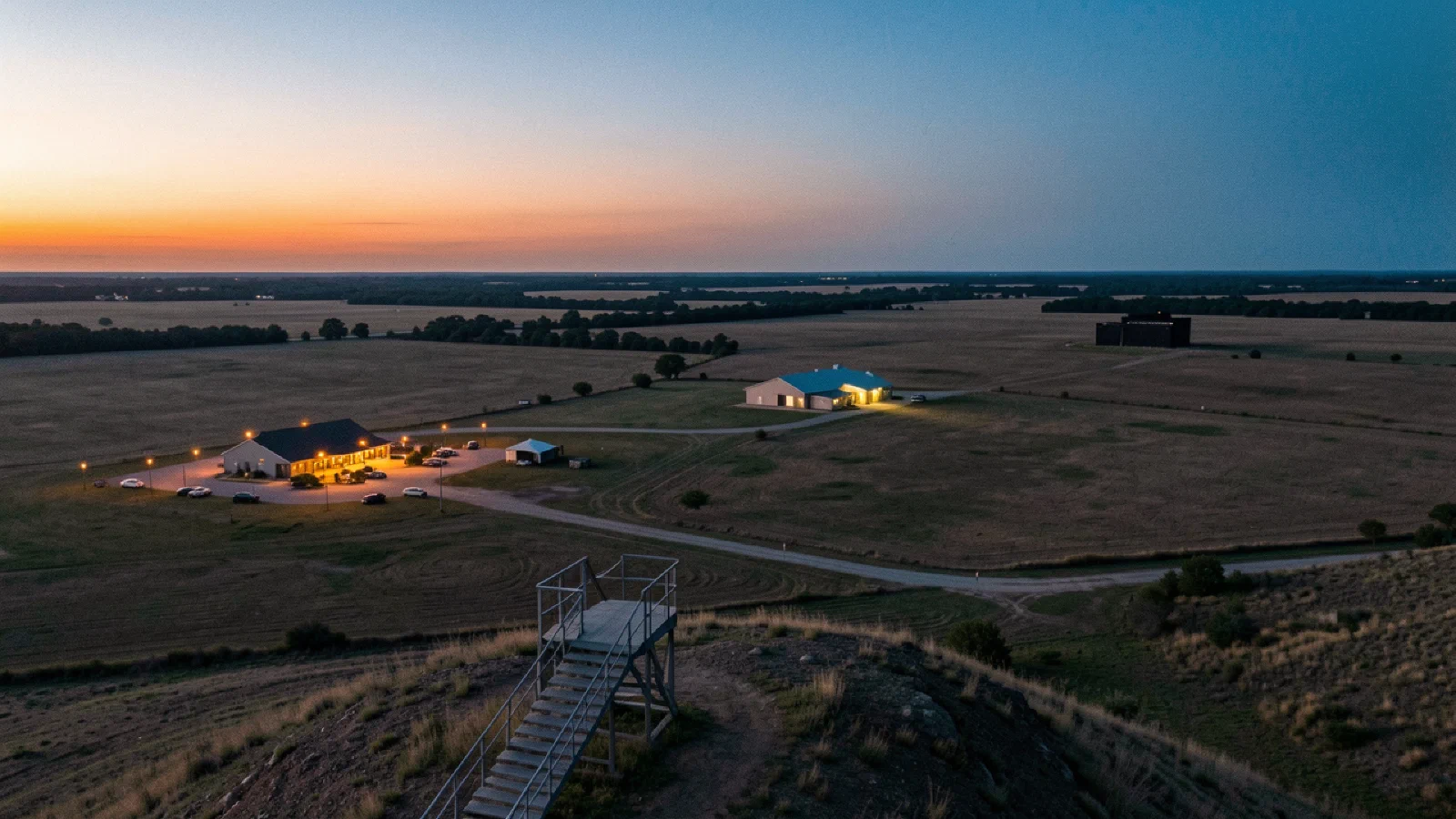
Which Future Will Rural America Experience?
The Integration Article
Three futures. One timeline. Choices that cannot be deferred.
Series 16 explored what happens if alternative architecture succeeds comprehensively, what happens if it succeeds in some places and fails in others, and what happens if current trajectories continue uninterrupted. The transformation scenario projects 800 service centers, 100,000 community health workers, and a narrowing rural-urban life expectancy gap by 2035. The managed decline scenario projects 600 fewer rural hospitals, primary care access falling to 45%, and a life expectancy gap widening toward four years. The partial transformation scenario projects both outcomes simultaneously, distributed across geography in patterns that create two rural Americas with widening distance between them.
This Synthesis does not predict which future arrives. Prediction implies a determinism that does not exist. The future that arrives depends on choices not yet made by federal policymakers, state legislators, community leaders, and rural residents themselves. What the analysis can do is clarify what determines outcomes, who makes the determining choices, and what must happen for transformation rather than decline.
The honest starting point is that decline requires no action. It is the default trajectory. Transformation requires sustained effort against organized opposition, structural barriers, and the inertia of systems designed for different realities. The question is not which future is easier but which future is worth the cost of achieving.
Part I: What the Scenarios Reveal#
The three scenarios are not equally probable. They represent different points on a continuum from comprehensive success to comprehensive failure, with partial transformation occupying the large middle range where most outcomes cluster.
The transformation scenario (Article 16B) assumes favorable conditions across multiple domains simultaneously: tribal demonstrations by 2028, Federal Innovation Zone authority, sovereign investment funds in 15 to 20 states, interstate compact expansion, AI companion maturation, and service center viability proof. The scenario projects rural primary care access reaching 88% by 2035, hospital closures declining to three to five annually, and the rural-urban life expectancy gap narrowing from 5.4 years to 3.9 years.
This scenario is achievable but improbable as a comprehensive outcome. The probability of achieving all assumptions is lower than achieving any single one. Tribal demonstrations may succeed without federal legislation following. Sovereign funds may emerge in some states while others resist. Technology may mature in some domains while governance lags in others. Comprehensive transformation requires simultaneous success across domains that operate on different political and technical timelines.
The managed decline scenario (Article 16D) assumes that current trends continue at current rates with no fundamental structural change. RHTP funding does not survive reauthorization at comparable scale. Medicaid cuts proceed as legislated. No major regulatory reform occurs. Technology deployment remains fragmented. The scenario projects 600 rural hospital closures by 2035, primary care access falling to 45%, behavioral health access dropping to 20%, and the life expectancy gap widening to 3.8 years.
This scenario requires no action to occur. Managed decline is what happens when nothing different happens. It does not require policy failure or implementation incompetence. It requires only continuation of trajectories already underway. The 432 rural hospitals currently identified as financially vulnerable do not need new pressures to fail. They need only existing pressures to continue.
The partial transformation scenario (Article 16C) represents the most probable outcome precisely because it requires neither comprehensive success nor comprehensive failure. Some states achieve substantial enabling conditions through crisis pressure, political alignment, and implementation capacity. Others make partial progress. Still others continue baseline trajectories. The scenario projects divergence rather than uniform outcome: transformation states approaching the metrics of Article 16B while non-transformation states experiencing the metrics of Article 16D.
The cruelest feature of partial transformation is that states with the greatest need are not reliably states with the greatest capacity to transform. Mississippi, with 49% of rural hospitals vulnerable to closure, faces implementation capacity constraints that states with less severe challenges do not. Texas, with 47 vulnerable rural hospitals, has the scale penalty that makes per-capita RHTP investment vanishingly thin. Need and capacity are inversely correlated in the states where transformation matters most.
Part II: What Determines Outcomes#
Six factors determine which scenario unfolds in any given state or region. Understanding these factors clarifies where intervention can change trajectories and where conditions constrain what intervention can achieve.
Crisis severity creates political windows. The 27 rural labor and delivery unit closures in 2025 generated attention that routine provider shortage stories cannot. Hospital closures force legislators to confront constituent pressure directly. Crisis does not guarantee reform, but crisis is prerequisite for reform in states where incumbent interests otherwise dominate legislative outcomes. States experiencing acute, visible crisis have political opportunities that states with diffuse, gradual decline do not.
Institutional capacity enables implementation. A state with strong rural health associations, experienced State Offices of Rural Health, capable Medicaid agencies, and traditions of health policy innovation can implement complex transformation programs. A state lacking these capacities cannot implement what it cannot administer. Capacity is not evenly distributed, and states with thin institutional infrastructure face implementation barriers even when political will exists.
Political alignment determines regulatory feasibility. Scope expansion, new facility categories, AI authorization, and payment reform all require legislative or regulatory action. States where rural interests align with governing majorities achieve reforms that states with different alignments cannot. Political geography matters: rural-dominated states do not reliably prioritize rural health transformation when physician organizations, hospital systems, or ideological commitments point elsewhere.
Revenue availability enables sovereign investment. The sovereign fund model described in Article 14E provides the most robust financial sustainability mechanism. But sovereign funds require initial capitalization from mineral royalties, cannabis taxes, insurance assessments, or dedicated appropriations. States lacking available revenue sources cannot create patient capital for transformation regardless of political will.
Demonstration effects from early adopters shift political dynamics. When tribal service centers show 30% emergency department visit reductions, when Montana nurse practitioners achieve outcomes comparable to Colorado physicians, when AI companions demonstrably reduce elder isolation, political arguments against transformation weaken. Success in visible locations creates pressure that abstract arguments cannot generate. States that move first create evidence that helps later movers overcome opposition.
Federal action shapes what states can achieve. RHTP funding, Medicare billing authority, CMS regulatory flexibility, and federal innovation zone legislation all affect what state-level transformation can accomplish. The lack of direct Medicare billing pathways for community health workers constrains local workforce models regardless of state authorization. Federal enabling action accelerates state transformation; federal inaction or obstruction constrains it.
Part III: The Divergence Dynamic#
Partial transformation creates dynamics that neither uniform success nor uniform failure would produce. Divergence is self-reinforcing: states that transform attract resources that accelerate transformation, while states that decline lose resources that accelerate decline.
Workforce redistribution accelerates divergence. Providers already concentrate where practice conditions are sustainable. Transformation states offering local career workforce models, AI-augmented practice support, and functional referral networks become more attractive. Non-transformation states with deteriorating infrastructure, unsupported solo practice, and closing facilities lose providers faster. This creates a cycle where states with better systems attract more providers, further improving systems, while states losing providers see further system degradation.
Population sorting compounds divergence. Health-sensitive populations, including families with children requiring specialty care, elderly residents needing reliable primary care, individuals with chronic conditions, and pregnant women seeking obstetric services, face powerful incentives to locate in transformation states. Research on Medicaid expansion showed measurable migration effects. As higher-income, working-age, and health-sensitive populations relocate, non-transformation states lose tax revenue, community capacity, and political constituencies for change. Remaining populations are older, sicker, poorer, and less politically powerful.
Technology investment follows transformation. Technology companies deploying AI companion platforms, telehealth infrastructure, and digital coordination systems invest where regulatory environments support deployment and patient populations reach viable scale. Transformation states attract technology investment that improves service delivery. Non-transformation states remain in analog care delivery while transformation states build digital infrastructure.
Economic vitality effects extend beyond healthcare. Rural communities with functioning health systems can attract employers whose workers need healthcare access. Communities without healthcare cannot recruit young families, cannot retain retirees, and cannot attract businesses that evaluate workforce healthcare availability. Healthcare transformation becomes economic development infrastructure; healthcare decline becomes economic development barrier.
The divergence dynamic means that the gap between transformation and non-transformation states widens over time. A community that waits to see whether transformation works elsewhere may find that waiting has foreclosed the option. By 2030 or 2032, the sorting and redistribution dynamics may have removed the workforce, population, and investment that transformation would require.
Part IV: What Communities Can Do#
Article 16F provides the most actionable content in the series: what communities can do without waiting for federal policy change, state regulatory reform, or sovereign fund creation. The answer is more than most communities realize and less than most communities need.
Phase 1 actions require minimal resources and no policy change. Asset mapping to inventory existing resources. Coalition building across institutional boundaries. Community health assessment using existing data sources. State program inventory to identify accessible funding. Story documentation creating narrative foundation for advocacy.
Phase 2 actions require modest investment and existing legal authority. Community health worker deployment for education and navigation. Telehealth partnerships using existing provider billing. AI companion pilots with 25 to 50 elders. Food access initiatives through farmers markets and food pharmacies. Transportation coordination through volunteer networks. Visiting professional hosting through space and scheduling support.
Phase 3 actions require significant commitment and possibly policy change. Service center development. Regional network formation. Governance structure formalization. Workforce pipeline establishment integrating with K-12 education.
The honest assessment is that community action alone cannot achieve transformation in states where enabling conditions remain blocked. Communities can improve their situation materially through Phase 1 and Phase 2 actions. They cannot overcome regulatory barriers, create billing pathways, or build regional infrastructure that requires state or federal authorization. Community action is necessary but not sufficient. It must be combined with advocacy for enabling conditions that communities cannot create alone.
Part V: What Must Happen#
For transformation rather than decline to prevail as the dominant rural health trajectory, the following must occur:
Tribal demonstrations must succeed and propagate. Five to seven tribal health enterprises implementing full alternative architecture by 2028, producing outcome data that shifts political dynamics from theoretical to demonstrated. Tribal success must then translate into state-level action through demonstration effects, advocacy, and political pressure.
Federal Innovation Zone authority must pass. Legislation creating geographic zones where states can waive specified regulations for communities implementing comprehensive alternative architecture. Innovation Zone authority removes the barrier of state-by-state reform for states ready to pursue transformation.
Implementation infrastructure must receive deliberate investment. Shared technology stacks, legal templates, training curricula, and technical assistance hubs require federal investment of $40 million or more over five years. Without this infrastructure, each community rebuilds what others have created, and transformation timelines exceed the RHTP window.
Political coalitions must form and hold. Nursing organizations, technology companies, AARP, rural community advocates, employers, and fiscal conservatives must find common cause against organized opposition from physician organizations and incumbent interests. Coalitions must survive electoral cycles and maintain pressure through the slow process of policy change.
Communities must act without waiting. Every Phase 1 and Phase 2 action a community takes improves its position regardless of which scenario unfolds. Communities that wait for certainty before acting will find that waiting has consumed the window for action.
The 2030 deadline must be treated as binding. RHTP funding ends. The 2030 cliff documented in Series 12 arrives. Communities that do not have alternative architecture in place by 2030 will face the managed decline scenario regardless of what happens elsewhere. Sustainability must be designed from Year 1, not Year 4.
The Honest Conclusion#
This project has produced 167 articles analyzing rural health problems, evaluating approaches, examining stakeholders, describing alternative architecture, assessing enabling conditions, and projecting futures. The analysis can be summarized simply:
Rural healthcare is failing because the system was designed for different conditions. Smaller versions of urban healthcare do not work in places where the urban model’s assumptions do not hold. Forty years of incremental intervention have not reversed decline because incremental intervention cannot overcome structural mismatch.
Alternative architecture could work. The components described in Series 14, enabled by the conditions analyzed in Series 15, would produce the outcomes projected in the transformation scenario. The evidence base is real. The models are feasible. The enabling conditions are achievable.
Whether alternative architecture is built depends on choices not yet made. The analysis cannot make those choices. It can only clarify what is at stake, what determines outcomes, and what must happen for transformation rather than decline.
The question for policymakers, implementers, and communities is not whether the analysis is correct. It is whether the vision is worth pursuing against the opposition, barriers, and inertia that stand between current reality and the future that rural communities deserve.
Forty-six million Americans live in rural communities. Their healthcare future will be determined in the next five years. The scenarios are visible. The choices are clear. What remains is the decision.
How this article connects to others in Blue Gray Matters.
Sources cited in this article.
- Center for Healthcare Quality and Payment Reform. "Rural Hospitals at Risk of Closure." CHQPR, Dec. 2025.
- Chartis Center for Rural Health. "2025 Rural Health: State of the State." Chartis, Feb. 2025.
- Kaiser Family Foundation. "A Closer Look at the $50 Billion Rural Health Fund in the New Reconciliation Law." KFF, Sept. 2025.
- Singh, Gopal K., and Mohammad Siahpush. "Widening Rural-Urban Disparities in Life Expectancy, U.S., 1969-2009." *American Journal of Preventive Medicine*, vol. 46, no. 2, 2014, pp. e19-e29.