Sustainability Beyond 2030
Building Systems That Last When the Funding Stops
RHTP distributes $50 billion over five years, from 2026 through 2030. On September 30, 2031, the program ends. What happens on October 1?
This question exposes the central vulnerability of federal transformation funding. Every previous rural health initiative has followed the same arc: launch with enthusiasm, build capacity with federal dollars, lose funding, watch capacity erode. The National Health Service Corps, the Community Health Center expansion, the State Innovation Models Initiative, the Flex Program, the Delta Health Alliance, and dozens of smaller efforts created real improvements that degraded when federal support withdrew. RHTP’s five-year window is generous by federal standards but vanishingly brief against the decades of sustained investment rural health transformation requires.
Alternative architecture, as outlined in Series 14, demands infrastructure with useful lives measured in decades: broadband networks lasting 15 to 25 years, service center facilities operating for 30 to 40 years, workforce pipelines requiring continuous renewal across generations. Building these systems is the easier challenge. Sustaining them is the harder one. Sustainability cannot be bolted on after implementation. It must be designed into every component from the beginning, embedded in financial structures, workforce pipelines, technology contracts, governance models, and community culture.
This article examines what makes alternative architecture durable across technology refresh cycles, workforce generations, economic downturns, political regime changes, and environmental disruption. The answer is not reassuring simplicity. It is deliberate design for permanence in a world that resists it.
Technology Refresh: Maintaining Infrastructure Over Decades#
Rural health technology does not age gracefully. Equipment wears out, software becomes obsolete, platforms lose support, and what was cutting-edge in 2026 will be inadequate by 2035. The challenge is not purchasing technology once; it is maintaining continuous technological capability across refresh cycles that never end.
Each technology component carries a different useful life. Broadband infrastructure, the fiber and tower installations that constitute digital rails, lasts 15 to 25 years before requiring major refresh. Service center facilities need renovation every 30 to 40 years but require continuous maintenance throughout. Medical equipment operates 7 to 12 years before replacement. AI platforms cycle on 3 to 5 year software generations, with each cycle potentially requiring hardware upgrades, retraining, and workflow redesign.
| Technology | Useful Life | Refresh Cost Profile | Primary Risk |
|---|---|---|---|
| Broadband infrastructure | 15-25 years | Major capital every two decades | Federal infrastructure cycle dependence |
| Service center facilities | 30-40 years | Continuous maintenance, periodic renovation | Deferred maintenance accumulation |
| Medical equipment | 7-12 years | Predictable replacement schedule | Budget competition with operations |
| Robotics systems | 5-8 years | Significant replacement and upgrade | Vendor dependency, obsolescence |
| AI platforms | 3-5 years (software) | Moderate but continuous | Platform lock-in, data migration |
| Telehealth equipment | 4-6 years | Moderate, predictable | Interoperability drift |
The critical design requirement is depreciation reserves built into operating budgets from day one. Rural health systems historically treat technology as a capital expense covered by grants rather than an ongoing operational cost requiring perpetual funding. This approach guarantees crisis when equipment fails and no grant materializes. Sustainable technology infrastructure requires annual set-asides calculated against replacement schedules, creating reserves that accumulate between refresh cycles and deploy when replacement becomes necessary.
Vendor contracts must include upgrade pathways. Rural communities lack the purchasing power to negotiate favorable terms individually, but regional consortia of 20 to 50 communities could negotiate collective contracts that include guaranteed software updates, hardware trade-in programs, and compatibility assurances. The alternative, individual communities locked into proprietary platforms with no migration path, replicates exactly the vendor dependency that has plagued rural health information technology for two decades.
The deepest technology sustainability challenge is workforce competency refresh. A CHW trained on 2027 telehealth platforms needs retraining when 2032 platforms deploy. A robot operator certified on first-generation systems requires recertification for second-generation equipment. Technology refresh is not merely a procurement problem. It is a human capital problem that compounds with each cycle.
Workforce Pipeline: Sustaining Local Careers Across Generations#
The local workforce model described in Series 14 promises something the recruitment model never delivered: health workers with roots in the communities they serve. But “grow your own” workforce strategies take a generation to mature and require sustained investment that spans political administrations, economic cycles, and cultural shifts.
Initial workforce development operates on grant funding. Training programs launch, cohorts graduate, communities gain workers. This startup phase attracts attention and resources because visible progress generates political support. The sustainability phase is different. When the first cohort of community health workers reaches mid-career, the question shifts from whether the model can produce workers to whether it can retain, advance, and replace them over decades.
Retention requires career advancement without relocation. The CHW hired in 2027 needs a pathway to senior CHW, to care coordinator, to program director, to regional health leader by 2037 and beyond. Without that pathway, ambitious workers leave for opportunities elsewhere, and the pipeline produces workers for urban systems rather than rural communities. Career ladders must be built before the first rung is needed, embedded in organizational structures and compensation models from the outset.
The deepest workforce sustainability mechanism is K-12 pipeline integration that makes health careers visible to children before they make educational decisions.
| Grade Level | Pipeline Activity | Sustainability Function |
|---|---|---|
| Elementary (K-5) | Health career awareness, technology familiarity | Normalize health work as community identity |
| Middle school (6-8) | Health science curriculum, job shadowing | Create aspiration before alternatives crystallize |
| High school (9-12) | Dual enrollment, apprenticeships, CNA/CHW certification | Produce credential holders before graduation |
| Post-secondary | Certificate programs, associate degrees, bachelor’s completion | Enable career entry and advancement locally |
This pipeline takes 12 to 15 years to produce its first fully trained graduates. A child entering kindergarten in 2026 reaches high school certification eligibility in 2038. No federal program operates on this timeline. Workforce sustainability requires community ownership of the pipeline, integration with local school systems, and cultural investment in health careers as community identity rather than individual advancement.
The “grow your own” culture becomes self-sustaining when each generation of workers mentors the next, when health careers carry community prestige alongside economic security, when alumni networks support current students, and when choosing to stay becomes as respected as choosing to leave. This cultural shift cannot be purchased with federal dollars. It can only be cultivated through decades of demonstrated commitment.
Financial Resilience: Surviving Economic and Political Cycles#
Alternative architecture operates in an environment where every revenue source is vulnerable. Medicaid faces perpetual political pressure. Medicare reimbursement erodes against inflation. Federal grants expire. State budgets fluctuate with economic cycles. Private philanthropy follows donor fashion. No single revenue stream can be trusted to persist.
Financial resilience requires diversification so thorough that no single funding disruption threatens system survival. The design principle is redundancy: if Medicaid cuts reduce operating revenue by 15%, the system absorbs the shock through reserves, efficiency gains, and alternative revenue. If federal grants disappear entirely, sovereign fund earnings and regional service contracts sustain core operations. If economic recession reduces utilization and tax revenue simultaneously, operating reserves cover the gap until recovery.
| Financial Threat | Impact Magnitude | Resilience Mechanism |
|---|---|---|
| Medicaid cuts | 15-30% operating revenue | Diversified payer mix, cost efficiency, direct primary care |
| Federal grant elimination | Capital and program funding loss | Sovereign fund earnings, multiple revenue streams |
| Economic recession | Reduced utilization, tax revenue decline | 6-12 month operating reserves, counter-cyclical capacity |
| Political regime change | Policy reversal, program elimination | Constitutional fund protection, bipartisan support building |
| Inflation erosion | Purchasing power decline | Revenue escalators, periodic rate renegotiation |
Reserve requirements are non-negotiable. Systems operating without reserves are one adverse event away from crisis. Operating reserves of 6 to 12 months’ expenses provide breathing room during revenue disruptions. Technology replacement reserves accumulate against 5-year rolling projections. Capital reserves of 10 to 15 percent of infrastructure value protect against unexpected facility needs. Innovation reserves of 3 to 5 percent of budget enable adaptation to emerging challenges and opportunities.
The sovereign investment fund model described in Article 14E provides the most robust financial sustainability mechanism. Endowment-style capital that preserves principal and distributes earnings creates permanent funding independent of political cycles. Alaska’s Permanent Fund demonstrates that properly structured sovereign wealth can sustain distributions across decades of political change, market volatility, and competing demands. But sovereign funds require initial capitalization that most states have not yet committed to, and the political economy of creating permanent health funds remains challenging in states where annual appropriation provides legislators with spending discretion.
Communities without sovereign fund access need alternative financial sustainability strategies. Revenue diversification across at least five distinct sources reduces vulnerability to any single disruption. Earned revenue from services provided, Medicaid and Medicare reimbursement, state appropriation, federal programs, and local funding (tax districts, mill levies, donations) create layered financial protection. The calculation is straightforward: if each source represents roughly 20% of operating revenue, losing any single source entirely still leaves 80% intact, survivable with reserves and efficiency measures.
Climate Adaptation: Building for Environmental Change#
Rural health infrastructure built in the 2020s will operate through the 2040s and 2050s in a climate substantially different from today’s. Designing for current conditions guarantees inadequacy within the system’s useful life. The question is not whether climate will affect rural health systems but how to build infrastructure that adapts to conditions we cannot precisely predict.
Climate impacts on rural health systems are regionally specific. Gulf Coast communities face hurricane intensification and flooding. Western communities confront wildfire expansion, drought, and extreme heat. Plains communities experience more frequent severe storms. Northern communities see infrastructure stress from freeze-thaw cycles and changing precipitation patterns. No single climate adaptation strategy serves all rural regions, but design principles apply everywhere.
| Climate Impact | Health System Effect | Adaptation Design |
|---|---|---|
| Extreme heat | Increased demand, facility cooling stress, workforce safety | Enhanced cooling capacity, heat illness protocols, worker protection |
| Flooding | Facility damage, access route destruction, contamination | Elevated construction, mobile backup, flood-resilient equipment |
| Wildfire | Evacuation, smoke exposure, facility loss | Redundant facilities, air filtration, virtual care continuity |
| Severe storms | Power loss, structural damage, communication disruption | Solar plus battery backup, structural hardening, satellite communication |
| Drought | Water stress, agricultural economic disruption, migration | Water security systems, economic diversification support |
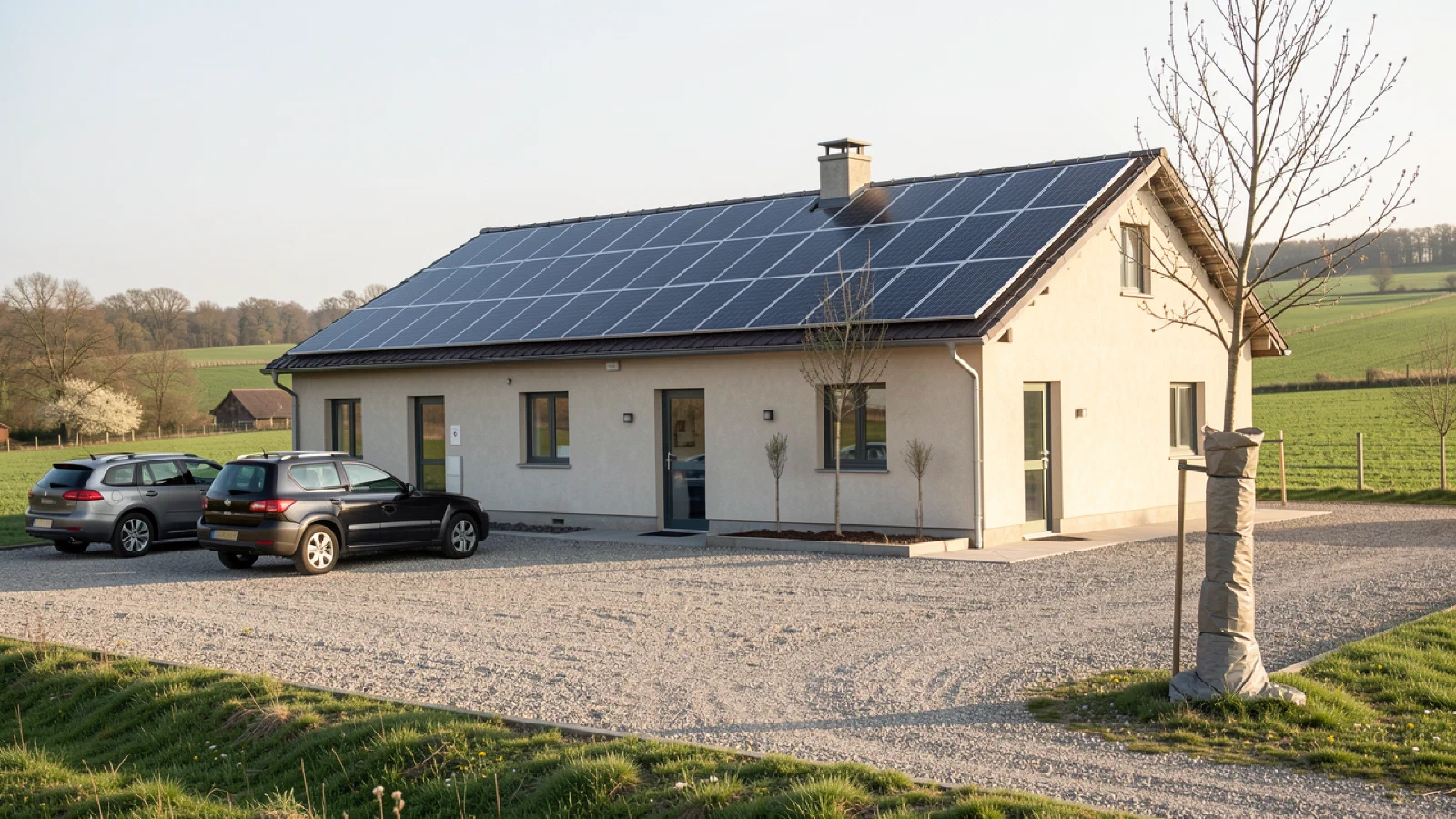
The alternative architecture described in Series 14 contains inherent climate resilience that centralized systems lack. Distributed service centers eliminate single points of failure; when one facility is damaged, others continue operating. Solar plus battery systems provide power independence during grid failures. Virtual care capability ensures service continuity when physical access is disrupted. Mobile units can redeploy to wherever need is greatest. AI companions maintain monitoring during emergencies when in-person contact becomes impossible.
Climate adaptation is not a separate budget line. It is a design parameter embedded in every infrastructure decision. Service center location accounts for flood zones and wildfire risk. Equipment selection prioritizes durability under extreme conditions. Communication systems include satellite backup for terrestrial network failure. Every component of alternative architecture should be evaluated against the question: will this still function under the climate conditions this community will experience in 2045?
The most honest assessment acknowledges that some rural communities face climate futures that may not be compatible with permanent health infrastructure investment. Coastal communities facing sea level rise, barrier island communities in hurricane paths, and communities in areas of increasing aridification may need health system strategies that prioritize mobility over permanence. Sustainability in these contexts means systems designed to relocate rather than systems designed to endure in place.
Governance Continuity: Maintaining Community Accountability#
Governance is the mechanism through which communities ensure that health systems continue serving their interests over time. Every other sustainability challenge, technology, workforce, finance, climate, is ultimately a governance challenge, because governance determines whether communities make the decisions necessary to address each one.
The primary governance sustainability threat is leadership transition. Many community health initiatives depend on one or two founders whose vision, relationships, and credibility hold the enterprise together. When founders depart through retirement, burnout, relocation, or death, organizations frequently deteriorate or shift direction. Succession planning is the most commonly recommended and most commonly neglected governance sustainability practice.
| Governance Challenge | Risk | Continuity Design |
|---|---|---|
| Founder departure | Vision loss, relationship disruption | Distributed leadership, documented values, succession planning |
| Board turnover | Institutional knowledge loss | Staggered terms, orientation programs, mentorship |
| Elite capture | Mission drift toward connected interests | Democratic accountability, term limits, conflict-of-interest policies |
| Governance fatigue | Volunteer exhaustion, declining participation | Professional management with community oversight, compensated participation |
| Political interference | External pressure distorting priorities | Legal protections, independent governance structures, broad constituency |
Distributed leadership is the most reliable governance sustainability mechanism. When knowledge, relationships, and decision-making authority spread across multiple individuals rather than concentrating in one leader, any single departure creates disruption rather than crisis. Building distributed leadership requires deliberate investment in developing multiple leaders simultaneously, even when having a single strong leader feels more efficient.
The tension between institutionalization and dynamism defines governance sustainability. Institutionalizing successful approaches protects them from leadership transition and political change. But institutionalization can also calcify organizations, preventing adaptation to new circumstances. The governance design challenge is creating structures stable enough to persist through transitions but flexible enough to evolve with changing conditions. Staggered board terms, regular strategic reviews, community engagement requirements, and sunset provisions on specific programs balance stability with renewal.
Community accountability requires mechanisms that ordinary residents can actually use. Annual reports available on websites fulfill transparency requirements without enabling genuine accountability. Meaningful accountability involves public meetings where residents can question decisions, governance structures where community members hold real power, and recall or replacement mechanisms for leaders who fail their communities. The cooperative and commons governance models described in Article 14F provide templates, but every community must adapt structures to its own culture, capacity, and circumstances.
Vignette: Twenty Years Later#
Thelma Hardin parks her car outside the Johnson County Service Center and pauses before going in. Twenty years ago, she was on the committee that fought to build this place when everyone said it could not work. Now she serves on the Johnson County Health Commons board, her second stint, because nobody serves more than two consecutive four-year terms. That rule was her idea, born from watching the previous county hospital board become a closed club that served itself.
The center looks different than it did in 2028. The original building stands, renovated twice, but solar panels that were cutting-edge when installed were replaced in 2036 with more efficient models. The charging station for the mobile health van did not exist in the original design. The robotics suite was a storage room until 2033. Technology changes. The building adapts.
Inside, Marcus Washington, the center director, is running his morning briefing. Marcus grew up in Johnson County, earned his community health worker certificate at the high school, completed his associate degree at the community college, finished his bachelor’s through the online partnership with the state university, and returned home for a master’s in health administration through the same program. He is exactly the kind of leader the pipeline was designed to produce: skilled, credentialed, and rooted.
The briefing covers the week’s challenges. A CHW is leaving for a position in the regional health system, but two candidates from this year’s high school cohort are ready for training. The AI companion system needs its scheduled platform migration, budgeted from the technology reserve fund established in 2027. A grant application is due for a new maternal health initiative, but the core operating budget does not depend on it. They can pursue innovation without risking stability.
After the briefing, Thelma walks through the facility. She knows every room. She remembers when the telehealth suite connected to specialists for the first time, when the first robot-assisted blood draw made a visiting nurse unnecessary for routine labs, when the community garden behind the building started producing food for the food pharmacy. Not everything worked. The dental program struggled for three years before they found a sustainable staffing model. The transportation coordination system crashed twice and had to be rebuilt. Two board chairs after Thelma were mediocre, and the community felt it.
But the system persisted. It persisted because the financial reserves absorbed the bad years. Because the governance structure limited how much damage any single leader could do. Because the workforce pipeline kept producing people who wanted to stay. Because the technology refresh plan meant they were never trapped on a dying platform. Because climate-resilient design meant the floods of 2039 damaged the parking lot but not the building.
Twenty years is not forever. Thelma knows the center will face challenges she cannot imagine. But it will face them as a community institution with reserves, leadership depth, and adaptive capacity. That is what sustainability looks like: not permanence but the capacity to persist through disruption and emerge on the other side still serving the community.
Conclusion#
Sustainability is not an outcome. It is a design discipline applied to every component of alternative architecture from inception. Technology refresh cycles demand depreciation reserves and vendor contracts that prevent lock-in. Workforce pipelines require K-12 integration and career ladders that take a generation to mature. Financial resilience demands diversification across at least five revenue sources and reserve funds that accumulate during good years to sustain operations during bad ones. Climate adaptation requires infrastructure decisions made against 2045 conditions, not 2026 conditions. Governance continuity demands distributed leadership and accountability mechanisms that survive any individual’s departure.
The history of rural health policy is a history of unsustained investments. Programs launch, build capacity, lose funding, and leave communities worse off than before, because temporary capacity that disappears is more demoralizing than capacity that never existed. RHTP’s five-year window creates an opportunity to build differently, but only if sustainability is embedded in every decision from the first dollar spent.
The honest assessment is that sustainability is harder than implementation. Building a service center is a construction project with a definable timeline. Sustaining it for 30 years is a governance, financial, workforce, and community challenge that never ends. Communities that succeed will be those that design for permanence rather than performance, that invest in reserves rather than spending every available dollar on expansion, that develop multiple leaders rather than depending on one champion, and that build flexible systems rather than optimized ones.
Transformation that cannot sustain is not transformation. It is a more expensive way to fail.
The 3A Policy Environment: The Only Payment Mechanism That Outlasts RHTP#
RHTP ends September 30, 2031. The policy environment Article 16E addresses is almost entirely defined by what happens when federal transformation funding stops. The ACCESS model is the single payment mechanism embedded in the Consolidated Appropriations Act of 2026 that extends meaningfully beyond the RHTP window. ACCESS authorizes a 10-year payment track running through 2036, five years after RHTP ends. For communities building alternative architecture that must survive the 2031 cliff, ACCESS represents the only federal payment commitment designed to outlast the program itself.
This makes ACCESS central to sustainability planning in ways that go beyond its clinical function. A service center built around virtual chronic disease management, staffed by local workforce trained to facilitate remote monitoring, and governed by community structures designed for long-term operation has a payment pathway through 2036 if it qualifies for ACCESS. The sustainability question becomes: does the alternative architecture qualify, and can it qualify before RHTP funding runs out?
The Making Care Primary precedent must be stated plainly. Making Care Primary was a CMMI model with 10-year commitments, multiple cohorts enrolled, and substantial provider investments made in reliance on those commitments. CMS cancelled it. The reasons were administrative, not clinical. ACCESS carries the same structural vulnerability: CMMI models are not contracts, the commitments are not legally binding, and a future administration restructuring CMMI’s portfolio can cancel ACCESS regardless of provider reliance or patient impact. Sustainability planning that treats ACCESS as a guaranteed revenue stream is sustainability planning built on a false foundation.
The honest posture is ACCESS as a favorable scenario requiring contingency design. Communities should plan for ACCESS revenue while designing systems that survive without it. This means financial reserves covering 12 months of operations if ACCESS disappears, alternative revenue streams independent of ACCESS-equivalent payment, and governance structures capable of rapid adaptation if the payment environment shifts. The sovereign fund model described in Article 14E is the sustainability mechanism that insulates communities from CMMI decisions: endowment earnings do not depend on CMS policy choices.
Medicaid restructuring creates the parallel threat. The $911 billion in Medicaid cuts documented in Article 3A operate on a longer timeline than ACCESS, affecting sustainability through coverage erosion that reduces the insured patient population alternative architecture serves. A service center financially modeled on 70% Medicaid-insured patients faces a different sustainability calculation if work requirements and eligibility restrictions reduce that proportion to 50%. Financial resilience planning must treat coverage erosion as a base-case scenario, not a worst case, because the legislative trajectory is already established in enacted law.
LIHEAP elimination and SNAP cuts affect sustainability through community economic conditions that determine whether tax districts, mill levies, and community contributions remain viable funding sources. Communities where households face energy cost stress and reduced food assistance have less economic capacity to support local health institutions through direct contribution. The financial diversification strategy requiring five revenue sources must account for community economic stress reducing the viability of locally-sourced funding at precisely the moment federal programs reduce their contribution.
The constructive reading requires precision. ACCESS through 2036 provides a payment pathway most federal programs do not. The LEAD accommodation for small practices extends ACCESS-equivalent payment to independent physicians serving as nomadic professionals in rotating workforce models. The CAA 2026 telehealth extension through December 2027 provides a limited runway for demonstrating outcomes. These are genuine provisions that communities can build toward. The discipline is treating them as tools in a difficult environment rather than solutions to it, designing sustainability around the possibility each provision performs as authorized while maintaining the reserves and diversification that survive if they do not.
The governance implication is concrete: sustainability boards must track ACCESS authorization status as a standing agenda item, maintain scenario planning for ACCESS cancellation, and establish financial triggers activating contingency measures if the Medicare payment landscape shifts materially. This is not pessimism. It is the governance discipline the Making Care Primary cancellation demonstrates is necessary. Communities that design for ACCESS revenue without designing for its absence are repeating exactly the sustainability failure this article documents across prior federal rural health initiatives.
Cross-reference: 3A RHTP Inside HR1 for ACCESS, LEAD, and Medicaid restructuring analysis; 12C Medicare’s Rural Reckoning for Medicare payment environment detail; 12A Coverage Erosion for Medicaid sustainability threats; 14E State Sovereign Investment for payment-independent capital structures.
How this article connects to others in Blue Gray Matters.
Sources cited in this article.
- Alaska Permanent Fund Corporation. "2025 Annual Report: 49 Forward." APFC, 2025, apfc.org.
- Centers for Medicare and Medicaid Services. "CMS Announces $50 Billion in Awards to Strengthen Rural Health in All 50 States." CMS Newsroom, 29 Dec. 2025, cms.gov.
- Centers for Medicare and Medicaid Services. "CMS Announces Establishment of the Office of Rural Health Transformation." CMS Newsroom, 22 Dec. 2025, cms.gov.
- Commonwealth Fund. "Sustaining Rural Health Services: Financial Strategies for Long-Term Viability." Commonwealth Fund, 2024, commonwealthfund.org.
- Government Accountability Office. "Rural Hospital Closures: Affected Residents Had Reduced Access to Health Care Services." GAO-21-93, Feb. 2021, gao.gov.
- National Rural Health Association. "NRHA Center for Rural Health Innovation: Rural Health Transformation Program." NRHA, 2025, ruralhealth.us.
- Ricketts, Thomas C. "The Changing Nature of Rural Health Care." Annual Review of Public Health, vol. 21, 2000, pp. 639-657.
- State Health and Value Strategies. "Tracking State Preparation for the Rural Health Transformation Program." SHVS, Sept. 2025, shvs.org.
- Stratis Health. "Sustaining Rural Health Quality Improvement: Lessons from Two Decades." Stratis Health, 2023, stratishealth.org.
- U.S. Department of Health and Human Services. "All 50 States Seek to Transform Rural Health with CMS." HHS Press Room, 6 Nov. 2025, hhs.gov.