The Service Center
2,000 Square Feet, Not 20,000
2,000 Square Feet, Not 20,000#
Rural healthcare facilities fail because they are designed for a scale that rural populations cannot sustain. A Critical Access Hospital requires 25 beds and generates annual operating costs of $8 to $15 million. A community of 5,000 cannot produce enough patients to fill those beds or enough revenue to cover those costs. The facility exists at the wrong scale for the population it serves. When the facility closes, as 152 rural hospitals have since 2010, nothing replaces it. The community is left with neither the facility it had nor any alternative.
The service center model starts from a different premise: what minimal physical footprint enables maximum care delivery? Instead of building small hospitals that cannot achieve viability, service centers combine telehealth capacity, robotic support, visiting professional space, and local workforce employment in facilities of 500 to 4,000 square feet. Capital costs run $500,000 to $1 million instead of $15 to $30 million. Annual operating costs run $400,000 to $700,000 instead of $8 to $15 million. Revenue requirements fall by 80% to 95%.
This article presents the service center component of alternative architecture: configurations scaled to population, robot integration enabling reduced staffing, mobile unit coordination extending service reach, emergency capability appropriate to rural settings, and cost structures that small populations can sustain. Service centers are not hospitals pretending to be smaller. They are different facilities designed for different purposes: connecting residents to expertise that travels virtually rather than housing expertise that refuses to relocate.
The Current Model Failure#
Rural healthcare facilities operate within financial constraints that have broken the model.
Hospitals require volume that rural populations cannot generate. Medicare cost-based reimbursement for Critical Access Hospitals assumes 25 beds operating at occupancy rates sufficient to cover fixed costs. Rural populations increasingly seek care at regional centers, and conditions that once required hospitalization are now managed outpatient or at home. Average daily census at rural hospitals has declined for decades. Facilities designed for higher utilization cannot survive lower utilization, regardless of payment generosity.
Clinics require full-time providers that rural areas cannot recruit. Rural Health Clinics and Federally Qualified Health Centers assume physician or mid-level provider presence for clinic hours. When providers cannot be recruited, positions remain vacant. When positions remain vacant, clinics operate at reduced capacity. When capacity falls below sustainability thresholds, clinics close. The model depends on provider availability that provider preferences no longer support.
Facility costs consume resources that could fund services. A Critical Access Hospital devotes substantial budget to building maintenance, equipment depreciation, utilities, compliance, and administrative overhead. These costs exist whether or not the facility treats patients. When patient volume declines, fixed costs become a larger percentage of total costs. Eventually, the facility cannot cover fixed costs regardless of operating efficiency. The building becomes the problem rather than the solution.
Empty space drains budgets. A 20,000 square foot hospital treating 10 patients daily heats, cools, cleans, and maintains 20,000 square feet. A 2,000 square foot service center treating the same 10 patients daily operates at appropriate scale. The difference in facility cost, spread across patient encounters, explains much of rural healthcare’s financial impossibility.
When facilities close, nothing replaces them. The current model offers binary options: a facility that cannot achieve financial sustainability or no facility at all. Communities cannot build smaller because regulatory categories do not permit smaller. They cannot operate differently because payment systems do not reward different. The Rural Emergency Hospital designation offers one alternative, but REH eliminates inpatient capacity that some communities genuinely need. The regulatory and payment environment constrains solutions to options that do not work.
The Alternative Model#
Service centers replace the failed facility model with infrastructure scaled to population, technology-enabled for capability, and connected to regional systems for services beyond local scope.
Configuration Framework#
Four configurations serve populations of different sizes, with technology and staffing matched to need.
| Configuration | Population | Square Feet | Technology Suite | Human Staff |
|---|---|---|---|---|
| Micro | Under 1,000 | 500-800 | Telehealth pod, medication kiosk, monitoring lending library | 1 part-time CHW |
| Minimal | 1,000-2,500 | 1,000-1,500 | Above plus vital signs station, specimen collection | 1-2 CHWs |
| Standard | 2,500-5,000 | 1,500-2,500 | Above plus reception robot, pharmacy robot | 2-3 CHWs, 1 MA |
| Enhanced | 5,000-15,000 | 2,500-4,000 | Full automation, lab processing, visiting professional suites | 4-6 CHWs, 2-3 MAs |
Micro service centers serve frontier communities where any permanent facility exceeds population support capacity. A telehealth pod enables virtual visits. A medication dispensing kiosk handles common prescriptions. A lending library for monitoring equipment (blood pressure cuffs, glucometers, pulse oximeters) supports chronic disease management. A part-time CHW maintains the facility and provides community connection. The facility occupies 500 to 800 square feet in a shared community building: library, fire station, post office, or church.
Minimal service centers add capacity for basic clinical activities that require physical presence. Vital signs stations with automated measurement equipment enable nursing assessments without nurses. Specimen collection capability supports laboratory testing with samples transported to regional processing. One to two CHWs staff the facility during operating hours.
Standard service centers introduce robotics that extend capability. Reception robots handle check-in, wayfinding, and triage screening questions. Pharmacy dispensing robots prepare and dispense medications. The combination of telehealth, robotics, and CHW staffing enables primary care delivery without full-time physician or nurse practitioner presence. Two to three CHWs and one medical assistant operate the facility.
Enhanced service centers serve as regional hubs, hosting visiting specialists, processing lab specimens for surrounding service centers, and coordinating mobile unit scheduling. Full automation suites include phlebotomy robots for blood draws, cleaning robots for environmental maintenance, and logistics robots for supply management. Professional visiting suites enable specialists to conduct hands-on examinations during scheduled rotations. Four to six CHWs and two to three medical assistants staff the facility.
Robot Integration#
Robotics reduce staffing requirements while maintaining or improving service quality.
| Robot Type | Functions | Technology Readiness | Capital Cost |
|---|---|---|---|
| Reception | Greeting, check-in, wayfinding, triage questions | High | $30,000-50,000 |
| Telepresence | Mobile video connection to remote providers | High | $5,000-15,000 |
| Vital Signs | BP, temperature, pulse ox, weight directly to EHR | Medium-High | $20,000-40,000 |
| Phlebotomy | Automated blood draw with vein visualization | Medium | $50,000-100,000 |
| Pharmacy | Dispense, package, label medications | High | $100,000-200,000 |
| Cleaning | Floor cleaning, surface disinfection, waste management | High | $10,000-30,000 |
| Logistics | Supply transport, inventory management | High | $15,000-35,000 |
Technology readiness indicates current deployment feasibility. High-readiness robots (reception, telepresence, pharmacy, cleaning, logistics) are commercially available and deployed in healthcare settings today. Medium-readiness robots (vital signs, phlebotomy) exist but require additional validation for autonomous operation in rural settings with limited backup.
The robot economic proposition compares favorably to human staffing costs for equivalent functions.
| Configuration | Robot Annual Cost | Equivalent Human Staffing | Human Annual Cost |
|---|---|---|---|
| Minimal | $15,000-25,000 | 0.5 FTE receptionist, 0.5 FTE MA | $40,000-60,000 |
| Standard | $50,000-80,000 | 2 FTE support staff | $80,000-120,000 |
| Enhanced | $100,000-150,000 | 4 FTE support staff | $160,000-240,000 |
Robots do not replace all human functions. They handle routine, repetitive tasks, freeing human staff for relationship-intensive activities that robots cannot perform. CHWs spend time with patients instead of checking patients in. Medical assistants focus on clinical preparation rather than supply management.
Robot reliability in rural settings requires consideration. When a pharmacy robot fails, no overnight technician arrives for repair. Service centers require maintenance contracts with response time guarantees, backup protocols for robot failure, and cross-trained staff who can perform essential functions manually when automation fails. Robots enable reduced staffing; they do not enable zero staffing.
Mobile Unit Integration#
Services requiring specialized equipment or hands-on professional delivery reach service centers through coordinated mobile unit schedules.
Dental units serve 4 to 6 service centers on weekly or biweekly rotation. A fully equipped mobile dental operatory with dentist and dental hygienist provides cleanings, fillings, extractions, and preventive services. Service centers schedule patients for mobile dental days, ensuring efficient utilization of specialist time.
Specialty units bring imaging equipment, procedure capability, and specialist physicians to service centers for scheduled clinics. Mammography, ultrasound, basic x-ray, and minor procedures reach populations who would otherwise travel hours for episodic services.
Lab processing units collect specimens from micro and minimal service centers, transporting them to enhanced service centers or regional laboratories for processing. The model enables point-of-care testing for urgent results while centralized processing handles routine panels.
Legal and financial units bring professionals for complex matters requiring in-person consultation. Estate planning, tax preparation for complicated returns, and benefits appeals benefit from face-to-face interaction that AI services (described in Article 14B) cannot fully replace.
Coordination across service center networks optimizes mobile unit routing. A dental unit serving six communities schedules routes minimizing travel time while maximizing patient access. Enhanced service centers anchor mobile unit schedules, with micro and minimal centers scheduled between hub visits.
Physical Design Principles#
Service center design follows principles distinct from hospital or clinic architecture.
Telehealth-first layout. Private consultation rooms with professional lighting, sound dampening, and reliable connectivity enable high-quality video visits. Patient comfort during 30 to 60 minute telehealth appointments requires seating designed for extended use, not waiting room chairs.
Robot circulation. Floor surfaces, doorway widths, and spatial layouts accommodate robot movement. Charging stations and maintenance access support daily operations. Storage for robot supplies (medication cartridges, cleaning supplies) integrates into facility design.
Flexible use. Rooms serve multiple purposes across daily schedules. A visiting specialist suite becomes a community meeting room when specialists are not present. A consultation room accommodates telehealth, CHW appointments, and mobile unit overflow.
Community integration. Service centers function best when integrated into community life rather than isolated as healthcare facilities. Co-location with libraries, community centers, or local government offices increases foot traffic, reduces stigma, and enables wraparound services.
Resilience requirements. Rural service centers require backup power for essential functions, connectivity redundancy for telehealth reliability, and climate control appropriate to regional conditions. Facilities must function during power outages, internet service disruptions, and extreme weather.
Cost Comparison#
The economic case for service centers rests on dramatically lower capital and operating costs compared to traditional facilities.
| Model | Capital Cost | Annual Operating | Annual Revenue Requirement |
|---|---|---|---|
| Critical Access Hospital | $15-30 million | $8-15 million | $10-18 million |
| Rural Health Clinic | $1-3 million | $800K-1.5 million | $1-2 million |
| Standard Service Center | $500K-1 million | $400-700K | $500K-900K |
A population of 5,000 generating $600,000 in annual healthcare revenue cannot sustain a Critical Access Hospital requiring $10 million or more in annual revenue. The same population can sustain a standard service center requiring $600,000 to $900,000. The math that dooms hospital models enables service center models.
Revenue sources for service centers include:
- Facility fees for telehealth visits conducted on site
- Reimbursement for services provided by visiting professionals
- CHW services billed through Medicaid where state programs allow
- Chronic disease management fees through value-based contracts
- Mobile unit revenue allocation for services delivered at the center
- Community health center funding where FQHC designation applies
The funding model requires regulatory accommodation described in Series 15. Current facility categories do not match service center configurations. Payment systems do not reimburse adequately for telehealth facilitation. The economic proposition is sound; the regulatory environment is not yet aligned.
Emergency Capability#
Service centers are not emergency departments. They do not promise emergency capability equivalent to hospital emergency rooms. They provide appropriate emergency response for rural settings where the nearest hospital is an hour away.
AI triage with immediate virtual physician access. When someone arrives with an emergency, the service center connects them to a remote physician within minutes. AI triage systems assess urgency and route appropriately. The virtual physician can direct CHW and MA staff in stabilization while transport is arranged.
Stabilization capacity for trained staff. CHWs with appropriate training can initiate CPR, apply pressure to wounds, assist with emergency medication administration, and maintain patients until transport arrives. Community paramedics, where scope of practice allows, provide additional emergency capability.
Drone delivery of emergency supplies. AEDs, naloxone, epinephrine auto-injectors, and basic wound care supplies can reach service centers via drone within minutes of emergency recognition. The technology exists; deployment requires regulatory pathway and infrastructure investment.
Coordinated transport. Service centers maintain communication with EMS dispatch, regional hospitals, and air ambulance services. When emergency transport is needed, coordination begins immediately. The service center stabilizes; transport moves the patient to definitive care.
The honest limitation. A service center cannot perform emergency surgery, manage a heart attack with catheterization, or treat major trauma. A patient needing these services in a community served by a service center instead of a hospital must travel to receive them. The question is whether that patient is better off with a service center providing initial response and coordinated transport or with no local healthcare presence at all. The closure alternative offers nothing. The service center offers something.
Problem Resolution#
Service centers address multiple problems from the eleven-problem framework.
| Problem | Mechanism | Direct or Integration |
|---|---|---|
| 1. Hospital survival | Service centers replace hospitals at sustainable scale | Direct |
| 2. Professionals refuse to stay | Facilities function without permanent professional presence | Direct |
| 3. Slow technology adoption | Robot and telehealth integration built into design | Direct |
| 4. Broadband challenges | Facilities include connectivity infrastructure | Direct |
| 5. No tech partnerships | Service centers operate with commodity technology | Integration with 14J |
| 6. Aging in place | Service centers anchor home-based care coordination | Integration with 14A, 14B |
| 9. Dental deserts | Mobile dental units serve service center networks | Direct |
| 10. Social coordination | Service centers platform for social service delivery | Integration with 14B |
Service centers directly address the hospital survival problem by replacing facilities that cannot achieve sustainability with facilities that can. The problem was never rural healthcare demand; it was facility scale mismatched to population.
Integration with other Series 14 components extends service center impact. The inverse hub model (14A) provides virtual expertise. AI infrastructure (14B) enables companions, coordination, and document management. The local workforce (14C) staffs service centers. State sovereign investment (14E) funds service center deployment. Governance models (14F) ensure community control.
Barriers and Counterarguments#
Regulatory Barriers#
Counterargument: Current facility licensing categories do not permit service center configurations. States require hospitals to meet hospital standards and clinics to meet clinic standards. Service centers fit neither category.
The counterargument identifies a real barrier. Series 15 analyzes enabling conditions including facility licensing reform. States must create new facility categories or waive existing requirements for service centers to deploy legally. Some states have begun this work; most have not.
The barrier is regulatory, not technical or economic. Service centers can be built. They can be staffed. They can deliver care. What they cannot do in most states is operate legally under current facility definitions.
Quality Concerns#
Counterargument: Service centers without physicians provide inferior care. Patients deserve access to real healthcare, not telehealth pods staffed by community health workers.
The counterargument assumes the alternative is physician presence. The actual alternative in many rural communities is nothing. When the hospital closes and the clinic cannot recruit, residents have no local healthcare access. A service center with telehealth physician access, CHW staffing, and robot assistance provides more care than an empty building.
Evidence on telehealth effectiveness, reviewed in Article 4C, demonstrates that virtual care produces outcomes comparable to in-person care for many conditions. CHWs with appropriate scope provide evidence-supported chronic disease management. The quality question should compare service centers to realistic alternatives, not to idealized physician availability that does not exist.
Financial Sustainability#
Counterargument: The cost projections assume revenue that payment systems do not currently provide. Service centers cannot bill Medicare for facility fees. Medicaid CHW reimbursement varies by state and often pays below cost. The financial model depends on regulatory changes that may not occur.
The counterargument is accurate. Service center financial sustainability requires payment reform analyzed in Series 15. Current payment systems do not adequately reimburse telehealth facilitation, CHW services, or non-traditional facility configurations.
The response is not that current payment systems work but that they must change. The alternative is continued hospital closure with no replacement. Payment reform enabling service centers costs less than subsidizing hospitals that cannot achieve sustainability regardless of subsidy level.
Technology Dependence#
Counterargument: Service centers depend on technology that can fail. Broadband outages, robot malfunctions, and power failures could leave communities without any healthcare capacity.
Service center design must address resilience. Backup systems for critical functions (power, connectivity), manual override protocols for robot failure, and cross-trained staff who can perform essential tasks without technology provide continuity during disruptions.
The counterargument applies equally to current facilities. Hospitals and clinics depend on technology for electronic health records, imaging, laboratory processing, and communication. Service centers are not uniquely technology-dependent; they are technology-dependent in different ways.
The Vignette: A Wednesday in Clearwater County#
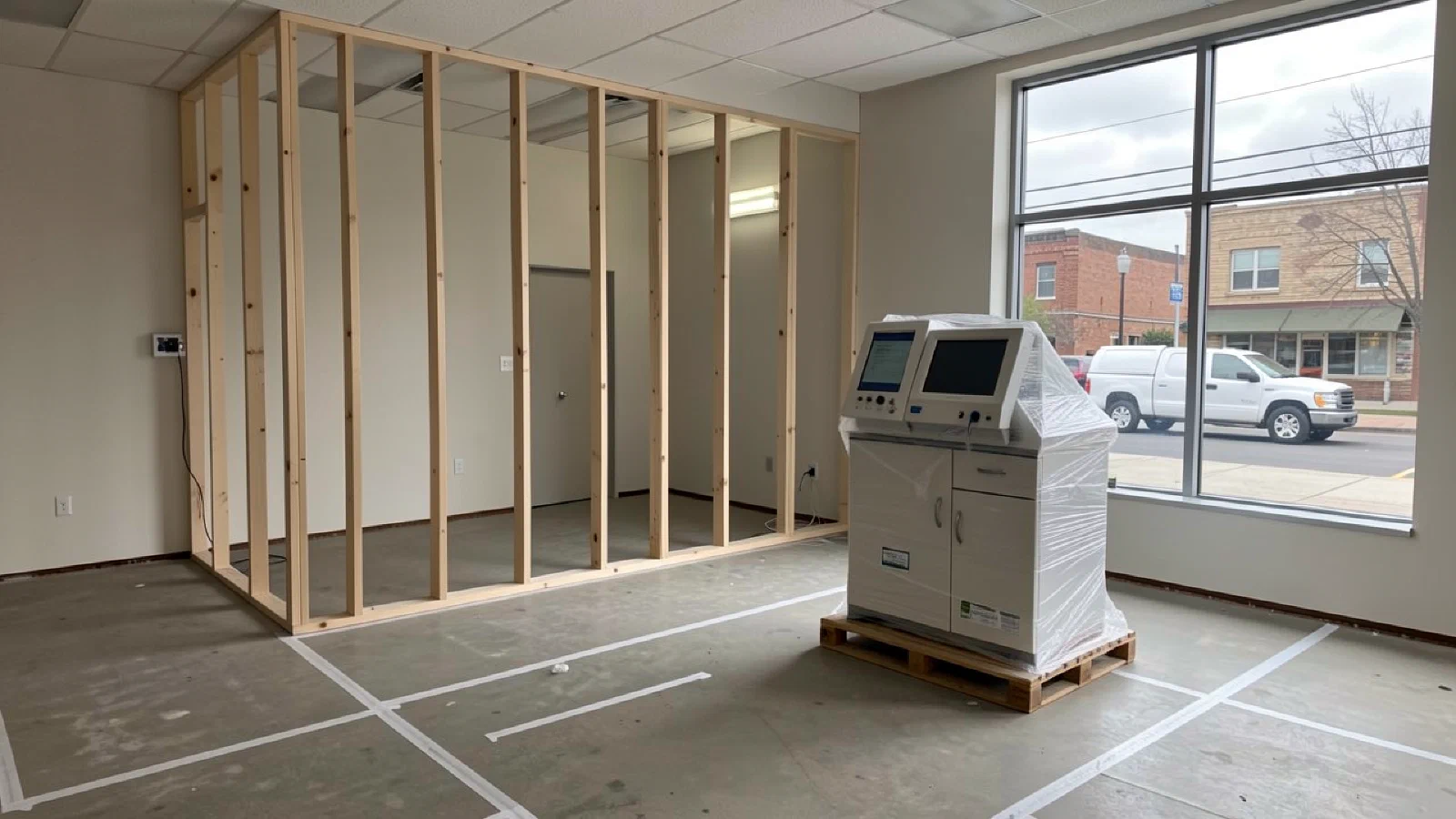
The Clearwater County Service Center opens at 8:00 AM in a converted storefront on Main Street, adjacent to the public library and across from the post office. The 2,200 square foot facility serves a population of 4,800 spread across 1,500 square miles of northwestern Minnesota.
Sarah Lindquist, the lead Community Health Worker, arrives first to power up systems and prepare the facility. The reception robot completes self-diagnostics and reports ready. The pharmacy robot has already filled the morning’s refill queue, medications waiting in secure compartments for patient pickup. The telehealth scheduling system shows 12 appointments across four hours with three different providers: a family physician in Fargo, an endocrinologist in Minneapolis, and a behavioral health counselor in Duluth.
By 8:30 AM, the first patient arrives. Martha Carlson, 72, is here for her monthly diabetes check-in. The vital signs robot measures her blood pressure, weight, and glucose. The results flow directly to her chart, accessible to the endocrinologist who will see her via telehealth at 9:00 AM. While waiting, she picks up her medications from the pharmacy robot kiosk, scanning her ID to release the secure compartment.
In consultation room two, another CHW is facilitating a telehealth visit for a patient with anxiety. The behavioral health counselor’s face fills the 50-inch screen mounted at eye level. The patient sits in a comfortable chair with good lighting, the room soundproofed for privacy. The CHW who introduced the session has stepped out; the patient and provider have the room to themselves.
At 10:30 AM, the mobile dental unit arrives. A dentist and hygienist from the regional oral health network will see patients until 4:00 PM, working through appointments Sarah’s colleague scheduled over the past two weeks. The service center’s reception robot checks dental patients in and directs them to the mobile unit parked in the designated space behind the building.
Midday brings a walk-in concern. A farmer presents with a hand laceration from equipment maintenance. The vital signs robot assesses him stable. Sarah connects him with the Fargo family physician, who examines the wound via high-resolution camera. The laceration needs cleaning and closure but nothing beyond what Sarah can do with physician guidance. She cleans the wound, applies steri-strips under the physician’s remote supervision, and administers a tetanus booster from the medication supply. If the wound had required sutures, the patient would have needed to travel; this one did not.
Afternoon brings a community paramedic from the county EMS service who uses the facility as a workspace when not responding to calls. He reviews medication adherence data from monitoring devices, calls patients who missed doses, and coordinates with the service center staff on patients appearing in both systems. The integration is informal but effective: everyone serving the same small population shares information to keep people well.
At 3:00 PM, the weekly visit from the county social services navigator begins. She meets with patients referred by CHWs for benefits enrollment, housing assistance, and food access support. The service center provides meeting space; the social services department provides the expertise. Neither could function alone.
By 5:00 PM, the facility has served 28 patients: 12 telehealth visits, 8 dental appointments, 4 walk-in needs, and 4 social services consultations. Operating costs for the day: approximately $1,900 including staffing, technology, and facility overhead. Revenue generated: approximately $2,400 from various payer sources. The margin is thin but positive, and the facility operates within budget.
Sarah locks up at 5:30 PM. The pharmacy robot has already prepared prescriptions for tomorrow’s pickups. The cleaning robot begins its evening cycle. Tomorrow will bring similar volume with different faces.
The nearest hospital is 65 miles away. Before the service center opened, residents of Clearwater County had no local healthcare access. Now they have something designed for their reality rather than designed for somewhere else and adapted poorly.
Conclusion#
Service centers represent healthcare infrastructure at appropriate scale. They replace facilities that cannot achieve sustainability with facilities that can. They combine telehealth capacity, robotic support, visiting professional services, and local workforce in configurations matched to population size.
The model requires enabling conditions not yet in place. Facility licensing must accommodate new configurations. Payment systems must reimburse telehealth facilitation and CHW services adequately. Technology governance must clarify liability for robot-assisted care. Series 15 analyzes these enabling conditions in detail.
The alternative to service centers is not better hospitals. Rural hospitals continue closing regardless of RHTP investment because the fundamental economics do not work. The alternative to service centers is nothing: communities without local healthcare presence, residents traveling hours for routine care, emergencies without initial response. Service centers provide something rather than nothing at costs communities can sustain.
The 2,000 square foot service center serving 5,000 people achieves what the 20,000 square foot hospital serving the same population cannot: financial viability, workforce sustainability, and continuous operation. The building got smaller because the building was the problem.
How this article connects to others in Blue Gray Matters.
Sources cited in this article.
- American Hospital Association. "Rural Hospital Closures: 2010-2024." AHA, January 2025.
- Chartis Center for Rural Health. "The Rural Health Safety Net Under Pressure: 2025 Update." Chartis, February 2025.
- Health Resources and Services Administration. "Rural Health Clinic Program Data." HRSA, December 2024.
- CMS Medicare Learning Network. "Critical Access Hospital Fact Sheet." CMS, December 2024.
- North Carolina Rural Health Research Program. "Rural Hospital Closures Tracking." UNC Sheps Center, updated January 2026.
- The Pew Charitable Trusts. "Emerging Technologies in Healthcare: Robotics Assessment." Pew, September 2024.
- World Health Organization. "Primary Health Care Facility Models in Low-Resource Settings." WHO Technical Report Series, 2024.
- Milbank Quarterly. "Right-Sizing Rural Healthcare Facilities: Evidence Review." Milbank Memorial Fund, March 2025.