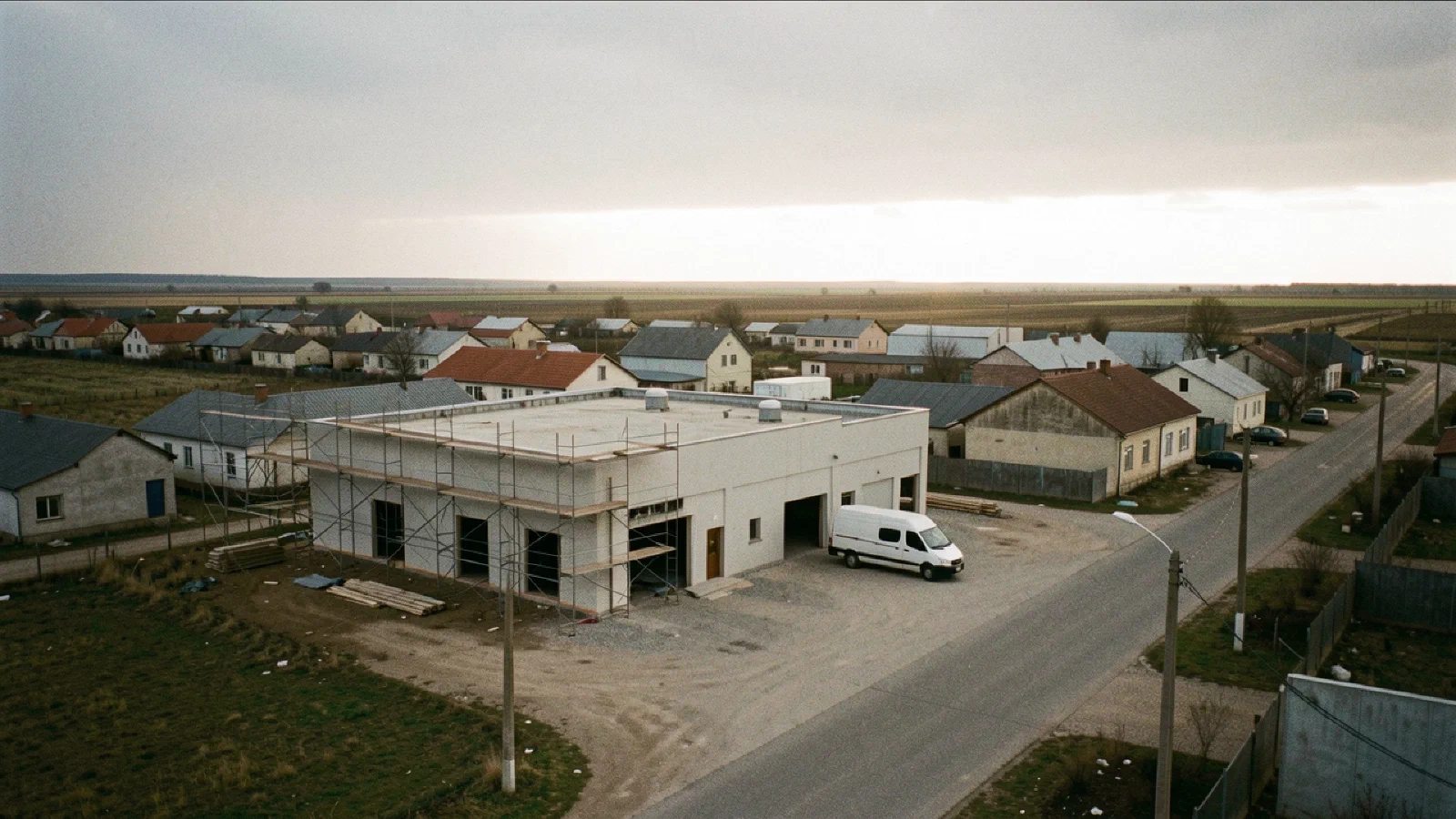
Can Alternative Architecture Succeed Where Current Models Have Failed?
The Distance Between Blueprint and Reality
The Distance Between Blueprint and Reality#
The engineer who designed the Floyd County Health Hub had never been to eastern Kentucky before the site visit. He had read the literature on inverse hub models, studied the India Stack deployments, reviewed broadband coverage maps, and built a financial model showing the facility would break even in eighteen months. His model assumed 60% telehealth visit completion rates, an 18-month CHW ramp-up to full caseload, and Medicaid reimbursement for chronic care management that the state had not yet authorized.
The facility opened on schedule. The broadband provider delivered the specified speeds 70% of the time, not the 99.5% the model assumed. The CHW hired from the community left after four months when her mother became ill; the replacement had less community trust and more turnover ahead. The pharmacy robot had a firmware problem that took eleven weeks to resolve. Medicaid reimbursement approval was still pending at month eighteen.
The engineer’s model was technically sound. His assumptions were not grounded in rural reality. The gap between blueprint and implementation is what this synthesis examines.
Series 14 presented an alternative architecture for rural health delivery across ten articles: the inverse hub, AI infrastructure, local workforce, service centers, sovereign investment, governance models, tribal demonstration, social care infrastructure, community ownership, and supplemental capital mobilization. The first seven articles (14A through 14G) build the operational and structural components. The final three (14H through 14J) provide the sustainability layer that determines whether the architecture endures or becomes another grant-funded initiative that disappears when funding does. Each component is coherent. The evidence supporting core premises is genuine. The question this synthesis addresses is whether the architecture, taken as a whole, can succeed where current models have failed, and whether the conditions required for success are achievable within realistic timeframes.
What the Alternative Architecture Gets Right#
The diagnosis is accurate. Series 14 begins from a correct assessment of why current models fail. Hub-and-spoke healthcare that requires patients to travel to expertise cannot serve populations where the spokes have snapped. Workforce recruitment models that assume professionals will relocate permanently fail because professional preferences have fundamentally changed. Facilities designed for urban volume cannot achieve viability at rural scale. These are structural failures, not implementation shortcomings that better management could address.
The inverse hub addresses the right problem. Article 14A’s central insight, that the challenge is not convincing professionals to move but building infrastructure that makes professional location irrelevant, is correct and important. Telestroke evidence demonstrates that video-based neurologist consultation produces outcomes equivalent to in-person evaluation. Telebehavioral health evidence demonstrates non-inferiority across depression, anxiety, and substance use disorders. The approximately 60 to 70 percent of primary care encounters that can occur virtually for established patients with stable conditions represent a massive share of healthcare demand that geography need not prevent. The inverse hub does not ask the impossible; it redirects the ask to infrastructure that can be built. The refactored article’s honest acknowledgment that virtual care is not a telehealth program but a different delivery architecture matters: telehealth programs supplement existing systems, while the inverse hub replaces a system that has already failed.
AI infrastructure addresses genuine service gaps rather than augmenting existing services. Article 14B’s distinction between AI as efficiency supplement and AI as foundational infrastructure carries the series’ most consequential framing. Rural communities do not need AI that makes their existing services slightly better. They need AI that provides services currently absent: continuous companion presence for isolated elders, legal and financial guidance where no attorneys or advisors practice, care coordination where no coordinators exist. The 37% of older Americans who report loneliness, with rural rates higher, represent a population that healthcare has never had a systematic response for. AI companions do not solve the structural conditions producing isolation, but they provide real presence where none currently exists. The refactored article’s treatment of companion archetypes (elder, caregiver, chronic condition, behavioral health) demonstrates that a single AI concept actually serves four distinct populations with different needs, design requirements, and evidence bases, a level of analytical specificity that strengthens the case by acknowledging complexity rather than papering over it.
The local workforce model solves the employment question that transformation must answer. Article 14C’s projection of 48 to 88 full-time equivalent positions per 10,000 rural residents compares to the 20 to 40 positions that facility-dependent models currently sustain. More critically, those positions survive facility closure. When the Critical Access Hospital closes and 150 jobs disappear overnight, the community loses healthcare access and economic anchor simultaneously. A distributed workforce of CHWs, digital navigators, broadband technicians, and AI support specialists does not disappear when one facility closes because those positions are not dependent on facility survival. The workforce model connects directly to community ownership (14I): CHWs employed by a worker cooperative share in enterprise governance and surplus, creating career investment that reduces the turnover destroying most CHW programs.
Service centers address the scale mismatch directly. Article 14D’s comparison of 2,000-square-foot service centers to 20,000-square-foot hospitals captures the fundamental problem. Facilities designed for a scale that rural populations cannot sustain will not survive regardless of how much transformation investment flows through them. Service centers cost $500,000 to $1 million to capitalize versus $15 to $30 million for traditional facilities. Annual operating costs run $400,000 to $700,000 versus $8 to $15 million. The math that makes hospital models impossible makes service center models possible, but only when held in community land trusts (14I) that prevent the real estate speculation and absentee ownership that could undermine community benefit.
Governance matters and the models are serious. Article 14F’s four governance approaches, commons, agricultural cooperative, distributed campus, and innovation zone, are not theoretical constructs. Rural electric cooperatives have served 42 million Americans through member-owned democratic structures for nearly a century. Tribal gaming enterprises manage $43.9 billion in annual revenues through governance structures that have survived political transitions and economic cycles. These precedents establish that community-accountable governance of essential services works at scale. The governance question connects to everything else in the architecture because without governance accountability, every other component, the inverse hub, AI infrastructure, service centers, local workforce, becomes another service imposed on communities rather than owned by them.
Tribal demonstration provides the regulatory laboratory the broader system needs. Article 14G’s core argument is compelling and underappreciated: tribal sovereignty enables immediate implementation of innovations that state-regulated systems cannot adopt without years of legislative change. Dental Health Aide Therapists have practiced in tribal communities since 2006, creating two decades of safety and quality evidence that is now accelerating state-level authorization. Community Health Aides have operated in Alaska villages since the 1960s. These are not experiments in progress; they are proven models generating the evidence that forces policy change elsewhere.
Social care infrastructure makes health transformation meaningful. Article 14H’s argument that social care is health infrastructure rather than supplemental programming reflects the epidemiological reality that social determinants account for an estimated 40 to 60 percent of health outcomes. The refactored article’s analysis of why interagency agreements determine whether a patient gets connected to housing assistance or handed a phone number she will never call captures what coordination means operationally. Siloed funding persists because it serves bureaucratic interests even while harming patients, and overcoming that persistence requires Medicaid managed care organizations recognizing that preventing hospitalizations through housing support improves their financial performance. The social care layer connects inverse hub (14A) virtual care to the community conditions that determine whether virtual care improves outcomes or merely documents deterioration.
Community ownership determines whether transformation extracts or builds. Article 14I introduces the distinction that reframes the entire series: every component of alternative architecture can be implemented under extractive ownership that transfers rural wealth to distant shareholders or community ownership that circulates value locally. Worker cooperatives employing CHWs, platform cooperatives owning AI coordination infrastructure, community land trusts holding service center facilities, and data trusts governing health information each represent ownership structures where transformation builds community wealth rather than extracting it. The distinction matters because the history of rural economic development is substantially a history of extraction, from resource extraction to hospital chain acquisition to vendor platform licensing, each removing value from communities that cannot afford to lose more.
Supplemental capital mobilization provides the sequencing that makes everything else possible. Article 14J’s sequential relationship analysis, philanthropic capital de-risks innovation, community crowdfunding builds local ownership, public capital funds replication, operational revenue sustains long-term, describes the capital lifecycle that transformation requires. No single capital source suffices. Philanthropic capital is catalytic but insufficient for scale. Public capital is substantial but risk-averse. Community investment builds ownership but cannot fund startup costs. Operational revenue sustains but cannot initiate. The sequential model explains why transformation efforts relying on a single capital type fail: they skip steps in a sequence where each phase depends on what the previous phase established.
Where the Architecture Faces Real Barriers#
Broadband requirements are more constraining than the architecture can resolve independently. Article 14A specifies minimum connectivity of 25 Mbps download and 99.5% uptime. The FCC’s 2024 data shows that 17% of rural Americans lack access to fixed broadband at minimally acceptable speeds, but this figure understates the problem in the communities where alternative architecture is most needed. Frontier areas with the longest distances from services, the oldest populations, and the most limited existing healthcare infrastructure are precisely the areas with the least reliable connectivity. Satellite internet reduces geographic coverage gaps but introduces latency issues that affect real-time telehealth performance and reliability variance that the 99.5% uptime specification cannot tolerate. The refactored 14A acknowledges this honestly: the communities that most need virtual care have the worst broadband, and resolving this contradiction requires infrastructure investment beyond what healthcare programs can fund. Redundant systems provide partial mitigation, not full resolution.
AI companion evidence is early-stage, not established. Article 14B accurately characterizes companion evidence as nine experimental studies, seven published since 2020, with small samples and short durations in institutional settings. The refactored article adds a critical honesty the original lacked: real-world rural effectiveness likely runs 10 to 20 percentage points lower than research settings suggest, because nursing homes provide WiFi, technical support, and staff oversight that isolated rural homes lack. The economic argument, one prevented hospitalization pays for years of companion service, is sound as a population-level calculation but cannot guarantee individual effectiveness. This matters not because the evidence case collapses but because policy decisions based on overstated evidence produce disappointment that discredits genuinely promising approaches.
CHW compensation and career pathway requirements are not what most programs deliver. Article 14C correctly identifies that the Penn Center’s 2.5% annual turnover requires compensation of $53,000 to $66,000 with benefits and genuine advancement pathways. Most CHW programs pay substantially less, offer minimal benefits, and provide no advancement. The transformation programs that will create CHW positions under RHTP will face budget pressures to deliver positions at lower cost than the Penn specification requires. Low compensation produces high turnover, which breaks the community trust relationships that make CHWs effective. Community ownership (14I) partially addresses this because worker cooperatives distributing surplus to CHW-members create compensation above what grant-funded positions typically offer. But cooperative formation itself requires capital and technical assistance that many communities lack, creating a dependency on the supplemental capital mobilization (14J) that is itself uncertain.
Service center financial models depend on reimbursement that does not yet exist. Article 14D’s projected revenue includes facility fees for telehealth visits conducted on site, CHW services billed through Medicaid, and chronic care management fees. Current reimbursement policy does not support these revenue streams in most states. Facility fees for telehealth facilitation are not uniformly available. Medicaid CHW billing exists in approximately half of states, often at rates below cost. Chronic care management fees require specific certification and payer agreement. The service center model is financially viable where reimbursement reform has occurred. It is not yet viable in most states, which means the financial model depends on the payment reform that Series 15 examines but cannot guarantee.
Sovereign investment fund creation requires political will that most states lack. Article 14E presents compelling evidence that permanent capital is necessary and achievable. Alaska demonstrates it. The problem is that Alaska had oil revenues so substantial that dedicating 25% still left abundant funding for other purposes. Most states do not have equivalent fiscal slack. Creating sovereign funds requires choosing rural health investment over competing budget priorities, overcoming opposition from interests currently receiving the revenues that would be redirected, and potentially winning ballot campaigns against well-funded opposition. The article’s vignette set in 2032 accurately reflects that fund creation would take years, not months.
Commons and cooperative governance models require civic capacity that stressed communities may lack. The models in Article 14F are theoretically sound and historically precedented. Rural electric cooperatives work. But rural electric cooperatives formed when rural populations had the density and civic infrastructure to organize. Contemporary rural communities facing population decline, institutional collapse, and social fragmentation may lack the organizing capacity that cooperative formation requires. Article 14I acknowledges this through its barrier analysis: cooperative formation costs, management complexity, and scale limitations are real obstacles that specialized technical assistance (funded by philanthropic capital per 14J) must address. The models that would work best for the communities with strongest civic infrastructure may be hardest to implement in the communities with the greatest health needs.
Social care integration requires interagency cooperation that bureaucratic self-interest resists. Article 14H’s barrier analysis identifies why siloed funding persists: HUD administrators maintain authority over housing programs, USDA controls nutrition funding, HHS manages social services grants, and each defends jurisdiction because categorical control justifies agency existence. Braiding funding streams means agencies accepting compliance risk when auditors question whether Medicaid dollars legitimately paid for housing support. This resistance reflects genuine structural incentives, not merely institutional inertia. The calculation shifts when Medicaid managed care organizations recognize financial benefit from integrated social care, but MCO penetration in rural markets remains limited and rural MCOs often lack the data infrastructure to measure cross-sector impact.
Community ownership faces capitalization gaps that specialized finance only partially fills. Article 14I’s analysis of why cooperatives cannot generate the exits conventional investors require explains why CDFIs, USDA cooperative development grants, and New Markets Tax Credits exist but also why these mechanisms are insufficient for the scale alternative architecture envisions. National CDFI lending to rural areas is a fraction of urban lending. USDA cooperative development grants fund feasibility studies but not operations. New Markets Tax Credits require complex structuring that exceeds community capacity without technical assistance. The capital landscape provides pathways but not highways, and most communities need highways.
Philanthropic capital is catalytic but structurally limited. Article 14J honestly acknowledges that total annual foundation health grantmaking is approximately $11 billion, rural health receives an estimated $500 million to $800 million, and alternative architecture at scale requires billions. The sequential relationship (philanthropic capital de-risks so public capital can follow) is logically sound, but the sequence assumes public capital actually follows, which requires political will, appropriations decisions, and bureaucratic willingness to fund proven but unconventional models. If public capital does not follow, philanthropic pilots become orphaned demonstrations rather than replicated successes.
The Enabling Conditions Problem#
Series 14 components require enabling conditions that Series 15 examines but cannot guarantee. The cross-dependencies deserve explicit recognition because they determine whether the architecture functions as a system or degrades into isolated components that accomplish less than the sum of their parts.
The inverse hub requires telehealth policy stability that the post-COVID regulatory landscape has not provided. Medicare telehealth flexibilities extended during the pandemic have been repeatedly threatened with expiration, creating uncertainty that discourages infrastructure investment premised on telehealth reimbursement. Health systems and communities hesitate to build inverse hub facilities when the payment rules that would sustain them could change with the next congressional appropriations cycle. Community ownership (14I) provides partial insulation because community-owned infrastructure persists through policy changes that would cause corporate-owned facilities to close, but even community-owned facilities cannot operate without revenue.
AI infrastructure requires technology governance frameworks that do not currently exist. The liability landscape for AI clinical decision support is undefined. State medical boards have not determined whether AI-assisted diagnosis constitutes the practice of medicine. Malpractice insurers do not know how to price coverage for AI companion systems that flag health concerns. Article 14B’s refactored analysis of liability scenarios demonstrates that the uncertainty itself is the barrier: organizations cannot adopt technologies whose legal exposure they cannot quantify, and the asymmetry between deployment risk (potential lawsuits) and non-deployment risk (no liability for service absence) guarantees beneficial AI remains undeployed in precisely the communities needing it most. Safe harbor protections (15C) are essential but politically contested because they require legislatures to choose innovation access over liability caution.
Local workforce sustainability requires Medicaid financing pathways that survive the federal budget environment. The $911 billion in proposed Medicaid reductions that Series 12 documented represent a direct threat to the revenue streams that fund CHW positions, service center operations, and care coordination programs. RHTP builds local workforce while parallel policy dismantles the payer infrastructure that would sustain those positions after 2030. The workforce cliff that Article 12D documents and the local workforce model that Article 14C proposes are on a collision course. Community ownership partially mitigates this because worker cooperatives generating revenue from diversified sources (Medicaid billing, community membership fees, foundation grants, state contracts) are less vulnerable to any single funding stream’s disruption than positions dependent entirely on Medicaid reimbursement. But diversification takes years to achieve, and the Medicaid cuts could arrive before cooperatives mature.
Service centers require facility licensing reform at the state level. Current regulations do not permit service center configurations in most states. Creating new facility categories or waiving existing requirements for alternative configurations requires state legislative or regulatory action that encounters opposition from incumbent institutions. Hospitals that see service centers as competitors rather than alternatives will mobilize against licensing reform. The regulatory pathway that would enable service centers to operate legally is controlled by institutions with incentives to keep that pathway closed.
Social care integration requires data sharing infrastructure that neither health systems nor social service agencies have built. Article 14H’s vision of closed-loop referral tracking, cross-agency communication, and coordinated intervention depends on Community Information Exchange platforms that most rural areas lack. Platform cooperatives (14I) provide the ownership model for shared data infrastructure, but platform development requires the philanthropic and public capital (14J, 14E) that is itself uncertain. The chicken-and-egg problem is real: integration requires platforms, platforms require capital, capital requires demonstrated integration value, and demonstration requires platforms.
The Integration Challenge#
Series 14 presents components as a system, but the architecture functions only when components cohere. The Floyd County vignette in Article 14A shows what integration looks like when it works: AI triage flags Margaret’s fluid retention, the remote nurse adjusts medications through telehealth, the CHW who sees Margaret at church provides continuity, the equipment lending library puts a scale in her home, the service center hosts visiting specialists when in-person examination is necessary.
When any component fails, the system degrades. Broadband outages in January isolate her from telehealth. CHW turnover breaks continuity. Equipment failure interrupts remote monitoring. Visiting specialist rotations cancel when professionals cannot travel. The inverse hub architecture has more points of failure than the hospital it replaces. The hospital’s point of failure is financial: when revenue cannot cover fixed costs, it closes. The architecture’s points of failure are distributed: broadband, workforce turnover, technology reliability, regulatory uncertainty, and reimbursement instability each represent independent failure modes.
This is not an argument against alternative architecture. It is an argument for recognizing that alternative architecture requires more intensive management, more redundancy planning, and more adaptive capacity than traditional facilities. The hospital that operates the same way for thirty years has a simpler management challenge than the service center network that must continuously adapt to connectivity variance, workforce changes, and regulatory evolution.
The sustainability layer (14H through 14J) addresses integration challenges that the operational layer (14A through 14G) creates but cannot resolve independently. Social care infrastructure (14H) connects clinical services to the community conditions that determine clinical outcomes, preventing the architecture from delivering excellent healthcare to people whose health deteriorates from unaddressed housing instability, food insecurity, and social isolation. Community ownership (14I) ensures that the people managing integration complexity have stakes in getting it right because they are the community rather than distant administrators. Capital mobilization (14J) provides the sequenced funding that allows integration to develop over years rather than requiring immediate perfection. Without the sustainability layer, the operational components function as isolated services. With it, they function as a system.
The Tribal Precedent as Partial Answer#
Article 14G’s tribal demonstration argument deserves emphasis because it addresses the chicken-and-egg problem constraining broader implementation. Alternative architecture components require regulatory change. Regulatory change requires evidence. Evidence requires implementation. Implementation requires regulatory change.
Tribal sovereignty breaks this loop. DHATs practiced for two decades before most states considered dental therapy authorization. Alaska Community Health Aides demonstrated primary care delivery by non-physician providers in settings where the alternative was no care, generating evidence that transformed national scope-of-practice debates. Southcentral Foundation’s Nuka System won two Malcolm Baldrige awards before most health systems had heard of the approach.
Tribal implementation is not peripheral to alternative architecture. It is the evidence engine that enables it. When opponents claim that AI companions in elder care raise unresolved safety questions, tribal programs that have deployed and evaluated them under sovereignty provide the evidence that resolves those questions. When state legislatures debate CHW billing, tribal programs operating under direct CMS arrangements demonstrate financial sustainability. When skeptics argue that community ownership cannot manage healthcare complexity, tribal health programs managing comprehensive systems under self-governance demonstrate otherwise. The 574 federally recognized tribes represent 574 potential demonstrations, though resource variation means a fraction will actually develop comprehensive alternative architecture.
The tribal precedent also illuminates the ownership question that Article 14I raises. Tribal health systems are community-owned by definition: governed by tribal councils, accountable to tribal members, and operated for community benefit rather than external shareholder return. Their success demonstrates that community-accountable governance of complex health systems is not only possible but can achieve quality outcomes that corporate-managed systems rarely match. The precedent does not transfer directly because tribal sovereignty provides regulatory authority that non-tribal communities lack, but the governance principles, community accountability, democratic oversight, and local employment, apply to cooperative and commons models designed for non-tribal rural communities.
Who Will Build This#
The alternative architecture requires actors who do not currently exist at sufficient scale. But the question of who builds is inseparable from the question of who owns, and Article 14I’s ownership analysis reframes the actor landscape.
Under extractive ownership, the architecture requires health systems willing to invest in rural markets with thin margins, technology companies willing to develop AI companions for populations too small to be profitable, and venture-backed platforms willing to accept returns below what urban markets offer. These actors emerge sporadically and disappear when financial conditions change because their participation is contingent on return expectations that rural markets cannot consistently meet.
Under community ownership, the architecture requires cooperative development infrastructure (CDFIs providing patient capital, technical assistance organizations supporting formation, legal expertise facilitating democratic governance), philanthropic capital willing to fund innovation that public agencies cannot yet support, and public capital willing to scale what philanthropy demonstrates. These actors are also insufficient at current scale, but Article 14J’s sequential relationship explains how they build on each other: philanthropic capital creates proof points that justify public investment, public investment creates the infrastructure that makes community ownership viable, and community ownership creates the accountability that sustains services beyond any single funding cycle.
Some of these actors are emerging. The Appalachian Regional Commission has funded Health Hub models. Rural electric cooperatives have explored healthcare delivery. Tribal nations with gaming revenues have demonstrated the capital formation that sovereign investment requires. CDFIs are developing rural health lending products. Foundations are creating rural health funding collaboratives. But the scale of actor development required to implement alternative architecture nationally dwarfs current momentum.
The more realistic trajectory is regional and partial: pockets of full implementation where the enabling conditions align, surrounded by communities that receive incremental improvements to current models rather than alternative architecture. Some regions will have the broadband, the civic capacity, the state regulatory environment, the community ownership infrastructure, and the capital sequencing that full implementation requires. Most will not. The question is whether successful demonstrations, particularly tribal demonstrations generating evidence under sovereignty, create enough political pressure and practical knowledge to expand the enabling conditions over time.
The Honest Assessment#
Can alternative architecture succeed where current models have failed? The answer is yes in the right conditions and no in the wrong ones, but the conditions themselves are not fixed.
The right conditions are: sufficient broadband reliability, state regulatory environments that permit service center configurations and expand workforce scope, Medicaid reimbursement structures that sustain service center economics, community civic capacity sufficient for cooperative or commons governance, patient capital for fifteen to twenty-five year infrastructure investment, philanthropic capital willing to fund innovation and formation, and community ownership structures that ensure transformation builds local wealth rather than extracting it. These conditions currently exist in some communities and regions. Where they exist, alternative architecture represents a genuinely viable path to sustainable rural health delivery.
The wrong conditions are: persistent broadband gaps, state regulations that prohibit alternative facility configurations, Medicaid cuts that eliminate the revenue streams service centers require, communities depleted of civic capacity by decades of population decline, dependence on federal grant cycles that cannot capitalize long-term infrastructure, and extractive ownership that removes value from communities through platform licensing fees, corporate management contracts, and distant shareholder returns. These conditions characterize most of the rural communities with the greatest health needs.
The architecture is sound. The limiting factor is conditions, not design. This is simultaneously more and less discouraging than if the architecture itself were flawed. More discouraging because conditions change slowly and unevenly, and the communities most in need are often furthest from the enabling conditions required. Less discouraging because conditions are not fixed: broadband is extending, tribal demonstration is generating evidence, state regulatory environments are evolving, cooperative development infrastructure is growing, philanthropic interest in rural health is increasing, and the sovereign investment model is proven if political will can be assembled.
The sustainability layer (14H through 14J) changes the honest assessment in one critical respect. Without it, the architecture depends on continuous external funding and favorable policy conditions to survive. With it, the architecture builds community assets (cooperatives, land trusts, platform cooperatives, data trusts) that persist through policy changes, funding disruptions, and political transitions. Community-owned infrastructure does not close when grants expire because the community has ownership stakes that motivate continued investment. This does not guarantee success, but it changes the failure mode from sudden collapse (grant ends, service disappears) to gradual evolution (community adapts ownership model to changing conditions). The difference between an architecture that can only succeed under favorable conditions and an architecture that can survive unfavorable ones is the difference between a demonstration project and a durable system.
Series 14’s contribution is not proving that alternative architecture will succeed. It is demonstrating that a coherent, evidence-grounded alternative exists to the models that are currently failing, and that the sustainability mechanisms, community ownership, sequenced capital, and social care integration, address the durability problems that have defeated previous transformation attempts. The current path, RHTP investment in transformation built on a Medicaid foundation simultaneously being eroded, leads to 2030 and a funding cliff that leaves communities with neither the facilities they had nor the transformed systems they were promised. Alternative architecture offers a different path. Whether that path can be built fast enough, at sufficient scale, through the political and institutional resistance that any genuinely different approach must overcome, is the question that Series 15 and 16 must address.
The engineer who designed Floyd County’s Health Hub learned something the second time. He hired a project manager who had grown up in Leslie County. She knew which broadband provider actually delivered its promised speeds and which did not. She knew the CHW candidate pool and which candidates had the community relationships that caseload ramp-up required. She knew that the Medicaid reimbursement timing was optimistic by six months. She also knew that the cooperative model forming around the Hub would keep it running after the grant ended because the community members who owned it would not let it close. Her adjustments changed the model’s financial outcomes from projections to actuals, and her ownership insight changed the model’s trajectory from demonstration to institution.
Alternative architecture requires that kind of knowledge. Not just the blueprint, which is sound, but the grounded understanding of where blueprints meet reality, where assumptions do not hold, where the system needs redundancy the model does not require, and where community ownership transforms a project into an institution. The architecture can succeed. Success requires more than architecture. It requires communities that own what they build.
How this article connects to others in Blue Gray Matters.
Sources cited in this article.
- Agency for Healthcare Research and Quality. "Telehealth: Mapping the Evidence for Patient Outcomes from Systematic Reviews." Evidence Report No. 209, AHRQ, June 2016.
- Alaska Permanent Fund Corporation. "2025 Annual Report." APFC, 2025.
- Association of American Medical Colleges. "The Complexities of Physician Supply and Demand: Projections From 2021 to 2036." AAMC, Mar. 2024.
- Bureau of Labor Statistics. "Occupational Employment and Wage Statistics: Community Health Workers." BLS, May 2024.
- Chartis Center for Rural Health. "2025 Rural Health State of the State." Chartis, 2025.
- Common Service Centres India. "CSC Statistics Dashboard." CSC e-Governance Services India Limited, Apr. 2025.
- De Freitas, Julian, et al. "AI Companions Reduce Loneliness." Harvard Business School Working Paper No. 24-078, June 2024.
- Federal Communications Commission. "2024 Broadband Deployment Report." FCC, 2024.
- Legal Services Corporation. "The Justice Gap: Measuring the Unmet Civil Legal Needs of Low-Income Americans." LSC, 2022.
- National Indian Gaming Commission. "Gross Gaming Revenue Report FY 2024." NIGC, July 2025.
- Penn Center for Community Health Workers. "IMPaCT Model Outcomes and Workforce Data." University of Pennsylvania, 2025.
- RAND Corporation. "Access, Quality, and Financial Performance of Rural Hospitals Following Health System Affiliation." RAND Health Care, 2020.
- Southcentral Foundation. "Nuka System of Care." SCF, 2025.
- World Health Organization. "Social Isolation and Loneliness Among Older People: Advocacy Brief." WHO, 2021.