The Convergence
The previous four articles examined policy changes in isolation: coverage erosion through Medicaid work requirements and unwinding, safety net cuts to SNAP and housing assistance, Medicare payment pressures through site-neutral expansion and MA penetration, and workforce contraction through structural exodus. Each analysis treated its domain as primary while acknowledging connections to others. This approach was analytically necessary but fundamentally misleading. The changes arrive together.
This article asks a different question: what happens when coverage erosion, safety net destruction, payment inadequacy, and workforce collapse occur simultaneously? The answer matters because additive effects differ from multiplicative ones. Four 10% problems might produce 40% aggregate difficulty. They might also trigger cascading failures where each change amplifies others, producing collapse rather than degradation. Understanding interaction effects determines whether transformation planning addresses realistic scenarios or ignores the structural dynamics that will define outcomes.
The core tension is between survivability of individual stresses and catastrophic interaction of combined ones. A rural hospital might adapt to Medicare payment changes through efficiency gains. It might manage workforce shortage through locum tenens and telehealth. It might survive Medicaid revenue loss through payer mix adjustment. But adapting to all three simultaneously while the surrounding community deteriorates through safety net cuts may exceed adaptive capacity. The hospital that could survive any single change cannot survive all changes together.
The Vignette: Three Conversations in One Week#
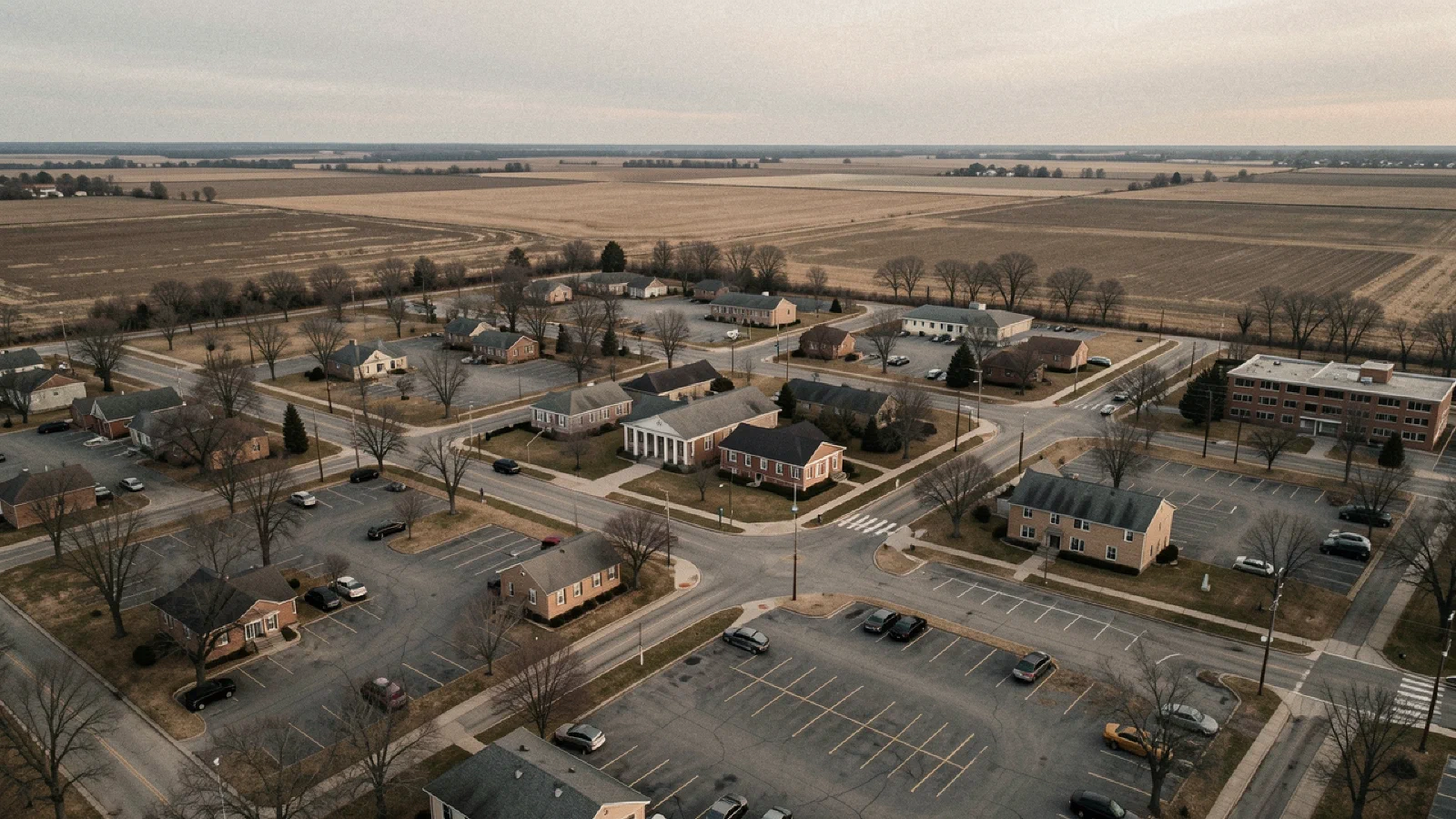
Martha runs a 25-bed Critical Access Hospital in southeastern Kentucky. The first week of February 2027 brings three meetings that, individually, each present manageable challenges. Together, they describe something else.
Monday’s board meeting reviews the January numbers. Medicaid enrollment dropped 23% in their service area since work requirements took effect January 1. The state’s reporting system crashed repeatedly during December, leaving thousands of beneficiaries uncertain whether they had documented their 80 hours. Many discovered coverage loss only when presenting for care. The hospital’s bad debt rose 34% in January. “We can absorb a few bad months,” the CFO says. But the drop reflects structural change, not temporary disruption.
Wednesday brings news from the recruitment firm. Their family medicine position has been open for 14 months. The latest candidate, a physician completing rural training in West Virginia, withdrew after her spouse could not find work in the region. The recruitment firm recommends increasing the signing bonus to $100,000 and guaranteeing minimum compensation of $350,000 for two years. The hospital cannot afford these terms, but the alternative is losing their remaining physician to the exhaustion of covering two-person work with one-person staff.
Friday’s finance committee reviews the CMS payment update. Site-neutral provisions reduced their off-campus clinic revenue 58% in January. The clinic served patients who could not travel to the main campus. Now those patients face 30-minute drives for services previously available in their community. Some will not make the trip. The committee discusses closing the clinic entirely rather than subsidizing its losses from the main campus operating budget.
Martha understands each problem individually. She has managed Medicaid revenue declines before. She has recruited physicians before. She has adjusted to payment changes before. What she has not done is manage all three while the county food bank reports 40% increased demand since SNAP changes, while the home health agency closed after losing Medicare reimbursement, and while the regional hospital 45 minutes away reduced its emergency department hours due to staffing. The problems are not additive. They interact in ways that foreclose the adaptive strategies she would use for any single one.
The board will discuss closure scenarios at next month’s meeting. Not because any single policy change forced that conversation, but because the convergence eliminated the adaptive space that made previous challenges survivable.
The Timeline of Simultaneous Arrival#
Policy changes that might have been phased over a decade instead compress into a 24-month period. The compression eliminates sequential adaptation, the process by which systems adjust to one change before confronting the next.
January 1, 2026 brought the sunset of enhanced FMAP rates that incentivized Medicaid expansion. States face sharply higher costs for maintaining expansion populations. February 1, 2026 imposed SNAP work requirements extending through age 64, with geographic waiver eliminations affecting millions in areas that previously received exemptions.
October 1, 2026 narrowed Medicaid eligibility for certain non-citizens. December 31, 2026 required six-month redeterminations for most Medicaid populations, doubling administrative burden and predictably increasing procedural disenrollment. Enhanced premium tax credits expired at the end of 2025, and without extension, exchange coverage became unaffordable for millions who might otherwise transition from Medicaid.
January 1, 2027 activated Medicaid work requirements nationwide. The CBO projects 10 million additional uninsured by 2034 as work requirements take effect. States must implement reporting systems, verify compliance, and manage the enrollment churn that experience suggests will follow. The compressed timeline means systems will be built while implementation is required, producing the administrative chaos that characterized previous work requirement attempts.
The fiscal impact compounds simultaneously rather than sequentially. The Commonwealth Fund estimates combined Medicaid and SNAP cuts will eliminate 1.03 million jobs in 2026 alone, reduce state GDPs by $113 billion, and cut state and local tax revenues by $8.8 billion. These are 2026 impacts before work requirements add additional coverage losses in 2027. The economic contraction occurs alongside the coverage contraction, meaning communities lose employment while residents lose health insurance and food assistance.
Compare this timeline to RHTP’s investment horizon. The program distributes $50 billion over five years, with implementation beginning in early 2026. Transformation planning assumed baseline conditions that policy changes will fundamentally alter. States designed transformation strategies for populations that will partially disappear, for facilities that may close, for workforces that are leaving, and for economic conditions that policy is actively destroying.
Interaction Effects: How Changes Amplify Each Other#
Individual policy changes produce first-order effects: work requirements reduce Medicaid enrollment, SNAP cuts reduce food security, site-neutral payment reduces hospital revenue, workforce shortage reduces provider availability. First-order effects are difficult but potentially manageable. Second-order interaction effects transform difficulty into impossibility.
Consider how coverage loss and safety net cuts interact. Patients losing Medicaid lose access to medications that manage chronic conditions. Patients simultaneously losing SNAP face food insecurity that worsens diabetes, hypertension, and other diet-sensitive conditions. The patient who loses both Medicaid and SNAP experiences uncontrolled chronic disease without coverage to treat it. When they present to emergency departments in crisis, they generate uncompensated care costs that destabilize facilities already weakened by payment changes. Coverage loss creates sicker patients; safety net cuts create sicker patients; together they create patients whose severity exceeds the system’s capacity to absorb.
Consider how payment changes and workforce shortage interact. Site-neutral provisions reduce revenue from services that previously cross-subsidized unprofitable operations. Hospitals facing revenue decline cannot offer competitive compensation to recruit providers. Recruitment failure increases reliance on expensive locum tenens and traveling nurses. Staffing costs rise while revenue falls, accelerating the financial deterioration that drives closure. The hospital that might have retained staff through competitive compensation cannot afford competitive compensation because payment changes eliminated the revenue that funded it.
Consider how workforce shortage and coverage loss interact. Physician shortages produce longer wait times, delayed care, and deferred treatment. Patients who lose Medicaid coverage might have used remaining coverage to establish care relationships that would persist through coverage gaps. But wait times make establishing care impossible before coverage ends. The patient cycles through coverage and un-coverage without ever achieving the stable care relationship that produces outcomes. The workforce shortage makes coverage less valuable; coverage loss makes workforce investment less sustainable.
Consider how all four interact in a single facility. A rural hospital loses 20% of Medicaid revenue from coverage erosion. It loses 15% of outpatient revenue from site-neutral payment. Its remaining physician announces retirement. The county’s unemployment rises as SNAP cuts reduce local grocery store employment. Property tax revenue declines. The hospital cannot recruit a replacement physician because it cannot offer competitive terms. It cannot offer competitive terms because revenue declined. Revenue declined because coverage eroded and payment changed. The physician shortage reduces volume, which reduces revenue further, which makes recruitment less viable.
This is not four separate problems. It is one cascading failure with four entry points.
Cascading Failures and Tipping Points#
Systems under stress exhibit nonlinear responses. Gradual pressure produces gradual adaptation until a threshold is crossed, at which point adaptation fails and collapse occurs rapidly. Understanding tipping point dynamics reveals why projections based on linear extrapolation understate convergence effects.
Hospital closure provides the clearest illustration. Chartis Group’s 2025 analysis identified 432 rural hospitals vulnerable to closure, approximately one-quarter of all rural hospitals. These facilities operate on negative margins, depend on public payer revenue, and cannot sustain additional pressure. The 182 hospitals that have closed or converted since 2010 demonstrated the pattern: declining margins for years, then sudden closure when a tipping point was reached.
The tipping point for any individual hospital reflects cumulative pressures rather than single causes. Research from Penn LDI suggests hospital closures often reflect broader community economic decline rather than health-sector-specific problems. But causation runs both ways. Hospitals both reflect and accelerate community decline. When a hospital closes, communities lose 75 to 150 jobs representing up to 10% of local employment. Unemployment increases. Residents leave to find work. Population decline reduces the patient base that sustains remaining services. The closure makes reopening economically unviable.
The closure cascade extends beyond the closed facility. Neighboring hospitals experience increased demand from patients previously served by the closed facility. UNC Sheps Center research documents how closure increases emergency department utilization at surviving facilities. If those facilities already operate at capacity, the additional volume strains resources without generating proportional revenue. The hospital that absorbs displaced patients may itself approach a tipping point that closure created.
Emergency medical services face particular stress. When hospitals close, EMS transport times increase. Research demonstrates that each additional minute of transport delay increases mortality for time-sensitive conditions. Rural EMS agencies, already operating with volunteer staff and aging equipment, absorb longer transport requirements without additional resources. The closed hospital created EMS burden that degrades response for the entire region.
Nursing homes face spillover effects documented in recent research. Rural hospitals serve as acute care resources for nursing home residents who require hospitalization. When hospitals close, nursing homes must transfer residents to more distant facilities, disrupting care relationships and increasing transport risk. The closed hospital weakens the nursing home that depended on proximity for acute care access.
The convergence creates conditions where multiple facilities approach tipping points simultaneously. If one closure triggers cascading effects on neighboring facilities, multiple facilities approaching tipping points together could trigger regional collapse rather than isolated closure.
Geographic Concentration of Vulnerability#
Policy changes do not distribute randomly across geography. Vulnerability concentrates in regions that share characteristics: non-expansion status, high Medicaid dependence, weak economic bases, existing provider shortage, and historical underinvestment. The convergence will hit hardest in places already most disadvantaged.
The Chartis analysis reveals state-level concentration. Arkansas leads with 50% of rural hospitals vulnerable to closure. Mississippi follows at 49%, Kansas at 47%, Tennessee at 44%. Georgia, Missouri, and Oklahoma each show 34% vulnerability. These states share characteristics beyond hospital finances: non-expansion status (except Arkansas’s partial expansion), high rural poverty rates, existing physician shortage, and limited state fiscal capacity to offset federal cuts.
County-level analysis sharpens the geographic pattern. Counties in the Mississippi Delta, the Black Belt, Appalachian coal regions, and the Texas-Mexico border concentrate multiple vulnerabilities. These counties have higher baseline uninsured rates that work requirements will worsen. They have higher SNAP participation that cuts will affect. They have older physician populations approaching retirement. They have facilities already operating on negative margins. The maps of hospital vulnerability, coverage exposure, safety net dependence, and workforce shortage largely overlay each other.
This geographic concentration contradicts RHTP’s allocation formula, which distributes funds based on rural population rather than vulnerability. Article 2A documented the “scale penalty” through which large rural states receive dramatically less per rural resident than small rural states. Rhode Island receives $6,305 per rural resident; Texas receives $65. But vulnerability does not follow the same distribution. States receiving the least RHTP funding per capita include those facing the greatest convergence pressure.
Regional health systems that cross state boundaries face coordination challenges as different states implement different responses to federal changes. The Delta spans Mississippi, Arkansas, Louisiana, and Tennessee. Each state implements Medicaid work requirements differently, operates distinct SNAP reporting systems, and pursues different RHTP strategies. A regional health crisis does not respect state boundaries, but policy responses fragment along them.
What Transformation Can and Cannot Accomplish#
RHTP investments address real problems through evidence-supported approaches. Workforce development, telehealth expansion, care coordination, and community health worker programs can improve outcomes in communities that receive them. The question is not whether these investments help but whether they can offset the damage that convergent policy changes inflict.
Transformation cannot replace coverage. A community health worker can screen for food insecurity and connect patients to resources. But if SNAP work requirements removed food assistance, connection achieves nothing. A care coordinator can ensure Medicaid patients receive preventive services. But if work requirements removed Medicaid coverage, there are no services to coordinate. RHTP builds systems to serve patients whom other policies simultaneously remove from those systems.
Transformation cannot prevent closures that payment inadequacy causes. RHTP can fund facility improvements, technology adoption, and efficiency investments. These may extend facility survival. They cannot make negative-margin operations sustainable when payment rates do not cover costs. The hospital that receives RHTP investment for telehealth infrastructure may close before implementing that infrastructure if Medicare payment changes accelerate its financial trajectory.
Transformation cannot reverse workforce exodus that structural conditions drive. RHTP can fund loan repayment, residency slots, and recruitment incentives. These may attract providers temporarily. They do not change the practice conditions that cause retention failure. The physician recruited through RHTP-funded incentives will face the same coverage erosion, payment inadequacy, and professional isolation that caused previous physicians to leave.
Transformation can do some things convergence makes more valuable. When hospital-based services disappear, community-based alternatives become essential. RHTP investments in community health centers, mobile health units, and telehealth networks provide care in settings that do not depend on facility survival. When coverage erodes, safety-net providers serving uninsured populations become the only access points remaining. RHTP investments that strengthen sliding-fee-scale capacity address populations that convergent policies create.
States that adjust transformation strategy to convergence reality may produce better outcomes than states that pretend convergence will not occur. This means prioritizing sustainability over expansion, preservation over innovation, and resilience over optimization.
Alternative Perspectives and Assessment#
Defenders of current policy trajectories offer several arguments.
Phasing allows adaptation. Policy changes implement over multiple years, giving systems time to adjust. This argument has partial validity. But the 24-month compression described above provides less phasing than adaptation requires. Hospitals that need five years to restructure have 18 months. Workforce pipelines that require a decade to produce providers confront immediate shortages. Phasing slows arrival but does not provide adaptation time sufficient for the adaptation required.
States and providers will find solutions. Adaptive capacity has produced survival through previous challenges. This argument underestimates the difference between single-stressor adaptation and multi-stressor convergence. A hospital might adapt to payment changes by expanding volume. But volume expansion requires patients who have coverage, providers to see them, and economic conditions that keep population stable. The adaptation to one change depends on conditions that other changes eliminate.
Worst-case scenarios rarely materialize. Projections of catastrophic outcomes often prove exaggerated. This argument ignores that localized catastrophes occur routinely even when national averages remain stable. The 182 rural hospitals that closed since 2010 represented catastrophe for the communities they served. The 432 hospitals currently vulnerable suggest additional localized catastrophes regardless of national-level outcomes. National averages averaging local catastrophes with local stability provide false reassurance to communities experiencing the catastrophes.
Resilience should not be underestimated. Rural communities have survived worse. This argument romanticizes survival that came at immense cost. Appalachian communities survived coal industry collapse. Delta communities survived agricultural mechanization. The survival involved population decline, persistent poverty, deteriorating health outcomes, and infrastructure abandonment. Survival differs from acceptable outcomes.
The honest assessment recognizes genuine uncertainty alongside clear trajectories. Policy changes may be modified. Implementation may be softer than law requires. But planning based on favorable assumptions ignores risk that planning should address. The question is not whether convergence will be as bad as projections suggest but whether transformation planning accounts for scenarios where convergence is severe.
Conclusion#
Convergent policy changes produce effects that exceed the sum of individual impacts. Coverage erosion, safety net destruction, payment inadequacy, and workforce collapse interact through feedback mechanisms that amplify each change’s damage while constraining adaptive responses to all of them. The timeline compresses changes into a period too short for sequential adaptation. Geographic concentration targets regions already most disadvantaged. Tipping point dynamics mean gradual pressure can produce sudden collapse.
RHTP’s $50 billion cannot offset these effects. The investment can improve outcomes within convergence constraints. It cannot eliminate those constraints. States that design transformation for favorable scenarios will watch those scenarios fail to materialize. States that design transformation for convergence reality may produce marginally better outcomes in circumstances that degrade regardless of what transformation achieves.
The synthesis that follows this article asks whether rural health can survive the policy earthquake. The answer requires integrating what the five domain articles reveal: coverage erosion creates uninsured populations transformation cannot serve, safety net cuts worsen determinants transformation cannot address, payment changes close facilities transformation cannot preserve, workforce exodus removes providers transformation cannot replace. The convergence article demonstrates that these effects compound rather than merely aggregate. Survival may not be the right frame. The question may be what form of managed decline produces least harm for communities that policy has decided to abandon.
How this article connects to others in Blue Gray Matters.
Sources cited in this article.
- Center for American Progress. "The Truth About the One Big Beautiful Bill Act's Cuts to Medicaid and Medicare." CAP, 5 Aug. 2025, www.americanprogress.org/article/the-truth-about-the-one-big-beautiful-bill-acts-cuts-to-medicaid-and-medicare/.
- Chartis Group. "2025 Rural Health State of the State." Chartis, 10 Feb. 2025, www.chartis.com/insights/2025-rural-health-state-state.
- Coates, Alison, et al. "The Impact of Rural Hospital Closures and Mergers on Health System Ecologies: A Scoping Review." Journal of Rural Health, 2025, journals.sagepub.com/doi/10.1177/10775587251355671.
- Commonwealth Fund. "Federal Cuts to Medicaid Could End Medicaid Expansion and Affect Hospitals in Nearly Every State." Commonwealth Fund, 22 May 2025, www.commonwealthfund.org/publications/issue-briefs/2025/may/federal-cuts-medicaid-could-end-medicaid-expansion-affect-hospitals.
- Ku, Leighton, et al. "How Potential Federal Cuts to Medicaid and SNAP Could Trigger the Loss of a Million-Plus Jobs, Reduced Economic Activity, and Less State Revenue." Commonwealth Fund, 25 Mar. 2025, www.commonwealthfund.org/publications/issue-briefs/2025/mar/how-cuts-medicaid-snap-could-trigger-job-loss-state-revenue.
- Medicare Rights Center. "Rural Health Fund Awards Cannot Compensate for Enormous Medicaid Cuts." Medicare Rights, 8 Jan. 2026, www.medicarerights.org/medicare-watch/2026/01/08/rural-health-fund-awards-cannot-compensate-for-enormous-medicaid-cuts-that-threaten-home-care.
- Penn LDI. "Economic Impact of Rural Hospital Closures." Leonard Davis Institute, 22 Aug. 2025, ldi.upenn.edu/our-work/research-updates/economic-impact-of-rural-hospital-closures/.
- RUPRI Center for Rural Health Policy Analysis. "Impact of Hospital Closure on Rural Communities: A Qualitative Study." RUPRI, May 2025, rupri.public-health.uiowa.edu/publications/policypapers/Rural%20Hospital%20Closures.pdf.
- Shepherd, Michael. "What Proposed Medicaid Cuts Could Mean for Rural Communities, Hospital Access." University of Michigan School of Public Health, 5 Jun. 2025, sph.umich.edu/news/2025posts/what-proposed-medicaid-cuts-could-mean-for-rural-communities-hospital-access.html.
- UNC Sheps Center. "Rural Hospital Closures." Cecil G. Sheps Center for Health Services Research, 2025, www.shepscenter.unc.edu/programs-projects/rural-health/rural-hospital-closures/.