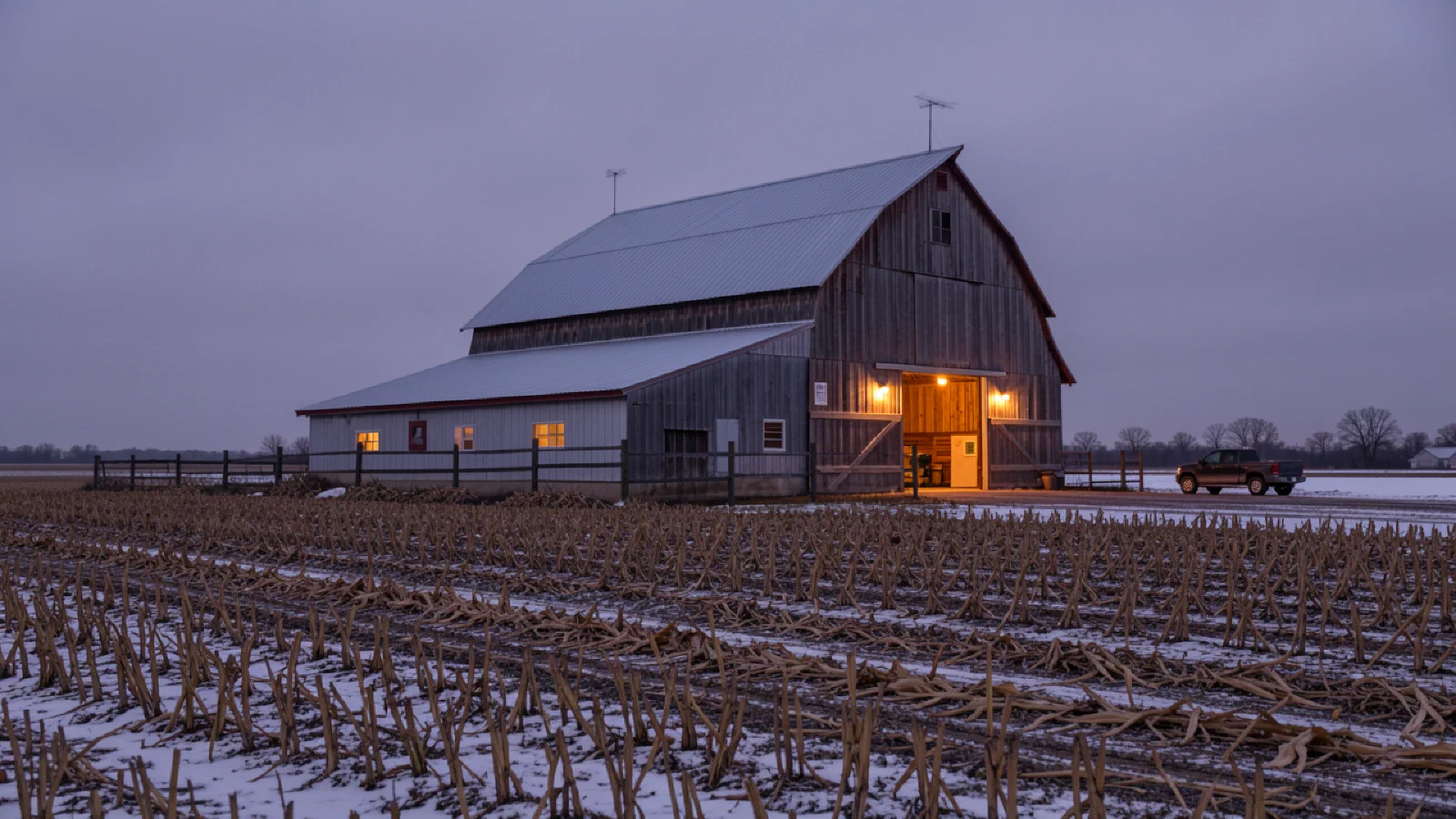
The Upper Midwest
Manufacturing Decline and Agricultural Aging
The Upper Midwest presents a study in parallel decline: manufacturing towns that lost their factories and farming communities that lost their young people aging together toward an uncertain future. The region that once produced both America’s milk and its machinery now produces primarily nostalgia and anxiety about what comes next.
Wisconsin, Minnesota, Michigan, and northern Iowa share landscapes of dairy farms and former factory towns, Scandinavian and German heritage, cooperative traditions that once supported community institutions, and demographic trajectories that suggest many communities may not survive another generation. The average dairy farmer is 58 years old. The average rural family physician is not much younger. Both occupations struggle to find successors.
The core analytical tension for the Upper Midwest is whether RHTP should concentrate resources in areas experiencing the worst manufacturing decline or distribute them across the broader agricultural region facing demographic collapse. Manufacturing towns in crisis need immediate intervention. Agricultural communities aging toward extinction need long-term transition support. Resources cannot fully serve both.
Regional Definition#
The Upper Midwest encompasses the dairy and manufacturing belt stretching from eastern Minnesota through Wisconsin and Michigan’s Upper and Lower Peninsulas into northern Iowa.
| State | Region Included | Rural Population | Character |
|---|---|---|---|
| Wisconsin | Northern and western rural counties | 2.14 million | Dairy, manufacturing, tourism |
| Minnesota | Southern agricultural, Iron Range | 1.1 million | Dairy, grain, mining legacy |
| Michigan | Upper Peninsula, northern Lower | 1.67 million | Manufacturing decline, tourism |
| Iowa | Northern tier counties | 400,000 | Dairy, grain, transition zone |
| Regional Total | ~180 counties | 5.3 million | Agricultural and post-industrial |
The Dual Challenge
What makes the Upper Midwest analytically distinct is the intersection of agricultural aging and manufacturing decline in overlapping geography. Manufacturing communities in Wisconsin’s Fox Valley, Michigan’s northern Lower Peninsula, and Minnesota’s Iron Range experienced factory closures that eliminated middle-class employment. Agricultural communities face different crisis: average farmers approaching 60, young people leaving for urban opportunity, and dairy economics making farm succession increasingly difficult. Many communities experience both crises simultaneously: the paper mill that closed in 2008 and the surrounding dairy farms whose operators will retire by 2030.
Cooperative traditions created distinctive institutional infrastructure that persists: dairy cooperatives, rural electric cooperatives, credit unions, and church-centered social life. These institutions provide foundation for transformation that other regions lack but also create expectations for services that declining populations cannot sustain.
Historical Context#
The Upper Midwest’s agricultural economy developed around dairy production suited to the region’s climate. Family farms of 80 to 200 acres created dense rural populations supporting small towns every ten to fifteen miles. The dairy economy built the infrastructure that declining dairy economics now threatens.
Farm consolidation began in the 1970s and accelerated through subsequent decades. Modern dairy operations require 500 or more cows to achieve economic viability. Young people leave because the farm cannot support them; farms consolidate because young people leave.
Manufacturing provided middle-class employment for workers who did not inherit farms. Beginning in the 1980s, Upper Midwest manufacturing collapsed. Automation reduced labor requirements. Competition from lower-cost regions closed plants. The paper industry exemplifies the pattern: Wisconsin was once the nation’s leading paper producer. Most mills have closed.
Today’s Upper Midwest faces agricultural and manufacturing crises simultaneously. The paper mill closed fifteen years ago. The dairy farmer will retire in five years. The communities were built for an economy that no longer exists.
Current Conditions#
Demographics#
Manufacturing-Affected Communities
| County | State | Population | 10-Year Trend | Median Age | Key Employer Loss |
|---|---|---|---|---|---|
| Marinette | WI | 40,000 | -6% | 48 | Paper mills |
| Iron | MI | 11,000 | -12% | 52 | Mining, paper |
| Menominee | MI | 22,000 | -8% | 49 | Manufacturing |
| St. Louis | MN | 200,000 | -3% | 43 | Iron Range mining |
| Delta | MI | 35,000 | -7% | Paper, manufacturing |
Agricultural Communities
| County | State | Population | 10-Year Trend | Median Age | Agricultural Character |
|---|---|---|---|---|---|
| Taylor | WI | 20,000 | -2% | 44 | Dairy |
| Clark | WI | 34,000 | -1% | 42 | Dairy |
| Fillmore | MN | 21,000 | -3% | 44 | Dairy, Amish |
| Chickasaw | IA | 12,000 | -5% | 46 | Dairy, grain |
| Baraga | MI | 8,500 | -4% | 45 | Agriculture, tribal |
Median ages in the mid-40s to low-50s indicate communities aging toward extinction: populations where retirees outnumber working-age adults, schools close for lack of students, and healthcare demand shifts entirely toward geriatric services.
Economy: Dairy#
Wisconsin produces more milk than any state except California, but dairy economics have transformed from small-farm prosperity to large-operation survival:
| Metric | 1970 | 2000 | 2025 |
|---|---|---|---|
| Wisconsin dairy farms | 50,000 | 20,000 | 6,000 |
| Average herd size | 35 | 75 | 200 |
| Economically viable minimum | 50 | 150 | 500+ |
| Average farmer age | 42 | 52 | 58 |
The economics favor consolidation: large operations achieve efficiencies that small farms cannot match. But consolidation means fewer families, less population, and eventually fewer communities.
Healthcare Infrastructure#
| Facility Type | Wisconsin Rural | Minnesota Rural | Michigan Rural | Regional Character |
|---|---|---|---|---|
| Critical Access Hospitals | 60 | 79 | 36 | Better than national rural average |
| Rural Health Clinics | 217 | 95 | 72 | Moderate density |
| FQHCs/Sites | 280 | 90+ | 150+ | Variable coverage |
| Nursing Homes | 200+ | 150+ | 250+ | Aging infrastructure |
The Upper Midwest’s healthcare infrastructure is better developed than the Deep South or Great Plains but faces accelerating stress.
Hospital Financial Stress
| State | Hospitals at Risk | Operating Margin Trend | Recent Closures |
|---|---|---|---|
| Wisconsin | 15-20% | Declining | 3 since 2020 |
| Minnesota | 10-15% | Stable but stressed | 2 since 2020 |
| Michigan | 25-30% | Declining | 11 since 2010 |
| Iowa (northern) | 15-20% | Variable | 1 since 2020 |
Eleven rural Michigan hospitals have closed or ended inpatient services since 2010, concentrating in the Upper Peninsula and northern Lower Peninsula.
Nursing Home Crisis
The Upper Midwest faces nursing home capacity crisis as demand rises and supply contracts. Workforce shortages make staffing impossible at reimbursement rates Medicaid provides. The nursing home closures create cascading effects: hospitals cannot discharge patients to nursing homes that do not exist.
Health Outcomes#
| Measure | Upper Midwest Rural | National Rural | Gap Assessment |
|---|---|---|---|
| Life expectancy | 77.2 years | 76.8 years | Slightly better |
| Heart disease mortality | 175 per 100,000 | 180 per 100,000 | Slightly better |
| Diabetes prevalence | 9.5% | 11.8% | Better |
| Suicide rate | 18.5 per 100,000 | 17.2 per 100,000 | Worse |
| Uninsured rate | 6.5% | 12.4% | Much better |
Suicide presents the starkest disparity. Rural Upper Midwest suicide rates exceed national rural averages, with particular concentration among middle-aged men during agricultural stress periods.
Workforce#
| State | Rural Primary Care Ratio | Trend | Age Distribution |
|---|---|---|---|
| Wisconsin | 1:2,200 | Worsening | 40% over 55 |
| Minnesota | 1:1,800 | Stable | 35% over 55 |
| Michigan | 1:2,500 | Worsening | 45% over 55 |
| Iowa | 1:2,000 | Stable | 38% over 55 |
Retirement projections suggest accelerating shortages. Within ten years, 30-40% of current rural primary care physicians will likely retire.
Vignette: Vernon County, Wisconsin#
Vernon County sits in Wisconsin’s Driftless Area, where dairy farming persists alongside growing Amish communities. Viroqua has reinvented itself as an organic food hub. But outside Viroqua, the old patterns hold.
Dr. James Olson has practiced family medicine in Westby for 38 years. His patient panel is largely Norwegian-American descendants of families who settled these hills in the 1870s.
“I’m 66,” Dr. Olson said. “I should retire. My wife wants to move closer to our grandchildren in Madison. But if I leave, there’s no one. We’ve been recruiting for five years. Three candidates came to look. None stayed. They see the winters, the isolation, the patient population that’s older than they want to serve.”
“My patients ask what happens when I retire. I tell them Gundersen Health in La Crosse will keep a presence here somehow. But it won’t be the same. I know these people. I delivered their children. Now I’m managing their parents’ deaths. That kind of practice dies with my generation.”
The Core Tension: Concentration vs. Distribution#
The Case for Concentration in Manufacturing Communities
Manufacturing decline communities face immediate crisis: hospital closures are imminent, economic trauma compounds health effects, and intervention windows are narrow. Concentration demonstrates impact that justifies continued investment.
The Case for Distribution Across Agricultural Communities
Agricultural communities face slower but equally terminal decline. More people need help. Prevention costs less than crisis response. Political sustainability requires broad benefit.
The Honest Assessment
The Upper Midwest may require hybrid strategy that concentrates emergency response resources in communities facing immediate hospital closure while distributing transformation resources across the broader region, and accepts that some communities cannot be sustained regardless of investment.
RHTP in This Region#
| State | FY2026 Award | Per Capita Rural | Application Focus |
|---|---|---|---|
| Wisconsin | $203.7 million | $95 | Workforce, technology, networks |
| Minnesota | $205.2 million | $186 | Integrated care, EMS |
| Michigan | $173.1 million | $104 | Hospital stabilization, telehealth |
| Iowa | $208.6 million | $208 | Workforce, rural hospitals |
Wisconsin’s RHTP application emphasizes “the right providers, empowered by the right technology, and supported by the right networks.” Minnesota’s application focuses on integrated care delivery and EMS system strengthening. Michigan’s application confronts the state’s severe hospital financial crisis directly, prioritizing hospital stabilization. Iowa’s application emphasizes workforce and hospital support.
What RHTP Misses#
Differentiated strategy for manufacturing versus agricultural communities does not exist. Nursing home crisis receives limited attention. Geriatric care systems are not prioritized despite the nation’s oldest rural populations. Agricultural mental health receives inadequate investment despite documented crisis.
Vignette: Iron Mountain, Michigan#
Iron Mountain sits in Michigan’s Upper Peninsula, a former mining center that reinvented itself around paper manufacturing when the mines closed. Now the paper industry has largely departed.
Dickinson County Healthcare System operates the region’s hospital. The hospital is the largest employer in the county. If it fails, Iron Mountain has no obvious future.
“We’re operating at a loss,” said the hospital’s CFO. “We’ve operated at a loss for three of the past five years. Medicare reimbursement doesn’t cover costs. Our patient population is old and on Medicare.”
“RHTP gives us breathing room. But five years from now, when the funding ends, we’ll be back where we started unless something changes about healthcare economics in rural America.”
A nurse with 25 years at the hospital described the staffing crisis: “My children won’t be here. There’s nothing for them. And when my generation retires, I don’t know who takes care of the people who are left.”
Alternative Perspective Assessment#
The Current Generation View#
People living in declining communities deserve healthcare now, whatever happens later. Current residents are not abstractions. Projections may be wrong. Healthcare creates economic anchor. Moral obligation transcends efficiency.
Assessment: The current generation view is morally compelling but practically constrained. Resources are finite. Some communities cannot be sustained regardless of investment. Serve current populations, but accept that service levels cannot be maintained everywhere.
The Managed Decline Perspective#
From this perspective, transformation resources should flow to communities with viable futures. Communities facing demographic extinction should receive support for managed decline rather than transformation investment.
Assessment: The managed decline perspective is analytically coherent but politically and ethically fraught. Identifying terminal communities is difficult. People do not want to leave home. The perspective can become self-fulfilling. Political feasibility is nil. The perspective contains truth that policymakers cannot say publicly.
Regional Strengths#
Cooperative Infrastructure: Dairy cooperatives, rural electric cooperatives, credit unions, and healthcare cooperatives provide organizational capacity other rural regions lack.
Health System Networks: Gundersen Health System, Essentia Health, and Marshfield Clinic Health System provide organizational scaffolding for RHTP implementation.
Educational Institutions: University of Wisconsin, University of Minnesota, and regional universities provide training pipeline other rural regions cannot match.
Community Social Capital: Church congregations, civic organizations, and volunteer infrastructure provide capacity for transformation that money cannot create.
Transformation Assessment#
What Transformation Can Achieve#
Hospital stabilization preventing additional closures. Incremental workforce improvement through intensified recruitment and training expansion. Telehealth normalization extending specialist access. Geriatric care pilots demonstrating comprehensive approaches. Agricultural mental health infrastructure creating programs that persist beyond federal investment.
What Transformation Cannot Achieve#
Reversal of demographic decline. Healthcare transformation cannot make young people stay. Manufacturing economy restoration. Healthcare investment does not bring back paper mills. Nursing home crisis resolution. RHTP focuses on hospitals and primary care. Long-term sustainability in all communities. Some communities will not sustain healthcare infrastructure beyond 2030. Young workforce recruitment at scale. Financial incentives cannot make rural practice attractive to providers who prefer other settings.
Vignette: What Transformation Could Look Like#
The Upper Midwest Rural Health Network, if it existed, might work like this:
Wisconsin, Minnesota, Michigan, and Iowa establish a four-state network coordinating rural health transformation through existing health systems that already span state lines.
Geriatric care teams deploy throughout the region. Agricultural mental health integrates with extension services at land-grant universities. Workforce development concentrates on grow-your-own programs. Nursing home stabilization receives dedicated funding.
Five years in, hospital closures have stopped. Workforce decline has slowed. Communities are still aging, still declining, but services persist that would otherwise have collapsed.
This network does not exist. It illustrates what coordinated transformation could accomplish.
Recommendations#
Wisconsin should leverage its cooperative infrastructure to deploy transformation through existing frameworks. Minnesota should address the Iron Range separately from agricultural southern Minnesota. Michigan should prioritize Upper Peninsula and northern Lower Peninsula facilities at greatest closure risk. Iowa should coordinate with Minnesota and Wisconsin for communities in natural healthcare markets.
Multi-State Coordination: The four states should establish coordination mechanisms enabling joint workforce recruitment, coordinated telehealth, shared training programs, and network formalization.
CMS should allow multi-state RHTP applications, require state plans to address geriatric care systematically, support agricultural mental health integration, and permit nursing home investment within RHTP.
How this article connects to others in Blue Gray Matters.
Sources cited in this article.
- Centers for Medicare and Medicaid Services. "CMS Announces $50 Billion in Awards to Strengthen Rural Health in All 50 States." *CMS Newsroom*, 29 Dec. 2025.
- Iowa Department of Public Health. "Iowa Rural Health Assessment." *IDPH*, 2024.
- Michigan Department of Health and Human Services. "Rural Health in Michigan: Status Report." *MDHHS*, 2024.
- Michigan Health and Hospital Association. "Rural Hospital Financial Analysis." *MHA*, 2024.
- Minnesota Department of Health. "Rural Health Profile." *MDH*, 2024.
- National Farmers Union. "Farm and Ranch Stress and Suicide." *NFU*, 2024.
- Ricketts, Thomas C. "The Changing Nature of Rural Health Care." *Annual Review of Public Health*, vol. 21, 2000, pp. 639-657.
- U.S. Census Bureau. "American Community Survey 5-Year Estimates: Wisconsin, Minnesota, Michigan, Iowa." *Census.gov*, 2023.
- U.S. Department of Agriculture. "Dairy Operations by State." *USDA NASS*, 2024.
- U.S. Department of Agriculture Economic Research Service. "Rural America at a Glance." *USDA ERS*, 2024.
- Wisconsin Department of Health Services. "Harnessing Innovation and Strengthening Partnerships: Building a Healthier Future for Rural Wisconsin." *DHS RHTP Application*, Nov. 2025.
- Wisconsin Office of Rural Health. "Wisconsin Rural Health Profile." *WORH*, 2024.