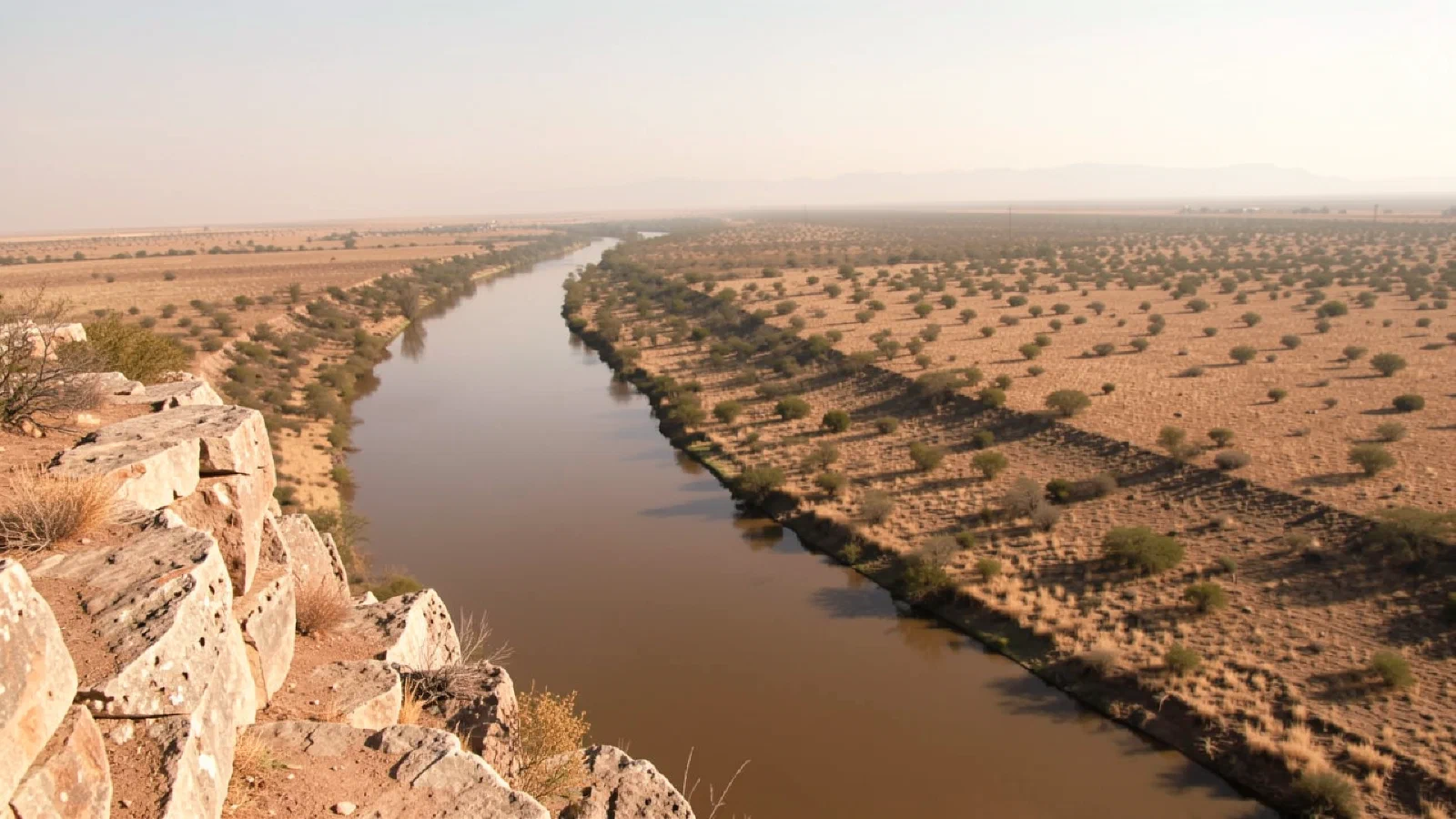
The Texas-Mexico Border and Colonias
Binational Reality, Domestic Policy: When Boundaries Cannot Contain Health
The Rio Grande flows 1,254 miles along the Texas-Mexico border, a boundary created in 1848 that divided one region into two nations. For residents on both sides, the border is daily reality and legal fiction simultaneously. Families span the boundary. Economic activity crosses it. Disease ignores it entirely. But healthcare policy stops at the river.
Texas RHTP addresses only the American side of a binational region. The 400,000 Texans living in colonias, unincorporated settlements without running water, sewage systems, or paved roads, exist in conditions more commonly associated with developing nations. Their health challenges include infectious diseases that cross borders, environmental hazards that ignore boundaries, and economic circumstances that force healthcare choices between two incompatible systems.
The core tension this article examines is state administration versus regional reality. RHTP is U.S. domestic policy administered by one state. The border region is binational, with health challenges, population movement, and economic integration that cross national boundaries. Can state-administered domestic transformation address binational regional reality?
This is not abstract governance theory. Tuberculosis does not stop at the border. Hepatitis B carriers cross bridges daily for work. Respiratory illness from maquiladora emissions affects Texas residents. Transformation limited to the U.S. side addresses half a problem whose other half remains untouched.
What analytical value does this article add? It examines the limits of domestic policy facing transnational challenges. Border health reveals what healthcare transformation can achieve within political boundaries and what it cannot achieve when health challenges cross boundaries that policy cannot.
Regional Definition#
Geographic Boundaries#
The Texas-Mexico border region encompasses approximately 32 Texas counties within 100 miles of the Rio Grande, stretching from El Paso in the west to Brownsville at the Gulf of Mexico. The region includes major urban centers, agricultural areas, and vast rural stretches with sparse population.
Border Region Geography:
| Segment | Major Cities | Population (Texas side) | Character |
|---|---|---|---|
| Far West | El Paso | 870,000 | Urban, manufacturing |
| Big Bend | Presidio, Alpine | 25,000 | Extremely sparse, ranching |
| South Texas | Laredo, Eagle Pass | 350,000 | Trade, retail, agriculture |
| Lower Rio Grande | McAllen, Brownsville | 1,400,000 | Dense, agriculture, healthcare |
Total border region population: approximately 2.8 million on the Texas side, with several million more on the Mexican side in paired cities (Ciudad Juarez, Nuevo Laredo, Matamoros, Reynosa).
The Colonias#
Colonias are unincorporated communities, primarily in Texas border counties, that lack basic infrastructure including potable water, adequate sewage systems, paved roads, and electricity. The Texas Secretary of State recognizes over 2,300 colonias housing an estimated 400,000 to 500,000 residents.
Colonia Characteristics:
| Factor | Typical Conditions | Health Implications |
|---|---|---|
| Water | Wells, trucked water, or no running water | Waterborne disease, inadequate sanitation |
| Sewage | Septic systems (often failing) or cesspools | Groundwater contamination, hepatitis |
| Roads | Unpaved, flooding during rain | Emergency access barriers |
| Electricity | Often present but unreliable | Medication storage, medical equipment |
| Housing | Self-constructed, substandard | Respiratory illness, injury hazard |
Colonias exist because of inadequate housing regulation and land sales to low-income buyers who could not afford conventional housing. Developers sold lots without infrastructure, leaving residents to build incrementally. Most colonia residents are U.S. citizens or legal permanent residents, not undocumented immigrants. They bought land believing infrastructure would follow. It has not.
Binational Integration#
The border region functions as single economic and social region divided by international boundary:
Cross-Border Dynamics:
| Domain | Binational Pattern |
|---|---|
| Employment | Maquiladora workers cross daily; professionals practice on both sides |
| Family | Families span border; grandparents, cousins, siblings on opposite sides |
| Healthcare | U.S. residents use Mexican services; Mexican residents use U.S. emergency care |
| Disease | Infectious disease ignores boundary; TB, hepatitis spread bidirectionally |
| Environment | Air pollution, water contamination cross river |
The economic integration is formal through NAFTA/USMCA trade agreements and informal through daily cross-border commerce. Twin cities function as single metropolitan areas despite national boundary: El Paso and Ciudad Juarez together exceed 2.5 million people; McAllen-Reynosa exceeds 1.5 million.
Historical Context#
Border Formation: 1848#
The Treaty of Guadalupe Hidalgo ending the Mexican-American War established the Rio Grande as boundary. The line was arbitrary relative to regional geography and population. Indigenous peoples, Spanish colonial settlements, and Mexican communities suddenly found themselves bisected by international boundary.
The border’s artificiality matters for health transformation. Communities that had existed as single region became legally separated. Family connections, economic patterns, and social organization that predated the boundary continued across it. The border created legal distinction where regional coherence remained.
Economic Development: Maquiladoras and Trade#
The Border Industrialization Program (1965) and subsequent trade agreements created maquiladora manufacturing along the Mexican side of the border. U.S. companies established factories paying Mexican wages while accessing U.S. markets. Workers commuted from Mexican border cities to factories often owned by U.S. corporations.
Maquiladora development brought:
- Employment for Mexican workers (at wages low by U.S. standards, decent by Mexican standards)
- Industrial pollution affecting both sides of the border
- Population growth in border cities straining infrastructure
- Economic interdependence making border function as single labor market
Healthcare implications include occupational exposures from manufacturing, environmental contamination from industrial emissions and waste, and population density exceeding infrastructure capacity.
Colonia Development: 1950s to Present#
Colonias emerged as unregulated housing for workers priced out of conventional markets. Low-income families, many employed in agriculture or border manufacturing, purchased lots from developers who subdivided land without installing infrastructure. Texas passed laws requiring infrastructure in new subdivisions (1989, strengthened 1995), but existing colonias were grandfathered.
The colonia population grew from an estimated 30,000 in 1990 to 400,000+ today. Growth occurred because:
- Housing costs in conventional markets increased
- Immigration brought workers who needed affordable housing
- Enforcement of subdivision regulations remained weak
- Infrastructure investment lagged far behind need
Colonia residents are predominantly U.S. citizens or legal permanent residents. The common assumption that colonias house undocumented immigrants is incorrect. These are Texans living in third-world conditions within America’s borders.
Health History: Binational Disease Patterns#
Border health has always been binational:
| Period | Health Challenge | Binational Dynamic |
|---|---|---|
| 1900s to 1940s | Typhus, cholera | Quarantine stations, border health cooperation |
| 1950s to 1980s | Tuberculosis | Binational treatment programs |
| 1990s to Present | Hepatitis A and B | Shared disease burden, uneven resources |
| 2020s | COVID-19 | Border closure, healthcare system stress |
Tuberculosis exemplifies binational health challenge. TB rates in border counties exceed Texas and national averages. Patients begin treatment in one country and continue in another. Treatment completion requires coordination across borders that healthcare systems struggle to maintain.
Current Conditions#
Demographics#
Border region population is overwhelmingly Hispanic, with majority of Texas border residents identifying as Hispanic or Latino.
Demographic Profile:
| Measure | Border Region | Texas | National |
|---|---|---|---|
| Hispanic/Latino | 85.2% | 40.2% | 18.9% |
| Poverty Rate | 26.4% | 14.2% | 11.6% |
| Median Household Income | $38,000 | $67,000 | $75,000 |
| Uninsured Rate | 23.8% | 17.3% | 8.6% |
| Limited English Proficiency | 28.4% | 13.1% | 8.2% |
The border region includes Texas’s highest poverty rates and highest uninsured rates. Non-expansion of Medicaid leaves hundreds of thousands of border residents in the coverage gap: too poor for marketplace subsidies, too “wealthy” (or childless) for Medicaid.
Colonia Conditions#
Colonias represent concentrated poverty with infrastructure deficits creating health hazards:
Infrastructure Gaps:
| Infrastructure | Colonias Status | Health Impact |
|---|---|---|
| Potable Water | 30% lack running water | Waterborne disease, dehydration |
| Sewage | 50%+ use cesspools or failing septic | Hepatitis, groundwater contamination |
| Paved Roads | Majority unpaved | Emergency access delays, dust |
| Drainage | Minimal | Flooding, standing water, mosquitoes |
| Electricity | Generally present | Medication storage challenges |
A family in a colonia outside McAllen may have no running water, relying on water trucked in weekly and stored in barrels. Their sewage drains to a cesspool that overflows during heavy rain. The unpaved road to their home floods, preventing ambulance access for hours after storms. Their children have asthma from dust and mold. The nearest clinic is 30 miles away.
Healthcare Infrastructure#
Border healthcare infrastructure includes substantial capacity in urban centers and severe shortages in rural areas:
Healthcare Facilities:
| Facility Type | Count | Distribution | Notes |
|---|---|---|---|
| Hospitals | 38 | Concentrated in cities | Several closing or at risk |
| FQHCs | 42 sites | Essential safety net | Capacity overwhelmed |
| Rural Health Clinics | 28 | Rural areas | Workforce shortages |
| Community Health Centers | 35+ | Throughout region | Primary care access |
Federally Qualified Health Centers provide essential access for uninsured and underinsured populations. Organizations like Su Clinica, Proyecto Juan Diego, and Valley Baptist Community Health Centers serve hundreds of thousands of patients annually.
Workforce shortages affect the entire region:
| Provider Type | Border Region | Texas Average | Gap |
|---|---|---|---|
| Primary Care per 100K | 42 | 68 | -38% |
| Mental Health per 100K | 48 | 102 | -53% |
| Dentists per 100K | 28 | 52 | -46% |
Health Outcomes#
Health outcomes in the border region lag state and national averages across most measures:
| Measure | Border Region | Texas | National | Source |
|---|---|---|---|---|
| Life Expectancy | 77.2 years | 78.5 years | 77.5 years | CDC |
| Infant Mortality | 5.9/1,000 | 5.4/1,000 | 5.4/1,000 | CDC |
| Diabetes Prevalence | 16.8% | 11.9% | 10.8% | BRFSS |
| Obesity Rate | 38.4% | 34.8% | 31.9% | BRFSS |
| TB Rate (per 100K) | 8.2 | 3.8 | 2.5 | CDC |
The tuberculosis rate exceeds state and national rates by factors of two to three, reflecting binational disease dynamics and healthcare access barriers. Diabetes prevalence significantly exceeds state averages, reflecting diet, genetics, and inadequate chronic disease management.
Cross-Border Healthcare Seeking#
Border residents obtain healthcare through binational patterns that RHTP cannot capture:
Healthcare Seeking Patterns:
| Pattern | Prevalence | Rationale |
|---|---|---|
| U.S. residents using Mexican pharmacies | Very common | Medications cost 50 to 90% less |
| U.S. residents using Mexican physicians | Common | Office visits cost 75% less |
| U.S. residents using Mexican dentists | Very common | Dental care costs 60 to 80% less |
| Mexican residents using U.S. emergency care | Common | Serious emergencies, then return |
| Binational families splitting care | Common | Insurance in one country, residence in other |
A U.S. citizen in Laredo with diabetes may see a primary care physician in Nuevo Laredo for $20 per visit, purchase insulin there for $30 per vial (versus $300 in the U.S.), and manage chronic disease through the Mexican healthcare system despite living in Texas. When complications require hospitalization, they use U.S. emergency services. Their healthcare is binational. RHTP sees only the emergency room visit.
A Colonia Family’s Health Journey#
The Garcia family lives in a colonia ten miles east of McAllen. The settlement has approximately 200 homes, unpaved roads, no municipal water system, and no sewage infrastructure. The Garcias have lived there for 15 years, since purchasing a quarter-acre lot for $8,000.
Roberto Garcia works at a maquiladora across the border in Reynosa. He crosses the international bridge daily, working a Mexican job while living in Texas. Maria Garcia cleans houses in McAllen three days a week. Together they earn approximately $32,000 annually. Neither has employer-sponsored health insurance. Their income exceeds Medicaid eligibility but cannot afford marketplace coverage. They are in the coverage gap.
Their home has electricity but no running water. They buy water from a truck that visits weekly, storing it in a 500-gallon tank. The septic system Roberto installed himself fails periodically, especially during heavy rain. When it fails, sewage surfaces in the yard where their children play.
Their daughter Sofia, age 8, has asthma triggered by dust from the unpaved roads and mold in their home. Her inhaler costs $80 per month at the U.S. pharmacy. Maria discovered the same medication costs $12 in Reynosa. Sofia’s asthma is managed through the Mexican healthcare system even though Sofia is a U.S. citizen living in Texas.
Their son Miguel, age 12, broke his arm falling from a tree. The family drove to the emergency room in McAllen, a 40-minute trip. The ER bill exceeded $4,000. They are paying $100 per month on a payment plan they will carry for years.
Roberto’s mother lives in Reynosa. When she had a stroke last year, she was treated in a Mexican hospital. Roberto crossed the border daily to help her, managing caregiving for his mother in Mexico while working and parenting in Texas.
What does healthcare transformation mean for the Garcias? They need affordable insurance that Texas has refused to provide through Medicaid expansion. They need colonia infrastructure that healthcare transformation cannot build. They need binational care coordination that does not exist. They need a system that sees their reality, which is binational, not just the Texas fragment that RHTP can address.
The Core Tension: State Administration vs. Binational Reality#
The State Administration View#
RHTP flows through state government addressing domestic healthcare challenges. The border region is within Texas. State administration can address Texas needs.
Proponents argue that:
Healthcare policy is domestic policy. The U.S. healthcare system serves U.S. residents within U.S. borders. What happens in Mexico is Mexico’s concern. Texas RHTP should focus on Texans in Texas receiving care from Texas providers.
State administration can target the border. Texas can prioritize border counties within its RHTP application. Regional targeting within state administration addresses border needs without requiring impossible binational coordination.
Binational health policy is unrealistic. The political barriers to binational coordination are insurmountable. Immigration politics, trade disputes, and national sovereignty make formal binational health programs impossible. Transformation must work within achievable constraints.
The Binational Reality View#
Border healthcare cannot be separated into national components. Health challenges cross borders. Population health depends on conditions in both countries.
Proponents argue that:
Disease does not respect borders. Tuberculosis, hepatitis, and emerging infectious diseases spread binationallly. Controlling disease on one side while it circulates on the other accomplishes little. Effective border health requires binational approach.
Healthcare seeking is already binational. Border residents obtain care through both systems. Transformation ignoring Mexican healthcare misses half of how residents actually obtain care. Policy should match reality.
Binational coordination exists in other domains. Trade, law enforcement, environmental protection, and emergency management have binational coordination mechanisms. Healthcare could too, with political will. Declaring binational health policy impossible surrenders before trying.
Evidence Assessment#
The evidence suggests binational health challenges are real, but binational policy coordination is extremely difficult, leaving transformation to work within suboptimal domestic constraints.
Binational health dynamics are documented:
TB demonstrates binational disease burden. Border TB rates reflect transmission across boundary. Treatment programs in one country fail when patients move to the other. Binational TB coordination has been attempted with modest success but lacks sustained investment.
Healthcare seeking is demonstrably binational. Research documents substantial cross-border healthcare use. Ignoring this misrepresents how border residents manage health.
But binational policy coordination faces enormous barriers:
Immigration politics poison binational cooperation. Any U.S. government program appearing to benefit Mexican nationals faces political attack. Binational health coordination becomes immigration debate proxy.
Healthcare systems differ fundamentally. Mexican and U.S. healthcare operate under different financing, regulation, and practice standards. Coordination requires reconciling incompatible systems.
No governance mechanism exists. Binational health coordination would require treaty-level agreement or sustained executive branch commitment. Neither has materialized despite decades of border health advocacy.
The honest conclusion: RHTP can address the Texas side of binational challenge but cannot achieve binational health policy. This limitation is real constraint, not failure of imagination. Transformation should acknowledge what it cannot do while doing what it can.
What Transformation Requires#
Colonia Infrastructure Investment#
Colonia conditions create health hazards that healthcare intervention alone cannot address. Safe water, functional sewage, and passable roads are prerequisites for health improvement.
RHTP cannot directly fund water and sewage infrastructure. But transformation should:
Coordinate with infrastructure programs: USDA Rural Development, EPA programs, and state resources address infrastructure. RHTP can ensure healthcare planning coordinates with infrastructure investment targeting the same communities.
Prioritize colonias in service deployment: New FQHC sites, mobile health services, and community health worker programs should prioritize colonia communities with worst access.
Address environmental health: Air quality monitoring, waterborne disease surveillance, and environmental health services address hazards that colonia conditions create.
Recognition of Binational Population#
Border healthcare serves population whose lives cross boundaries daily. Transformation should design for this reality:
Spanish-language services as default: Border healthcare should operate in Spanish as primary language with English accommodation, not the reverse. Signage, patient education, and provider communication should assume Spanish.
Documentation-sensitive access: Mixed-status families include citizens and non-citizens. Access design should minimize documentation barriers that prevent some family members from receiving care while others can.
Cross-border care coordination where possible: Informal coordination with Mexican providers can improve continuity for patients who use both systems. Electronic health information that patients can carry across borders enables coordination without formal binational agreement.
Environmental Health Focus#
Border environmental health challenges include industrial pollution, agricultural exposures, and infrastructure deficits:
Air quality: Maquiladora emissions, agricultural burning, and dust from unpaved roads affect respiratory health. Monitoring and mitigation should inform healthcare planning.
Water contamination: Groundwater contamination from industry, agriculture, and inadequate sewage affects both sides of the border. Testing and treatment address contaminated supply.
Vector-borne disease: Standing water from poor drainage creates mosquito breeding habitat. Dengue, Zika, and other vector-borne diseases have border presence. Surveillance and response should recognize binational dynamics.
Workforce Strategies#
Border workforce challenges require approaches acknowledging regional labor market:
Binational practice where permitted: Some physicians and nurses are licensed in both countries. Enabling binational practice expands workforce availability.
Spanish-language training: Providers serving border populations should be fluent in Spanish, not merely able to communicate through interpreters. Training programs should prioritize bilingual capacity.
Community health workers from border communities: CHWs recruited from colonia communities understand conditions patients face. Local hiring expands workforce while building community capacity.
What Transformation Cannot Achieve#
Binational Health Policy#
RHTP is domestic policy. It cannot create binational health coordination that would require international agreement:
- No U.S. healthcare program can fund Mexican services
- No Texas program can coordinate Mexican providers
- No RHTP allocation can address Mexican side of binational disease burden
This limitation is fundamental, not correctable through better program design.
Resolution of Immigration Complexity#
Border healthcare occurs within immigration policy context that RHTP cannot affect:
- Immigration enforcement creates access barriers for mixed-status families
- Fear of deportation prevents some residents from seeking care
- Documentation requirements exclude some border residents from coverage
Healthcare transformation cannot resolve immigration debates that shape access.
Colonia Infrastructure Beyond Healthcare Scope#
Colonias need water, sewage, and roads that healthcare transformation cannot provide:
- Safe drinking water is not healthcare expense
- Sewage systems are not RHTP-allowable investment
- Road construction is infrastructure, not health services
Transformation can coordinate with infrastructure programs but cannot substitute for them.
Cross-Border Care Coordination#
Meaningful coordination between U.S. and Mexican healthcare requires institutional relationships that do not exist:
- No mechanism connects U.S. and Mexican medical records
- No referral pathway sends patients appropriately between systems
- No shared protocols guide binational care
Informal coordination may improve. Formal coordination would require bilateral agreement beyond RHTP capacity.
Implications and Recommendations#
For Texas RHTP Implementation#
Texas should explicitly recognize border region within state planning:
Recommendations:
- Designate border counties as priority region with dedicated allocation
- Require Spanish-language services as condition of border investment
- Prioritize colonia communities for FQHC expansion
- Coordinate with infrastructure programs addressing colonia conditions
- Engage border health organizations (Border Health Foundation, TACHC border caucus) as implementation partners
For CMS#
Federal guidance should acknowledge border region uniqueness:
Recommendations:
- Allow flexibility for documentation-sensitive access design
- Recognize binational healthcare patterns in outcome measurement
- Enable cross-border care coordination where legally permissible
- Consider pilot programs specifically addressing colonias
For Border Health Organizations#
Border health advocates should engage RHTP strategically:
Recommendations:
- Document binational healthcare patterns to inform transformation design
- Advocate for colonia prioritization in state allocation
- Coordinate with Mexican counterparts for informal care coordination
- Monitor implementation for access barriers affecting mixed-status families
Conclusion#
The Texas-Mexico border reveals transformation’s limits at national boundaries. Health challenges cross the Rio Grande. Healthcare policy stops there. RHTP can improve access for Texas border residents but cannot address binational disease dynamics, cross-border healthcare seeking, or Mexican side conditions that affect Texas health outcomes.
Colonias represent domestic crisis requiring domestic response. Four hundred thousand Texans live without running water, adequate sewage, or basic infrastructure. Their conditions create health hazards that healthcare services alone cannot remedy. Transformation must coordinate with infrastructure investment or merely treat conditions that inadequate infrastructure perpetuates.
The border test is whether domestic transformation can meaningfully engage challenges that cross national boundaries. The honest answer is partially. Texas can improve border healthcare access, address colonia community needs, and design services for binational population. It cannot achieve binational health policy, resolve immigration complexity, or substitute for infrastructure investment.
What transformation requires is acknowledgment of both what it can and cannot do, investment proportional to need, and design recognizing binational reality even within domestic constraints. What it cannot achieve is health transformation for region whose health crosses boundaries that policy cannot.
How this article connects to others in Blue Gray Matters.
Sources cited in this article.
- Bastida, Elena, et al. "The Managed Care Experiences of Hispanics in the United States-Mexico Border Communities." *Journal of Healthcare for the Poor and Underserved*, vol. 21, no. 3, 2010, pp. 1055-1072.
- Castaneda, Heide, and Milena Andrea Melo. "Beyond the US-Mexico Border: Health Consequences of Anti-Immigration Policies." *PLOS Medicine*, vol. 16, no. 7, 2019, e1002851.
- Federal Reserve Bank of Dallas. "Texas Border Economy: A Companion to the Border Business Indicators." *El Paso Branch*, 2024, www.dallasfed.org/research/border.
- Kaiser Family Foundation. "Health Coverage and Care in the U.S.-Mexico Border Region." *KFF*, Aug. 2024, www.kff.org/racial-equity-and-health-policy/issue-brief/health-coverage-border-region.
- Mier, Nelda, et al. "Health-Related Quality of Life in a Binational Population with Diabetes at the Texas-Mexico Border." *Pan American Journal of Public Health*, vol. 23, no. 3, 2008, pp. 154-163.
- Ortega, Alexander N., et al. "Health Care Access, Use of Services, and Experiences Among Undocumented Mexicans and Other Latinos." *Archives of Internal Medicine*, vol. 167, no. 21, 2007, pp. 2354-2360.
- Rural Health Information Hub. "Texas Rural Health Resources." *Rural Health Information Hub*, 2025, www.ruralhealthinfo.org/states/texas.
- Texas Department of State Health Services. "Border Health Update 2024." *DSHS*, 2024, www.dshs.texas.gov/border-health.
- Texas Office of Border Public Health. "Colonias Health Assessment Report." *DSHS*, 2023.
- University of Texas at El Paso. "Border Region Health Disparities Research." *UTEP*, 2024, www.utep.edu/border-biomedical-research-center/.
- Ward, Peter M. *Colonias and Public Policy in Texas and Mexico: Urbanization by Stealth*. University of Texas Press, 1999.
- Warner, David C. "Access to Health Services for Immigrants in the USA: From the Great Society to the 2010 Health Reform Act and After." *Ethnic and Racial Studies*, vol. 35, no. 1, 2012, pp. 40-55.