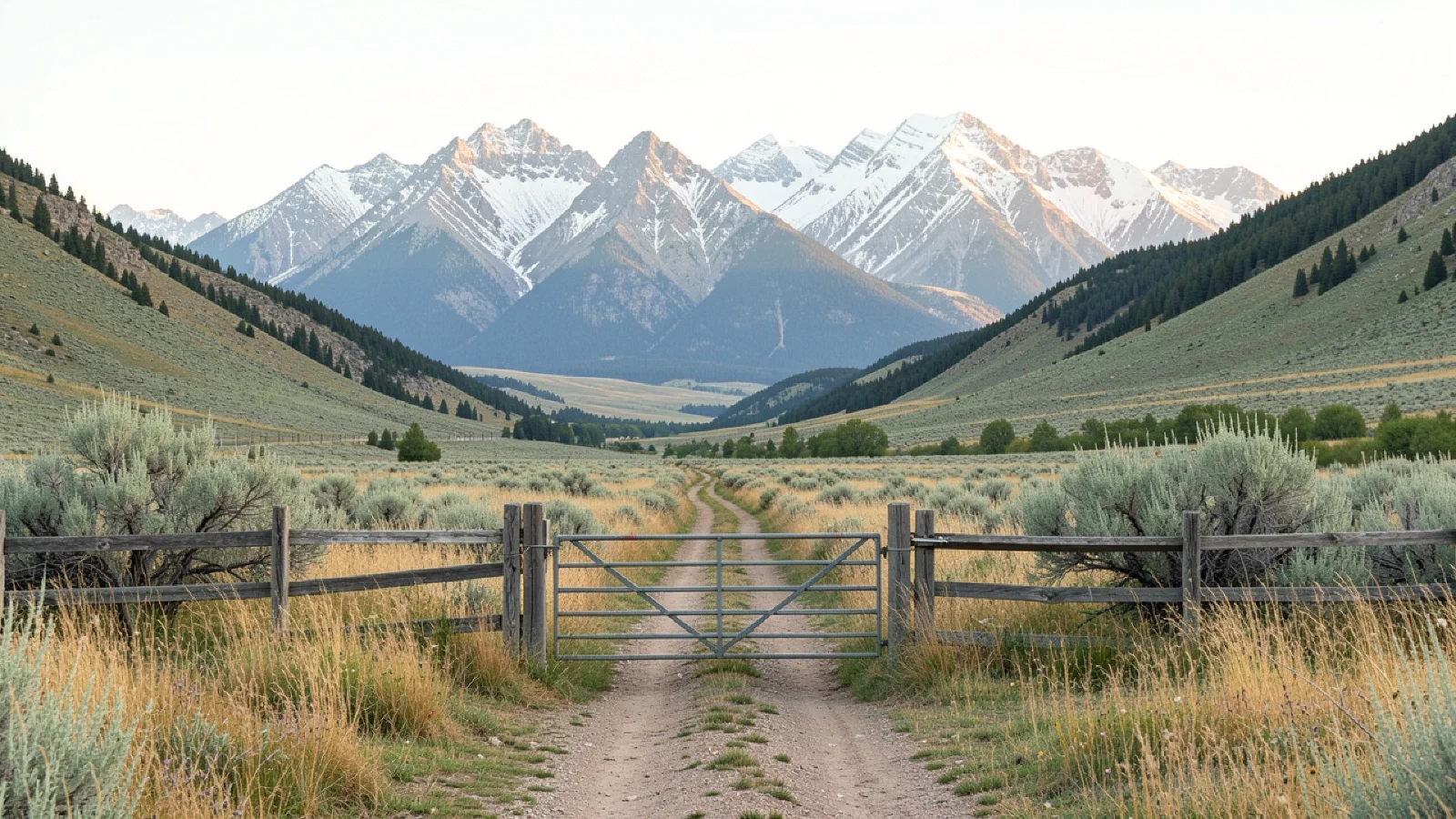
The Rocky Mountain West
Amenity Bifurcation and the Two-Region Problem
The Rocky Mountain West contains two regions masquerading as one. Ski resort communities and amenity destinations attract wealthy residents, second-home owners, and tourists whose healthcare needs are served by well-staffed facilities with modern equipment. Ranch country and former resource communities forty miles away struggle with provider shortages, aging infrastructure, and populations too sparse to support conventional healthcare. Both exist within the same mountain range, the same states, and the same RHTP programs.
This bifurcation creates a fundamental question: do these disparate sub-regions require fundamentally different transformation approaches, or can solutions developed in one context scale to the other? The amenity community that recruits providers with quality-of-life appeals cannot transfer that strategy to the ranch town where quality of life means something entirely different.
The core analytical tension for the Rocky Mountain West is whether regional specificity is necessary or whether scalable solutions can serve both wealthy and poor, growing and declining, amenity-rich and amenity-poor communities.
Regional Definition#
The Rocky Mountain West encompasses the high-elevation mountain zones of Colorado, Montana, Wyoming, and Idaho, excluding Great Plains portions.
| State | Mountain Region Counties | Population | Trend | Character |
|---|---|---|---|---|
| Colorado | 22 mountain counties | 380,000 | +12% | Mixed amenity/resource |
| Montana | 20 mountain counties | 285,000 | +8% | Ranching with resort pockets |
| Wyoming | 12 mountain counties | 125,000 | +3% | Predominantly ranching |
| Idaho | 15 mountain counties | 265,000 | +15% | Fast-growing amenity zones |
| Regional Total | 69 counties | 1.05 million | +9.5% | Bifurcated |
The Bifurcation Pattern
Amenity Communities: Summit County, Colorado (Breckenridge): median household income $98,000. Teton County, Wyoming (Jackson Hole): $98,000. Blaine County, Idaho (Sun Valley): $75,000. Gallatin County, Montana (Big Sky, Bozeman): $72,000.
Resource Communities: Park County, Montana (Livingston): $48,000. Custer County, Colorado (Westcliffe): $45,000. Sublette County, Wyoming (Pinedale): $55,000. Lemhi County, Idaho (Salmon): $42,000.
The distance between these community types is not great in miles but vast in circumstance. Teton County and Sublette County share a border; one has household incomes nearly double the other. Summit County and Park County, Colorado are separated by a mountain pass; one attracts providers effortlessly while the other cannot recruit.
Historical Context#
Mining and Extraction Origins
Leadville, Aspen, and Telluride began as mining camps. Mining towns that survived extraction developed different trajectories based on subsequent economic opportunities. Aspen’s spectacular setting attracted skiers when mining ended; Leadville’s less appealing location left it struggling. The same historical starting point led to divergent outcomes.
The Amenity Transition
Beginning in the 1970s, amenity migration transformed selected mountain communities. This migration increased population in amenity communities while resource communities stagnated, raised incomes dramatically, created demand for services including healthcare, and priced out longtime residents who could not afford housing. Geography determined destiny.
Healthcare System Development
Modern healthcare growth concentrated in amenity communities with populations and incomes to support services. Resource communities retained whatever infrastructure had survived from earlier eras. The result: amenity communities have healthcare infrastructure exceeding many urban areas, while resource communities have infrastructure inadequate for their smaller populations.
Current Conditions#
Demographics#
Amenity Community Sample
| County | State | Population | 10-Year Trend | Median Age | Median Income |
|---|---|---|---|---|---|
| Summit | CO | 31,000 | +14% | 36 | $98,000 |
| Teton | WY | 24,000 | +11% | 39 | $98,000 |
| Gallatin | MT | 120,000 | +32% | 33 | $72,000 |
Resource Community Sample
| County | State | Population | 10-Year Trend | Median Age | Median Income |
|---|---|---|---|---|---|
| Custer | CO | 5,200 | +2% | 56 | $45,000 |
| Sublette | WY | 9,200 | -3% | 44 | $55,000 |
| Lemhi | ID | 8,300 | +1% | 52 | $42,000 |
Amenity communities grow while resource communities stagnate. Amenity populations are younger because in-migrants include working-age professionals. Income disparity within the same region approaches a factor of two.
Healthcare Infrastructure#
Amenity Community Healthcare
| Facility | Location | Beds/Services |
|---|---|---|
| St. Anthony Hospital | Summit County, CO | 56 beds, Level III trauma |
| St. John’s Health | Teton County, WY | 60 beds, Level III trauma |
| Bozeman Health | Gallatin County, MT | 86 beds, regional referral |
Amenity community hospitals have capabilities exceeding many urban facilities. St. John’s Health in Jackson offers services that rural hospitals elsewhere cannot imagine.
Resource Community Healthcare
| Facility | Location | Beds/Services |
|---|---|---|
| Custer County Medical Center | Custer County, CO | 10 beds, CAH |
| Sublette County Rural Health | Sublette County, WY | Clinic only, rotating providers |
| Steele Memorial | Lemhi County, ID | 18 beds, CAH, financial stress |
Resource community facilities operate at margins of viability. Physician recruitment fails repeatedly; facilities rely on locum tenens providers who rotate without building patient relationships.
Health Outcomes#
| Measure | Amenity Communities | Resource Communities | State Averages |
|---|---|---|---|
| Life expectancy | 81.2 years | 77.4 years | 79.8 years |
| Heart disease mortality | 128 per 100,000 | 185 per 100,000 | 152 per 100,000 |
| Mental health provider ratio | 1:380 | 1:1,200+ | 1:450 |
Health outcomes mirror economic bifurcation. The gaps are substantial and persistent.
Workforce#
Amenity communities have adequate healthcare workforce relative to population. The challenge is not recruiting but housing: providers who can be recruited cannot afford to live where they work. Housing-driven commuting has emerged as a workforce pattern.
Resource communities face chronic workforce shortage. The communities lack quality-of-life features that attract providers. Providers who might accept lower pay for mountain lifestyle can obtain that lifestyle in amenity communities without sacrifice. The workforce challenge is structural, not financial.
Vignette: Fifty Miles and Two Worlds#
Dr. Sarah Chen completed her family medicine residency with a rural track and wanted to practice in the mountains. She interviewed in Jackson, Wyoming and Pinedale, Wyoming, fifty miles apart.
Jackson offered a position at St. John’s Health. Salary: $280,000. Patient panel: insured ski instructors and wealthy retirees. Housing: a $1.8 million condo.
Pinedale offered a position at Sublette County Rural Health, the only clinic for 9,000 residents spread across 10,000 square miles. Salary: $250,000 plus loan repayment. Patient panel: ranchers and elderly longtime residents. Housing: a $350,000 house.
She chose Jackson. “Pinedale’s isolation was real. My husband couldn’t find work there. If I got sick, there was no coverage.”
Sublette County eventually hired a physician from South Africa on a J-1 visa. He stayed the required three years and left for Denver.
“We can’t compete with Jackson,” said the county health officer. “We’re asking for doctors willing to accept good enough. That pool keeps shrinking.”
The Core Tension: Regional Approaches vs. Scalable Solutions#
The Case for Scalable Solutions
Common elements exist in all rural healthcare. Telehealth, community health workers, expanded scope of practice, and hub-and-spoke networks apply regardless of community type. Resource constraints require efficiency. Evidence generation requires replication.
The Case for Regional Specificity
Workforce dynamics differ completely. Amenity communities can recruit providers; resource communities cannot. Strategies that assume recruitment work in amenity communities but fail in resource communities. Economic sustainability differs. Services viable in high-income communities are not viable in lower-income communities. Cultural context differs. Amenity residents include in-migrants with cosmopolitan orientations. Resource residents include multigenerational families with traditional values.
The Honest Assessment
Some transformation elements scale: technology infrastructure, care coordination, emergency systems. Other elements require sub-region specificity: workforce strategy, service scope, financial sustainability. The optimal approach combines scalable and specific elements.
RHTP in This Region#
| State | FY2026 Award | Mountain Allocation | Bifurcation Address |
|---|---|---|---|
| Colorado | $200.1 million | Not specified | Minimal |
| Montana | $233.5 million | Not specified | Moderate |
| Wyoming | $205.0 million | Not specified | Minimal |
| Idaho | $186.0 million | Not specified | Minimal |
No state explicitly allocates resources between amenity and resource communities or addresses bifurcation analytically.
What RHTP Provides#
Workforce investment may work differently across the bifurcation. In amenity communities, it may be unnecessary because providers will locate there anyway, or insufficient because housing costs exceed what loan repayment provides. In resource communities, it may be insufficient regardless of amount.
Telehealth infrastructure is more likely to scale because technology works similarly in both settings.
What RHTP Misses#
Differentiated strategy for bifurcated region. Housing as healthcare infrastructure: in amenity communities, provider housing is the primary constraint. Transfer mechanisms between sub-regions. Formalization of hub-and-spoke relationships. Alternative staffing models for resource communities.
Vignette: The Commute That Becomes Healthcare#
Darlene Martinez works as a nurse at Bozeman Health, a 45-minute commute from her home in Livingston. She cannot afford Bozeman housing on a nurse’s salary.
“Bozeman patients have everything. Livingston patients drive to Bozeman for anything beyond basics.”
Montana’s RHTP application proposes workforce incentives for underserved areas. “An extra $10,000 a year might help. But then I’d be working in a hospital that might close if federal payments change.”
The bifurcation extracts labor from resource communities for amenity community benefit while leaving resource communities without the healthcare workforce their residents need.
Alternative Perspective Assessment#
The Scalable Solution View#
Partially valid for infrastructure and technology elements. Broadband, telehealth platforms, and information systems can scale across the bifurcation.
Less valid for workforce and service delivery. Scaling recruitment strategies to communities where recruitment cannot succeed wastes resources.
Verdict: Scale infrastructure and technology; adapt workforce and service delivery to community circumstances.
The Redistribution Critique#
The critique correctly identifies that resource availability differs across the bifurcation. Jackson has healthcare resources Pinedale lacks. However, RHTP flows through states, not within-state redistribution mechanisms. Amenity communities have distinct challenges even with resources. Political sustainability requires broad benefit.
Verdict: Prioritize resource communities but do not exclude amenity communities entirely.
Regional Strengths#
Existing Hub-and-Spoke Patterns
Informal referral networks already connect resource and amenity communities. Formalizing these networks could improve coordination without creating new structures.
Telehealth Adoption
The region has demonstrated willingness to adopt virtual care technologies.
Interstate Healthcare Markets
Referral relationships cross state lines where geography makes interstate travel shorter than intrastate travel.
Transformation Assessment#
What Transformation Requires#
Differentiated strategy acknowledging that amenity and resource communities require distinct approaches.
For amenity communities: Housing solutions enabling providers to live where they work.
For resource communities: Alternative staffing models that do not depend on physician recruitment. Advanced practice providers with expanded scope, community health workers, telehealth as primary care modality.
Hub-and-spoke formalization converting informal referral patterns into coordinated networks.
Telehealth infrastructure throughout the region.
What Transformation Can Achieve#
Stabilization of resource community infrastructure. Formalized hub-and-spoke networks. Telehealth expansion. Incremental workforce improvement in resource communities. Demonstration of differentiated approaches.
What Transformation Cannot Achieve#
Elimination of bifurcation. The economic forces creating two Rocky Mountain Wests are beyond healthcare scope. Provider recruitment in resource communities through traditional means. Healthcare equity between sub-regions. Resolution of housing constraints in amenity communities.
Vignette: What Transformation Could Look Like#
The Rocky Mountain Rural Health Network, if it existed, might work like this:
Colorado, Montana, Wyoming, and Idaho jointly establish a regional network connecting amenity-hub and resource-spoke facilities. St. John’s Health in Jackson becomes the hub for Sublette, Lincoln, and Teton counties.
Hub facilities agree to accept resource community patients at rates resource communities can sustain, with state RHTP funds covering the difference. Telehealth creates virtual staffing for spoke facilities. Transportation support helps patients travel when virtual care is insufficient.
Community health workers in resource communities connect patients to the network, help elderly patients navigate appointments, and ensure medication adherence after discharge.
Five years in, resource community emergency room utilization at hub facilities has decreased by 15%. Patient satisfaction has increased because care feels coordinated. Resource community hospitals have not closed, stabilized by network participation.
This network does not exist. It illustrates what coordinated transformation across a bifurcated region could accomplish.
Recommendations#
For State RHTP Implementation#
Colorado should explicitly distinguish between mountain communities by type. Montana should formalize the Bozeman-Livingston relationship as prototype for hub-and-spoke coordination. Wyoming should acknowledge that Teton County and Sublette County require different approaches. Idaho should leverage rapid growth in amenity communities to support resource communities.
For Multi-State Coordination#
Regional workforce recruitment acknowledging that providers serve multi-state populations. Interstate telehealth agreements reducing licensure barriers. Coordinated emergency services. Shared evaluation determining what works across the region.
For CMS#
Require state plans to address within-state variation. Allow flexibility for multi-state coordination. Recognize housing as healthcare infrastructure. Support alternative staffing model development.
For Healthcare Organizations#
Amenity community facilities should formalize relationships with resource community partners. Resource community facilities should focus on realistic service scope. Health systems spanning both sub-regions should implement differentiated strategies.
How this article connects to others in Blue Gray Matters.
Sources cited in this article.
- Beyers, William B., and Nelson, Peter B. "Contemporary Development Forces in the Nonmetropolitan West." *Journal of Rural Studies*, vol. 16, no. 4, 2000, pp. 459-474.
- Centers for Medicare and Medicaid Services. "CMS Announces $50 Billion in Awards to Strengthen Rural Health in All 50 States." *CMS Newsroom*, 29 Dec. 2025.
- Colorado Department of Public Health and Environment. "Colorado Rural Health Profile." *CDPHE*, 2024.
- Colorado Rural Health Center. "Rural Health Facilities Assessment." *CRHC*, 2024.
- Idaho Office of Rural Health and Primary Care. "Idaho Rural Health Assessment." *Idaho DHW*, 2024.
- McGranahan, David A., and Beale, Calvin L. "Understanding Rural Population Loss." *Rural America*, vol. 17, no. 4, 2002, pp. 2-11.
- Montana Department of Public Health and Human Services. "Montana Rural Health Profile." *DPHHS*, 2024.
- Montana Office of Rural Health. "Critical Access Hospital Assessment." *Montana AHEC*, 2024.
- National Rural Health Association. "About Rural Health Care." *NRHA*, 2024.
- U.S. Census Bureau. "American Community Survey 5-Year Estimates: Colorado, Montana, Wyoming, Idaho." *Census.gov*, 2023.
- U.S. Department of Agriculture Economic Research Service. "Rural-Urban Continuum Codes." *USDA ERS*, 2023.
- Wyoming Department of Health. "Wyoming Rural and Frontier Health Assessment." *WDH*, 2024.
- Wyoming Office of Rural Health. "Healthcare Workforce Report." *Wyoming ORH*, 2024.