The High Plains
Aquifer Depletion and Healthcare Sustainability
The High Plains present a transformation question no other region forces policymakers to answer: should RHTP invest in healthcare infrastructure for communities whose economic base has a known expiration date?
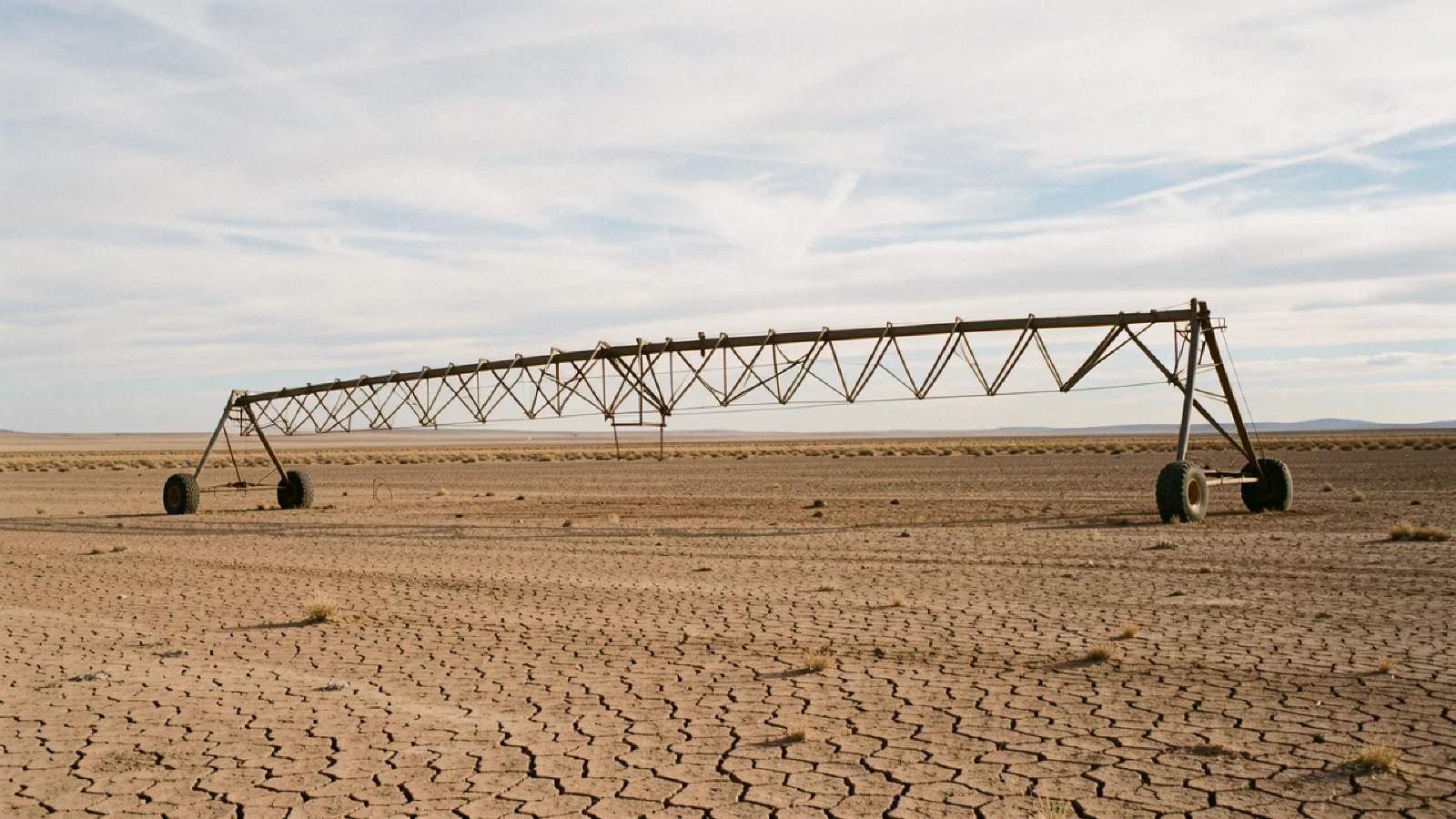
Beneath the semi-arid expanse stretching from the Texas Panhandle through western Kansas lies the Ogallala Aquifer, one of the world’s largest underground freshwater stores. Center-pivot irrigation transformed marginal grassland into agricultural powerhouse, producing 20% of the nation’s wheat, corn, cotton, and cattle. The agricultural economy built towns, hospitals, schools, and communities where rainfall alone could never sustain them.
The aquifer is depleting. Water levels in southwestern Kansas dropped more than 1.5 feet in 2024 alone, the largest annual decline in recent years. A University of Texas projection indicates that up to 70% of the Texas Panhandle will become unusable within 20 years if current pumping rates continue. Thirty percent of Kansas access points have already run dry.
RHTP runs through 2030. The aquifer crisis will intensify beyond 2030 in most areas. Should federal transformation funding invest in hospitals and workforce infrastructure for communities that may not exist in their current form by 2050? Transformation for the High Plains must acknowledge temporal limits that transformation elsewhere does not face.
The challenge is not abstract. Every Critical Access Hospital in the Texas Panhandle, every primary care practice in western Kansas, every nursing home in the Oklahoma Panhandle serves a community whose agricultural economy depends on water that is running out. Healthcare planning cannot ignore the water planning that will ultimately determine whether communities persist.
Regional Definition#
The High Plains constitute the western, semi-arid portion of the Great Plains, characterized by higher elevation, lower rainfall, and dependence on groundwater irrigation:
Texas Panhandle: 26 counties north of Lubbock with some of the most severe aquifer depletion. Amarillo serves as the regional hub, but surrounding counties face accelerating water decline.
Western Kansas: The western third of the state, including Groundwater Management Districts 1, 3, and 4. Garden City and Dodge City anchor the meatpacking industry dependent on feedlot cattle dependent on irrigated grain.
Eastern Colorado: Plains east of the Front Range, including Prowers, Baca, and Kiowa counties. Agricultural communities with limited connection to Front Range metropolitan resources.
Oklahoma Panhandle: Cimarron, Texas, and Beaver counties, among the most isolated in the continental United States. Guymon serves as the commercial center for a region with no hospitals for 100+ miles in some directions.
Eastern New Mexico: Portions of Curry, Roosevelt, and Lea counties. Clovis and Portales serve as regional centers with economies tied to both agriculture and military installations.
The Ogallala Aquifer underlies approximately 174,000 square miles across eight states. The High Plains region contains roughly 3 million people, though population has been declining for decades as agricultural consolidation accelerates.
The High Plains distinction from the broader Great Plains matters because aquifer depletion creates time-limited viability that general depopulation does not. A sparsely populated area can persist indefinitely at low density. An irrigation-dependent area without water cannot persist in any form resembling current community structure.
Population characteristics include median age above 45, population decline of 5-15% from 2010-2020, agricultural employment of 15-25%, and Hispanic/Latino population of 25-45%. The Hispanic population requires attention: agricultural labor needs attracted significant migration, and in many counties Hispanic residents now constitute a plurality facing compounded vulnerability from economic dependence on agriculture, language barriers, and immigration status concerns.
The region’s healthcare infrastructure developed to serve populations and economies that existed when water seemed unlimited. Infrastructure assumptions that made sense in 1980 do not necessarily make sense in 2025, when the temporal limits of the underlying economy have become clear.
Historical Context#
The Irrigation Transformation#
The High Plains were considered unsuitable for agriculture until center-pivot irrigation transformed the landscape after World War II. The semi-arid climate produces only 15-20 inches of annual rainfall, insufficient for most crops without supplemental water. Early settlers who attempted dryland farming largely failed, giving the region its reputation as part of the Great American Desert.
The transformation was extraordinary. Center-pivot systems drawing from the Ogallala could irrigate hundreds of acres from a single well. Semi-arid land suddenly produced crops requiring 30+ inches of water. Corn, soybeans, cotton, and wheat flourished where native grasses had barely survived. The High Plains became one of the world’s most productive agricultural regions.
Feedlots concentrated where grain was abundant. Cattle operations moved to the High Plains to access cheap, irrigated feed. Meatpacking followed feedlots. Cargill, Tyson, and JBS built processing facilities in communities like Garden City, Dodge City, and Guymon. Towns grew around processing facilities, attracting immigrant labor from Mexico, Central America, and Southeast Asia.
By 1960, 170,000 irrigation wells were drawing from the High Plains Aquifer. The region supplied an increasing share of national agricultural production. Communities that had barely survived became prosperous. Hospitals, schools, and civic infrastructure expanded to serve growing populations.
The Policy of Planned Depletion#
States understood from early decades that extraction exceeded recharge. The Ogallala is a fossil aquifer, recharged primarily during the last Ice Age. It receives less than one inch of recharge annually in most areas, while irrigation extracts feet per year. The math was always clear: the aquifer would eventually run dry.
Rather than restrict pumping, states adopted what Kansas explicitly termed a policy of planned depletion: gradually emptying the aquifer to support agriculture with full knowledge the water would eventually run out. Water in the ground produces no economic value; water pumped for irrigation produces crops, income, and communities. The policy assumed that communities would develop alternatives before water ran out, or that remaining residents would relocate.
The calculation made sense when timelines seemed distant. A 100-year depletion timeline felt like someone else’s problem. It makes less sense as Day Zero approaches. Kansas officials acknowledge some areas lack water to last another 25 years. The Texas Panhandle faces even shorter timelines in heavily pumped areas.
Accelerating Decline#
Depletion is accelerating rather than slowing. Climate change produces hotter, drier conditions increasing irrigation demand. Drought years require more pumping. Heat stress on crops requires more water per acre.
Corn production for ethanol requires more water than wheat or cotton. Federal biofuel mandates increased corn acreage, accelerating aquifer decline. Commodity prices encourage maximum production rather than conservation.
Water levels in southwest Kansas fell 1.52 feet between January 2024 and January 2025, exceeding the previous year’s decline. Some monitoring wells show declines of 5-7 feet annually. At these rates, irrigation becomes impossible within 10-15 years in the most affected areas.
Conservation programs exist but face adoption challenges. Kansas established Local Enhanced Management Areas (LEMAs) allowing voluntary pumping reductions. Participation remains limited because individual conservation merely extends availability for neighbors who continue pumping. The classic tragedy of the commons plays out aquifer by aquifer.
Current Conditions#
Healthcare Infrastructure Under Pressure#
High Plains healthcare infrastructure reflects agricultural economy prosperity that is ending. Hospitals built in prosperous decades now serve declining populations with eroding economic bases. The infrastructure was designed for communities that no longer exist in their previous form.
| State Region | Rural Hospitals | At Financial Risk | Closed (since 2010) |
|---|---|---|---|
| Texas Panhandle | 12 | 6-8 | 3 |
| Western Kansas | 18 | 10-12 | 2 |
| Oklahoma Panhandle | 3 | 2 | 1 |
| Eastern Colorado | 8 | 3-4 | 1 |
Workforce challenges compound infrastructure stress. Providers considering rural practice see declining populations and eroding economic bases. Why build a career in a community that may not exist in 20 years? Recruitment and retention difficulties affect communities where the aquifer question creates uncertainty about long-term viability.
Service line reductions precede closures. Hospitals eliminate obstetrics, surgery, and specialty services before closing entirely. Communities lose access to services years before losing the hospital itself.
Differentiated Timelines#
Different portions of the High Plains face different timelines:
Southwest Kansas: Some areas already at Day Zero for irrigation. Monitoring wells show exhaustion. Timeline for fundamental community transformation: 10-25 years.
Texas Panhandle: 70% projected unusable within 20 years at current rates. Timeline: 15-25 years for widespread impact. Some northern counties have deeper sections with longer timelines.
Northwest Kansas: Deeper aquifer sections with more remaining water. Timeline: 40-60 years at current pumping rates. Conservation could extend significantly.
Eastern New Mexico: Timeline uncertain pending infrastructure alternatives and conservation adoption.
Eastern Colorado: Variable by location. Some areas approaching exhaustion; others with deeper reserves.
These timelines matter because RHTP investment assumes infrastructure will be used. A hospital expansion completed in 2028 assumes the community will need that hospital in 2040 and beyond. In portions of the High Plains, that assumption is questionable.
Core Tensions#
Place-Based Investment vs. People-Based Support#
The place-based view holds that rural communities deserve healthcare regardless of economic projections. People live there now and need healthcare now. Abandoning communities because of uncertain timelines betrays residents who may spend their entire remaining lives there. The fifth-generation rancher deserves the same healthcare access as the urban newcomer, and his need does not diminish because aquifer levels are falling.
The people-based view recognizes that some places may not sustain healthcare infrastructure at any investment level once the economic base disappears. Supporting people’s ability to access care, including through relocation assistance, may serve them better than investing in places that cannot sustain services. If a community will not exist in 2050, building a hospital in 2025 does not serve long-term interests.
The evidence suggests both views contain truth. Current residents need current care. But infrastructure investment implicitly bets on community persistence. The honest question is whether that bet makes sense across the full High Plains or only in portions with longer timelines.
Structural Determinism vs. Agency#
The structural view holds that High Plains healthcare future is determined by aquifer levels, which are determined by geology and climate. No amount of healthcare transformation changes water supply. Communities will thrive or disappear based on water availability, and healthcare planning should accept this reality rather than pretend investment can overcome physics.
The agency view insists that communities and individuals make choices that shape outcomes. Conservation programs could extend aquifer life substantially. Economic diversification could reduce agricultural dependence. Technology could enable healthcare delivery without traditional infrastructure. Human choices, not geology alone, will determine community futures.
The evidence suggests structural constraints are real but not absolute. Technology adoption could extend aquifer life 50-100 years in some areas. Dryland farming and ranching could sustain smaller populations indefinitely. But structural limits eventually bind. The question is whether RHTP timelines align with remaining capacity in specific locations.
Current Residents vs. Future Possibility#
The present-focused view argues transformation should maximize healthcare for current residents without speculation about distant futures. Current populations have current needs. Serving those needs is transformation’s purpose.
The future-focused view argues investment should consider long-term sustainability. Stranded assets serve no one. Infrastructure that outlives communities wastes resources that could serve people elsewhere.
The evidence supports balanced approaches: serve current populations with investments matching likely timelines. This is not abandonment but prudent planning.
Alternative Perspective: The Managed Transition View#
Some observers argue that High Plains transformation should explicitly embrace managed transition rather than pretending business as usual is possible:
- Aquifer depletion is irreversible at human timescales. Recharge requires 6,000+ years.
- Agricultural transition is inevitable. Dryland farming will replace irrigation. Populations will shrink. Towns will contract or disappear.
- Healthcare transformation should support transition, not deny it: telehealth for remaining residents, support for elderly populations aging in place, assistance for those who relocate, hospice for dying communities.
- Honesty serves communities better than false hope. Pretending transformation can sustain what water cannot sustain delays necessary adaptation.
Assessment: This view has significant merit but faces practical challenges. Acknowledging that communities may not persist feels like abandonment. Federal programs cannot easily fund managed decline. Community leaders resist narratives that might accelerate decline by discouraging investment. The managed transition view is analytically sound but practically difficult to implement through RHTP structures designed for growth and sustainability, not graceful contraction.
What Transformation Requires#
Short-Term Investment with Long-Term Awareness#
RHTP investment should prioritize approaches that serve current populations without creating stranded assets:
Telehealth infrastructure serves current residents and can be repurposed if communities shrink. Unlike facility construction, telehealth equipment can relocate. Broadband investment serves communities regardless of population trajectory.
Workforce support helps providers serve current populations. Loan repayment and recruitment incentives bring providers now. When providers retire, communities can assess whether replacement makes sense given population trajectories.
Mobile health services provide care without fixed infrastructure assuming community persistence. Mobile clinics, visiting specialists, and circuit-rider models adapt to changing populations.
Community health workers provide care through people, not facilities. CHW programs can expand or contract with populations more readily than brick-and-mortar infrastructure.
Differentiated Investment by Timeline#
RHTP should differentiate between areas facing different timelines:
Areas with 10-25 year timelines: Focus on current population service, telehealth, mobile care, and transition support. Avoid major facility investment. Prioritize primary care access and chronic disease management for aging populations likely to remain.
Areas with 40-60 year timelines: More conventional transformation investment may be appropriate. Facility improvements, workforce recruitment, and service line development can reasonably assume communities will persist for infrastructure lifespans.
Areas with successful diversification: Some communities have developed tourism, renewable energy, or other economic bases independent of irrigation agriculture. These may warrant investment similar to other rural areas without aquifer dependence.
Honest Conversation#
The most important requirement may be honest conversation between state agencies, communities, and CMS:
RHTP cannot resolve aquifer depletion or guarantee community persistence. RHTP can serve current residents with healthcare access and support transition planning that helps communities prepare for different futures. Pretending otherwise serves no one.
What Transformation Cannot Achieve#
Healthcare infrastructure cannot persist where economic infrastructure collapses. If irrigation agriculture ends and nothing replaces it, towns will shrink below thresholds sustaining healthcare facilities. A hospital requires 5,000-10,000 service area population to remain viable. Communities shrinking below these thresholds cannot maintain hospitals regardless of transformation investment.
RHTP has no authority over water policy. Aquifer management falls to state water authorities and individual water rights holders. Health outcomes will ultimately be determined by water policy outcomes that RHTP does not control.
RHTP should not fund major facility construction in areas where community persistence beyond facility lifespan is questionable. A 30-year mortgage on a hospital serving a community with a 15-year economic timeline creates liability without benefit.
This does not mean abandoning current residents. It means choosing investment approaches appropriate to circumstances.
State RHTP Engagement#
Texas focuses statewide rather than regionally, with Panhandle counties competing with other rural regions for limited resources. The state’s right of capture water regime allows landowners to pump without restriction, accelerating depletion. Texas RHTP does not distinguish between rural areas with sustainable economic bases and areas facing irrigation collapse. The state could develop Panhandle-specific strategies acknowledging the region’s unique timeline constraints.
Texas Health and Human Services Commission administers RHTP through the existing Texas Center for Rural Health framework. The 26-county Panhandle region competes with the Rio Grande Valley, East Texas Piney Woods, and West Texas border regions for attention and resources. Each region has distinctive challenges, but only the Panhandle faces existential economic constraints from aquifer depletion. Texas RHTP planning would benefit from acknowledging this distinction.
Kansas has recently acknowledged the aquifer crisis more explicitly. Legislative action in 2024-2025 pushed groundwater management districts toward mandatory usage reductions, though implementation faces political resistance from agricultural interests. The state’s Care Collaborative network includes 72 of 75 rural counties with hospitals, providing coordination infrastructure that could support differentiated transformation approaches.
Kansas represents a potential model for timeline-differentiated transformation. The state’s groundwater management districts already map aquifer conditions in detail. This mapping could inform healthcare investment decisions, directing facility investment to areas with longer timelines while prioritizing flexible approaches in areas approaching exhaustion. Kansas transformation planning should explicitly link to water policy planning rather than treating healthcare and water as separate domains.
Oklahoma Panhandle contains three of the state’s most isolated counties: Cimarron, Texas, and Beaver. These counties are among the most isolated in the continental United States, with distances exceeding 100 miles to major healthcare facilities in some directions. Oklahoma’s 2023 modification of water rules to tie permits to sustainable yield signals growing awareness, though implementation remains in early stages.
Oklahoma’s RHTP application emphasizes telehealth expansion statewide but does not specifically address Panhandle aquifer constraints. The state could develop Panhandle-specific approaches acknowledging both the region’s isolation and its economic uncertainty. The Panhandle requires approaches combining frontier health strategies with aquifer-aware investment decisions.
Colorado eastern plains counties receive less attention than mountain communities and Front Range suburbs in state health planning. Colorado’s rural health policy focuses heavily on ski communities and agricultural communities in the Western Slope, leaving the eastern plains as a lower priority despite comparable healthcare access challenges.
Eastern Colorado’s aquifer situation varies by location. Some areas have deeper reserves with longer timelines; others face nearer-term constraints. Colorado RHTP could differentiate between eastern plains communities based on aquifer status rather than treating the region uniformly.
New Mexico faces aquifer constraints in eastern counties alongside different water challenges elsewhere in the state. The Rio Grande corridor and tribal lands face distinct water issues unrelated to the Ogallala. New Mexico’s RHTP engagement could acknowledge eastern plains as distinct from other rural categories, with transformation approaches acknowledging agricultural economic constraints.
Recommendations#
For States: Differentiate investment approaches based on aquifer timelines; prioritize flexible approaches over fixed infrastructure in areas with shorter timelines; support honest community conversations about futures; coordinate health planning with water policy.
For CMS: Permit regional differentiation within state plans based on sustainability projections; allow transition support as allowable expense; recognize that transformation success may look different in areas with time-limited economic bases; accept different metrics for different circumstances.
For Communities: Engage honestly with timelines rather than assuming indefinite persistence; advocate for appropriate investment matching circumstances; connect healthcare planning to economic development and transition planning; consider what healthcare residents will need during transition, not just during current conditions.
Honest Assessment#
The High Plains present the hardest transformation question: whether federal investment makes sense in places whose economic foundations are time-limited.
RHTP should serve current High Plains residents. Their need does not diminish because aquifer levels are falling. Current populations deserve current care.
RHTP should match investment to circumstances. Telehealth and flexible services make sense everywhere. Major facility construction makes sense only where community persistence can be reasonably assumed for infrastructure lifespans.
RHTP cannot pretend that all High Plains communities will persist. Transformation rhetoric promising sustainable healthcare systems ignores physical constraints that will determine community futures.
The aquifer’s depletion is healthcare policy’s outer boundary in the High Plains. RHTP operates within that boundary but cannot move it. Understanding this constraint is prerequisite for designing transformation approaches that serve current residents while acknowledging limits on what healthcare investment alone can achieve.
How this article connects to others in Blue Gray Matters.
Sources cited in this article.
- Kansas Geological Survey. "Annual Water Level Measurement Campaign." January 2025.
- Kansas Reflector. "Ogallala Aquifer Drops by More Than a Foot in Parts of Western Kansas." January 28, 2025.
- NOAA Climate.gov. "National Climate Assessment: Great Plains' Ogallala Aquifer Drying Out." Archived June 2025.
- Ogallala Water Coordinated Agriculture Project. "Ogallala Timeline." ogallalawater.org, accessed January 2026.
- Steward, D.R., et al. "Tapping Unsustainable Groundwater Stores for Agricultural Production in the High Plains Aquifer of Kansas, Projections to 2110." Proceedings of the National Academy of Sciences, 2013.
- University of Texas Bureau of Economic Geology. "Texas Panhandle Aquifer Projections." 2025.
- USDA Climate Hubs. "Impacts to the Ogallala Aquifer: How Changes in Long-term Weather Affect Agricultural Decisions." December 2024.
- Wikipedia. "Ogallala Aquifer." Last modified December 8, 2025.