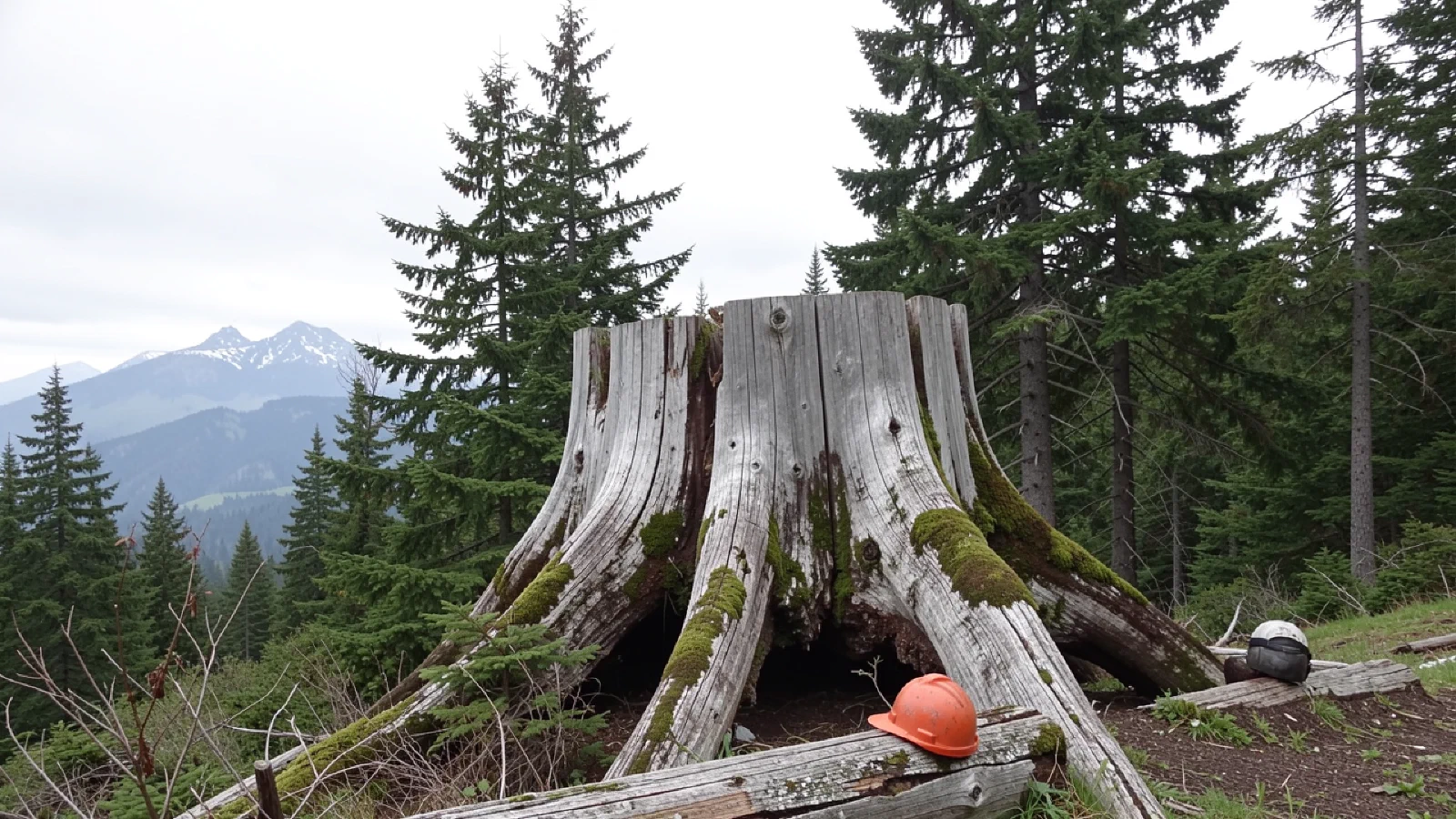
Pacific Northwest Timber Country
Collapse and Reinvention: When History Becomes Present
In 1990, the U.S. Fish and Wildlife Service listed the northern spotted owl as threatened under the Endangered Species Act. The decision restricted logging in old-growth forests across western Oregon and Washington, triggering economic collapse in communities built around timber extraction. Mills closed. Jobs disappeared. Towns that had provided middle-class livelihoods for generations watched their economic foundation vanish within years.
Thirty-five years later, these communities have not recovered. Median household incomes remain below $30,000 in many former timber towns. Methamphetamine and opioid addiction have devastated families. Healthcare infrastructure has deteriorated alongside the economy. The region that once produced lumber for the nation now produces some of America’s worst rural health outcomes.
The core tension this article examines is historical depth versus current intervention. The spotted owl decision shaped present conditions in ways that current policy cannot undo. Should transformation acknowledge and address historical causes, or focus on present conditions regardless of how they emerged? Can RHTP meaningfully engage communities whose crises began with federal policy decisions three decades ago?
This is not an academic question. Pacific Northwest timber country experienced policy-induced economic collapse. The federal government made a decision that served national environmental interests while devastating regional economies. Whether federal healthcare transformation owes something to these communities, and what form that obligation might take, shapes how transformation should proceed.
The evidence suggests that historical understanding is necessary but not sufficient for effective intervention. Communities cannot heal without acknowledgment of what happened to them. But acknowledgment without investment changes nothing. And investment without economic base replacement cannot sustain healthcare infrastructure. The timber country challenge reveals RHTP’s limits: healthcare transformation cannot substitute for economic transformation, and economic transformation requires intervention beyond healthcare scope.
Regional Definition#
Geographic Boundaries#
Pacific Northwest timber country encompasses non-metropolitan western Oregon and Washington, stretching from the coastal ranges through the Cascade foothills. The region includes former timber towns in the Coast Range, the western slopes of the Cascades, and river valleys that once floated logs to coastal mills.
Geographic Scope:
| State | Counties | Population | Primary Economy |
|---|---|---|---|
| Oregon | Coos, Curry, Douglas, Lane (rural), Josephine, Jackson (rural), Clatsop, Tillamook, Lincoln | ~450,000 | Former timber, cannabis, tourism |
| Washington | Grays Harbor, Pacific, Lewis, Cowlitz (rural), Wahkiakum, Skamania | ~200,000 | Former timber, remnant mills, service |
| Combined Region | ~20 counties/portions | ~650,000 | Diverse, distressed |
The region excludes metropolitan Portland, Seattle, and their immediate suburbs. It includes communities that depended on federal timber sales and private logging operations that employed thousands in woods work and mill operations.
Why This Constitutes a Coherent Region#
Timber country coherence derives from shared economic history, shared trauma, and shared present condition. The spotted owl decision affected communities throughout this geography simultaneously. The aftermath followed similar patterns: mill closure, population loss, poverty, substance abuse, infrastructure decline.
The region shares cultural characteristics that distinguish it from other Pacific Northwest areas. Working-class identity, resource extraction heritage, and resentment of federal environmental policy unite communities that otherwise differ in local circumstances. Residents identify as timber people even when timber employment has not existed for decades.
State-level analysis obscures timber country’s distinct challenge. Oregon RHTP addresses “rural Oregon” as a category that includes Willamette Valley agriculture, high desert ranching, and timber country. Washington RHTP similarly aggregates diverse rural contexts. Neither state specifically targets timber country as a region requiring distinct approaches.
Historical Context#
The Timber Economy: 1880 to 1990#
For more than a century, Pacific Northwest timber supported one of America’s most prosperous blue-collar economies. Old-growth Douglas fir, Sitka spruce, and western red cedar provided lumber for national construction. Mills in coastal towns and river valleys employed thousands at wages that supported middle-class families.
The industry created company town culture throughout the region. Mills provided employment. Logging camps provided housing. Company stores provided goods. Communities organized around timber extraction with schools, churches, and social institutions serving mill workers and their families.
Peak Employment Period (1970 to 1988):
| Metric | Oregon | Washington | Regional Total |
|---|---|---|---|
| Timber Industry Employment | 72,000 | 48,000 | 120,000 |
| Average Mill Wage (1988 dollars) | $32,000 | $31,000 | $31,500 |
| Percent of Rural Employment | 28% | 22% | 25% |
A high school graduate could hire into a mill, learn skills on the job, and earn enough to buy a home, support a family, and retire with a pension. The work was dangerous but steady. The pay was substantial but earned.
The Spotted Owl Decision: 1990#
The northern spotted owl requires old-growth forest habitat. By 1990, decades of logging had reduced old-growth stands to fragments insufficient for species survival. Environmental litigation demanded protection. The Fish and Wildlife Service listed the owl as threatened.
Endangered Species Act protections restricted federal timber sales that had supplied regional mills. The Northwest Forest Plan of 1994 formalized reductions, cutting annual federal timber harvest from 4.5 billion board feet to approximately 800 million. Mills dependent on federal supply closed. Mills dependent on private land supply faced reduced availability as private owners responded to changed economics.
The decision was correct environmental policy. Old-growth ecosystems required protection. Species extinction was unacceptable. The environmental movement celebrated a victory for conservation.
The decision also devastated communities. Between 1990 and 2000, Oregon lost 32,000 timber jobs. Washington lost approximately 20,000. Counties that had derived majority employment from timber watched unemployment spike to 15 to 20 percent. Mill towns became former mill towns.
The Aftermath: 1990 to Present#
The federal government acknowledged disruption through the Northwest Economic Adjustment Initiative, providing transition assistance, retraining programs, and economic development support. The programs proved inadequate. Workers in their forties and fifties could not readily retrain for new careers. Economic development in remote former timber towns attracted few alternatives.
What emerged was poverty, despair, and resentment:
| Outcome | Timeline | Regional Impact |
|---|---|---|
| Population Loss | 1990 to 2010 | 15 to 30% in hardest-hit communities |
| Median Income Decline | 1990 to 2000 | 20 to 35% in real terms |
| Methamphetamine Epidemic | 1995 to 2010 | Highest rates nationally |
| Opioid Crisis | 2010 to Present | Among highest rural rates |
| Political Resentment | 1990 to Present | Deep distrust of federal government |
The resentment persists. Residents remember who did this to them. Federal environmental policy destroyed their livelihoods. No amount of retraining or adjustment assistance replaced what was lost. Communities that voted Democratic when timber supported union jobs now vote Republican as expression of anger at perceived abandonment.
Current Conditions#
Demographics#
Timber country populations reflect decades of out-migration, aging, and economic decline. Young people leave for Portland, Seattle, or elsewhere. Those who remain are older, poorer, and sicker than state or national averages.
Current Demographics:
| Measure | Timber Country | Oregon Statewide | National Rural |
|---|---|---|---|
| Median Age | 47 years | 40 years | 41 years |
| Population Change (2010 to 2020) | -2.8% | +10.6% | -0.1% |
| Poverty Rate | 18.4% | 11.4% | 15.4% |
| Median Household Income | $42,000 | $71,000 | $52,000 |
| Uninsured Rate | 9.2% | 6.1% | 12.1% |
Oregon Medicaid expansion has improved coverage compared to non-expansion states, but uninsured rates remain elevated relative to state averages, reflecting populations with irregular employment, distrust of government programs, and difficulty navigating enrollment.
Economy#
The contemporary timber country economy combines remnant timber operations, cannabis cultivation, tourism, and poverty. No single industry has replaced timber’s role as economic anchor.
Current Economic Activity:
| Sector | Employment Share | Notes |
|---|---|---|
| Healthcare/Social Services | 22% | Largest employer, irony acknowledged |
| Retail/Service | 18% | Low-wage, part-time |
| Cannabis (Legal) | 8% | Growing but wages low |
| Tourism/Recreation | 7% | Seasonal, coastal concentration |
| Timber/Wood Products | 6% | Remnant of former dominance |
| Cannabis (Illegal) | Unknown | Significant but underground |
Cannabis legalization in Oregon (2014) and Washington (2012) created new economic activity but has not replaced timber’s economic role. Legal cannabis employs workers at low wages with few benefits. Illegal cultivation on federal lands and private property provides income for some while creating law enforcement and environmental challenges.
Healthcare Infrastructure#
Healthcare infrastructure has declined alongside economic base. Hospitals that served timber workers now struggle to serve populations without employer-sponsored coverage or stable income.
Healthcare Infrastructure:
| Facility Type | Count | Trend | Notes |
|---|---|---|---|
| Critical Access Hospitals | 12 | Declining | Financial stress throughout |
| Rural Health Clinics | 24 | Stable | Workforce shortages |
| FQHCs | 18 sites | Growing | Filling gaps |
| Independent Pharmacies | Declining | Many closed | Access problem |
Several timber country hospitals operate at negative margins with uncertain futures. Bay Area Hospital in Coos Bay serves as regional center but draws from economically distressed population. Smaller facilities in former mill towns face existential pressure.
Health Outcomes#
Health outcomes in timber country reflect economic despair, substance abuse, and healthcare access barriers:
| Measure | Timber Country | State Average | National Rural | Source |
|---|---|---|---|---|
| Life Expectancy | 75.2 years | 79.6 years | 76.8 years | CDC |
| Drug Overdose Death Rate | 28.4/100K | 18.1/100K | 22.1/100K | CDC |
| Suicide Rate | 22.6/100K | 17.8/100K | 20.1/100K | CDC |
| Diabetes Prevalence | 12.8% | 9.2% | 10.8% | BRFSS |
Deaths of despair, suicide, overdose, and alcoholic liver disease concentrate in timber country at rates exceeding both state and national rural averages. These are not random misfortunes but predictable consequences of economic collapse.
A Mill Town Thirty Years Later#
Randy Kemp graduated from Douglas High School in Roseburg, Oregon, in 1989. His father worked at the Bohemia Lumber mill. His grandfather had worked there before. Randy expected to follow.
The mill closed in 1993. Randy’s father received severance and retraining assistance. He completed a program in computer repair. No jobs existed in Roseburg. He took work at a big box store for $8 an hour. He died in 2008 from cirrhosis.
Randy worked construction through the 2000s, cash jobs without benefits. When the housing crash hit, the work disappeared. He tried logging on private lands, but the pay was poor and the work sporadic. Somewhere in there came the pills, then heroin, then methamphetamine when heroin became hard to find.
Now Randy is 53 years old. He works in a cannabis greenhouse for $15 an hour, no benefits. His wife works at the tribal casino. Together they earn $45,000 annually. He has no health insurance. His father’s death scared him about drinking. He has been clean from hard drugs for three years but cannot afford the Suboxone that helped him quit.
“The government killed this town,” Randy says. “They decided some bird mattered more than people. Then they wonder why we don’t trust them.”
Randy’s son moved to Portland. His daughter lives in Bend. Neither plans to return. The house Randy grew up in sold for $85,000 last year. A couple from San Francisco bought it as a vacation home.
What does transformation mean for Randy? He needs healthcare access. He needs addiction support. He needs economic opportunity. RHTP can help with two of these. The third remains beyond reach.
The Core Tension: Historical Depth vs. Current Intervention#
The Historical Necessity View#
The historical necessity view holds that effective intervention requires understanding historical causation. Timber country’s present crisis did not emerge randomly. Federal policy decisions created it. Communities bear consequences of choices made to serve national environmental interests.
Proponents argue that:
Acknowledgment matters. Communities cannot engage transformation designed by federal agencies when those agencies have never acknowledged what federal policy did. Trust requires recognition. Federal investment in timber country healthcare could begin healing if accompanied by acknowledgment of federal responsibility.
Historical understanding shapes intervention design. Approaches that assume neutral starting conditions misunderstand timber country reality. These communities did not decline because of market forces or demographic inevitability. They declined because federal policy destroyed their economic base. Intervention must account for this causation.
Proportional investment is owed. Communities bore costs of national environmental benefit. The nation gained preserved old-growth ecosystems. Timber workers lost livelihoods. Some redistribution of benefit is appropriate. Healthcare investment proportional to harm caused represents partial repayment.
The Current Focus View#
The current focus view holds that transformation must address present conditions regardless of historical causation. Whatever created current crisis, RHTP operates now with current resources. Historical analysis, however accurate, cannot change what happened. Focus should fall on what can be changed.
Proponents argue that:
History cannot be undone. No amount of acknowledgment returns lost jobs, heals broken families, or resurrects closed mills. Dwelling on historical causation distracts from present action. Communities need healthcare now, not apologies for decisions made thirty years ago.
Correct policy caused harm. The spotted owl decision was correct environmental policy. Old-growth ecosystems required protection. Communities affected by correct decisions deserve support, but framing as “owed” confuses the issue. The federal government does not owe compensation for correct decisions that had unintended consequences.
Universal transformation suffices. Timber country needs what other rural areas need: healthcare access, workforce, infrastructure, behavioral health services. The historical causes of current need do not change what need exists. Universal RHTP approaches can serve timber country without special historical consideration.
Evidence Assessment#
The evidence suggests both perspectives contain partial truth, with historical acknowledgment necessary but not sufficient.
Historical understanding matters for several reasons:
Trust requires acknowledgment. Research on community trauma demonstrates that affected populations cannot fully engage interventions until their experience is recognized. Timber communities exhibit classic trauma responses: distrust of authority, anger, social dysfunction. Healing begins with acknowledgment.
Intervention design improves with historical understanding. Programs that assume communities failed through their own choices produce defensive reactions. Programs that acknowledge external causation face less resistance. The difference matters for engagement.
Political dynamics reflect history. Timber country’s political realignment from Democratic to Republican reflects policy trauma. Communities that feel abandoned vote to punish those who abandoned them. Health transformation occurs within political context shaped by historical experience.
But historical focus has limits:
Current conditions require current resources. Whether or not federal policy created crisis, crisis exists now. RHTP must deploy available resources to available problems. Historical analysis cannot substitute for present action.
Proportional investment exceeds available capacity. If timber country is “owed” investment proportional to harm, the obligation vastly exceeds RHTP capacity. The spotted owl decision affected more than 100 communities across two states over three decades. No healthcare program can repair damage of that magnitude.
Economic transformation exceeds healthcare scope. Timber country’s fundamental problem is absent economic base. Healthcare transformation cannot create jobs, attract investment, or restore middle-class livelihoods. RHTP can address healthcare symptoms but cannot cure economic disease.
What Transformation Requires#
Addiction Treatment Infrastructure#
Substance use disorder treatment must anchor timber country transformation. Methamphetamine and opioid epidemics devastate these communities at rates exceeding state and national averages. Without robust treatment capacity, other healthcare investments cannot succeed.
Current treatment capacity is grossly insufficient. Residential treatment programs have multi-month waitlists. Medication-assisted treatment requires travel to larger towns. Rural providers lack buprenorphine waiver capacity. Mental health integration remains limited.
RHTP should prioritize:
- Expanding medication-assisted treatment in primary care settings
- Supporting residential treatment capacity in regional hubs
- Training rural providers in addiction medicine
- Integrating substance use and mental health services
Workforce Strategies for Reluctant Markets#
Timber country faces workforce challenges beyond general rural shortages. Providers must want to work in communities marked by poverty, addiction, and political resentment. Recruitment requires strategies acknowledging these challenges.
Effective approaches include:
- Loan repayment programs with extended service commitments
- Community integration support for incoming providers
- Partnerships with regional training programs
- Telehealth to extend specialist capacity
The workforce challenge connects to economic development. Providers will not stay in communities without amenities, schools, and social infrastructure. Healthcare transformation cannot substitute for community viability.
Acknowledgment Within Federal Framework#
Federal agencies can acknowledge historical causation without assuming legal liability or unlimited obligation. Recognition that federal policy contributed to community decline does not require compensation claims or endless investment.
Acknowledgment could include:
- Explicit recognition in RHTP guidance that timber communities face policy-induced challenges
- Prioritization of timber country communities within Oregon and Washington state plans
- Federal flexibility for approaches addressing policy-trauma contexts
- Coordination with economic development programs addressing broader needs
Economic Development Coordination#
RHTP cannot replace economic base but can coordinate with programs that address broader needs. USDA Rural Development, Economic Development Administration, and state programs target economic diversification. Healthcare transformation works better when economic context improves.
Coordination opportunities include:
- Broadband investment enabling telehealth and remote work
- Housing development improving provider recruitment
- Small business support for healthcare-adjacent enterprises
- Tourism infrastructure creating economic alternatives
What Transformation Cannot Achieve#
Economic Base Replacement#
RHTP is healthcare policy, not economic policy. Timber country needs economic diversification, job creation, and wage growth that healthcare transformation cannot provide. Communities cannot sustain healthcare infrastructure when populations lack income to support it.
The irony of healthcare as largest employer reflects economic dysfunction. Healthcare should serve communities; communities should not exist to provide healthcare employment. When the hospital is the only significant employer, the community has not recovered but merely survived.
Resolution of Environmental/Economic Tradeoff#
The spotted owl decision reflected genuine tradeoff between environmental preservation and economic activity. Old-growth ecosystems required protection. Protection destroyed livelihoods. No policy could achieve both outcomes.
RHTP cannot resolve this tradeoff or address the anger it generates. Communities may never forgive the decision. Federal healthcare investment may reduce hostility but cannot eliminate it. The wound is too deep, the loss too real.
Healing of Three-Decade Resentment#
Thirty years of decline have produced entrenched political and cultural resentment that healthcare transformation cannot cure. Communities that feel abandoned by federal government will not easily trust federal programs.
Engagement requires patience, consistency, and respect. Quick wins are unlikely. Communities will test federal commitment repeatedly. Only sustained presence over years can rebuild trust damaged over decades.
Implications for State RHTP Implementation#
Oregon#
Oregon’s RHTP application addresses rural challenges statewide without specific timber country targeting. The state should consider regional strategies that acknowledge timber country’s distinct circumstances.
Recommendations:
- Designate timber country as priority region within state plan
- Concentrate addiction treatment investment in affected counties
- Partner with regional economic development for coordinated approach
- Engage communities through acknowledgment of historical context
Washington#
Washington timber communities are smaller and less numerous than Oregon’s but face similar challenges. State RHTP should recognize these communities within broader rural strategy.
Recommendations:
- Target Grays Harbor, Pacific, and Lewis counties specifically
- Coordinate with tribal nations sharing regional challenges
- Address coast-inland service disparities
- Integrate behavioral health throughout regional approach
Conclusion#
Pacific Northwest timber country represents federal policy creating regional crisis that federal policy now attempts to address. The spotted owl decision was correct environmental policy that devastated communities. Thirty years later, those communities remain poor, sick, and angry.
RHTP can help but cannot heal. Healthcare transformation can improve access, expand treatment capacity, and strengthen infrastructure. It cannot restore economic base, repair social fabric, or resolve historical grievance.
What transformation requires is honest acknowledgment combined with sustained investment. Communities need recognition that what happened to them was real and that federal policy contributed. They also need healthcare access, addiction treatment, and workforce. Neither acknowledgment alone nor investment alone suffices.
What transformation cannot achieve is return to what was lost. The timber economy will not return. Communities built around extraction cannot simply extract something else. Some places may not survive in forms their residents remember.
The timber country test is whether RHTP can meaningfully engage communities whose crisis began with federal decisions. The answer is conditional: yes, if engagement acknowledges history while focusing on present need. If transformation pretends history does not matter, or pretends healthcare can substitute for economic development, timber country will remain beyond reach.
How this article connects to others in Blue Gray Matters.
Sources cited in this article.
- Chartis Group. "2025 Rural Health State of the State: Rural Hospital Closures and Care-Access Crisis." *Chartis*, 2025, www.chartis.com/insights/2025-rural-health-state-state.
- Daniels, Jean M., and Kyle Wendel. "Production, Prices, Employment, and Trade in Northwest Forest Industries: 1958-2019." *U.S. Department of Agriculture, Forest Service, Pacific Northwest Research Station*, 2020, www.fs.usda.gov/pnw/pnw-datasets/ppet.
- Economic Development Administration. "Pacific Northwest Mass Timber Tech Hub Consortium Application." *U.S. Department of Commerce*, 2023, www.eda.gov/sites/default/files/2023-11/Pacific_Northwest_Mass_Timber_Tech_Hub.pdf.
- Ferris, Ann, and Eyal Frank. "Labor Market Impacts of Land Protection: The Northern Spotted Owl." *Journal of Environmental Economics and Management*, vol. 107, June 2021, doi.org/10.1016/j.jeem.2021.102448.
- Freudenburg, William R., et al. "Forty Years of Spotted Owls? A Longitudinal Analysis of Logging Industry Job Losses." *Sociological Perspectives*, vol. 41, no. 1, 1998, pp. 1-26.
- Kline, Jeffrey D. "Tourism and Natural Resource Management in Rural Oregon." *U.S. Forest Service Pacific Northwest Research Station*, General Technical Report PNW-GTR-506, 2001.
- Oregon Health Authority. "Oregon's Health Care Workforce Needs Assessment 2025." *Oregon Health Authority*, Jan. 2025, www.oregon.gov/oha/HPA/HP-HCW/Documents/2025-Health-Care-Workforce-Need-Assessment-report-final.pdf.
- Oregon Office of Rural Health. "2025 Areas of Unmet Health Care Need Report." *Oregon Health and Science University*, 2025, www.ohsu.edu/oregon-office-of-rural-health.
- Rural Health Information Hub. "Oregon Organizations and Resources." *Rural Health Information Hub*, 2025, www.ruralhealthinfo.org/states/oregon.
- Scott, Aaron. "Timber Wars." *Oregon Public Broadcasting*, podcast series, 2020, www.opb.org/article/2020/09/22/timber-wars-episode-3-the-owl/.
- University of Chicago News. "Protecting Spotted Owls Cost Far Fewer Jobs Than Timber Industry Claimed." *UChicago News*, 27 Jan. 2025, news.uchicago.edu/story/northern-spotted-owls-conservation-timber-jobs-endangered-species-act.
- Washington Department of Natural Resources. "20-Year Forest Health Strategic Plan: Central and Eastern Washington." *WA DNR*, 2024, www.dnr.wa.gov/ForestHealthPlan.