Northern New England
Aging in the Woods
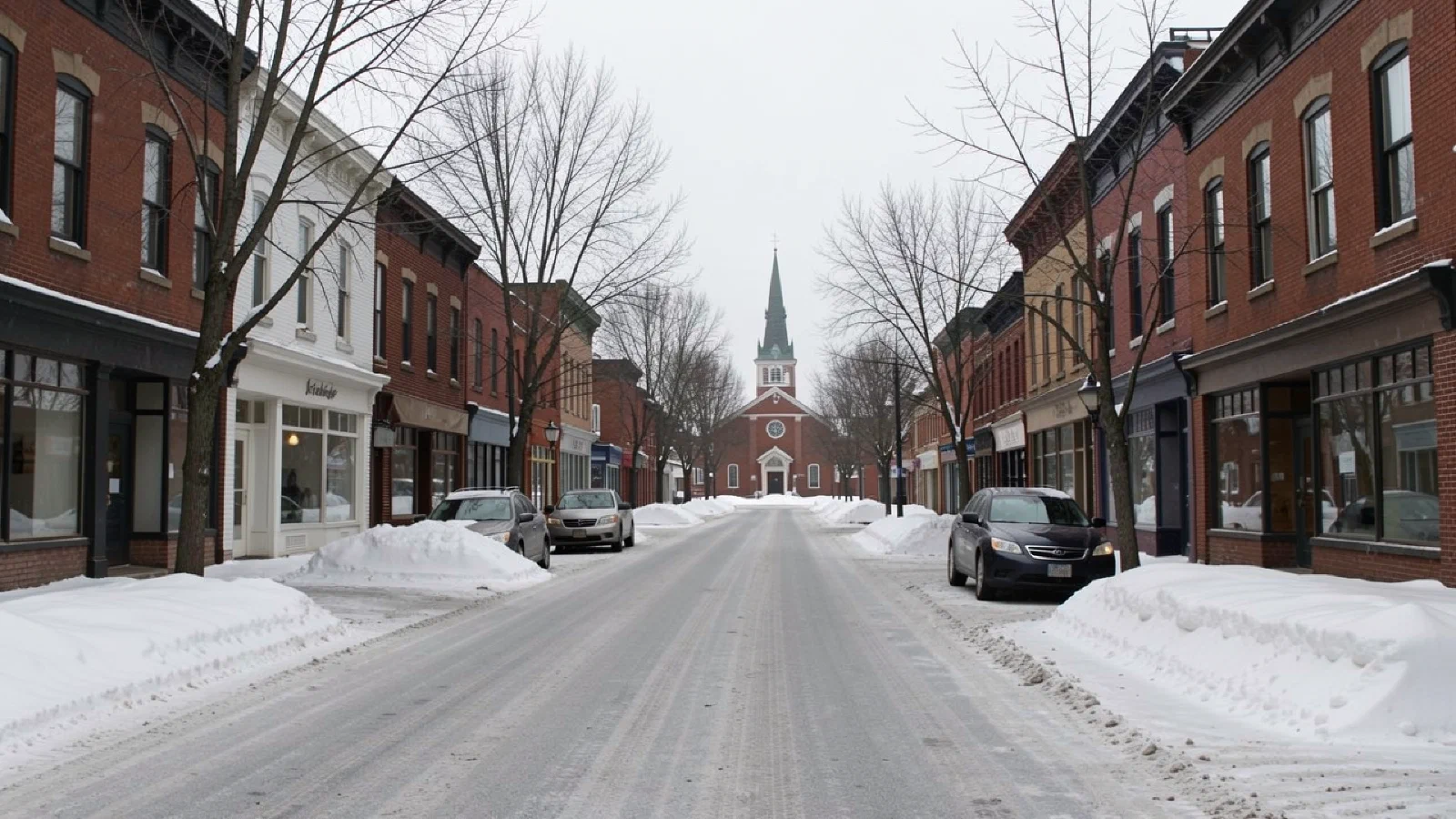
Northern New England contains America’s oldest rural population in communities that bear little resemblance to rural stereotypes. Maine, Vermont, and New Hampshire blend aging former logging towns with retirement in-migration, progressive politics with Yankee independence, strong community institutions with demographic decline. The region’s median ages approach 50 in many communities, creating healthcare demand profiles dominated by geriatric needs.
The three states share forested landscapes, small-state governance, and New England political culture emphasizing local control through town meetings. They also share something unusual for rural America: Medicaid expansion, relatively strong healthcare systems, and community institutions that function where they have collapsed elsewhere. Northern New England is not rural Texas or rural Mississippi.
The core analytical tension for this region is whether approaches that work in New England’s distinctive context can scale to other rural regions, and whether approaches developed elsewhere can work here. New England’s small states, progressive politics, and strong institutions create conditions different from most rural America. Solutions developed here may not transfer. Solutions developed elsewhere may not fit.
Regional Definition#
Northern New England encompasses rural Maine, Vermont, and New Hampshire, excluding the Boston-commuter suburbs of southern New Hampshire and the Portland and Burlington metropolitan areas.
| State | Rural Population | Percent Rural | Median Age | Character |
|---|---|---|---|---|
| Maine | 840,000+ | 60%+ | 45.1 | Oldest state nationally, vast northern forests |
| Vermont | 400,000+ | 61% | 43.9 | Fourth oldest state, progressive politics |
| New Hampshire | 350,000+ | 40% | 43.8 | Southern exurbs, northern forests |
| Regional Total | ~1.6 million | ~55% | 44.3 | Oldest rural region nationally |
What Makes Northern New England Distinctive
Oldest rural population in America. Maine has the nation’s oldest population by median age (45.1 years). Vermont ranks fourth (43.9). New Hampshire ranks eighth (43.8). Nearly one in four Maine residents is over 65.
Progressive politics in rural setting. Unlike most rural America, Northern New England votes Democratic, supports Medicaid expansion, and maintains social programs. All three states expanded Medicaid. Vermont has attempted single-payer healthcare.
Strong community institutions. Town meeting governance persists. Volunteer organizations function. Community health centers have deep roots. The institutional infrastructure that has collapsed in other rural regions remains.
Small state scale. Vermont’s entire population (647,000) is smaller than many American cities. Small scale enables coordination impossible in larger states but also limits resources.
Tourism and retirement economy. Northern New England has transitioned from logging and agriculture to tourism and retirement. Ski resorts, fall foliage, summer vacations, and retiree in-migration drive economies that once depended on timber and potatoes.
Historical Context#
Northern New England’s economy developed around forest products and agriculture suited to thin soils and short growing seasons. Maine’s logging industry supplied construction lumber and paper pulp. Vermont’s dairy farms exploited hillside pastures. Every valley had its mill town, its logging camp, its farm community. Population density was never high but was sufficient to sustain basic services.
Tourism emerged as replacement economy beginning in the late 19th century. Summer camps, lakeside resorts, and ski areas developed. But tourism brought seasonal instability: busy seasons followed by winter lulls.
Beginning in the 1970s, Northern New England attracted retirees seeking quality of life. Retirement in-migration changed community demographics. Towns that once exported young people now imported old people. Median ages rose as retirees arrived while young families departed.
Northern New England’s political culture evolved from Yankee Republicanism to progressive politics while retaining emphasis on local control. Town meeting governance persisted. Progressive politics emerged from environmentalism, education, and quality-of-life concerns. This political context created policy infrastructure for healthcare that other rural regions lack.
Today’s Northern New England experiences competing migration patterns: retiree in-migration continues, young adult out-migration continues, and remote work in-migration accelerated during COVID-19. The net effect is continued aging with episodic working-age influx.
Current Conditions#
Demographics#
Maine Counties
| County | Population | Median Age | 65+ Percent | Trend |
|---|---|---|---|---|
| Aroostook | 67,000 | 48 | 26% | Declining |
| Washington | 31,000 | 50 | 28% | Declining |
| Piscataquis | 17,000 | 52 | 29% | Declining |
| Somerset | 50,000 | 47 | 24% | Stable |
| Franklin | 29,000 | 48 | 25% | Stable |
Vermont Counties
| County | Population | Median Age | 65+ Percent | Trend |
|---|---|---|---|---|
| Essex | 5,900 | 51 | 28% | Declining |
| Orleans | 27,000 | 47 | 24% | Stable |
| Caledonia | 30,000 | 46 | 23% | Stable |
| Lamoille | 25,000 | 44 | 21% | Growing |
| Windham | 43,000 | 49 | 27% | Stable |
New Hampshire Counties
| County | Population | Median Age | 65+ Percent | Trend |
|---|---|---|---|---|
| Coos | 31,000 | 49 | 27% | Declining |
| Grafton | 91,000 | 43 | 21% | Stable |
| Carroll | 49,000 | 52 | 29% | Growing (retirees) |
| Sullivan | 43,000 | 46 | 23% | Stable |
Median ages in the mid-to-high 40s, often exceeding 50, with quarter or more of population over 65. Maine’s population over 65 will increase 36% by 2030. The healthcare system must prepare for populations where geriatric care is the default, not the specialty.
Economy#
Tourism Dominance
| State | Tourism Employment | Seasonal Variation | Tourism Revenue |
|---|---|---|---|
| Maine | 80,000+ (peak) | 40% seasonal reduction | $6.5 billion |
| Vermont | 40,000+ (peak) | 30% seasonal reduction | $3.0 billion |
| New Hampshire | 60,000+ (peak) | 35% seasonal reduction | $4.5 billion |
Tourism provides economic foundation but with seasonal instability that complicates healthcare delivery. Year-round residents subsidize infrastructure that tourists use seasonally.
Retirement Economy brings transfer payments (Social Security, pensions) that support local economies. Retirees spend less than working families but require healthcare more than other services.
Remote Work Emergence accelerated during COVID-19. Remote workers bring working-age income and expectations shaped by urban experience.
Healthcare Infrastructure#
| Facility Type | Maine | Vermont | New Hampshire | Regional Character |
|---|---|---|---|---|
| General Hospitals | 36 | 14 | 26 | Small, nonprofit |
| Critical Access Hospitals | 16 | 8 | 13 | Network concentrated |
| FQHCs/Sites | 20+ networks | 11 (60+ sites) | 10+ networks | Strong CHC tradition |
| Rural Health Clinics | 40+ | 10 | 20+ | Variable coverage |
Northern New England’s healthcare infrastructure is better than national rural averages but faces intensifying stress. Hospital financial distress affects all three states. Half of Maine’s hospitals lack delivery services. Multiple hospitals operate at negative margins.
Community health center strength distinguishes the region. Vermont’s 11 FQHCs operate over 60 sites reaching all 14 counties.
Maternity care collapse has occurred across the region. Eleven Maine hospitals have closed birthing units in the past decade. Rural women face extended travel for delivery, deterring family formation.
Health Outcomes#
| Measure | Northern New England Rural | National Rural | Gap Assessment |
|---|---|---|---|
| Life expectancy | 78.5 years | 76.8 years | Better |
| Heart disease mortality | 160 per 100,000 | 180 per 100,000 | Better |
| Diabetes prevalence | 8.5% | 11.8% | Much better |
| Suicide rate | 15.5 per 100,000 | 17.2 per 100,000 | Better |
| Uninsured rate | 5.5% | 12.4% | Much better |
Health outcomes are among the best for rural America. The combination of Medicaid expansion, progressive health policy, and educated population produces outcomes exceeding national rural averages. This comparative advantage can obscure absolute challenges: outcomes trail urban outcomes, aging populations face increasing chronic disease burden, and mental health needs exceed service capacity.
Workforce#
| State | Primary Care Physicians per 10,000 | Trend | Age Distribution |
|---|---|---|---|
| Maine | 8.2 | Declining | 35% over 55 |
| Vermont | 9.1 | Declining | 38% over 55 |
| New Hampshire | 7.9 | Declining | 40% over 55 |
| National Rural Average | 5.5 | Declining | 42% over 55 |
Northern New England has better physician ratios than most rural regions but faces the same workforce aging. Over one-third of primary care physicians will reach retirement age within a decade.
Nursing workforce faces particular pressure. Wages in Boston, Portland, and Burlington exceed rural facility capacity to compete. Behavioral health shortages are severe despite progressive policy. Vermont’s social workers are aging rapidly.
Vignette: Hardwick, Vermont#
Hardwick exemplifies Northern New England’s transformation from extraction to something new. Once a granite quarrying center, later a struggling small town, Hardwick has reinvented itself as an artisanal food hub where small-scale producers cluster in unlikely concentration.
The Hardwick Area Health Center serves 12,000 patients. Dr. Sarah Chen has practiced here for fifteen years. Her patient panel tells the story of two Hardwicks.
“The longtime residents are loggers, farmers, people who’ve been here for generations. They’re stoic about health. They’re getting old, and they don’t want to leave their land.”
“The newcomers are foodies, remote workers, back-to-the-landers. They’re health-conscious to a fault. They bring resources and expectations.”
“We can’t recruit specialists. We refer to Burlington or Dartmouth for anything complex. That’s 45 minutes to two hours depending on weather. For my elderly patients who don’t drive, that’s a major barrier.”
Hardwick Area Health Center employs community health workers who bridge clinical care and community life. This is transformation that works in a community small enough to know everyone.
“Can this scale?” Dr. Chen asked. “Hardwick works because it’s small, because people know each other. Can you replicate that in a Texas county with 50,000 people spread across thousands of square miles? I don’t know.”
The Core Tension: Regional Approaches vs. Scalable Solutions#
The Case for New England Exceptionalism
Small state governance enables coordination impossible in larger states. Vermont’s Department of Health can convene stakeholders statewide in a room. Texas cannot.
Progressive politics create policy possibilities unavailable in non-expansion states. Medicaid expansion, state investment in community health, and support for social programs reflect political choices that rural Mississippi has not made and may not make.
Strong institutions persist where they have collapsed elsewhere. Town meeting governance, community organizations, and civic participation provide infrastructure for collective action.
Historical affluence (relative to other rural regions) created educational and healthcare infrastructure that compounds over time.
The Case for Transferable Lessons
Aging-in-place strategies will become relevant everywhere as America ages. Northern New England is simply experiencing first what other regions will experience later.
Community health center models originated partly in New England and spread nationally. The FQHC system demonstrates that New England approaches can transfer.
Progressive policy proves possibility. New England demonstrates that Medicaid expansion and healthcare investment improve outcomes. Other states could choose these policies.
The Honest Assessment
Northern New England is both exceptional and instructive: exceptional in its small state scale, progressive politics, strong institutions, and historical affluence; instructive in demonstrating what works for aging populations and what progressive policy achieves. Policy lessons transfer more readily than institutional or cultural factors. Transformation planners should learn from Northern New England without assuming they can copy it.
RHTP in This Region#
| State | FY2026 Award | Per Capita Rural | Application Focus |
|---|---|---|---|
| Maine | $190 million | $226 | Workforce, technology, sustainability |
| Vermont | $195 million | $488 | Integrated care, AHEAD model alignment |
| New Hampshire | $185 million | $529 | Technology, hospital stabilization |
All three states received favorable RHTP allocations relative to rural population. Vermont’s $488 per rural resident and New Hampshire’s $529 exceed most larger states. The favorable allocation reflects the RHTP formula’s equal distribution component benefiting small states.
Maine’s RHTP application balances immediate stabilization with longer-term transformation. Vermont’s application integrates with the state’s AHEAD model participation, aligning RHTP transformation with broader payment reform. Vermont’s approach is most explicitly systemic. New Hampshire’s application reflects the state’s more immediate challenges with hospital finances and more libertarian context.
What RHTP Misses#
Interstate coordination receives limited attention despite geographic proximity and shared challenges. Maternity care collapse receives acknowledgment but no comprehensive response. Nursing home crisis parallels the Upper Midwest’s challenges but falls outside RHTP focus. Housing as healthcare infrastructure receives insufficient attention; providers cannot afford to live where they work.
Vignette: Machias, Maine#
Machias sits in Washington County, Maine’s poorest and most remote. Down East Community Hospital has 25 beds, Critical Access Hospital designation, and the distinction of being one of the most financially distressed rural hospitals in America.
“If we close, the nearest hospital is 60 miles,” said the hospital administrator. “In winter, in a snowstorm, that’s not reachable. People will die. So we stay open, lose money, and hope something changes.”
“We’re training community health workers. We’re expanding telehealth. We’re doing everything the transformation playbook says. But at the end, we’re a hospital serving a population that’s shrinking and aging. The math doesn’t work.”
Down East Community Hospital illustrates the limits of transformation in terminal decline. RHTP investment can improve care for current residents. It can delay closure. It cannot create population growth or economic vitality that would sustain the facility long-term.
“We’ll take the money and do good with it. And when the funding ends, we’ll face the same question: can this community sustain a hospital? The honest answer might be no.”
Alternative Perspective Assessment#
The New England Exceptionalism View#
Scale advantages are real. Institutional infrastructure cannot be built quickly. Historical affluence compounds over time. Political culture is path-dependent.
Assessment: The exceptionalism argument is partially correct but potentially self-limiting. Scale effects can be addressed through sub-state regionalization. Institutions can be built over time. Affluence advantage is relative. Treating political context as fixed surrenders to current choices. New England exceptionalism contains truth but should not become excuse for inaction elsewhere.
The Universal Aging Challenge View#
Aging is the great equalizer. Northern New England is simply experiencing first what all rural America will experience as baby boomers age.
Assessment: The universal aging view is correct about demographics, limited about context. Aging populations in non-expansion states will face the same healthcare needs without the same resources. Aging demographics create common challenges; responses will vary based on context.
Regional Strengths#
Community Health Center Infrastructure: Vermont’s 11 FQHCs operate 60+ sites reaching all 14 counties. These organizations have community relationships and organizational infrastructure that transformation can build upon.
Progressive Policy Environment: Medicaid expansion, state investment in community health, and progressive regulatory environment enable innovation.
Small State Coordination Capacity: Vermont’s ability to convene statewide stakeholder engagement demonstrates small-state advantage.
AHEAD Model Alignment: Vermont’s participation in CMS’s AHEAD model provides transformation framework beyond RHTP, integrating payment and delivery transformation.
Educational Institutions: University of Vermont, University of Maine, and Dartmouth-Hitchcock provide training infrastructure for workforce development.
Transformation Assessment#
What Transformation Can Achieve#
Stabilization of at-risk hospitals through supplemental funding. Community health worker deployment creating community-based care capacity. Telehealth normalization establishing virtual care as routine. Behavioral health improvement through CCBHC expansion. Aging-in-place model development demonstrating approaches other regions can adapt.
What Transformation Cannot Achieve#
Reversal of demographic aging. Healthcare transformation cannot make populations younger. Restoration of maternity care to historical levels. Hospital-based obstetrics has collapsed for economic reasons transformation cannot change. Long-term sustainability for all facilities. Some communities cannot sustain healthcare infrastructure beyond 2030. Interstate coordination without new mechanisms. Transfer of New England context to other regions.
Vignette: What Regional Transformation Could Look Like#
The Northern New England Rural Health Compact, if it existed, might work like this:
Maine, Vermont, and New Hampshire establish a three-state compact for rural health coordination. Geriatric care teams deploy across state lines based on geography, not state boundaries. Workforce development operates regionally through collaborating universities. Telehealth operates on regional platform enabling cross-state practice.
Maternity care networks formalize referral relationships. Women in communities without delivery services have planned pathways to delivering hospitals.
Five years in, hospital closures have been minimal. Geriatric care has improved. Workforce decline has slowed through regional coordination.
This compact does not exist. It illustrates what coordinated transformation could accomplish.
Recommendations#
Maine should prioritize sustainability planning given severe hospital financial distress. Vermont should leverage AHEAD model alignment and document community health worker deployment as model for other regions. New Hampshire should address hospital financial crisis while building toward longer-term transformation.
Multi-State Coordination: The three states should establish formal coordination enabling joint workforce development, coordinated telehealth, shared specialty services, and regional maternity care networks.
CMS should enable interstate RHTP coordination, recognize New England as laboratory for aging-population healthcare, address maternity care collapse through policy beyond RHTP scope, and support international border considerations.
How this article connects to others in Blue Gray Matters.
Sources cited in this article.
- Centers for Medicare and Medicaid Services. "CMS Announces $50 Billion in Awards to Strengthen Rural Health in All 50 States." *CMS Newsroom*, 29 Dec. 2025.
- DeJoy, Gianna. "Maine's Vanishing Maternity Care and Community Resilience." *University of Maine Digital Commons*, 2024.
- Green Mountain Care Board. "Vermont Health Care System Report." *GMCB*, 2024.
- Kaiser Family Foundation. "Medicaid Eligibility and Enrollment: Maine, Vermont, New Hampshire." *KFF.org*, 2025.
- Maine Department of Health and Human Services. "Rural Health Transformation Program Application." *DHHS*, Nov. 2025.
- Maine Hospital Association. "Hospital Financial Analysis." *MHA*, 2025.
- New Hampshire Department of Health and Human Services. "Rural Health Profile." *DHHS*, 2024.
- Ricketts, Thomas C. "Rural Health in America." *Oxford University Press*, 2022.
- U.S. Census Bureau. "American Community Survey 5-Year Estimates: Maine, Vermont, New Hampshire." *Census.gov*, 2023.
- Vermont Agency of Human Services. "Rural Health Transformation Program Application." *AHS*, Nov. 2025.
- Vermont AHEC Network. "The Rural Health Gap Is Growing: How Vermont is Pushing Back." *NVTAHEC*, 2025.
- Vermont Department of Health. "Vermont Rural Health Profile." *VDH*, 2024.