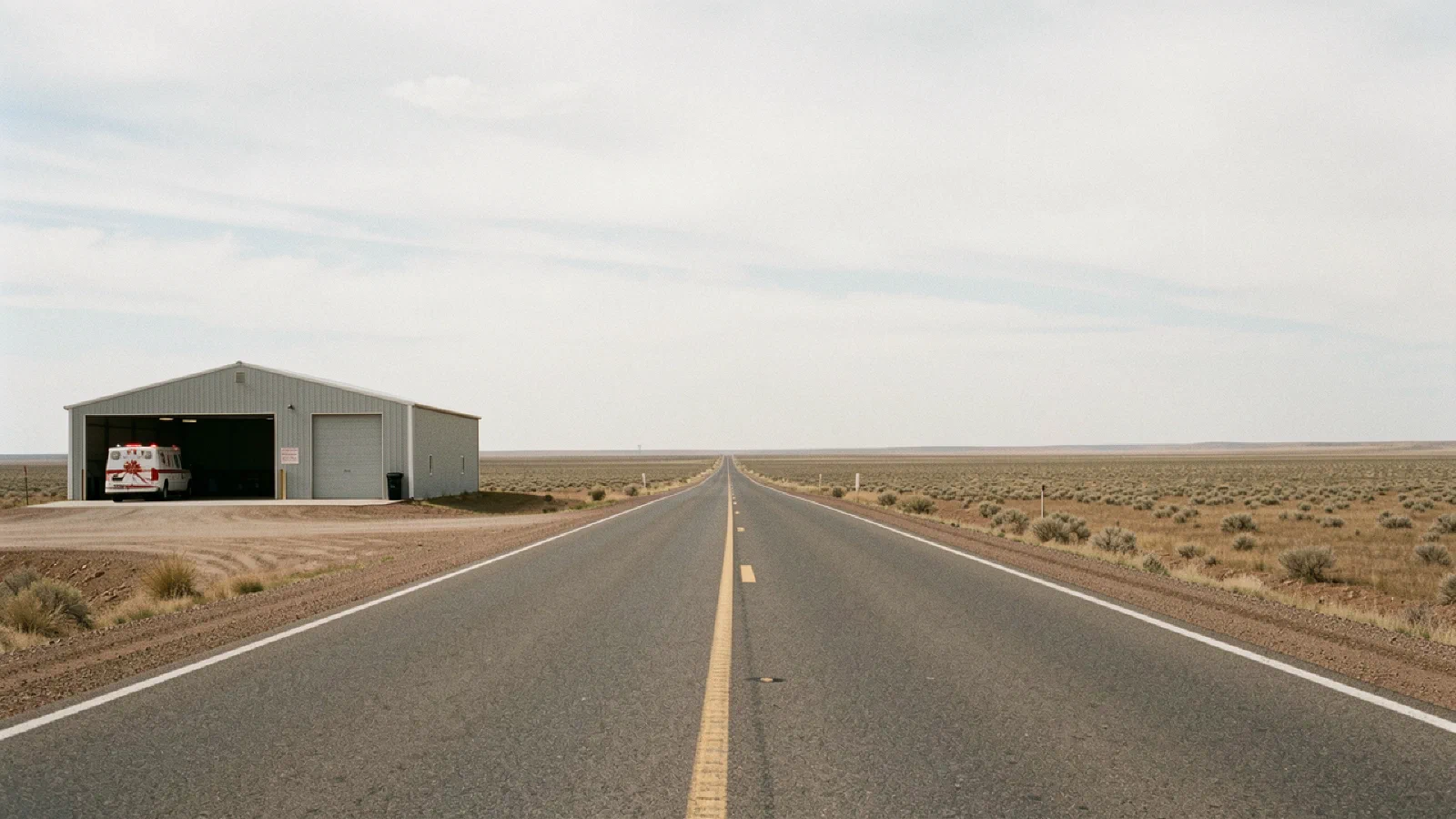
Frontier Populations
When Geography Defeats Healthcare Design
Frontier and Remote Area (FAR) Level 4 captures the most isolated communities in America: places where the nearest town of 2,500 people lies more than an hour away by car. Where population densities drop below one person per square mile. Where the assumptions underlying every healthcare policy ever written dissolve against the mathematics of extreme isolation.
Approximately 2.3 million Americans live in FAR Level 4 territory. Another 10 million live in FAR Level 1-3 areas, facing varying degrees of remoteness from urban centers. Together, these populations occupy roughly 35% of U.S. land area while comprising less than 4% of the population. They live where America is emptiest, where the nearest hospital may be a two-hour drive in good weather, where calling 911 initiates a response measured in hours rather than minutes.
The USDA’s FAR codes attempt to capture degrees of remoteness based on travel time to urban areas of varying sizes. Level 1 identifies areas more than 60 minutes from any urban area of 50,000 or more people. Level 2 adds distance from areas of 25,000+. Level 3 from 10,000+. Level 4, the most restrictive, identifies areas where even reaching a town of 2,500 people requires an hour or more of driving. In these places, access to “low-order” goods and services that denser communities take for granted becomes genuinely difficult.
Geographic concentration follows predictable patterns. Wyoming leads with 57% of its population in FAR Level 1 areas. Montana, North Dakota, South Dakota, and Alaska follow with the highest frontier population shares. These are the states where rural health programs designed for “rural” populations encounter something entirely different: frontier reality.
| State | FAR 4 Population Share | Primary Frontier Regions |
|---|---|---|
| North Dakota | 26.2% | Western ND |
| South Dakota | 24.5% | Western SD, reservations |
| Montana | 15.5% | Eastern plains, mountain valleys |
| Wyoming | 12.9% | Most of state |
| Nebraska | 10.3% | Western NE, Sandhills |
| Alaska | Varies | Bush Alaska (effectively 100%) |
| Nevada | Significant | Rural Nevada |
| New Mexico | Significant | Northern NM, tribal areas |
Core Tension: Universal Approach vs. Extreme Accommodation
Federal rural health programs treat rural America as a single category with slight adjustments for “frontier” designation. RHTP’s formula provides enhanced weighting for FAR codes and low population density. But the fundamental program structure assumes healthcare systems that can be improved, infrastructure that can be strengthened, providers who can be recruited.
Frontier populations require extreme accommodation that universal programs do not provide. Standard approaches assume hospitals within reasonable distance, ambulance response within reasonable time, providers who can be located within reasonable commute. None of these assumptions hold in FAR Level 4 territory. Healthcare delivery to frontier populations may require abandoning the very concept of “healthcare delivery” in favor of something entirely different.
The Frontier Reality#
Distance as Daily Reality#
In metropolitan America, distance to healthcare is measured in minutes. In rural America, in miles. In frontier America, in hours.
Consider the geography of a Montana county with 0.3 people per square mile. The county seat, population 800, contains the only medical clinic in the county. Residents in outlying areas drive 45 minutes to an hour to reach that clinic for routine appointments. The nearest hospital, a 25-bed Critical Access Hospital, sits in the next county, 90 miles away. Specialty care requires traveling to Billings, 200 miles distant, or Great Falls, 175 miles in the opposite direction.
These are not exceptional distances in frontier America. They represent normal distances that shape every healthcare decision. A diabetic managing blood sugar must consider whether the hour drive to the clinic justifies a routine check. A woman experiencing pregnancy complications must calculate whether symptoms warrant the two-hour drive to the nearest hospital with obstetric capability. A parent with a sick child must decide whether fever and vomiting merit six hours of driving for what might be a simple virus.
Distance functions as a filter that screens out healthcare utilization for anything short of emergencies. People defer care because the burden of accessing it exceeds the perceived benefit. By the time symptoms become severe enough to justify the journey, conditions have often progressed beyond what earlier intervention might have addressed.
Population Density and Service Impossibility#
Traditional healthcare infrastructure requires population to sustain it. A primary care physician needs approximately 1,500 to 2,000 patients to support a practice. A hospital needs sufficient volume to maintain competencies, meet staffing requirements, and generate revenue. Frontier populations cannot support these minimums.
A county with 2,000 total residents spread across 3,000 square miles cannot sustain a physician practice even if every resident became a patient. A region with 500 people cannot support a hospital regardless of need severity. The mathematics of population density dictate service impossibility before any policy intervention is considered.
This reality distinguishes frontier health from rural health. Rural communities often have healthcare access problems that can be addressed through recruitment incentives, facility support, or transportation programs. Frontier communities face problems that cannot be solved through conventional means because the population base required to support conventional services does not exist.
| Population Density | Healthcare Infrastructure Potential |
|---|---|
| 50+ per sq mi | Full service potential |
| 10-50 per sq mi | Limited services viable |
| 6-10 per sq mi | Marginal sustainability |
| 1-6 per sq mi | Frontier; only emergency/basic |
| Less than 1 per sq mi | No sustainable infrastructure |
Weather and Seasonal Isolation#
Frontier communities in the northern Great Plains, Mountain West, and Alaska experience seasonal isolation that compounds year-round distance challenges. Winter storms close roads for hours or days. Mountain passes become impassable. In Alaska, entire communities become accessible only by air for months at a time.
This creates healthcare crises within crises. A cardiac event during a blizzard means no ambulance response until roads clear. A complicated labor when the pass is snowed in means delivery wherever the mother happens to be. An acute appendicitis when the only bush plane pilot is grounded by weather means hoping the condition stabilizes long enough for conditions to improve.
Weather-related isolation affects healthcare planning throughout frontier regions. Providers maintain supplies for extended self-sufficiency. Pregnant women relocate to communities with hospitals weeks before due dates. Chronic conditions that require regular medication stockpile supplies against potential isolation. The healthcare system adapts to weather reality in ways that urban and even rural systems never consider.
Frontier Economies#
The economies supporting frontier populations differ fundamentally from those supporting denser communities. Ranching, farming, resource extraction, tourism, and subsistence dominate. Employment often lacks health insurance benefits. Incomes may be highly variable depending on commodity prices, weather, and seasonal patterns.
These economic realities shape healthcare financing. Many frontier residents are self-employed without employer-sponsored insurance. Individual market coverage, where available, commands high premiums. Medicare Advantage plans, which have expanded dramatically in recent years, often provide weaker networks in frontier areas than traditional Medicare.
The economic base also affects healthcare workforce availability. Spouse employment represents a critical factor in physician recruitment. A physician willing to practice in a frontier community may find that their spouse has no employment opportunities. A nurse recruited to a remote hospital may discover that children must be educated through distance learning because the nearest school is 40 miles away.
Healthcare Absence#
No Hospital Within Reasonable Distance#
For FAR Level 4 populations, “no hospital within reasonable distance” is not metaphor. It is geographic fact.
Wyoming’s seventeen frontier counties contain populations scattered across territories where no hospital location would place more than a fraction of residents within reasonable reach. Montana’s 46 frontier counties present similar challenges. Even where Critical Access Hospitals exist, they serve populations spread across areas where many residents live hours from the facility.
The absence of hospitals creates cascading absences. No hospital means no emergency department for stabilization. No obstetric unit for labor and delivery. No surgical capability for emergencies requiring immediate intervention. No imaging equipment for diagnostic assessment. The entire infrastructure of acute medical care that Americans expect simply does not exist in forms accessible to frontier populations.
No Physician Presence#
Several Wyoming counties have five or fewer family practice physicians. Some have none. The entire state is designated a Health Professional Shortage Area for mental health services, with only 41% of mental health needs currently met.
Montana reports that 51 of 56 counties lack adequate mental health providers. Primary care shortages affect communities across the state’s vast frontier territory. Specialist availability essentially does not exist outside the state’s few urban centers.
Physician absence in frontier areas does not respond to conventional recruitment strategies. The factors that make physicians reluctant to practice in rural areas intensify in frontier settings. Professional isolation is extreme. Backup coverage is unavailable. Continuing education requires long-distance travel. Income potential, while potentially competitive through loan repayment programs, cannot match urban opportunities. And the lifestyle factors that attract some physicians to rural practice become limitations when isolation crosses certain thresholds.
EMS Response: Hours, Not Minutes#
Urban EMS strives for 8-minute response times. Rural EMS often achieves 20-30 minutes. Frontier EMS response times of 60 minutes are not uncommon. In some areas, response times extend to two hours or more.
The mathematics of frontier EMS expose fundamental operational impossibilities. Wyoming estimates that between 71 and 113 ambulances must be on call at any given moment to provide adequate coverage across the state. Annual fixed costs for this readiness capacity reach approximately $66.5 million. Actual EMS revenue from billing covers only $36.7 million, creating a structural gap that cannot be closed through payment reform alone.
Most frontier EMS services rely heavily on volunteer labor. Volunteer firefighters double as EMTs. Ranchers maintain EMT certification to serve their communities. This volunteer model provides coverage that would otherwise not exist, but it creates significant quality and availability concerns. Volunteers may not be available during working hours. Training levels may be inconsistent. Response times depend on who happens to be nearby when calls arrive.
Research using the National Emergency Medical Services Information System found that approximately one in fifteen EMS emergency responses in the continental U.S. occurs in FAR areas. FAR responses are significantly more likely to result in on-scene death than non-FAR responses (12.2 vs. 9.6 deaths per 1,000 responses). Air medical transport and Advanced Life Support care are more common in FAR responses, reflecting the severity of cases that cannot be managed locally.
Air Transport: Life-Saving and Financially Devastating#
When ground transport cannot reach hospitals within the “golden hour” that determines survival for trauma, stroke, and cardiac emergencies, air ambulance becomes the only option. More than 80 million Americans can reach a Level 1 or 2 trauma center within an hour only if transported by helicopter.
Air ambulance is essential for frontier populations. It is also financially devastating. The median cost for helicopter transport reaches approximately $36,400; for fixed-wing aircraft, $40,600. Many air ambulance providers remain out-of-network with major insurers, historically resulting in surprise bills that could exceed $50,000 for uninsured or out-of-network patients.
The No Surprises Act, effective since 2022, provides some protection against balance billing for emergency air transport. However, the fundamental cost structure remains. Medicare reimburses approximately $6,500 for services that providers bill at $36,000-$40,000. The gap between reimbursement and billed charges drives the industry dynamics that created surprise billing problems in the first place.
For frontier residents, air ambulance represents a Hobson’s choice. Accept transport and face potential financial devastation. Decline transport and face potential death. The choice is no choice at all, but the consequences extend far beyond the immediate emergency.
Vignette: The Rancher’s Chest Pain#
Garfield County, Montana, covers 4,668 square miles with a population of approximately 1,100 people, a density of 0.3 persons per square mile. The county seat of Jordan, population 300, contains the county’s only medical clinic, operated by a nurse practitioner who visits twice weekly. The nearest hospital, a 25-bed Critical Access Hospital in Circle, lies 70 miles northeast. The nearest facility with cardiac catheterization capability is in Billings, 175 miles away.
James, 58, runs a cattle operation 35 miles from Jordan. At 2 PM on a Tuesday in February, he experiences sudden onset chest pain while checking fences. Crushing pressure. Shortness of breath. Shooting pain down his left arm. He recognizes the symptoms.
His cell phone shows no signal. He drives his truck toward the county road where reception sometimes works. Fifteen minutes pass. Signal appears. He calls 911.
The volunteer ambulance in Jordan can reach him in approximately 45 minutes assuming he can describe his exact location. Ground transport to the Circle hospital would take another 90 minutes from there. From Circle to Billings, another two and a half hours.
Air ambulance is the alternative. If weather permits. If a helicopter is available. Typical response time: 60-90 minutes from initial contact. Cost if uninsured or out-of-network: $40,000 or more. James carries insurance through the individual market, but he does not know whether his plan covers air transport or at what rate.
Drive himself? He knows this is dangerous. If he loses consciousness at the wheel, the outcome is worse than waiting for help. But waiting for help means hours before reaching care. Every minute matters for cardiac events.
What does he do?
He drives. Slowly, carefully, toward Jordan, hoping the symptoms do not worsen. Hoping he does not become another rural statistic. Hoping that if he can reach Jordan, someone there can help.
This is not a policy failure. It is geography. No amount of funding can put a hospital within reach of James’s ranch. No payment reform can make air ambulance affordable. No workforce program can station a cardiologist in a county with 1,100 people.
What would transformation provide? Perhaps better cellular coverage for the 911 call. Perhaps a community health worker who might have checked on James that morning and noticed warning signs. Perhaps telehealth consultation guiding him through initial response. Perhaps improved roads reducing transport time by a few minutes.
What transformation cannot provide: immediate access to emergency cardiac care. The mathematics of frontier geography defeat every intervention that assumes proximity to services.
Alternative Perspective: The Frontier Impossibility View#
There is a perspective on frontier healthcare that policy discussions rarely acknowledge openly: healthcare delivery to frontier populations may be operationally impossible at any cost.
This view holds that population density establishes minimum thresholds for service viability. Below those thresholds, no amount of funding, no program design, no policy innovation can create sustainable healthcare infrastructure. Distance cannot be overcome. Sparse population cannot support services. The question is not how to provide frontier healthcare but whether some areas are beyond healthcare system reach.
This perspective is not callous. It is mathematical. A hospital needs patients to remain viable. An ambulance service needs call volume to sustain operations. A physician needs panel size to maintain competency and generate income. When population density drops below levels that can support these minimums, the services cannot exist in any form resembling their standard models.
The policy implications of this view are uncomfortable. It suggests that some Americans have made choices about where to live that healthcare systems cannot fully accommodate. That frontier living involves accepting limitations that more densely populated areas do not face. That the national commitment to healthcare access has practical boundaries determined by geography rather than resources.
Proponents of this view argue that honesty about frontier limitations is preferable to promising transformation that cannot occur. Programs that invest heavily in frontier healthcare without acknowledging fundamental impossibilities create expectations that will inevitably disappoint. Better to communicate realistic scope and focus resources on what can actually be achieved.
Critics respond that this perspective abandons populations to geography, treating accident of birth location as justification for healthcare deprivation. They note that frontier populations contribute to national food production, resource extraction, and land stewardship. They argue that society has obligations to support healthcare access for all citizens regardless of where they live.
The synthesis recognizes that both perspectives contain truth. Frontier healthcare faces genuine limitations that optimistic policy language often obscures. Simultaneously, frontier populations deserve honest engagement about what can and cannot be achieved, combined with maximum effort to provide what geography permits.
What Transformation Must Provide#
Accepting frontier limitations does not mean accepting inaction. Within geographic constraints, RHTP can provide meaningful improvements for frontier populations.
Telehealth Infrastructure#
Broadband connectivity and devices represent the highest-impact investment for frontier healthcare. When providers cannot be present, virtual presence becomes essential. Telehealth enables consultations that would otherwise require hours of travel. Remote patient monitoring enables chronic disease management without repeated clinic visits. Telestroke and tele-psychiatry provide specialty access that frontier populations could never access in person.
Frontier telehealth requires more than video visits. It requires diagnostic capability at the patient end. Blood pressure monitors, glucometers, pulse oximeters, and other devices that enable meaningful clinical assessment remotely. It requires broadband reliable enough to support real-time video. It requires training for patients who may be unfamiliar with technology.
RHTP investments in telehealth infrastructure may provide frontier populations their greatest opportunity for healthcare improvement.
Community Health Worker Presence#
When physicians and nurses cannot be sustained, community health workers offer an alternative model. Trained community members can provide health education, chronic disease support, medication management assistance, and early warning identification that prevents emergencies from developing.
CHW models are not substitutes for medical care. But in communities where medical care cannot exist in traditional forms, CHWs provide human presence addressing health needs that would otherwise go entirely unmet. They can identify the rancher with chest pain before the emergency call, potentially enabling earlier intervention.
Frontier CHW programs require training, supervision, and compensation structures adapted to isolated communities where traditional employment models may not function.
Emergency Transport Support#
RHTP cannot make air ambulance affordable, but it can support EMS infrastructure that improves ground transport capabilities. This includes regional EMS coordination that shares resources across larger geographies, upgraded vehicles and equipment, training for volunteer responders, and protocols that optimize transport decisions.
Investment in helicopter landing zones and coordination with air ambulance services can reduce response times when air transport is required. Communication systems ensuring 911 calls reach dispatch even in areas with limited cellular coverage address a basic prerequisite for emergency response.
Frontier-Specific Program Flexibility#
Federal programs designed for “rural” populations often include requirements that frontier communities cannot meet. Staffing ratios, facility specifications, and reporting requirements assume contexts that do not exist in FAR Level 4 territory.
RHTP can provide flexibility mechanisms that allow frontier adaptation of program requirements. This might include alternative compliance pathways, modified facility standards for frontier-specific designations, or reporting accommodations that recognize data collection challenges in isolated areas.
Wyoming’s proposed “Critical Access Hospital, Basic” designation represents this kind of frontier-specific adaptation, creating a new facility category with modified requirements appropriate to extreme isolation.
What Transformation Cannot Provide#
Honest assessment requires acknowledging what no program can deliver.
Population Density to Support Infrastructure#
RHTP cannot create population where population does not exist. A county with 500 residents cannot sustain a hospital regardless of payment rates. An area with no physician cannot recruit one if no physician is willing to live there.
Transformation operates within demographic constraints that policy cannot alter. Population decline in frontier areas may reduce service viability over time regardless of RHTP investment.
Shorter Distances#
RHTP cannot move hospitals closer to patients. Geography is fixed. The rancher 90 miles from the nearest hospital will remain 90 miles away after transformation just as before.
Investment in telehealth, transport, and community-based care can address some consequences of distance. It cannot eliminate distance itself.
Immediate Emergency Response#
No investment can provide 8-minute ambulance response to a patient 45 minutes from the nearest ambulance station. The physics of frontier geography impose constraints that no resource level overcomes.
RHTP can improve response times at margins. It cannot achieve urban-equivalent emergency access in areas where that access is geographically impossible.
Traditional Healthcare Delivery Models#
Frontier healthcare requires abandoning assumptions about facility-based, provider-centered care delivery. The physician office, the hospital, the clinic as architectural and organizational forms may not translate to frontier contexts.
Alternative models built on telehealth, community health workers, mobile services, and regionalized systems represent the frontier future. Traditional models will not succeed regardless of investment levels.
RHTP and Frontier States#
High Per-Capita Formula Winners#
RHTP’s funding formula dramatically favors frontier states through its baseline allocation and geographic weighting provisions.
| State | Per Rural Resident | Frontier Context |
|---|---|---|
| Wyoming | ~$554 | 17 of 23 counties frontier; non-expansion |
| Montana | ~$463 | 46 of 56 counties frontier; expansion state |
| North Dakota | ~$442 | 40 of 53 counties frontier; expansion state |
| South Dakota | ~$513 | 52 of 66 counties frontier; expansion state |
| Alaska | ~$368 | Effectively 100% frontier; expansion state |
These per-capita advantages reflect formula recognition of frontier challenges. Whether resources translate to improved outcomes depends on implementation choices.
Wyoming proposes consolidation and right-sizing of hospital and EMS systems, explicitly acknowledging that current infrastructure cannot be sustained. The approach represents unusual candor about frontier limitations while investing heavily in what can be improved: workforce, telehealth, and prevention.
Montana leverages existing telehealth and health information exchange infrastructure, building on investments predating RHTP. The state’s CONNECT referral system provides social care coordination capability most states lack.
North Dakota combines near-universal broadband coverage with wellness and prevention initiatives adapted to frontier demographics. The state’s stable rural health infrastructure provides foundation for enhancement rather than rescue.
Alaska faces the most extreme frontier conditions, with communities accessible only by air for months each year. The Alaska Tribal Health System provides backbone for rural health services, but RHTP funds flow through the state rather than directly to tribal systems.
Medicaid Expansion Matters Even in Frontier#
Among major frontier states, only Wyoming has not expanded Medicaid, leaving approximately 11,000 residents in the coverage gap. This creates compounding challenges: providers serving uninsured patients cannot bill Medicaid, reducing revenue available to support transformation.
Expansion states benefit from revenue flows that sustain frontier infrastructure. Non-expansion states must transform without that financial foundation.
Tribal Populations in Frontier Areas#
Several frontier states include significant Native American populations facing the most severe health disparities. Pine Ridge and Rosebud in South Dakota, Standing Rock across North and South Dakota, the Navajo Nation across Arizona, New Mexico, and Utah, and Alaska Native villages across the Last Frontier all combine frontier isolation with tribal health challenges.
RHTP funds flow to states, not directly to Indian Health Service or tribal health systems. Whether state implementation prioritizes reservation communities determines whether favorable formula positions translate to improved outcomes for tribal populations experiencing the most extreme health disparities.
Conclusion#
Frontier populations represent the irreducible limit of healthcare policy ambition. When distance is measured in hours, when population cannot support infrastructure, when emergency response requires accepting geographic impossibility, transformation encounters boundaries that funding and program design cannot cross.
This is not defeatism. It is realism. Within genuine constraints, RHTP can deliver meaningful improvements for frontier Americans through telehealth infrastructure, community health worker presence, emergency transport support, and program flexibility that acknowledges frontier reality.
What RHTP cannot do is pretend that frontier healthcare resembles healthcare elsewhere. The rancher experiencing chest pain 90 miles from the nearest hospital will never have access equivalent to suburban Americans minutes from emergency departments. The mother laboring in a community without obstetric services will never have the safety margins available in urban settings. The elder aging in place in a county with no physician will never receive care comparable to those in denser communities.
Honest transformation for frontier populations requires communicating these limitations while maximizing what can be achieved. The formula advantages delivering $500+ per rural resident to frontier states create genuine opportunity within geographic constraints. Whether states seize that opportunity determines whether RHTP provides meaningful improvement or disappointing promises.
For 2.3 million Americans in FAR Level 4 territory and millions more in less extreme frontier conditions, the question is not whether healthcare can match urban standards. It cannot. The question is whether healthcare can improve enough to matter within the unyielding mathematics of distance, density, and isolation that define frontier life.
How this article connects to others in Blue Gray Matters.
Sources cited in this article.
- Centers for Medicare and Medicaid Services. "Rural Health Transformation Program: Award Announcements." December 2025.
- HRSA Advisory Committee on Rural Health and Human Services. "Access to Emergency Medical Services in Rural Communities." 2025. https://www.hrsa.gov/sites/default/files/hrsa/advisory-committees/rural/access-to-ems-rural-communities.pdf
- Levy, Michael. "How Should We Fund and Reimagine EMS to Support Sustainable Rural Health Infrastructure?" Journal of Ethics, American Medical Association. July 2025. https://journalofethics.ama-assn.org/article/how-should-we-fund-and-reimagine-ems-support-sustainable-rural-health-infrastructure/2025-07
- Montana Department of Public Health and Human Services. "Rural Health Transformation Program Application." November 2025. https://dphhs.mt.gov/assets/RuralHealthTransformation/RHTP-Plan.pdf
- Patterson, P.D., et al. "National Characteristics of Emergency Medical Services in Frontier and Remote Areas." Prehospital Emergency Care 20, no. 5 (2016): 569-577. https://pmc.ncbi.nlm.nih.gov/articles/PMC4853204/
- U.S. Department of Health and Human Services, Assistant Secretary for Planning and Evaluation. "Air Ambulance Use and Surprise Billing." Issue Brief HP-2021-20. September 2021. https://aspe.hhs.gov/sites/default/files/2021-09/aspe-air-ambulance-ib-09-10-2021.pdf
- USDA Economic Research Service. "Frontier and Remote Area Codes." 2020. https://www.ers.usda.gov/data-products/frontier-and-remote-area-codes
- USDA Economic Research Service. "Frontier and Remote Area Codes Documentation." https://www.ers.usda.gov/data-products/frontier-and-remote-area-codes/documentation
- Wyoming Department of Health. "Rural Health Transformation Program Application." November 2025.