Border Communities
Binational Reality Meets Single-Nation Policy
The United States-Mexico border stretches 1,954 miles from the Pacific Ocean to the Gulf of Mexico, passing through California, Arizona, New Mexico, and Texas. On the U.S. side, 44 counties with approximately 8 million residents directly adjoin the border. But the border region extends beyond adjacent counties to encompass communities whose daily lives, economies, and healthcare patterns are shaped by international proximity. Approximately 15 million Americans live in border zones where binational dynamics influence health and healthcare.
This article examines the tension between universal approaches and binational reality. RHTP provides funding for U.S. healthcare transformation. Border residents live binational lives. Families span the border. Employment crosses the border. Healthcare seeking follows price and access logic that does not recognize international boundaries. When insulin costs $300 monthly in Texas and $30 in Mexico, border residents use Mexican pharmacies. When the nearest U.S. hospital is 60 miles away and the Mexican hospital is 5 miles, border residents make rational choices that U.S. health policy ignores.
RHTP’s framework assumes healthcare recipients are U.S. residents using U.S. healthcare paid for by U.S. payers. This assumption fails at the border. Border residents construct healthcare from both systems. They see U.S. primary care physicians and Mexican dentists. They fill prescriptions in Mexico and receive emergency care in the U.S. They navigate two systems simultaneously because no single system meets their needs. RHTP transformation that addresses only the U.S. side of a binational region addresses half of how border residents actually obtain care.
The analytical value of this article lies in assessing whether U.S.-only healthcare transformation can meaningfully serve populations whose healthcare reality is binational, and identifying what accommodation the border context requires.
Population Profile#
Definition and Geographic Distribution#
The border region defies simple definition. The La Paz Agreement (1983) defined the border zone as the area within 100 kilometers (62 miles) of the international boundary. Other definitions use county boundaries. Health policy discussions often focus on counties directly adjacent to the border.
Border Counties by State:
| State | Border Counties | Border Population | % Hispanic/Latino |
|---|---|---|---|
| California | 2 (San Diego, Imperial) | 3.4 million | 34% |
| Arizona | 4 | 1.1 million | 35% |
| New Mexico | 4 | 0.4 million | 52% |
| Texas | 34 | 3.1 million | 85% |
| Total | 44 | 8.0 million | 52% |
Texas dominates border health discussions because Texas contains the majority of border counties and has the largest border population. The Rio Grande Valley, encompassing Hidalgo, Starr, Cameron, and Willacy counties, represents the most medically underserved border region and the greatest concentration of colonias.
The Colonia Reality#
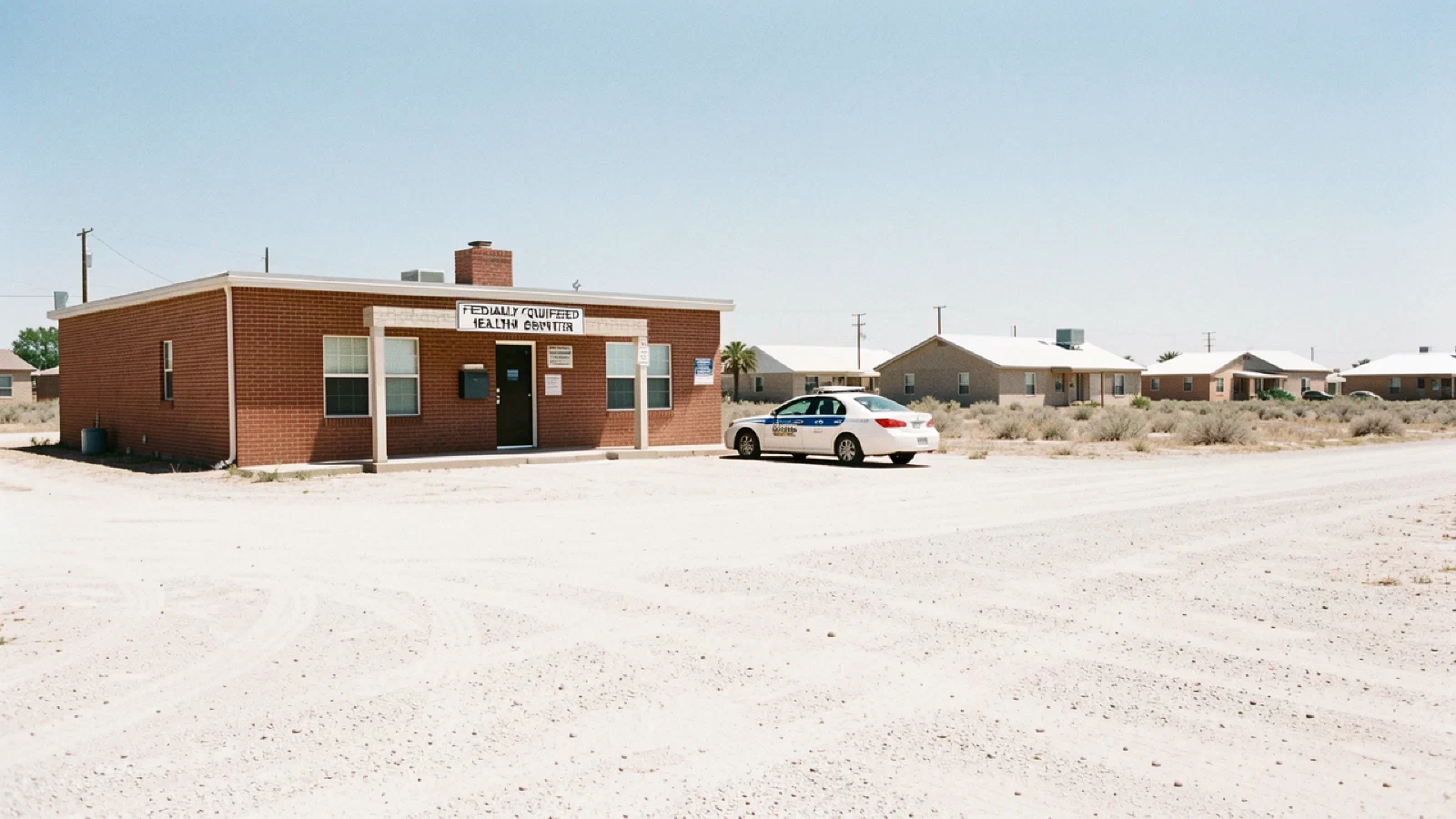
Colonias are unincorporated communities along the U.S.-Mexico border that lack basic infrastructure: paved roads, potable water, sewage systems, and sometimes electricity. The Texas Secretary of State identifies over 2,300 colonias in Texas alone, housing approximately 500,000 residents. Colonias also exist in New Mexico, Arizona, and California.
Colonias developed because they provided the only homeownership opportunity for low-income families unable to qualify for traditional mortgages. Developers sold lots without infrastructure requirements, allowing families to build incrementally over time. The resulting communities lack the services that incorporated areas take for granted.
Colonia Characteristics:
| Feature | Typical Status | Health Implication |
|---|---|---|
| Paved Roads | Often absent | Ambulance access impaired |
| Street Signs | Often absent | Emergency response delayed |
| Potable Water | Often absent or contaminated | Waterborne disease risk |
| Sewage Systems | Often absent | Sanitation-related illness |
| Healthcare Facilities | Absent | Requires travel for any care |
| Pharmacy | Absent | Medication access barriers |
Colonias represent environmental justice communities where infrastructure absence produces health risks that infrastructure presence would prevent. Respiratory illness from dust on unpaved roads. Gastrointestinal illness from contaminated water. Delayed emergency response because ambulances cannot find addresses. The health burden reflects infrastructure deficit that healthcare alone cannot address.
Demographic Characteristics#
Border populations are predominantly Hispanic/Latino, with percentages ranging from 34% in San Diego County to over 95% in some South Texas counties. Many families include members with different documentation status: U.S. citizens, permanent residents, DACA recipients, and undocumented individuals. This mixed-status family structure shapes healthcare access because eligibility differs by documentation.
| Characteristic | Border Counties | Texas | National |
|---|---|---|---|
| Hispanic/Latino Population | 52% | 40% | 19% |
| Limited English Proficiency | 21% | 13% | 8% |
| Below Poverty Level | 22% | 14% | 11% |
| Uninsured Rate | 24% | 17% | 8% |
| Medicaid Enrollment | 34% | 22% | 23% |
| Median Household Income | $38,000 | $67,000 | $75,000 |
The uninsured rate in border communities reaches 24% overall and exceeds 30% in some Texas border counties. Texas non-expansion status creates a coverage gap affecting border residents disproportionately. Undocumented residents are ineligible for most coverage programs. Even citizens and permanent residents face enrollment barriers including language access, documentation requirements, and limited enrollment assistance.
Health Status and Access#
Border Health Outcomes#
Border communities experience health outcomes that reflect socioeconomic disadvantage, environmental exposures, and healthcare access barriers.
Population Experience Analysis:
| Measure | Border Counties | Texas | National | Gap | Source |
|---|---|---|---|---|---|
| Diabetes Prevalence | 14.2% | 11.8% | 9.4% | +4.8% | CDC |
| Obesity Rate (Adult) | 38.4% | 34.8% | 30.4% | +8.0% | CDC |
| Childhood Obesity | 24.1% | 19.3% | 16.1% | +8.0% | CDC |
| Uninsured Rate | 24.0% | 17.0% | 8.0% | +16.0% | Census |
| Primary Care Ratio (pop:provider) | 3,200:1 | 1,640:1 | 1,310:1 | +1,890 | HRSA |
| Mental Health Ratio (pop:provider) | 8,500:1 | 4,210:1 | 3,130:1 | +5,370 | HRSA |
| Life Expectancy | 77.2 years | 78.0 years | 78.6 years | -1.4 years | CDC |
| Infant Mortality (per 1K) | 6.2 | 5.5 | 5.4 | +0.8 | CDC |
The “Hispanic Paradox” complicates interpretation. Despite socioeconomic disadvantage, Hispanic populations often demonstrate better-than-expected health outcomes on some measures, potentially reflecting protective cultural factors, selective migration, or data limitations. Border health statistics may underestimate disparities because the comparison population itself faces significant disadvantage.
The Binational Healthcare System#
Border residents do not experience healthcare as a U.S. system or a Mexican system but as a single binational resource from which they construct their care.
Cross-Border Healthcare Patterns:
| Service | Typical Pattern | Driver |
|---|---|---|
| Prescription Medications | Mexico | Cost (10-30% of U.S. prices) |
| Dental Care | Mexico | Cost (20-40% of U.S. prices) |
| Specialist Consultations | Mexico | Access, shorter waits |
| Emergency Care | U.S. | Quality, insurance coverage |
| Primary Care | Mixed | Depends on coverage, relationship |
| Hospital Procedures | U.S. for insured, Mexico for uninsured | Insurance coverage |
Research estimates that 1 to 2 million U.S. border residents use Mexican healthcare services annually. The practice is not primarily about medical tourism for elective procedures but about regular healthcare maintenance that U.S. systems make inaccessible through cost, distance, or wait times.
[VIGNETTE: Maria lives in Hidalgo County, Texas with her husband and three children. She is a U.S. citizen; her husband has a green card; one child is a U.S. citizen, one is a DACA recipient, and one is undocumented. Each family member has different healthcare eligibility. Maria gets primary care at the FQHC when she can get an appointment (usually 6-8 week wait). For acute needs, she crosses to Reynosa where physicians see patients same-day for $30. She fills all prescriptions in Mexico because the same medications cost one-tenth of U.S. prices. Her diabetic husband manages his condition using Mexican insulin because Texas Medicaid does not cover him as a green card holder under five years. When their undocumented child had appendicitis, they drove 45 minutes to the U.S. hospital because emergency care is better and EMTALA requires treatment regardless of documentation. Her healthcare is binational not by choice but by necessity. The system she constructs works, imperfectly. RHTP sees only the U.S. portion and cannot understand why she has gaps in care continuity.]
Documentation and Healthcare Access#
Documentation status shapes healthcare access in border communities more than anywhere else in the country:
| Documentation Status | Emergency Medicaid | Full Medicaid | Marketplace | FQHC Sliding Scale | Medicare |
|---|---|---|---|---|---|
| U.S. Citizen | Yes | Yes (if eligible) | Yes | Yes | Yes (if 65+) |
| Permanent Resident (5+ years) | Yes | Yes (if eligible) | Yes | Yes | Yes |
| Permanent Resident (<5 years) | Yes | State-dependent | Yes | Yes | Yes |
| DACA | Emergency only | No | No | Yes | No |
| Undocumented | Emergency only | No | No | Yes | No |
Mixed-status families navigate these eligibility differences constantly. Parents may be undocumented while children are citizens. Spouses may have different documentation. The complexity creates situations where family members receive care from different systems with different rules, producing fragmented care that integrated approaches cannot resolve without addressing documentation barriers.
The Core Tension: Universal Approach Versus Binational Reality#
The U.S.-Only Framework#
RHTP operates within a U.S.-only framework that assumes healthcare recipients are U.S. residents using U.S. facilities, providers are licensed in the U.S. and paid by U.S. payers, transformation success is measured by U.S. healthcare utilization, and international boundaries are barriers to cross rather than lines that people regularly traverse.
This framework functions adequately for most rural populations. A resident of rural Nebraska receives healthcare from Nebraska providers paid by Nebraska Medicaid or private insurers. The U.S.-only assumption matches reality.
The framework fails at the border because the assumption does not match how border residents actually obtain care. Measuring transformation success by U.S. utilization misses the Mexican healthcare that border residents regularly use. Building U.S. capacity without recognizing that residents compare U.S. services to accessible Mexican alternatives means building capacity that may not be used.
The Binational Integration Perspective#
The alternative view: Effective border health requires binational coordination. Programs addressing only the U.S. side miss half the system border residents use. True transformation would coordinate across the border, creating continuity between U.S. and Mexican care, enabling information sharing between systems, and recognizing that border health is binational health.
Assessment: This perspective correctly identifies the problem. Border health is inherently binational. U.S.-only approaches are inherently limited. However, binational health policy faces enormous political and practical barriers: sovereignty concerns, different systems, licensing and liability mismatches, payment mechanisms that do not cross borders, and the political sensitivity of any program perceived as facilitating care for undocumented individuals.
The realistic assessment: Binational integration is conceptually correct but practically constrained. RHTP cannot create binational health policy because that requires international agreements beyond program scope. What RHTP can do is acknowledge binational reality while operating within U.S.-only constraints, designing programs that recognize how border residents actually obtain care even if the program cannot directly address the Mexican portion.
RHTP Relevance#
How Border States Address Border Health#
Texas has the largest border population and the most developed border health infrastructure, though that infrastructure remains inadequate for need.
| Texas Border Program | Function | RHTP Relevance |
|---|---|---|
| Texas-Mexico Border Health Commission | Coordination, data | Limited RHTP integration |
| DSHS Border Health | State agency programs | Some RHTP alignment |
| FQHCs (border region) | Primary care | Significant RHTP subawardee potential |
| UTHealth School of Public Health (Brownsville) | Research, training | Workforce development |
| Texas A&M Colonias Program | Infrastructure, health | Cross-sector coordination |
Texas RHTP focuses on statewide transformation without distinct border targeting. The border region competes with other Texas regions (Panhandle, East Texas, West Texas) for state attention and resources.
Arizona border health is complicated by tribal health overlaps. The Tohono O’odham Nation’s reservation straddles the U.S.-Mexico border, creating unique jurisdictional and healthcare coordination challenges.
New Mexico has the smallest border population but faces similar challenges around colonias, uninsured populations, and cross-border healthcare seeking.
California’s border region centers on San Diego and Imperial counties. San Diego’s metropolitan character differs from rural border communities elsewhere, while Imperial County faces rural border challenges similar to South Texas.
State RHTP Examples:
| State | Border Population | RHTP Border Provisions | Assessment |
|---|---|---|---|
| Texas | 3.1 million | No distinct targeting | Lost in statewide approach |
| Arizona | 1.1 million | Limited | Tribal focus dominates |
| New Mexico | 0.4 million | Some colonia recognition | Modest accommodation |
| California | 3.4 million | Urban focus (San Diego) | Rural Imperial overlooked |
Gap Assessment#
What RHTP Provides:
- FQHC expansion reaching border communities
- Community health worker deployment including promotores
- Telehealth expansion (valuable but limited by broadband gaps)
- Workforce development including Spanish-language competency
- Some states include culturally appropriate care language
What RHTP Does Not Provide:
- Recognition of cross-border healthcare reality
- Coordination mechanisms with Mexican health systems
- Documentation-sensitive design for mixed-status families
- Colonia infrastructure investment (outside health sector scope)
- Binational health information exchange
- Competitiveness with accessible Mexican healthcare alternatives
The core gap: RHTP assumes border residents will use RHTP-funded U.S. services. Border residents will use U.S. services when those services are superior to accessible Mexican alternatives. For many services (especially pharmacy, dental, and non-emergency care), Mexican options are more accessible, affordable, and immediate. RHTP transformation that does not account for this competition may build capacity that goes unused.
Alternative Perspective: The Documentation-Sensitive Design Imperative#
The Perspective: Border health transformation requires documentation-sensitive design that serves all residents regardless of immigration status. Mixed-status families cannot be served by programs that create differential eligibility. Healthcare transformation that excludes undocumented residents is not transformation for border communities; it is transformation that leaves the most vulnerable behind.
Assessment: This perspective has both moral force and practical implications. Undocumented residents are part of border communities. They work, pay taxes, raise children, and contribute to community life. Excluding them from healthcare creates public health risks (untreated infectious disease, delayed care producing emergency presentations) that affect everyone.
However, documentation-sensitive design faces intense political opposition. Programs perceived as providing benefits to undocumented residents attract attacks that can undermine entire initiatives. State agencies in politically conservative border states (Texas, Arizona) face constraints on how explicitly they can accommodate undocumented populations.
The practical reality: FQHCs serve patients regardless of documentation under sliding fee scales. Emergency departments treat patients under EMTALA regardless of status. These existing structures provide some documentation-sensitive access. RHTP cannot explicitly expand undocumented access in politically hostile environments, but can strengthen institutions (FQHCs, community health workers) that serve all populations as part of their standard operation.
State and Regional Variation#
Border Health Varies by Context:
| Factor | South Texas | Arizona Border | California Border |
|---|---|---|---|
| Primary Challenge | Poverty, coverage | Tribal overlap | Urban/rural split |
| Colonia Prevalence | High | Moderate | Low |
| Cross-Border Traffic | Very high | Moderate | High |
| Healthcare Infrastructure | Limited | Moderate | Strong (SD), limited (Imperial) |
| Political Environment | Hostile to expansion | Moderate | Supportive |
| RHTP Potential | High need, limited targeting | Moderate | Limited rural focus |
South Texas represents the most acute border health challenge: highest poverty rates, most extensive colonias, highest uninsured rates, and healthcare infrastructure least adequate for need. The McAllen-Edinburg-Mission metropolitan area has among the lowest health rankings of any U.S. metro.
[VIGNETTE: El Paso and Ciudad Juárez function as a single binational metropolitan area of 2.7 million people divided by an international border. Residents cross daily for work, shopping, and services. El Paso hospitals serve Mexican patients who can pay; Juárez clinics serve El Paso residents seeking affordable care. A diabetic in El Paso may see a U.S. endocrinologist annually (insurance covers), purchase monthly insulin in Juárez (one-tenth the cost), and check blood sugar using strips bought at a Juárez pharmacy. When her daughter needed braces, they went to an ortodoncista in Juárez for $1,500 rather than the El Paso orthodontist quoting $6,000. The family’s healthcare is integrated across the border in ways that neither U.S. nor Mexican health systems recognize. RHTP measures only what happens on the U.S. side and sees gaps that do not exist. The family has continuous, adequate care; it just is not U.S. care.]
Intersectionality Considerations#
Border populations intersect with other categories creating distinct experiences:
| Intersection | Compound Effect | Estimated Population |
|---|---|---|
| Border + Farmworker | Seasonal mobility, documentation barriers | ~500,000 |
| Border + Elderly | Medicare limits in Mexico, transportation barriers | ~800,000 |
| Border + Children | School health limited, CHIP complications for mixed-status | ~2 million |
| Border + Diabetes | High prevalence, medication cost barriers | ~1 million |
| Border + Tribal (Tohono O’odham) | Reservation straddles border, unique jurisdiction | ~30,000 |
The intersection of border status and farmworker status produces extreme vulnerability. Farmworkers in border regions may be seasonal migrants from Mexico, permanent U.S. residents who came as farmworkers, or undocumented workers in agricultural employment. Their healthcare needs are extensive (occupational injury, pesticide exposure, chronic conditions from hard labor), and their access is constrained by documentation, mobility, and the same barriers all farmworkers face, compounded by border-specific factors.
What Transformation Requires#
Necessary Conditions:
Recognition of binational healthcare reality in program design, measurement, and evaluation. This does not require coordination with Mexican systems but acknowledgment that border residents use both systems.
Documentation-sensitive design that serves all residents through structures (FQHCs, community health workers) that do not require documentation verification.
Services competitive with Mexican alternatives recognizing that border residents compare U.S. services to accessible Mexican options. Building U.S. capacity that is more expensive, less accessible, and slower than Mexican alternatives will not change utilization patterns.
Colonia infrastructure investment addressing the environmental determinants that healthcare alone cannot address. This requires coordination with housing, water, and transportation agencies beyond health sector scope.
Culturally and linguistically appropriate care matching border community demographics. Spanish-language capacity is not optional accommodation but baseline requirement.
What Transformation Cannot Provide#
RHTP cannot create binational health policy. International agreements require diplomatic processes beyond RHTP scope. Coordination with Mexican health systems would require statutory changes, liability frameworks, and payment mechanisms that do not exist.
RHTP cannot resolve immigration policy. Documentation-based eligibility is determined by federal immigration and healthcare law. RHTP cannot change who qualifies for Medicaid or Marketplace coverage.
RHTP cannot invest in colonia infrastructure. Housing, water, roads, and sewage require infrastructure investment outside health sector scope. RHTP can provide healthcare to colonia residents but cannot address the environmental conditions producing health risks.
RHTP can acknowledge binational reality while operating within U.S.-only constraints. Programs designed with border context understanding will serve border residents better than programs that assume border residents are like residents elsewhere who simply happen to live near an international boundary.
Conclusion#
Border communities live binational lives in a policy framework that recognizes only nations. Families span borders. Employment crosses borders. Healthcare seeking follows logic that prices and access drive regardless of international boundaries. RHTP’s U.S.-only framework meets this reality imperfectly because the framework does not match how border residents actually obtain care.
The tension between universal approaches and binational reality cannot be resolved at RHTP’s level. True resolution would require binational health policy that political and practical barriers make infeasible. What RHTP can accomplish is border-aware implementation that acknowledges cross-border healthcare patterns, designs services competitive with Mexican alternatives, and serves border residents through structures that do not require documentation verification.
Border residents have constructed healthcare systems from binational resources out of necessity. They navigate two systems simultaneously because no single system meets their needs. They demonstrate sophistication in assembling care that health policy often ignores. RHTP transformation that fails to recognize this sophistication will build capacity that border residents may not use because they already have working systems, imperfect but functional.
The test of RHTP in border communities is whether transformation acknowledges binational reality or pretends the border does not exist. Transformation designed for generic rural populations will serve border populations poorly. Transformation designed with border context understanding can serve border populations within U.S.-only constraints. The difference is whether program designers recognize that the border creates distinct circumstances requiring distinct approaches.
How this article connects to others in Blue Gray Matters.
Sources cited in this article.
- Bastida, Elena, et al. "Persistent Disparities in the Use of Health Care Along the US-Mexico Border." American Journal of Public Health, vol. 98, no. 11, 2008.
- Centers for Disease Control and Prevention. "Border Health." CDC, 2025.
- Health Resources and Services Administration. "Health Professional Shortage Areas." HRSA Data Warehouse, 2025.
- Kaiser Family Foundation. "Health and Health Care in the U.S.-Mexico Border Region." KFF, 2025.
- MHP Salud. "US Mexico Border Region." MHP Salud, 2024.
- Mier, Nelda, et al. "Health-Related Quality of Life Among Mexican Americans Living in Colonias at the Texas-Mexico Border." Social Science and Medicine, vol. 66, no. 8, 2008.
- Ortiz, Gabriela, et al. "Seeking Care Across the US-Mexico Border." Social Science and Medicine, vol. 347, 2024.
- Su, Dejun, et al. "Cross-Border Utilization of Health Care." Journal of Immigrant and Minority Health, vol. 15, no. 4, 2013.
- Texas Department of State Health Services. "Border Health." DSHS, 2025.
- Texas Secretary of State. "Colonia Identification." SOS, 2025.
- U.S.-Mexico Border Health Commission. "Healthy Border 2020." BHC, 2020.
- Wallace, Steven P., et al. "Undocumented Immigrants and Health Care Reform." UCLA Center for Health Policy Research, 2024.