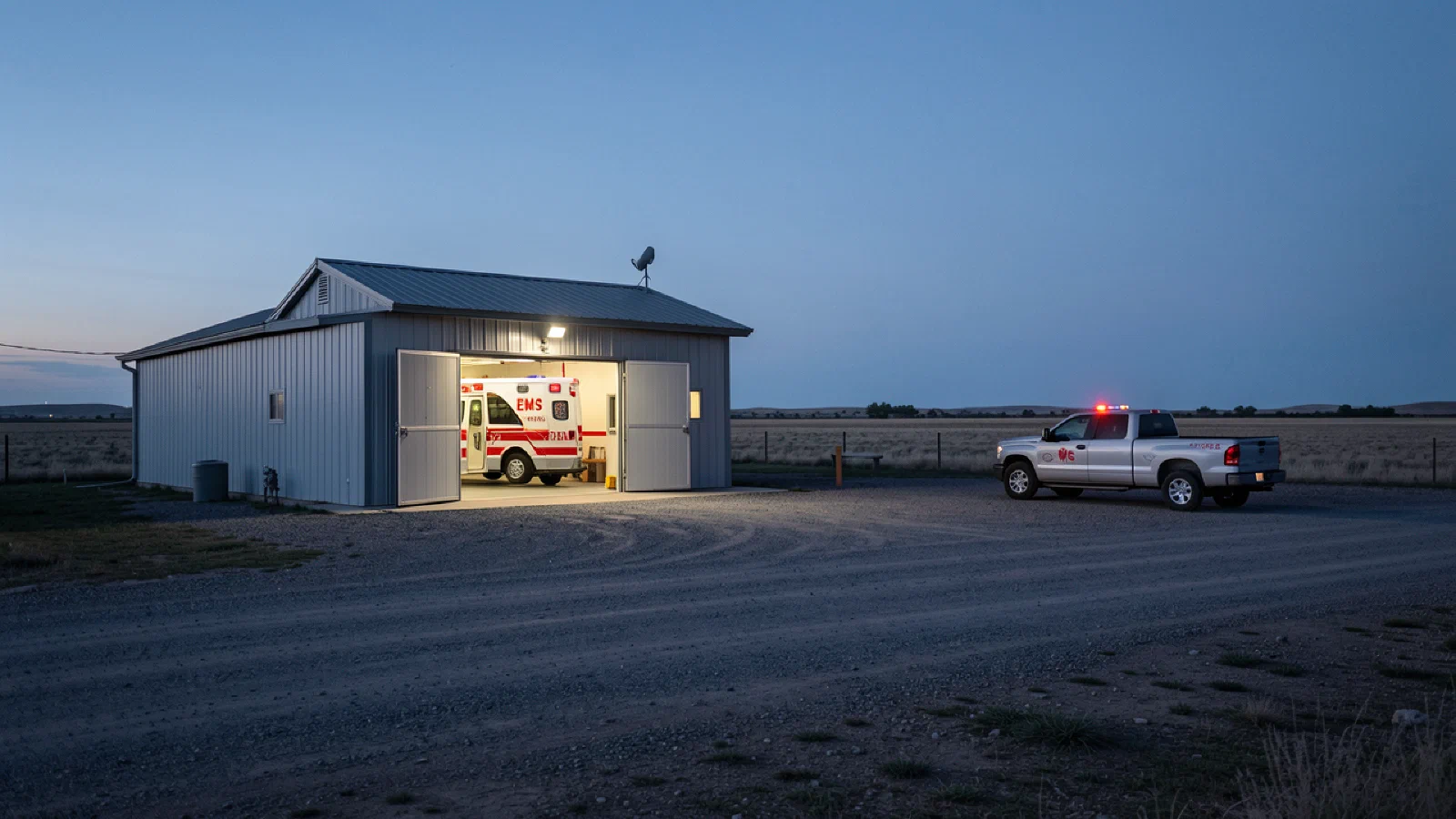
Emergency Medical Services
Emergency Medical Services represent an anomaly in American public safety. Police departments receive dedicated tax revenue. Fire departments receive dedicated tax revenue. Roads and bridges receive dedicated tax revenue. EMS operates differently. Half of rural EMS budgets are “paid for” with volunteer hours, donated time from people who respond to heart attacks and car crashes without compensation, then spend weekends running fundraisers to purchase the equipment they need to save lives.
This funding model, established in the 1960s when communities organized ambulance services as extensions of funeral homes and volunteer fire departments, has produced a crisis of collapsing EMS agencies, lengthening response times, and growing “ambulance deserts” where no ambulance arrives at all. The volunteer EMS model has failed communities across the country. Local leaders are grappling with how to provide this essential service without any sustainable funding mechanism.
The core tension is local control versus sustainable operations. Rural communities value local autonomy. The ambulance that arrives when you call 911 should be staffed by neighbors, maintained by local government, responsive to community priorities. But local control cannot generate the scale economies necessary for sustainable operations. A community of 2,000 people cannot support a professional ambulance service. Neither can four adjacent communities of 2,000 people each, unless they cooperate. Cooperation means shared governance. Shared governance means surrendering local control. Most communities choose to keep control and lose their ambulance service.
RHTP engages EMS through workforce development, care coordination, and community paramedicine expansion. These investments assume EMS agencies exist to receive them. In communities where EMS is collapsing, RHTP’s workforce training produces workers with nowhere to work. Understanding what conditions enable EMS transformation, and what conditions make transformation impossible regardless of funding, is essential for targeting RHTP resources effectively.
Information Limits
EMS operates with less systematic data collection than nearly any other healthcare sector. No comprehensive national registry tracks ambulance agency locations, staffing levels, or financial status. The analysis here relies on recent research identifying ambulance deserts, state-level workforce studies, and industry surveys. Significant gaps remain, particularly regarding volunteer agency sustainability and transition pathways.
The EMS Landscape#
National Profile#
Approximately 21,000 EMS agencies operate across the United States, ranging from single-ambulance volunteer squads serving isolated communities to metropolitan systems with hundreds of units. The EMS workforce includes roughly one million licensed clinicians, though estimates vary widely depending on whether inactive licenses are counted.
| Characteristic | Current Status |
|---|---|
| Total EMS agencies | ~21,000 |
| Total EMS clinicians | ~474,000-1,000,000 |
| Volunteer share (national) | 13% of all EMS personnel |
| Volunteer share (rural) | 74% of volunteers work in rural areas |
| Annual 911 responses | ~28.5 million |
| Revenue model | Insurance reimbursement + local subsidy |
Rural EMS differs fundamentally from urban systems. Urban agencies are typically municipal departments or contracted private services, staffed by paid professionals, operating multiple units across defined service areas. Rural agencies are predominantly volunteer-based, operating one or two ambulances covering hundreds of square miles, responding to low call volumes that cannot support professional staffing.
According to the 2024 CDC analysis Emergency Medical Services: A Look at Disparities in Funding and Outcomes, rural EMS agencies more often rely on volunteers and part-time staff, operate at basic life support level rather than advanced life support, and travel longer distances per run due to larger service areas and lower population density. This results in higher average costs per trip while generating lower revenue per transport.
Governance Models#
EMS operates under diverse governance structures reflecting local history, resources, and preferences:
Volunteer Services: Community-based organizations staffed by unpaid volunteers who respond from home or work when dispatched. Requires 24/7 availability from multiple individuals. Common in smallest rural communities.
Fire Department Integration: EMS operated as a division of local fire departments. Firefighters cross-train as EMTs or paramedics. Provides staffing stability but can create scope conflicts between fire and medical priorities.
Hospital-Based EMS: Ambulance services owned and operated by hospitals, typically Critical Access Hospitals. As of 2022, approximately 21% of CAHs had hospital-based ambulance services. Advantages include integration with emergency department personnel and favorable Medicare reimbursement in remote areas (35+ miles from another EMS unit).
Municipal Services: Dedicated EMS departments funded through local government budgets, staffed by paid professionals. Provides service reliability but requires substantial tax support that many rural communities cannot generate.
Private Ambulance Companies: For-profit or non-profit organizations contracting with local governments. May provide efficient operations but creates conflicts between profit motives and universal service obligations.
Regional Authority Models: Multi-jurisdiction organizations sharing resources across county or multi-county areas. Achieves economies of scale but requires surrender of local control.
Each model produces different relationships between sustainability and accountability. No governance model solves the fundamental problem of insufficient revenue for rural EMS operations.
The Funding Crisis#
How EMS Financing Differs#
EMS is the only essential public safety function expected to fund itself by billing the person who needs help. Fire departments do not bill homeowners whose houses burn. Police departments do not bill crime victims. EMS does.
Medicare, Medicaid, and commercial insurance reimburse ambulance services, but only if a patient is transported to a healthcare facility. The reimbursement model assumes EMS exists to transport patients. It does not reimburse:
Treat-and-release calls: When EMS responds, stabilizes a patient, and the patient declines transport. The ambulance crew’s time, equipment, and expertise generate no revenue.
Community paramedicine: When EMS personnel provide preventive care, chronic disease management, or post-discharge follow-up without transport. Medicare currently has no standard reimbursement pathway for these services.
Standby readiness: The cost of maintaining ambulances, equipment, and available personnel to respond within minutes, 24 hours daily, 365 days yearly. These fixed costs must be covered regardless of call volume.
Dry runs and non-billable responses: Calls cancelled en route, calls where the patient dies before arrival, calls assisting other agencies. All consume resources without generating revenue.
The Rural Math Problem#
Rural EMS faces a mathematical impossibility. Fixed costs remain constant regardless of call volume, but revenue depends entirely on transports.
Consider a typical rural ambulance agency:
- Annual operating costs: $300,000-$500,000
- Required staffing: 2 personnel per ambulance, 24/7 coverage
- Call volume: 200-400 runs annually
- Transport rate: 60-70% of calls result in transport
- Average reimbursement: $300-$500 per transport after write-offs
At 300 runs annually with 65% transport rate and $400 average reimbursement, an agency collects approximately $78,000 in transport revenue. The remaining $220,000-$420,000 must come from somewhere else.
That “somewhere else” is volunteers and community goodwill. Volunteer labor substitutes for $150,000-$300,000 in annual salary costs. Community fundraisers, local tax levies, hospital subsidies, and foundation grants cover remaining gaps. When any component fails, the agency fails.
Insurance Reimbursement Inadequacy#
Medicare ambulance reimbursement follows a fee schedule that bears no relationship to actual rural EMS costs. The Medicare Ambulance Fee Schedule establishes base rates for different service levels and geographic adjustments, but does not account for the fundamental cost structure differences between high-volume urban systems and low-volume rural agencies.
Research from the Maine Rural Health Research Center found that reimbursement is often not sufficient to cover operating costs, particularly in rural areas where low call volume and longer drives combine to create higher fixed operating costs. The 2024 NRHA policy brief on community paramedicine describes the situation bluntly: EMS practitioners often fill gaps in primary care by providing necessary medical services, but they are unable to be compensated under current reimbursement rules, including Medicare, Medicaid, and private insurance.
Medicaid reimbursement compounds the problem. Medicaid typically pays 40-60% of Medicare rates for ambulance services. In states with high Medicaid enrollment, rural EMS agencies serve populations that generate the lowest revenue per transport. A 2023 Michigan law addressing this issue increased Medicaid ambulance reimbursement to 100% of Medicare rates, representing a substantial increase from typical state Medicaid payments.
Ambulance Deserts#
Definition and Scope#
An ambulance desert is defined as a populated area more than 25 minutes from an ambulance station. This threshold represents the practical limit for emergency response, given that cardiac arrest survival drops precipitously beyond 8-10 minutes without intervention.
The 2023 Maine Rural Health Research Center analysis Ambulance Deserts: Geographic Disparities in the Provision of Ambulance Services found:
| Finding | Statistic |
|---|---|
| Population in ambulance deserts | 4.5 million Americans |
| Rural share | 2.3 million (51%) |
| Urban share | 2.2 million (49%) |
| Rural population in deserts | ~5% of rural population |
| Urban population in deserts | <1% of urban population |
| Counties with ambulance deserts | 82% of all counties |
| Rural counties with deserts | 84% |
While only 14% of Americans live in rural areas, they constitute more than half of those living in ambulance deserts. Rural Americans are approximately five times more likely than urban residents to live beyond 25 minutes from ambulance coverage.
Geographic Distribution#
Ambulance deserts concentrate in predictable patterns:
Southern Appalachia: Kentucky, West Virginia, Tennessee, Alabama, and North Carolina contain large populations without timely ambulance access. These areas combine challenging terrain, limited tax bases, and hospital closures that force ambulances to travel further.
Western states: Montana, Nevada, Utah, New Mexico, Wyoming, Idaho, North Dakota, and South Dakota have fewer than three ambulances per 1,000 square miles. Geographic scale overwhelms available resources.
Rural mountains of New England: Maine, Vermont, and New Hampshire contain ambulance deserts in mountainous areas where population density cannot support coverage.
Texas: At the top nationally in terms of populations living in ambulance deserts, with 94.9% of Texas counties containing desert areas. The scale of rural Texas creates coverage gaps impossible to address without significant state investment.
A September 2025 study in the Journal of Trauma and Acute Care Surgery confirmed these patterns, finding that 8.9% of rural populations live in ambulance deserts compared to 0.3% of urban populations. The study also found ambulance deserts are associated with higher area deprivation index scores, indicating that disadvantaged communities have fewer EMS stations available.
Consequences#
Ambulance deserts have direct mortality implications. Rural response times of 60 minutes are not uncommon, compared to urban EMS striving for 8-minute response. The Institute of Medicine documented that rural communities have higher mortality and morbidity for time-critical emergencies, including heart attacks, strokes, and major trauma.
When rural hospitals close, the problem compounds. An EMS agency serving a community whose hospital closes must now transport patients to more distant facilities. Transport times double. The ambulance is unavailable for the next call for hours rather than minutes. Response capacity effectively shrinks as coverage demands expand.
The AMA Journal of Ethics noted in July 2025 that rural EMS response times “of 60 minutes are not uncommon” and that “the crisis of health care ‘deserts,’ exacerbated by the closure of 193 rural hospitals from January 2005 through December 2024, is a major contributor to rural communities’ increased mortality and morbidity.”
The Workforce Crisis#
Volunteer Decline#
The volunteer EMS model that sustained rural communities for 60 years is collapsing. Volunteerism is in decline across all sectors, but EMS faces particular challenges:
Time demands exceed typical volunteer commitment. EMS volunteering requires 24/7 on-call availability, ongoing training to maintain certification, and emergency responses that cannot wait for convenient times. This differs fundamentally from volunteering at a food bank or church.
Training requirements have increased. Modern EMS requires more sophisticated clinical skills than the first aid training that sufficed in the 1970s. EMT certification requires 150-190 hours of training. Paramedic certification requires 1,200-1,800 hours. Few volunteers can invest this time without compensation.
Work patterns have changed. When rural communities had local employment, workers could respond to midday calls from nearby workplaces. The shift to commuter work patterns, where rural residents drive 45-60 minutes to employment, eliminates daytime volunteer availability.
Demographic shifts reduce the volunteer pool. Rural population decline means fewer potential volunteers. Aging rural populations mean volunteers themselves age out of physically demanding EMS work.
The work is dangerous and traumatic. Ambulance crew mortality is three times higher than average workers. Risk of injury from bloodborne pathogens, patient violence, lifting injuries, and vehicle crashes is substantial. Only 11 states monitor on-the-job EMS injuries.
New York State data illustrates the magnitude: EMS responders declined 17.5% between 2019 and 2022. The number of ambulance services decreased 9% in a decade, from 1,078 to 982.
Paid Workforce Challenges#
Professional EMS workers face conditions that drive high turnover:
Low wages. According to Bureau of Labor Statistics data, EMTs earn an average of $40,120 annually while paramedics earn $53,560. Two of five EMTs report hourly wages of $19 or less. These wages compete with retail jobs that impose fewer physical demands and emotional burdens.
Burnout prevalence. The 2025 What Paramedics Want report found that 76% of respondents cite burnout as a critical issue, up from already elevated levels. Research using the Copenhagen Burnout Inventory found over half of EMS clinicians surveyed meet criteria for burnout.
Insufficient staffing. Nearly 60% of EMS agencies report insufficient staffing to meet 911 call demands. This creates a spiral where remaining workers absorb more calls, experience more burnout, and leave faster.
Social needs among providers. A study in Prehospital Emergency Care found EMS providers reporting housing insecurity (23%), food insecurity (27%), substance use struggles (21%), and mental health concerns (42%) during their careers. Two-thirds of EMS providers report depending on overtime pay to make ends meet.
Competition from other sectors. Hospitals experiencing nursing shortages are hiring trained paramedics to work in emergency departments, offering better pay, regular schedules, and climate-controlled environments. Fire departments offer better compensation and benefits than standalone EMS.
The 2024 Ambulance Employee Workforce Turnover Study by the American Ambulance Association found significant turnover among paramedics and EMTs, with educational program attrition accounting for substantial loss of potential workforce. Twenty-one percent of potential paramedics never complete their educational programs, and an additional 11% complete training but never obtain certification.
Essential Service Designation#
The Policy Gap#
EMS exists in a unique policy position: essential to public safety but not legally designated as essential in most states. Unlike police, fire, and even snow removal, EMS agencies in most states have no guaranteed funding, no required coverage standards, and no governmental obligation to ensure service provision.
As of April 2024, only 14 states and the District of Columbia had enacted legislation designating EMS as an essential service. These designations vary widely:
- Some establish minimum requirements for EMS provision
- Some provide flexibility to organize and finance EMS locally
- Some provide resources for system improvement
- California and Colorado focus on requiring local written EMS plans
- North Carolina requires counties to ensure EMS is provided to all citizens
The remaining 36 states impose no requirement that EMS exist at all. Communities can, and increasingly do, simply lose ambulance coverage when volunteer agencies collapse or private providers exit contracts.
Legislative Momentum#
Momentum for essential service designation has accelerated, driven by visible service collapses:
New York (2024-2025): The Senate passed Senator Mayer’s bill to designate EMS as an essential service, establish special funding districts, and require comprehensive statewide EMS plans. The legislation aims to create “a guarantee of prehospital care for every city, town and village.”
Idaho (2024): Legislation advanced to relocate the EMS Bureau under the Office of Emergency Management and establish state cost-sharing, though fiscal impact estimates remain preliminary.
Minnesota (2024-2025): Governor Walz signed legislation allocating $30 million for rural EMS, including $24 million in emergency aid and $6 million for a “sprint medic” pilot program.
South Dakota (2025): House Bill 1043 defining EMS as an essential service and creating a state EMS fund was deferred (effectively killed) in committee, despite strong testimony about service gaps. The bill’s $1.4 million annual funding request was deemed insufficient, as stakeholders estimated $50 million would be needed to adequately fund statewide EMS.
The South Dakota outcome illustrates the challenge: acknowledging EMS as essential without providing adequate funding creates unfunded mandates that local governments cannot meet.
What Essential Designation Requires#
Effective essential service designation includes multiple components:
Form: Clear legal structure defining governmental responsibility for EMS provision. Which level of government must ensure coverage? What constitutes adequate coverage?
Function: Operational requirements specifying service levels, response time standards, staffing requirements, and quality metrics.
Funding: Dedicated revenue streams adequate to cover operational costs. Property tax authority, dedicated fees, state appropriations, or formula-based distribution.
Essential designation without funding is symbolic. As one policy analysis noted, if designation “doesn’t come with the form, function and funding to maintain a sustainable EMS system, all we will do is assure that this designation is merely a hollow one.”
Community Paramedicine#
The Expanded Role#
Community paramedicine allows EMTs and paramedics to operate in expanded roles beyond emergency response, providing preventive care, chronic disease management, post-discharge follow-up, and primary care services under physician oversight.
The model addresses a fundamental mismatch: EMS has the infrastructure to reach rural populations, but traditional EMS only responds to emergencies. Community paramedicine uses existing EMS capacity to fill primary care gaps.
Common community paramedicine functions include:
- Post-hospital discharge visits to prevent readmissions
- Chronic disease monitoring for diabetes, CHF, COPD
- Medication management and reconciliation
- Wellness checks for homebound patients
- Hospital-at-home support visits
- 911 call diversion when emergency transport is unnecessary
- Primary care gap-filling when physicians are unavailable
The 2025 NAEMSP position statement on Mobile Integrated Healthcare and Community Paramedicine documents more than 200 peer-reviewed manuscripts since 2012 examining these expanded roles. Programs exist in over 40 states, though most operate without sustainable reimbursement.
Reimbursement Barriers#
Community paramedicine’s potential remains largely unrealized because Medicare does not reimburse these services. The December 2024 NRHA policy brief states the problem directly:
“EMS practitioners often fill this gap by providing necessary medical services, but they are unable to be compensated under current reimbursement rules, including Medicare, Medicaid, and private insurance. To support the sustainability and expansion of community paramedicine, it should be recognized nationally as a formal health care service eligible for reimbursement across all major payer systems.”
The COVID-19 pandemic produced temporary authority for Medicare to waive transport requirements for treatment-in-place, but permanent policy change has not followed. CMS has authority to implement community paramedicine reimbursement but has not exercised it.
State Medicaid programs have moved faster. North Dakota defined services eligible for Medicaid reimbursement including health assessments, chronic disease management, follow-up care, and medication management. Eight states have some Medicaid coverage for community paramedicine services. But Medicaid-only reimbursement creates sustainability challenges in communities with predominantly Medicare populations.
RHTP Integration#
RHTP explicitly includes community paramedicine as a transformation priority. The Center for Health Care Strategies notes that states can invest in community paramedicine to support RHTP’s workforce development goals, with investments aligning across provider payments, workforce, and appropriate care availability. EMS is a scoring factor in RHTP applications.
States using RHTP to expand community paramedicine face the sustainability paradox: RHTP funding can launch programs that ongoing reimbursement cannot sustain. Five-year demonstration funding creates services that collapse when federal support ends unless underlying payment policy changes.
The most promising RHTP-funded community paramedicine programs therefore include advocacy components aimed at changing state and federal reimbursement policy, recognizing that program success depends on policy outcomes beyond program design.
Hospital-Based EMS#
The CAH Connection#
Critical Access Hospitals have particular relationships with EMS that differ from other provider types. CAHs must provide 24/7 emergency care, meaning they depend on EMS to deliver patients. When local EMS collapses, CAH emergency departments lose their patient pipeline.
Some CAHs have responded by acquiring ambulance services directly. The May 2025 Flex Monitoring Team analysis found approximately 21% of CAHs operate hospital-based ambulance services. Benefits identified include:
Integration advantages: Improved coordination between ambulance and emergency department personnel. Seamless handoffs. Shared protocols. Quality control over the entire emergency care episode.
Community perception: Rural residents trust hospitals. Hospital-based ambulances inherit that trust and community support.
Medicare reimbursement: CAH-based EMS units located 35 miles or more from another EMS unit qualify for cost-based reimbursement under Medicare, the same protection that sustains the parent hospital. This eliminates the fee schedule reimbursement inadequacy that destroys standalone agencies.
Cross-training opportunities: Ambulance personnel can work in emergency department roles when not on transport, improving utilization and providing skill development opportunities.
Financial Realities#
Hospital-based EMS is not profitable. Flex Monitoring Team interviews found that even CAHs receiving cost-based reimbursement typically transfer $600,000 or more annually from ambulance operations to hospital cost centers. The ambulance service operates at a loss that the hospital absorbs as community benefit.
CAHs that can absorb this loss view ambulance services as essential infrastructure. Those operating on negative margins cannot take on additional losses, regardless of community benefit.
The decision to acquire or operate ambulance services depends on:
- Hospital financial stability (positive margins enabling cross-subsidy)
- Distance from other EMS providers (eligibility for cost-based reimbursement)
- Community alternatives (whether any other agency can provide service)
- Leadership commitment (willingness to manage non-hospital operations)
- State regulatory environment (licensing and scope of practice rules)
When Hospital-Based EMS Works#
Hospital-based EMS succeeds when:
The hospital is financially stable. Facilities operating on negative margins cannot absorb ambulance losses. Transformation requires stable foundation.
Geographic isolation enables cost-based reimbursement. The 35-mile rule creates strong financial incentive for remote facilities. CAHs closer to other providers face fee schedule reimbursement that produces losses.
Leadership views EMS as mission-critical. Ambulance operations require management attention, regulatory compliance, and community relations distinct from hospital operations. Leadership must commit resources beyond funding.
The community lacks alternatives. When volunteer agencies collapse or private providers exit, hospital acquisition may be the only option for maintaining service.
When Hospital-Based EMS Fails#
Hospital-based EMS fails when:
Hospital financial distress prevents cross-subsidy. Facilities in survival mode cannot take on additional losses.
Reimbursement is inadequate. CAHs within 35 miles of other providers receive fee schedule payment that generates losses exceeding hospital capacity to absorb.
Leadership is stretched. Small CAHs with limited administrative capacity cannot add ambulance management without compromising core hospital operations.
State regulations create barriers. Scope of practice rules, licensing requirements, or certificate of need processes may impede hospital ambulance acquisition.
Transformation Pathways#
Regional Models#
Regionalization offers the most promising pathway for sustainable rural EMS, despite its political difficulty. Individual communities cannot support professional ambulance services. Aggregated populations across multiple jurisdictions can.
Regional models consolidate:
- Dispatch operations
- Vehicle and equipment purchasing
- Training and continuing education
- Administrative functions
- Revenue collection and billing
Consolidation creates scale economies that reduce per-capita costs while enabling professional staffing. A five-county regional authority can support paramedic-level service that no individual county could fund alone.
Barriers to regionalization are political, not operational. Local governments resist surrendering control over essential services. Fire departments resist EMS integration that changes their identity. Existing agencies resist consolidation that eliminates their autonomy.
Successful regional models have typically emerged from crisis. When volunteer agencies collapse and no individual community can replace them, regional cooperation becomes acceptable. Proactive regionalization, before crisis forces the issue, remains rare.
Technology Enhancement#
Technology cannot solve the fundamental funding problem, but can improve sustainability at given resource levels:
Telemedicine integration: South Dakota, Minnesota, Nebraska, and Kansas have implemented systems allowing ambulance personnel to connect with emergency physicians by video during transport. This provides clinical support when single-paramedic crews cannot access real-time medical direction and allows the receiving facility to prepare for arrival.
eCare systems: Avel eCare and similar services provide 24/7 access to emergency medicine expertise. A single paramedic in an ambulance can consult with physicians, have documentation assistance, and receive decision support. North Dakota legislators are exploring state funding for such systems.
Dispatch optimization: Modern dispatch systems can optimize resource deployment across regional areas, ensuring closest available unit response regardless of jurisdictional boundaries.
Training platforms: Online and simulation-based training can maintain certification requirements for volunteer and paid personnel without requiring travel to distant training sites.
State Funding Mechanisms#
Sustainable rural EMS requires revenue sources beyond transport billing and volunteer labor. States pursuing EMS sustainability have created:
Dedicated millages: Local property tax levies dedicated to EMS funding. Requires voter approval. Creates stable, predictable revenue. Examples include numerous Michigan communities.
Court fee allocations: Portions of court fees directed to EMS funds. South Dakota’s failed bill proposed a $5 court fee increase generating approximately $400,000 annually.
State general fund appropriations: Direct state funding for EMS operations or grants. Minnesota’s $30 million appropriation for 2024-2025 represents significant state investment.
Special districts: Legal authorities for multi-jurisdiction EMS funding through dedicated taxes. New York’s essential service legislation enables special EMS districts.
Per-resident fees: Subscription or assessment models charging residents for EMS availability. Provides predictable revenue independent of call volume.
Foundation support: Private philanthropy supporting EMS operations, equipment, and training. Limited to communities with active philanthropic infrastructure.
Each mechanism has advantages and limitations. No single approach works everywhere. Effective state policy provides multiple tools communities can deploy based on local circumstances.
When EMS Can Transform#
Enabling Conditions#
EMS transformation succeeds when multiple conditions align:
Regional governance exists or can be created. Aggregating populations across jurisdictions enables economies of scale impossible for individual communities.
State policy provides funding mechanisms. Essential service designation with adequate funding, dedicated revenue sources, and grant programs create financial foundation.
Hospital integration offers sustainability. Where CAHs can absorb ambulance operations with cost-based reimbursement, transformation becomes possible.
Community paramedicine generates revenue. Where Medicaid or commercial payers reimburse expanded EMS roles, agencies can diversify beyond transport billing.
Leadership commits to change. Volunteer EMS directors willing to pursue regionalization, hospital administrators willing to acquire ambulance services, county commissioners willing to fund professional services.
State workforce support enables staffing. Training programs, reciprocity agreements, and retention initiatives address workforce pipeline.
RHTP Opportunities#
RHTP can accelerate EMS transformation through:
Workforce funding: Training subsidies for EMT and paramedic certification. Retention programs addressing wage gaps. Pipeline development targeting rural residents.
Community paramedicine expansion: Demonstration programs developing sustainable CP models. Technical assistance for program design and implementation.
Regional planning support: Facilitation for multi-jurisdiction collaboration. Legal and operational templates for regional authorities.
Technology investment: Telemedicine infrastructure for ambulance consultation. Dispatch system modernization.
Integration with other transformation: Connecting EMS transformation with CAH transformation, primary care expansion, and behavioral health integration.
When EMS Cannot Transform#
Blocking Conditions#
EMS transformation fails when:
Local control resistance blocks regionalization. Communities that refuse to share governance cannot achieve necessary scale, regardless of funding availability.
No state funding mechanism exists. States without essential service designation, dedicated revenue sources, or appropriations leave communities without options beyond volunteer labor and fundraisers.
Hospitals cannot absorb losses. CAHs operating on negative margins cannot take on ambulance service losses, eliminating the hospital-based pathway.
Community paramedicine remains unreimbursed. Without Medicare reimbursement and with limited Medicaid coverage, expanded EMS roles cannot generate sustainable revenue.
Workforce pipeline is broken. Training programs unavailable locally, wages uncompetitive with alternatives, working conditions driving burnout create workforce shortages that no funding level can immediately resolve.
Geographic scale exceeds any feasible service model. Some Western areas are simply too large and too sparsely populated for any sustainable EMS model at current technology levels.
What Happens When EMS Fails#
When EMS agencies close, communities experience:
Extended response times: Neighboring agencies must cover larger areas, doubling or tripling response times.
Service degradation: Mutual aid from distant agencies provides basic transport, not advanced life support or rapid response.
Mortality increases: Time-critical emergencies become non-survivable when response times exceed therapeutic windows.
Hospital impact: CAH emergency departments receive fewer patients when ambulances don’t exist to transport them. Reduced ED volume affects hospital sustainability.
Out-migration acceleration: Healthcare access, including EMS, affects residential decisions. Loss of ambulance service signals community decline.
Regional cascade: When one agency closes, neighboring agencies absorb its coverage area. Increased burden on those agencies can trigger their own collapse, expanding the ambulance desert outward.
Recommendations#
For EMS Agencies#
Pursue regional models despite political difficulty. Volunteer sustainability is ending regardless of local preferences. Regionalization preserves some service; collapse preserves none. Lead difficult conversations before crisis forces them.
Develop community paramedicine capacity. Even without current reimbursement, building CP capability positions agencies for future payment policy changes. Document outcomes rigorously to support reimbursement advocacy.
Explore hospital partnerships. Where CAHs can absorb operations, hospital-based EMS may be the most sustainable pathway. Approach local hospitals as potential partners rather than competitors.
Engage state advocacy. Essential service designation with adequate funding requires political pressure from EMS leadership, local governments, and community members. Participate in state EMS advisory councils and legislative processes.
For States#
Designate EMS as essential service with adequate funding. Designation without funding creates unfunded mandates. Designation with funding enables transformation. Identify revenue sources before imposing requirements.
Enable regional governance structures. Provide legal frameworks, templates, and technical assistance for multi-jurisdiction EMS authorities. Remove barriers to cooperation across county lines.
Expand Medicaid community paramedicine reimbursement. While waiting for Medicare policy change, states can establish Medicaid payment for CP services, creating partial revenue sustainability.
Invest in workforce pipeline. Fund training programs in rural areas. Support reciprocity for out-of-state certifications. Address wage gaps through direct subsidies or minimum wage requirements.
For CMS#
Reimburse community paramedicine and treat-in-place services. The infrastructure and workforce exist. The clinical evidence supports effectiveness. Only payment policy prevents sustainability.
Expand cost-based reimbursement for rural EMS. The 35-mile rule protects extremely remote agencies but leaves most rural EMS on fee schedules that generate losses. Extend cost-based payment to rural EMS agencies regardless of distance from other providers.
Integrate EMS into value-based care models. As Medicare moves toward accountable care, EMS should be included as partners in population health management, not excluded as fee-for-service outliers.
For RHTP Implementation#
Target EMS investment to communities with transformation capacity. Assess governance structures, state policy environment, and hospital partnership potential before investing in workforce development for agencies that cannot sustain themselves.
Couple workforce funding with sustainability planning. Training workers for agencies that will close within five years wastes resources. Require sustainability plans as condition of workforce investment.
Support regional planning processes. Use RHTP funds to facilitate multi-jurisdiction conversations, develop governance frameworks, and provide transition support for consolidation.
Document EMS transformation models. Successful regional authorities, hospital-based services, and community paramedicine programs should be studied and replicated. Build evidence base for what works.
Conclusion#
EMS transformation faces a paradox unique among healthcare sectors. The service is essential. The funding is insufficient. The workforce is declining. The governance is fragmented. Policy has acknowledged the crisis without providing solutions. RHTP operates within this policy environment, able to invest in workforce and innovation but unable to solve the fundamental sustainability problem.
The volunteer model that created rural EMS is ending. Communities face a choice: professional services funded through sustainable revenue sources, regional cooperation achieving necessary scale, or no ambulance service at all. RHTP can accelerate transition to sustainable models where conditions permit. It cannot substitute for state and federal policy changes that the sector requires.
Some communities will transform their EMS systems during the RHTP period. They will have regional governance, state funding support, hospital partnerships, or community paramedicine revenue that enables professionalization. Their residents will continue receiving timely emergency care.
Other communities will watch their volunteer agencies collapse without replacement. They will join the 4.5 million Americans already living in ambulance deserts. When they call 911, the ambulance will not arrive in time.
The difference between these outcomes is not primarily a function of RHTP funding. It is a function of state policy, local governance, and federal payment reform that RHTP cannot control but must navigate. Understanding these constraints is essential for targeting RHTP resources where transformation is possible, rather than investing in systems that cannot be sustained regardless of initial funding.
EMS is a public good struggling with private funding. Resolving that contradiction requires acknowledging that markets cannot provide emergency response services where market conditions cannot support them. Public investment is required. The only question is whether that investment comes proactively, preserving services, or reactively, after services have already collapsed.
Policy Environment Update: 2026#
Revised February 2026. The following section integrates policy developments finalized after this article’s original publication.
Ambulance Add-On Extensions#
Ambulance add-on payments extended through December 31, 2027. The Consolidated Appropriations Act 2026 extended the rural ambulance add-on (+3% above standard payment) and the super-rural ambulance add-on (+22.6%) through the end of 2027. These payments represent the primary federal lifeline for rural EMS agencies billing Medicare.
This is a two-year extension, not permanent authorization. Rural EMS agencies remain dependent on biennial legislative action to maintain what the article correctly identifies as the difference between financial distress and outright failure. The extender economy that makes long-term planning impossible for hospitals applies with equal force to ambulance services. An agency building a 2027-2030 sustainability plan cannot assume these add-ons continue.
State RHTP offices should note the 2027 cliff. RHTP workforce and infrastructure investments in EMS should account for the possibility that the ambulance add-on expires concurrent with RHTP’s own funding cliff in 2030. The two-year extension creates a three-year window (2025-2027) of relative payment stability, followed by potential simultaneous loss of add-ons and RHTP resources.
Rural Emergency Hospital and MA Rate Calculations#
REH designation now included in MA growth rate calculations. Rural Emergency Hospitals, the 2023 designation allowing facilities to convert from inpatient to emergency-and-outpatient-only status, are now included in the Medicare Advantage benchmark rate calculation. This is a modest structural acknowledgment that REH represents a distinct facility type affecting rural healthcare access in ways MA plan payment calculations should recognize.
The practical significance for EMS is indirect but real. REH conversion is increasingly the transition pathway for CAHs that cannot sustain inpatient services. When a CAH converts to REH status, the ambulance service that transported patients to that facility’s inpatient units must now transport further, to a facility with inpatient capacity. This extends response-to-definitive-care timelines and increases costs for EMS agencies serving REH catchment areas. EMS agencies in communities where CAH-to-REH conversion is possible should assess transport pattern implications before conversion occurs.
Community Paramedicine and ACCESS#
The CMMI ACCESS model’s co-management payment structure creates an indirect pathway for community paramedicine investment. ACCESS pays referring primary care providers approximately $100/year for co-managing aligned beneficiaries. If primary care practices use this revenue to fund community health worker or paramedic-level care coordination, EMS agencies positioned as community paramedicine partners gain potential revenue without directly receiving ACCESS payment.
This is speculative. The current reality is that community paramedicine remains substantially unreimbursed in Medicare FFS. But ACCESS’s logic, paying for care coordination that prevents avoidable utilization, aligns with what community paramedicine programs demonstrate. EMS agencies building community paramedicine capacity should document outcome data rigorously to support eventual reimbursement advocacy.
Updated Recommendations#
Track ambulance add-on extension cycles as closely as state EMS designation advocacy. The 2027 expiration is two years away. Begin advocacy for permanent authorization or long-term extension now, rather than waiting until extension expiration creates crisis pressure.
Assess REH conversion risks in regional EMS planning. When CAHs in your service area are considering REH conversion, model the transport implications before conversion finalizes. EMS perspective should be part of CAH transformation planning, not an afterthought.
Document community paramedicine outcomes systematically. CMMI and CMS attention to chronic care coordination models creates a policy environment where reimbursement for CP may eventually materialize. Evidence from well-documented programs is the currency of reimbursement advocacy.
How this article connects to others in Blue Gray Matters.
Sources cited in this article.
- American Ambulance Association. "Ambulance Employee Workforce Turnover Study." AAA, 2024.
- Brown, Joshua E., et al. "Ambulance Desert Prevalence and Associated Socioeconomic Characteristics in the United States." Journal of Trauma and Acute Care Surgery, Sept. 2025.
- Maine Rural Health Research Center. "Rural Ambulance Service Sustainability: Reimbursement and Operational Challenges." University of Southern Maine, 2024.
- Michigan Department of Health and Human Services. Medicaid Ambulance Reimbursement Rate Alignment Act. State of Michigan, 2023.
- National Rural Health Association. "Community Paramedicine in Rural America: Workforce, Reimbursement, and Implementation." NRHA, 2024.
- Rural Health Information Hub. "Emergency Medical Services in Rural Areas." RHIhub, accessed Jan. 2026, www.ruralhealthinfo.org/topics/emergency-medical-services.