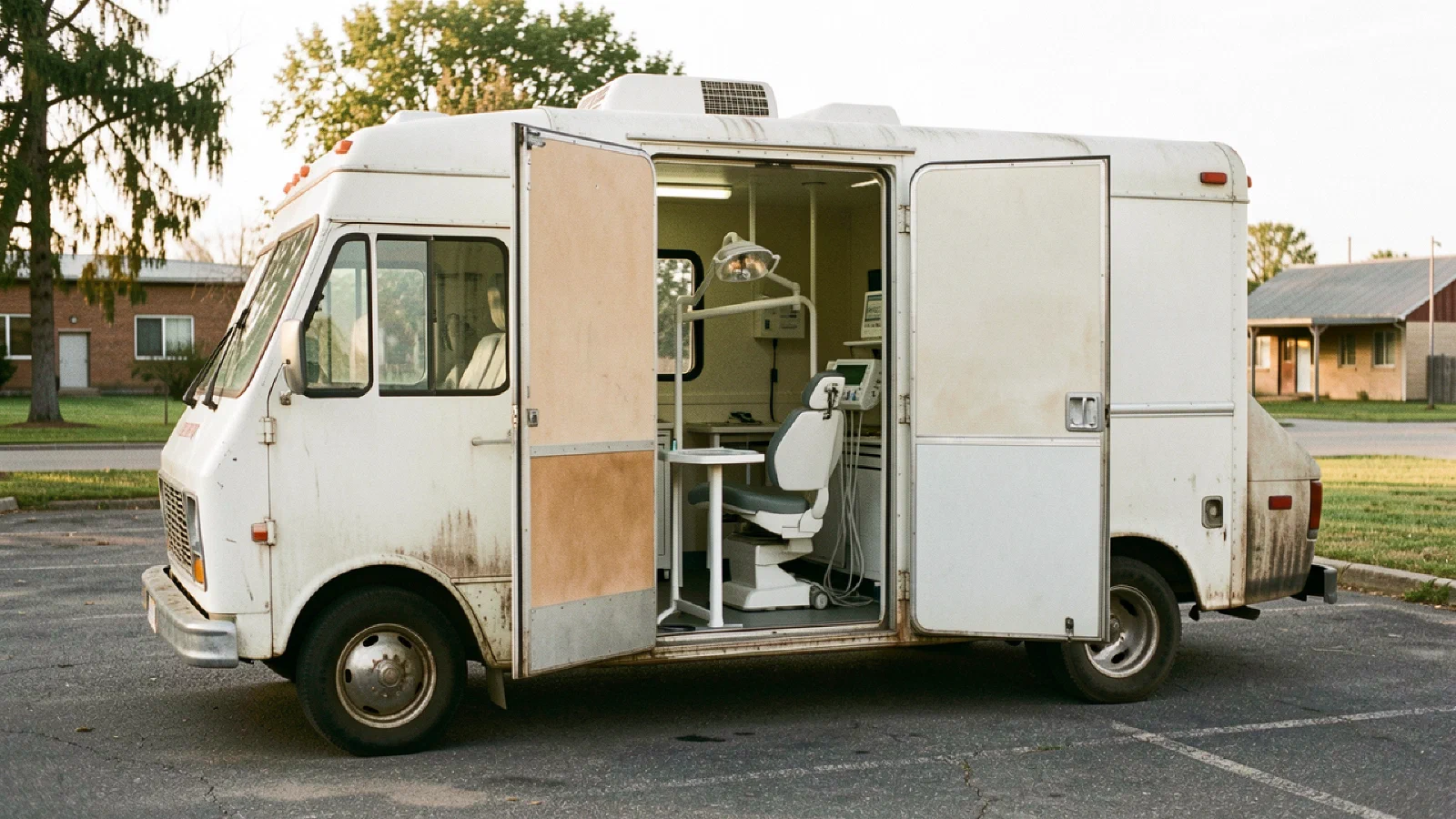
Dental and Vision in Rural Settings
Rural America’s dental and vision crisis exists not because these services are unimportant but because the economics of providing them cannot sustain rural practice. More than 59 million Americans lack adequate access to dental care, with 66% of Dental Health Professional Shortage Areas located in rural communities. Vision care faces parallel challenges: only 29% of ophthalmology workforce needs are met in rural areas compared to 77% in urban settings. These are not workforce distribution problems alone. They represent fundamental failures in how dental and vision care is financed, organized, and delivered.
RHTP places limited direct emphasis on dental and vision transformation. The $50 billion initiative focuses primarily on medical care infrastructure, hospital sustainability, and behavioral health integration. Yet oral health and vision directly affect the conditions RHTP aims to address: chronic disease management, workforce participation, and quality of life. The question is whether RHTP’s peripheral attention to these services represents appropriate prioritization or a critical oversight that undermines transformation goals.
This article examines the structural reasons dental and vision care fail in rural markets, assesses whether workforce expansion or payment reform offers more promising solutions, and evaluates what evidence suggests about realistic intervention pathways. The tension between access deserts (the problem) and business model failure (the cause) frames the analysis.
The Provider Landscape#
Dental Care#
Workforce Distribution
The United States has approximately 200,000 practicing dentists, but their distribution creates profound rural deficits. According to the American Dental Association’s 2025 workforce analysis, rural areas have 4.7 dentists per 10,000 people compared to 7.8 in urban areas. This ratio continues declining as younger dentists increasingly choose metropolitan practice.
State variation is extreme. Arkansas has the nation’s lowest dentist-to-population ratio at 40.2 per 100,000, while the District of Columbia leads at 103.2. States with large rural populations, including Mississippi, Alabama, and West Virginia, cluster at the bottom of workforce rankings.
Health Professional Shortage Areas
As of January 2026, HRSA designates 7,254 Dental Health Professional Shortage Areas nationally, with 5,185 (71%) located in rural or partially rural areas. These designations indicate population-to-provider ratios exceeding 5,000:1, or 4,000:1 in high-need areas. An estimated 10,143 additional dental practitioners would be needed to eliminate all dental HPSAs.
The shortage is not merely geographic. Even where dentists practice, Medicaid participation remains problematic. Only 41% of U.S. dentists participate in Medicaid or CHIP as of 2024, a rate that has remained essentially unchanged since 2015 despite substantial expansion of adult dental benefits across states.
Practice Economics
Rural dental practice economics differ fundamentally from urban settings. Higher Medicaid patient concentrations combine with lower reimbursement rates to compress margins. The ADA Health Policy Institute reports that Medicaid fee-for-service reimbursement averages 48% of dentist charges nationally, with substantial state variation. In some states, reimbursement falls below 30% of charges.
Rural practices face additional cost pressures: higher per-patient travel distances for home visits, difficulty recruiting and retaining hygienists and dental assistants, and lower patient volumes spread across larger geographic service areas. These factors make solo rural dental practice increasingly unviable.
FQHC Dental Services
Federally Qualified Health Centers represent the most significant organized dental safety net in rural America. In 2023, FQHCs served more than 31.5 million patients nationally, with 73% of FQHCs operating dental facilities. Rural FQHCs increasingly emphasize dental services as a core mission component.
FQHC dental programs operate under distinct economics. Section 330 grant funding covers sliding-scale fee discounts for uninsured and underinsured patients. Prospective Payment System reimbursement provides more favorable Medicaid rates than private practices receive. However, FQHC dental programs face persistent workforce challenges: recruiting dentists to FQHC positions requires competitive salaries that strain organizational budgets, while National Health Service Corps loan repayment helps but does not eliminate the recruitment gap.
Vision Care#
Workforce Composition
Vision care involves multiple provider types with distinct scopes and practice patterns. Ophthalmologists (approximately 18,000 nationally) provide medical and surgical eye care but concentrate heavily in metropolitan areas. Only 5.6% of ophthalmology subspecialists practice in rural areas despite 17.4% of Medicare patients residing there.
Optometrists (approximately 44,000 nationally) provide primary eye care, vision correction, and increasingly expanded clinical services. Unlike ophthalmology, optometry distribution more closely matches population distribution, with 99% of Americans living in counties with at least one optometrist. This makes optometry the practical backbone of rural vision care.
Opticians (approximately 63,000 nationally) dispense corrective lenses but do not examine patients. Rural optician shortages parallel dental assistant shortages: supporting workforce scarcity limits the productivity of available examining providers.
Access Patterns
Rural vision access follows a different pattern than dental access. Routine vision care is more available through optometry practices distributed across small towns and rural communities. The critical gap occurs in specialty ophthalmology services: cataract surgery, retinal treatment, glaucoma management, and emergency care.
Wait times for specialty eye care illustrate the access problem. Rural patients frequently wait six to eight months for cataract surgery consultations. Patients requiring retinal specialists may face travel of 100 miles or more. For emergency conditions like retinal detachment, travel delays can result in permanent vision loss.
Medicare and Insurance Coverage
Vision coverage gaps compound workforce shortages. Original Medicare does not cover routine eye exams, glasses, or contact lenses. Coverage exists only for diagnosis and treatment of eye diseases and for patients with diabetes or post-cataract surgery needs. This leaves routine vision care as an out-of-pocket expense for Medicare beneficiaries unless they enroll in Medicare Advantage plans with supplemental vision benefits.
Approximately 99% of Medicare Advantage plans now offer some vision coverage, but benefit adequacy varies substantially. Rural areas have fewer Medicare Advantage plan options, limiting beneficiary access to vision benefits that urban residents may take for granted.
The Core Tension: Access Desert vs. Business Model Failure#
The Access Desert View#
Rural communities face genuine access crises in dental and vision care. Children in rural areas have higher rates of untreated tooth decay. Adults delay care until conditions become emergencies. Seniors lose teeth that could have been preserved with timely treatment. Vision problems go undiagnosed until they affect driving, working, and daily functioning.
The access perspective emphasizes distribution and supply. If more dentists and eye care providers practiced in rural areas, access would improve. NHSC loan repayment, dental therapy authorization, scope of practice expansion, and telehealth could draw more providers to underserved areas. The solution is workforce development targeted at rural communities.
This view treats the business model as background constraint rather than primary cause. Providers should locate where patients need them. Financial challenges can be addressed through loan forgiveness, grant funding, and payment adjustments. The ethical imperative is expanding access; the economic challenges are obstacles to overcome.
The Business Model Failure View#
The alternative perspective inverts the causation. Rural communities lack dental and vision providers because the business models cannot generate sustainable revenue in low-volume, low-reimbursement environments. No amount of workforce training produces providers willing to practice where they cannot earn reasonable incomes or build viable practices.
The business model failure has multiple components:
Fee-for-service payment rewards volume. Rural practices with smaller patient populations cannot generate the visit volumes that urban practices achieve. A dentist serving a 5,000-person rural county cannot match the productivity of a dentist in a 50,000-person suburban area.
Medicaid reimbursement falls below cost. When rural practices depend heavily on Medicaid patients, and Medicaid pays 30-50% of charges, practices cannot cover overhead. Dentists rationally limit Medicaid patients to preserve financial viability.
Insurance coverage gaps eliminate paying patients. In rural areas with lower rates of employer-sponsored dental and vision coverage, more patients must pay out-of-pocket. Many cannot or will not pay, eliminating potential revenue.
Workforce costs exceed revenue capacity. Recruiting dental hygienists, assistants, and opticians to rural areas requires competitive wages. But patient revenue cannot support urban-competitive compensation.
This perspective suggests that workforce programs without business model reform will continue to fail. Loan repayment helps individual providers but does not change the underlying economics. Dental therapy expands the workforce but may not produce sustainable rural practices if the same revenue limitations apply.
What Evidence Supports#
Evidence on this tension is mixed but leans toward the business model explanation for several reasons.
First, dentist Medicaid participation has not increased despite benefit expansion. Thirty-eight states now offer enhanced adult dental benefits through Medicaid, up from 20 states a decade ago. Yet dentist participation rates remain flat at 41%. Benefits without adequate payment do not produce access.
Second, workforce programs show limited sustained impact. NHSC loan repayment helps recruit providers initially, but retention after obligation completion varies. Providers recruited through financial incentives may leave when obligations end if underlying economics remain unfavorable.
Third, FQHC dental programs work better than market-based approaches in many rural areas precisely because they operate under different business models. Grant funding, PPS reimbursement, and mission-driven organizational cultures produce more sustainable rural dental access than private practice recruitment.
Fourth, dental therapy has not yet demonstrated rural practice viability at scale. While 14 states now authorize dental therapists, Minnesota data show 73% of dental therapists practice in metropolitan areas. Mid-level providers face similar economic pressures to dentists: if rural practice cannot support decent incomes, workforce expansion does not automatically produce rural practice.
The evidence suggests that access expansion requires business model change, not merely workforce increase. This does not mean workforce programs are useless, but that they work best when combined with payment and organizational reforms.
Provider Experience Analysis#
| Facility | State | Type | Setting | Payer Mix | RHTP Connection | Access Model | Sustainability Assessment |
|---|---|---|---|---|---|---|---|
| Delta Dental Clinic of the Bolivar County Community Health Center | MS | FQHC Dental | Rural | 72% Medicaid, 18% Uninsured | None direct | Sliding scale | Stable with 330 funding |
| Appalachian Mountain Community Health Centers | WV | FQHC Dental | Rural | 68% Medicaid, 22% Uninsured | State RHTP partner | Mobile + fixed site | Workforce constrained |
| Northern Lights Dental Clinic | MN | Private Practice w/ Dental Therapist | Rural | 45% Medicaid, 40% Private | None | Dental therapy model | Testing new workforce model |
| Community Vision Care | TX | FQHC with Vision Services | Rural | 65% Medicaid, 25% Uninsured | None | Integrated primary care | Limited scope |
| Access Community Health Centers Dodgeville | WI | FQHC Dental | Rural | 60% Medicaid, 15% Uninsured | None | Dental therapist pilot | Workforce expansion underway |
| Vision Now Trinidad | CO | Private Optometry | Rural | 55% Medicaid, 30% Private | None | Telehealth-augmented | Testing telehealth viability |
| Wallace Medical Concern Dental | OR | FQHC Dental | Urban/Peri-urban | 70% Medicaid, 20% Uninsured | None | Traditional FQHC model | Stable |
| Rural Health Center Dental Services | PA | RHC-integrated | Rural | 50% Medicaid, 35% Medicare | None | RHC co-location | Dependent on RHC viability |
| Tiburcio Vasquez Health Center Dental | CA | FQHC Dental | Suburban serving rural | 75% Medicaid, 15% Uninsured | None | Multi-site network | Organizational strength supports sustainability |
Analysis Observations:
FQHC dental programs demonstrate the clearest sustainability, but depend heavily on Section 330 grant funding and favorable PPS reimbursement. Private practices attempting rural dental care face revenue constraints that FQHCs do not. Vision services remain less integrated into safety net systems, with most rural vision access depending on private optometry practices that face their own business model pressures.
Dental therapy models remain too new to assess long-term sustainability. Minnesota’s experience suggests that authorization alone does not ensure rural practice. Wisconsin’s recent investments in dental therapy training combined with scholarship programs for rural practice represent a more comprehensive approach, but results will take years to evaluate.
The Coverage Gap Reality#
Access Community Health Centers in Dodgeville, Wisconsin illustrates the structural challenge facing rural dental care. The clinic serves a catchment area where alternative dental care requires 45 minutes of travel. Patients regularly present with advanced disease that could have been prevented with earlier intervention. Delayed preventive care cascades into advanced disease, which requires more expensive treatment, which patients still cannot afford, leading to extraction rather than preservation.
The Dodgeville clinic has embraced Wisconsin’s new dental therapy authorization as a potential workforce solution. With 160 designated dental shortage areas in Wisconsin, most concentrated in rural communities, the clinic sees dental therapists as a way to expand capacity without recruiting additional dentists. But workforce is only part of the challenge.
Many patients in the service area lack any dental coverage. Medicare excludes routine dental care. Employer-sponsored dental insurance is less common in small businesses and agricultural operations. Even if the clinic could see more patients, many cannot pay anything. Workforce expansion through dental therapy helps only if patients can afford the care therapists provide.
Case Study: Trinidad’s Vision Innovation#
Rocky Mountain Eye Center served Trinidad, Colorado and surrounding communities for years before closing in July 2024, citing financial strain from the COVID-19 pandemic and inadequate Medicaid reimbursement. The closure left a rural region without local eye care.
Vision Now, a newer optometry practice, occupied the vacated space and attempted a different approach. The practice uses telehealth technology to connect patients with optometrists remotely. On-site technicians operate diagnostic equipment while doctors evaluate results and conduct examinations via video. The model allows the practice to serve multiple rural locations with fewer on-site providers.
The innovation addresses workforce scarcity creatively but faces the same revenue challenges that contributed to Rocky Mountain’s closure. Vision Now developed a membership program offering discounted services at zero interest to help patients without adequate insurance coverage. The practice explicitly built its financial model around the Medicaid reimbursement rates it actually receives rather than the rates it might wish it received.
Early results suggest the model can work, but sustainability depends on technology reducing costs faster than revenue constraints tighten. The practice’s leadership acknowledges that rural vision care cannot rely on traditional fee-for-service economics. Whether telehealth-augmented practice represents a scalable model or a creative solution for specific circumstances remains to be seen.
Dental Transformation Approaches#
Mid-Level Provider Expansion#
Dental therapy represents the most significant workforce innovation in dental care. As of March 2025, 14 states authorize dental therapists: Alaska, Arizona, Colorado, Connecticut, Idaho, Maine, Michigan, Minnesota, Nevada, New Mexico, Oregon, Vermont, Washington, and Wisconsin. Several additional states have introduced authorizing legislation.
Dental therapists complete two to three years of training beyond high school or, in some states, build on dental hygiene credentials. They can perform examinations, fillings, extractions of primary teeth, and other routine procedures under dentist supervision. The model originated in Alaska’s tribal health system and expanded based on demonstrated safety and effectiveness.
The promise of dental therapy is expanding access at lower cost. Dental therapists earn less than dentists and can provide routine care while dentists focus on complex procedures. In settings where a dentist supervises multiple dental therapists, overall practice capacity increases.
The limitation is deployment. Minnesota’s experience shows that dental therapists, like dentists, prefer metropolitan practice. The 2019 Minnesota Department of Health report found 73% of dental therapists working in metropolitan areas. If dental therapy merely adds providers to already-served areas, it does not solve rural access problems.
Effective dental therapy deployment may require practice in underserved areas as a condition of licensure or loan repayment. Wisconsin’s 2025 legislation combining dental therapy authorization with technical college funding and rural scholarship programs attempts this integrated approach. Oregon’s Pacific University program recruits students from underserved communities with expectations of return.
FQHC Dental Expansion#
FQHCs provide the most proven model for rural dental access, but expansion faces constraints. Not every rural community can support an FQHC. The Health Center Program application process is complex and competitive. Grant funding is not unlimited.
Strengthening existing FQHC dental programs may be more realistic than establishing new centers. Many FQHCs have dental facilities but lack adequate staffing. NHSC placement in FQHC dental positions, combined with organizational support for competitive compensation, could expand capacity without new organizational development.
Dental integration with primary care represents another FQHC opportunity. When dental services are co-located with medical care, patients receive oral health screening during routine visits. Referral to on-site dental services is more effective than referral to distant providers. This integration model works in FQHCs that prioritize it organizationally.
Medicaid Payment Reform#
Increasing Medicaid dental reimbursement rates is the most direct business model intervention, but also the most expensive. States that have increased dental Medicaid rates have generally seen increased dentist participation. North Carolina’s 2025 legislative effort to increase dental reimbursement reflects growing recognition that benefit expansion without rate adequacy fails.
The fiscal constraint is substantial. Medicaid dental spending is already significant, and rate increases multiply across all Medicaid dental beneficiaries. States facing budget pressures, particularly those anticipating federal Medicaid funding reductions, may struggle to prioritize dental rate increases.
Value-based payment models offer theoretical alternatives but face implementation challenges in dental care. Most dental treatment is episodic rather than chronic disease management. Quality metrics for dental care are less developed than for medical care. Dental practices generally lack the data infrastructure that value-based payment requires.
Vision Transformation Approaches#
Scope of Practice Expansion#
Optometry scope of practice expansion addresses the ophthalmology shortage by allowing optometrists to perform procedures previously restricted to ophthalmologists. Multiple states passed scope expansion legislation in 2024 and 2025, authorizing optometrists to perform certain laser procedures and minor surgeries.
Evidence suggests scope expansion increases access particularly for Medicare beneficiaries and rural patients. A West Virginia University study found that optometry scope expansion filled care gaps created by ophthalmology shortages. The American Optometric Association emphasizes that 99% of Americans live in counties with optometrists, making scope expansion an efficient way to increase specialty-level care access.
Ophthalmology organizations oppose scope expansion, arguing that patient safety requires physician-level training for surgical procedures. This professional turf battle delays policy changes that could address access needs. The debate will likely continue as workforce shortages intensify.
Telehealth and Remote Monitoring#
Vision care has significant telehealth potential. Diabetic retinopathy screening can be performed with retinal cameras operated by technicians, with images interpreted remotely by specialists. Vision Now’s telehealth-augmented practice model demonstrates broader applications.
Remote monitoring of eye diseases could reduce the need for specialist visits. Patients with stable glaucoma or macular degeneration might have conditions monitored through periodic imaging rather than in-person examinations, with specialist visits reserved for condition changes.
Implementation barriers include equipment costs, reimbursement policies, and regulatory frameworks that may require in-person examinations for prescription renewals. Medicare telehealth flexibilities established during COVID-19 have been partially extended, but permanent policy for vision telehealth remains unsettled.
Medicare Vision Coverage#
The most fundamental vision access reform would be adding routine vision coverage to Medicare Part B. The Medicare Dental, Vision, and Hearing Benefit Act has been introduced repeatedly but has not advanced. The American Dental Association and some other stakeholders oppose including dental benefits in Medicare, complicating coalition-building.
Medicare Advantage plans provide de facto vision coverage for beneficiaries who enroll, but rural areas have fewer Medicare Advantage options and lower enrollment rates. This means rural Medicare beneficiaries are more likely to lack vision coverage than their urban counterparts.
Without Medicare policy change, vision access improvement depends on workforce expansion, telehealth adoption, and state-level initiatives. These approaches can help but do not address the fundamental coverage gap affecting the Medicare population that dominates rural demographics.
RHTP Connection#
RHTP does not directly address dental and vision care in most state implementations. The program focuses on medical care transformation: hospital sustainability, primary care access, behavioral health integration, and chronic disease management. Dental and vision services appear in RHTP contexts primarily when states integrate oral health screening into primary care transformation or include dental services in community health worker scope.
This peripheral attention reflects federal program design. RHTP funds flow through state Medicaid agencies and focus on services Medicaid covers comprehensively. Medicaid adult dental coverage varies by state, and many states offer only emergency dental services. Vision coverage is similarly limited. RHTP cannot easily transform services that Medicaid does not robustly cover.
The question is whether this represents appropriate prioritization or problematic omission. Arguments for RHTP’s medical focus note that limited resources require concentration on highest-impact interventions. Stabilizing rural hospitals and expanding primary care access may produce more population health benefit per dollar than dental and vision expansion.
Arguments against this omission note that oral health affects systemic health conditions that RHTP aims to address. Untreated dental disease worsens diabetes management. Vision problems contribute to falls and injuries among elderly populations. Excluding dental and vision from transformation may undermine transformation goals.
The most promising RHTP connection involves integration rather than parallel services. States that use RHTP funds to support community health workers trained in oral health screening, or that include dental referral networks in care coordination programs, address dental access without diverting resources from medical transformation priorities.
Assessment: What Can Be Achieved#
Honest assessment of dental and vision transformation requires acknowledging the limited evidence that current approaches produce sustained rural access improvement. Workforce programs have existed for decades without eliminating dental HPSAs. Scope of practice expansion helps but does not solve the underlying business model problem. FQHC expansion is effective but constrained by funding and organizational development capacity.
What realistically can be achieved in the RHTP timeframe (through 2030):
Marginal workforce expansion through dental therapy authorization in additional states, with uncertain rural deployment. FQHCs in states with RHTP dental integration may strengthen existing programs. Telehealth adoption for vision care will increase but face reimbursement barriers. Scope of practice for optometry will continue expanding state by state.
What cannot realistically be achieved:
Elimination of dental HPSAs. Universal dental and vision coverage for rural Medicare beneficiaries. Fundamental transformation of dental and vision business models in rural areas. Recruitment of ophthalmology subspecialists to rural practice.
The most important policy insight is that dental and vision access problems require different solutions than primary care access problems. The business model failures are more severe. The safety net infrastructure is weaker. The federal coverage gaps are larger. Applying primary care transformation frameworks to dental and vision will produce primary care improvement and continued dental and vision neglect.
States serious about comprehensive rural health transformation should consider dental and vision as distinct policy domains requiring targeted intervention rather than assuming that general transformation efforts will address them. This may mean dedicated dental access initiatives, vision care partnerships with schools and employers, and explicit attention to oral health in RHTP planning even when RHTP funds do not directly support dental services.
How this article connects to others in Blue Gray Matters.
Sources cited in this article.
- American Dental Association Health Policy Institute. "Dental Care in Medicaid Programs: Update Based on the Latest Available Data from Multiple Sources as of November 2025." American Dental Association, Dec. 2025.
- American Dental Association Health Policy Institute. "Medicaid Reimbursement for Dental Care Services: 2024 Data Update." American Dental Association, Oct. 2024.
- American Dental Association Health Policy Institute. "U.S. Dentist Workforce: 2025 Update." American Dental Association, 2025.
- American Optometric Association. "In Rural America, Opportunity for Optometry Amid Shortfall of Ophthalmologists." AOA News, 2024.
- Benavidez, Gabriel A., et al. "Congruence Between County Dental Health Provider Shortage Area Designations and the Social Vulnerability Index." Preventing Chronic Disease, vol. 21, 2024, article 230315.
- CareQuest Institute for Oral Health. "Rural Oral Health Access Report." CareQuest Institute, 2024.
- Defocus Media Group. "Eye Care Workforce Crisis: Why We Urgently Need More Optometrists and Ophthalmologists." Defocus Media, 19 May 2025.
- Health Resources and Services Administration. "Designated Health Professional Shortage Areas Statistics: Quarterly Report." HRSA Data Warehouse, Jan. 2026.
- Health Resources and Services Administration. "Health Center Program Data." Bureau of Primary Health Care, 2024.
- National Association of Community Health Centers. "Community Health Centers: Providers, Partners and Employers of Choice: 2024 Chartbook." NACHC, 2024.
- National Partnership for Dental Therapy. "State-by-State Dental Therapist Authorization Overview." Oral Health Workforce Research Center, Mar. 2025.
- Rural Health Information Hub. "Oral Health in Rural Communities Overview." RHIhub, 2025.
- SightView Partners. "Unpacking 2025 in Eye Care: Trends, Shifts, and Breakthroughs." SightView, 16 Dec. 2025.
- Wisconsin State Legislature. "Dental Workforce Package: AB 123, AB 124, AB 125, AB 126, AB 127." 2024 Wisconsin Act, signed Sept. 2025.