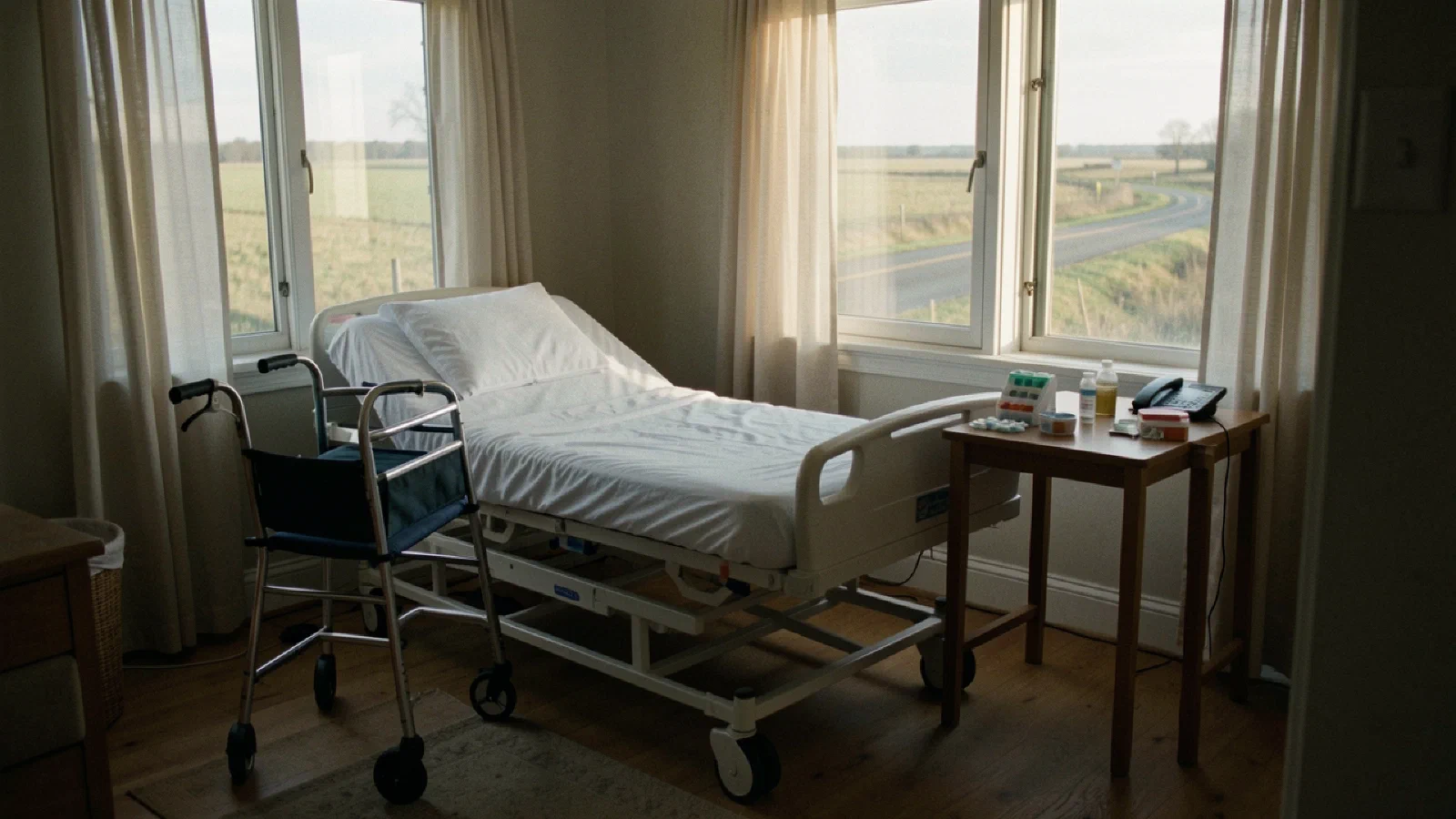
Aging in Place
The American promise of aging in place collides with rural reality: the institutions that once supported elderly residents are disappearing faster than alternatives emerge. Nursing homes close. Home health agencies withdraw. Family caregivers move away. What remains is a population of 9.3 million rural residents over age 65 facing a care infrastructure in active collapse.
RHTP investments acknowledge this crisis. State applications universally invoke aging services, caregiver support, and home-based care expansion. But the evidence base for what actually works in rural eldercare reveals uncomfortable truths: the interventions with strongest evidence require infrastructure rural communities lack, while approaches feasible in sparse populations often lack rigorous evaluation. States proposing to spend billions on aging transformation are largely operating on faith rather than evidence.
This article examines the evidence landscape for rural aging interventions, distinguishing between what we know, what we hope, and what we’re guessing. The core question is not whether rural elders deserve support for aging in place. They do. The question is whether RHTP investments can deliver meaningful impact before the 2030 sunset, given implementation realities that evaluation literature consistently identifies as rate-limiting.
The Demographic Imperative#
Rural America is older than urban America and aging faster. Census data shows 17.5% of rural populations are 65 or older compared to 15.4% in metropolitan areas. The disparity increases with age: rural counties have disproportionately higher shares of residents over 75 and over 85. This aging-in-place-by-default results not from preference but from circumstance. Younger residents leave for education and employment while older residents remain, creating communities where the median age climbs each decade.
Natural decrease now characterizes hundreds of rural counties. Deaths exceed births in communities where the reproductive-age population has departed. Without in-migration, these counties face population decline that compounds year over year. The residents who remain are disproportionately elderly, disabled, or economically unable to relocate.
The health implications compound exponentially. Older populations require more services across every dimension: chronic disease management, acute interventions, rehabilitation, and long-term care. Yet rural communities provide fewer services at greater distances with older and scarcer providers. The demographic trajectory guarantees increasing demand precisely as capacity contracts.
For RHTP planning, this demographic reality establishes both urgency and constraint. Urgency because the population requiring services exists now and grows annually. Constraint because workforce and infrastructure investments require years to produce capacity that addresses immediate needs.
The Institutional Collapse#
Nursing Home Deserts#
The nursing home crisis has accelerated dramatically since 2020. Industry data shows at least 774 nursing homes closed between February 2020 and July 2024, displacing over 28,000 residents. The closure rate exceeds new facility openings by a factor of twenty: while 774 facilities closed, only 37 new facilities opened in 2023, and just seven through the first eight months of 2024.
Rural communities bear disproportionate impact. Forty additional counties became nursing home deserts since February 2020, with 85% of these in rural areas. A nursing home desert is a county with no skilled nursing care options for residents requiring that level of support. For rural residents, closure means not merely inconvenience but geographic impossibility. When the nearest nursing home is an hour away, family visitation becomes exceptional rather than routine. The resident who needs institutional care must leave their community permanently.
Recent research quantifying SNF capacity changes finds national operating capacity declined 5% between 2019 and 2024, with one quarter of counties experiencing declines of 15% or more. Counties with the largest declines were substantially more rural (66.8% versus 49.5%), had lower population densities, and higher proportions of residents over 75. The association between rurality and capacity loss persisted after controlling for staffing shortages.
The workforce crisis drives closures regardless of ownership type or quality ratings. Industry surveys show 66% of nursing homes express concern that persistent workforce challenges may force closure. Twenty percent have already closed units, wings, or floors due to staffing shortages. Forty-six percent limit new admissions. The facilities that remain cannot serve all who need care.
Home Health Gaps#
Medicare-certified home health agencies theoretically provide an alternative to institutional care, but coverage gaps leave many rural counties without any certified home health provider. Even where agencies exist, capacity constraints mean referrals go unfilled and services remain unavailable.
The financial dynamics disfavor rural service areas. Home health workers in rural regions spend significant time traveling between patient homes, reducing direct care hours and increasing per-visit costs. Fuel costs and vehicle maintenance consume larger shares of already thin margins. Medicare payment policy provides modest rural add-ons that fail to offset geographic cost differentials.
Agency consolidation compounds access problems. Publicly traded companies and insurer-owned organizations that acquire independent agencies often subsequently reduce service areas, especially in low-density rural markets. The financial logic is straightforward: the same caregiver can complete more visits per day in dense suburban territories than in scattered rural geographies. Rationalization follows.
The workforce shortage affecting nursing homes extends to home health. Nationally, 59% of home care agencies report operating with insufficient staff. Annual caregiver turnover reaches 77%. Median hourly wages of $15.14 fall below living wage thresholds in most markets. Fewer than 20% of home care aides receive employer-sponsored health insurance. The supply of workers willing to provide care under these conditions cannot meet demand.
Family Caregiver Exhaustion#
The traditional backstop for formal care has been family caregiving. But the demographic dynamics that aged rural communities also depleted the family caregiver pool. Adult children who might provide care have moved to metropolitan areas for employment. They manage crises from a distance through phone calls and periodic visits but cannot provide daily assistance.
Family caregivers who remain are themselves aging. A spouse providing care may be in their late seventies or eighties. Adult children still in rural communities are often in their fifties or sixties with their own health limitations. The sandwich generation cannot be squeezed indefinitely between elder care and other responsibilities.
Caregiver burnout produces predictable consequences: premature institutionalization, emergency department utilization for manageable conditions, unaddressed decline in function. When caregivers collapse, care recipients often face abrupt transitions to whatever institutional options remain available, regardless of fit or preference.
What Collapse Looks Like#
Helen Caudill is 79 years old and has lived in Owsley County, Kentucky, her entire life. She taught fourth grade for 34 years, raised three children, buried her husband in 2021. Until March 2024, she lived at Riverside Manor, the county’s only nursing facility, where staff knew her name and her daughter Amy visited twice weekly from Lexington.
Riverside Manor closed on March 15, citing workforce shortages and financial losses. Helen had 30 days to relocate. The nearest available nursing bed was in Richmond, 68 miles and an hour and twenty minutes from Amy’s house. Helen refused. She would go home.
Home is a frame house built in 1962, where Helen raised her children and where her husband died in the bedroom that still smells faintly of his cigarettes. The bathroom is upstairs. Helen’s knees no longer manage stairs reliably. She has installed a commode in the kitchen, behind a curtain she sewed herself, and sleeps on the couch.
Amy drove down every weekend through summer, then every other weekend when her own health problems mounted. Now she comes monthly when she can. A neighbor, Brenda, who works the morning shift at the Dollar General and the evening shift at the gas station, stops by Wednesdays to check that Helen is alive. Helen’s other two children live in Ohio and Florida. They call on Sundays.
Helen manages her diabetes by feel, adjusting her insulin based on how she felt yesterday, because the clinic is 40 minutes away and she no longer drives. She falls sometimes. She has learned to wait on the floor until she can pull herself up using the kitchen chair. She has not told Amy about the falls.
This is what aging in place means in Owsley County in 2026: not a program, not a policy, not a supported transition to home-based care with wraparound services. It means an elderly woman alone in a house she can barely navigate, visited occasionally by people who love her but cannot help her, waiting for the next fall, the next crisis, the next decision she cannot make alone.
The evidence reviewed below attempts to address situations like Helen’s. The interventions proposed range from housing-with-services integration to community paramedicine to caregiver support programs. Some show promise. None exist in Owsley County. None are coming before Helen needs them.
Policy Environment: What the 3A Landscape Changes#
Three provisions in the current federal policy environment directly affect rural aging-in-place strategies. Each shifts the calculation state planners should make when designing RHTP aging investments.
Hospital-at-Home matched RHTP’s timeline. The Consolidated Appropriations Act, 2026, extended the Acute Hospital Care at Home waiver through September 30, 2030, the same endpoint as RHTP. This is the only major federal flexibility extension matching the program window. States designing aging-in-place strategies should treat hospital-level home care as a viable long-term model, not a temporary pandemic artifact. Technology-enabled acute care delivered at home to elderly patients who would otherwise require hospitalization represents the most consequential expansion of the aging-in-place intervention menu. The extension creates a five-year window to build operational models, develop clinical protocols, and demonstrate sustainability.
HCBS workforce requirements tighten the labor market. The Medicaid Access Rule, finalized in 2024, requires 80% of Medicaid home and community-based services reimbursement to be directed to direct care worker compensation, with a January 2027 implementation deadline for most states. The intent is to raise wages and improve retention in the direct care workforce. The effect in rural areas may include both benefit and burden: higher wages should reduce turnover among home care aides, but the 80% floor constrains agency administrative capacity and may accelerate closures among thin-margin rural home health providers unable to comply. States building RHTP aging strategies around HCBS-funded home care must account for this operational shift.
Dual eligibles sit at the intersection of every coverage cut. The One Big Beautiful Budget Act per capita caps, work requirements, and FMAP phase-downs reduce Medicaid coverage and payment for a population that is disproportionately rural, elderly, and dependent on HCBS for daily function. Nationally, 12.8 million Americans are dually enrolled in Medicare and Medicaid. In rural communities with older-than-average populations, dual eligibles represent a larger share of aging service users than national statistics suggest. RHTP applications that do not identify dual eligibles as a distinct high-risk subgroup are underestimating the compound exposure this population faces. Medicaid cuts reduce HCBS funding. Medicare Advantage penetration changes how these patients access home health. Work requirement procedural disenrollment risks caregivers who support elderly relatives. The aging-in-place infrastructure that dual eligibles depend on faces pressure from all directions simultaneously.
For state RHTP directors: hospital-at-home creates genuine opportunity, HCBS wage requirements demand operational planning, and dual eligible exposure warrants explicit targeting. See 3A for the complete policy environment and 9A for dual eligible population analysis.
Evidence Review#
The evidence base for rural aging interventions reveals substantial gaps between what research supports and what programs attempt. Few interventions have been rigorously evaluated in specifically rural contexts. Urban evidence may not transfer to low-density settings with different service configurations and access patterns.
Evidence Rating Table#
| Intervention | Evidence Quality | Effect Size | Rural Evidence | Implementation Difficulty |
|---|---|---|---|---|
| Home-Based Primary Care | Strong | Moderate | Limited | High |
| PACE Programs | Strong | Large | Limited | Very High |
| Care Coordination/Transitions | Moderate | Small to Moderate | Limited | Moderate |
| Telehealth for Chronic Disease | Moderate | Small | Yes | Moderate |
| Caregiver Support Programs | Moderate | Small | Limited | Low |
| Housing-Plus-Services (SASH) | Moderate | Moderate | Yes | Moderate |
| Community Paramedicine | Limited | Unknown | Yes | Moderate |
| ALF Stabilization | Limited | Unknown | Yes | Variable |
| Adult Day Services | Moderate | Small to Moderate | No | High |
| Home Modification Programs | Limited | Unknown | Limited | Low |
Home-Based Primary Care#
Home-based primary care (HBPC) delivers physician or advanced practice provider visits to homebound patients, addressing the fundamental access barrier that prevents many rural elders from receiving care. Evidence from the Independence at Home demonstration showed reductions in hospitalizations and emergency department visits, with Medicare savings averaging $2,700 per beneficiary per year in early cohorts.
However, HBPC implementation requires provider density that rural communities lack. A physician making home visits in urban areas can see multiple patients per day within a defined geographic radius. The same physician in rural territory may spend hours driving between patients, reducing visit capacity to a handful per day. The economics work in urban settings with concentrated homebound populations. They fail in rural geographies where homebound patients scatter across vast distances.
Rural-specific HBPC evidence remains sparse. Most published studies evaluated urban or suburban programs. Whether demonstrated effect sizes transfer to rural contexts with different travel patterns, service availability, and care coordination infrastructure is uncertain.
PACE Programs#
The Program of All-Inclusive Care for the Elderly represents the strongest evidence base for comprehensive eldercare integration. PACE enrollees show 24% lower hospitalization rates and 16% lower rehospitalization rates compared to dually-eligible beneficiaries in other care arrangements. Participants experience fewer than one emergency room visit annually and low nursing home admission rates despite qualifying for nursing home level of care.
The evidence on costs is more nuanced. ASPE’s comprehensive literature review found PACE reduces Medicare expenditures but increases Medicaid costs, with Medicaid spending gaps narrowing over time. Total program costs may exceed fee-for-service alternatives, though with improved outcomes and participant satisfaction. The National PACE Association reports the model costs states 13% less per month than other Medicaid services, though this calculation depends on specific state rate-setting methodologies.
Rural PACE implementation faces substantial barriers. Programs require adult day centers that participants attend multiple times weekly. Transportation systems must move frail elders across service areas. Interdisciplinary teams need sufficient enrollment to justify staffing. The National PACE Association estimates programs need approximately 100 participants to achieve financial viability. In rural areas with sparse populations, achieving this enrollment requires enormous geographic service areas.
Only 160 PACE programs operate across 32 states, serving approximately 70,000 enrollees nationally. Most programs concentrate in metropolitan areas. Rural PACE sites that exist (such as Midland Care in Kansas or Northland PACE in North Dakota) serve as promising exceptions but have not achieved sufficient scale to demonstrate whether the model can become widespread in rural America.
Congress authorized grants for rural PACE expansion, and several states are attempting rural adaptations. But the fundamental tension between PACE’s comprehensive service model and rural population dispersion remains unresolved. A model requiring participants to travel to a day center multiple times weekly for health monitoring and social engagement may be structurally incompatible with geographies where that travel requires hours rather than minutes.
Vermont SASH Model#
Support and Services at Home (SASH) in Vermont provides the strongest rural-specific evidence for housing-with-services approaches. The program uses affordable housing properties as platforms for care coordination, with SASH coordinators and wellness nurses serving panels of approximately 100 participants each.
Federal evaluation spanning 2010 to 2016 found significant impacts in specific program configurations. Urban panels (those in Chittenden County) showed Medicare spending growth $1,450 lower per beneficiary per year compared to matched controls. The program reduced injuries associated with falls leading to emergency department visits or hospitalizations. Medicaid costs for long-term institutional care grew more slowly for participants than non-participants.
However, the evidence reveals critical implementation heterogeneity. The favorable Medicare cost impacts appeared primarily in panels operated by Cathedral Square Corporation, the program originator, and specifically in urban areas. Rural panels did not show the same Medicare spending impacts. The evaluation explicitly noted that urban panels had access to more health care and social support services than those in rural areas.
This pattern illustrates a recurring challenge: interventions developed and validated in resource-rich settings may not transfer effectively to resource-poor contexts. SASH works by connecting residents with existing services. When those services are scarce or distant, the connection produces less value.
Vermont has sustained and expanded SASH through its All-Payer ACO Model, demonstrating that housing-with-services can achieve ongoing financing. But SASH serves a state with unusual characteristics: small geographic scale, strong affordable housing infrastructure, and integrated health system arrangements that other states lack. Whether the model can replicate in states with less supportive policy environments remains uncertain.
Community Paramedicine for Seniors#
Community paramedicine programs use emergency medical services personnel in expanded roles to provide preventive care, chronic disease management, and care coordination for elderly residents. The approach leverages an existing workforce already distributed across rural territories for emergency response.
Evidence from rural-serving programs shows promising early results. A randomized controlled trial in rural Oregon demonstrated 14% reductions in urgent ED visits and 40% reductions in avoidable ED visits for participants receiving community paramedic services. Programs in rural Nova Scotia reduced annual ED trips by 40% and decreased health care expenses from $2,380 to $1,375 per person annually. Rural Ontario programs targeting high utilizers reduced 911 activations by 24%, ED visits by 20%, and hospital admissions by 55%.
However, the evidence base remains limited by methodological constraints. Most studies use before-and-after designs that cannot exclude regression to the mean. Target populations are often selected for high utilization, where improvement is expected regardless of intervention. Only one cluster randomized controlled trial has been published, from the UK rather than rural North America.
Systematic reviews consistently identify evidence gaps. A 2021 review found community paramedicine promising for elderly care but noted that safety outcomes were not reported in most studies and long-term effects remain unknown. The 2017 Institute of Health Economics review concluded that while programs were associated with reduced emergency service utilization, appropriateness of paramedic decisions and patient safety were not well supported by available evidence.
Sustainability financing presents ongoing challenges. Traditional EMS reimbursement links payment to transport. Community paramedicine explicitly aims to avoid transport through prevention and home management. Some Medicaid programs now reimburse community paramedicine services (14 states offer some EMS services beyond transport, with 5 explicitly covering community paramedicine), but coverage remains inconsistent.
Telehealth for Chronic Disease Management#
Telehealth offers theoretical advantages for rural eldercare: specialist access despite distance, reduced travel burden for routine monitoring, and caregiver respite when virtual visits substitute for transportation logistics. Over 68% of Medicare-certified home health agencies now use some form of telemonitoring or virtual care.
Evidence for telehealth in chronic disease management shows modest effect sizes with inconsistent findings. Systematic reviews find telehealth can improve some outcomes for some conditions (particularly heart failure monitoring), but effects are often small and heterogeneous across patient populations and technology configurations.
Rural-specific telehealth evidence for elderly populations is surprisingly thin given the intuitive appeal of the approach. Studies often exclude or underrepresent older adults with technology barriers. Broadband access, while improving, remains inconsistent in rural areas. Digital literacy among the oldest patients limits engagement with technology platforms.
The patients who most need telehealth support often have characteristics that limit telehealth effectiveness: cognitive impairment, sensory limitations, unfamiliarity with technology, and lack of caregiver support for technical assistance. The gap between telehealth’s potential and its actualized benefit among rural elderly populations remains substantial.
Caregiver Support Programs#
Programs supporting family caregivers include respite care, training, counseling, and care coordination assistance. Evidence from the Resources for Enhancing Alzheimer’s Caregiver Health (REACH) trials and related programs demonstrates modest but consistent effects on caregiver burden, depression, and self-efficacy.
Caregiver support has the advantage of low implementation complexity. Programs can be delivered through existing social service infrastructure, community organizations, or health systems. They do not require new facilities or extensive workforce development.
However, effect sizes on the outcomes that matter most are small. Caregiver support programs show limited impact on care recipient outcomes such as hospitalization or nursing home placement. Supporting caregivers is valuable for caregiver wellbeing, but the hope that caregiver support substantially reduces utilization of acute and long-term care services is not strongly supported.
Rural-specific caregiver evidence is limited. Most studies were conducted in mixed or urban populations. Whether interventions designed around access to support groups, day programs, and in-person services transfer effectively to contexts where such services are unavailable has not been systematically evaluated.
State Program Examples#
Vermont: Integration Achievement#
Vermont’s combination of SASH, the Blueprint for Health, and the All-Payer ACO Model represents the most integrated approach to rural aging in any state. SASH operates in every Vermont county, serving approximately 5,000 participants through 54 panels. Embedded mental health programs at pilot sites demonstrated success sufficient to warrant statewide expansion.
The integration extends to financing. SASH funding flows through OneCare Vermont, the state’s Medicare and Medicaid ACO. This creates sustainability that demonstration programs elsewhere lack. But Vermont’s small scale, policy coherence, and decades of infrastructure investment are difficult to replicate.
Pennsylvania Area Agencies on Aging#
Pennsylvania coordinates aging services through a statewide network of Area Agencies on Aging (AAAs) that can serve as platforms for RHTP investments. The state’s OPTIONS program provides care coordination and service access for elderly residents at risk of institutionalization.
Pennsylvania’s rural challenges include significant geographic variation between eastern suburban areas with aging services infrastructure and western rural counties with sparse providers. The Pennsylvania Rural Health Model, operating in certain rural hospitals, creates potential for integration between acute care and aging services, but systematic evaluation of impact on eldercare outcomes is pending.
Nebraska ALF Stabilization#
Nebraska’s RHTP application emphasizes assisted living facility stabilization as a nursing home alternative. The state’s approach recognizes that maintaining existing ALF capacity may be more feasible than creating new capacity in sparse markets.
Evidence for ALF stabilization is essentially observational. Whether financial support for existing facilities prevents closures, maintains quality, and produces better resident outcomes than alternatives has not been rigorously evaluated. The approach represents a reasonable hypothesis rather than evidence-based intervention.
Montana PACE Adaptation#
Montana’s attempt to adapt PACE for sparse populations illustrates the fundamental challenges. The state explored models with reduced day center requirements and enhanced telehealth components. Geographic distances make traditional PACE attendance patterns impossible across much of the state.
Whether modified PACE models that relax attendance requirements retain the effectiveness of traditional PACE is unknown. The day center model serves purposes beyond service delivery: social engagement, regular monitoring, and caregiver respite. Eliminating or reducing this component may eliminate the mechanism that produces PACE outcomes.
RHTP Application Assessment#
Reviewing state RHTP applications reveals universal acknowledgment of aging challenges and nearly universal absence of evidence-based intervention specifications. States propose aging services, caregiver support, and care coordination without specifying which evidence-supported models they will implement or how they will adapt those models for rural contexts.
Common Application Elements#
Aging-specific initiatives appear in virtually every state application, typically including:
- Care coordination for elderly populations
- Caregiver support programs
- Telehealth expansion for chronic disease management
- Workforce development for home health and direct care
- Transportation assistance
- Social isolation interventions
The language is often generic. States commit to improving aging services without specifying program models, implementation timelines, enrollment targets, or evaluation designs that would enable accountability.
Concerning Patterns#
Several patterns raise questions about implementation viability:
Workforce assumptions without workforce strategies. States propose expanding home health and direct care services without addressing the labor market dynamics that cause current workforce shortages. More funding does not automatically produce more workers willing to provide care at prevailing wages.
Technology solutions for populations with technology barriers. Telehealth features prominently in applications, but plans to address digital literacy, broadband access, and technology support for elderly users are typically absent or superficial.
Care coordination without care to coordinate. States propose connecting elderly residents with services when the problem is often service absence rather than service fragmentation. Coordination produces value when services exist to coordinate.
Infrastructure investments with operational gaps. Building or renovating facilities requires capital. Operating facilities requires sustainable funding streams. Applications addressing capital needs often ignore operational sustainability beyond the RHTP period.
Promising Elements#
Some applications demonstrate more sophisticated approaches:
Housing-with-services integration. States proposing to link aging services with affordable housing development acknowledge the SASH evidence base and attempt adaptation.
Workforce strategies addressing fundamentals. Applications that address wages, benefits, and working conditions rather than just training pipelines show awareness of labor market realities.
Realistic geographic targeting. States that concentrate initial efforts in areas with sufficient population density and existing infrastructure to achieve viable scale, rather than attempting statewide transformation immediately, demonstrate implementation sophistication.
The 2030 Question#
RHTP funding sunsets in 2030. For aging interventions, this timeline creates profound challenges because meaningful workforce and infrastructure development requires years that the program does not provide.
What Can Be Accomplished#
Certain aging interventions can achieve implementation and demonstrate outcomes within the five-year window:
Care coordination programs can deploy within 12 to 18 months and show utilization impacts within 24 to 36 months. The SASH timeline from launch to measurable Medicare spending effects was approximately four years.
Caregiver support programs have short implementation timelines and can demonstrate caregiver-level outcomes quickly, though impacts on care recipient outcomes require longer observation.
Community paramedicine programs can expand with existing workforce and show effects within implementation year. Programs that have achieved outcomes did so quickly once operational.
Telehealth infrastructure can be deployed rapidly where broadband exists. Demonstrating outcomes for elderly users requires addressing adoption barriers.
What Cannot Be Accomplished#
Other aging infrastructure requires timelines beyond RHTP:
PACE program development from initial planning to CMS approval to operational viability typically requires five or more years. States without existing PACE infrastructure cannot achieve meaningful rural PACE enrollment by 2030.
Workforce expansion through training pipelines cannot produce material supply increases within the program period. Nursing programs are two to four years. Home health aide certification can be quicker, but retention challenges mean training investments may not translate to sustained workforce growth.
Facility development including construction, licensure, and operational stabilization extends beyond typical five-year program timelines.
Sustainability Assessment#
The aging interventions most likely to survive RHTP sunset are those that:
- Generate demonstrated Medicare savings sufficient to attract continued ACO investment
- Build into existing state agency structures rather than creating freestanding programs
- Address populations with Medicaid coverage creating state financial interest in continuation
- Achieve sufficient scale to justify ongoing administrative infrastructure
Interventions dependent on grant funding, operated by non-governmental entities without institutional permanence, or producing benefits that accrue primarily to Medicare without state financial offset face sustainability challenges regardless of effectiveness.
Recommendations for Implementation#
For States#
Prioritize evidence-aligned interventions. Among aging approaches, housing-with-services (SASH model), care coordination, and community paramedicine have the strongest rural evidence. PACE is highly effective but implementation feasibility in sparse rural areas is questionable.
Address workforce fundamentals. Direct care worker wages, benefits, and working conditions determine workforce availability more than training investments. RHTP funds used for wage supplements or benefit provision may produce more workforce impact than training program expansion.
Target geographically. Concentrate initial efforts in rural areas with sufficient population density to achieve program viability. Attempting uniform statewide deployment typically produces thin implementation everywhere rather than meaningful implementation somewhere.
Build evaluation infrastructure. Designate evaluation resources from program inception. Without rigorous evaluation, interventions cannot demonstrate effectiveness necessary for sustainability financing.
For CMS and Federal Evaluators#
Prioritize rural-specific evidence generation. Current evidence base draws heavily from urban and mixed populations. Mandate rural subgroup analyses in all RHTP evaluations.
Evaluate implementation fidelity. Document whether states implement evidence-based models as designed or adapt them in ways that may alter effectiveness.
Assess sustainability pathways. Include analysis of financing sustainability in program evaluations. Effective programs that cannot continue beyond RHTP provide limited long-term value.
For Rural Communities#
Inventory existing assets. Effective aging services build on existing infrastructure. Understand what housing, transportation, social services, and health care resources exist before designing interventions.
Engage elder voices. The elderly residents whom programs serve have perspectives on what supports aging in place. Program design without their input typically misses critical practicalities.
Plan for sustainability from inception. Programs that depend entirely on RHTP funding will end when funding ends. Building local financial and organizational capacity during the funded period creates post-RHTP viability.
Conclusion#
Rural elders survive institutional collapse through remarkable adaptation: relying on weakening family networks, traveling impossible distances, accepting untreated conditions, and ultimately institutionalizing far from home when alternatives exhaust. RHTP offers resources to improve this situation but not to solve it.
The evidence base supports certain interventions: housing-with-services integration, care coordination, community paramedicine, and caregiver support. These can be implemented within RHTP timelines and may demonstrate meaningful outcomes. But none substitutes for the institutional care infrastructure that continues to collapse, and none addresses the fundamental workforce crisis that drives that collapse.
States should pursue aging investments with clear awareness of evidence strength and implementation constraints. The interventions with strongest evidence (PACE, home-based primary care) require infrastructure that rural communities lack and timelines that exceed RHTP windows. The interventions feasible in rural contexts (community paramedicine, housing-plus-services) have more limited evidence bases and unknown scalability.
Honest assessment suggests RHTP can improve conditions for some rural elders in some locations. It cannot prevent the broader structural decline in rural eldercare infrastructure. That decline results from demographic forces, economic dynamics, and policy choices beyond any single program’s scope. RHTP can demonstrate what effective rural aging support looks like. Whether that demonstration produces lasting change depends on policy choices that extend far beyond 2030.
How this article connects to others in Blue Gray Matters.
Sources cited in this article.
- Agency for Healthcare Research and Quality. "Evaluating PACE: A Review of the Literature." ASPE Reports, Office of the Assistant Secretary for Planning and Evaluation, aspe.hhs.gov/reports/evaluating-pace-review-literature-executive-summary.
- American Health Care Association. "Access to Care Report 2024." AHCA/NCAL, Aug. 2024, ahcancal.org/News-and-Communications/Press-Releases/Pages/Report-Access-to-Nursing-Home-Care-is-Worsening-.aspx.
- Center for Health Care Strategies. "Making a Case for Community Paramedicine: Evidence Roundup." CHCS, Sept. 2025, chcs.org/resource/making-a-case-for-community-paramedicine/.
- Foubister, Vida, et al. "Can Community Paramedicine Improve Health Outcomes in Rural America?" Commonwealth Fund, Mar. 2023, doi.org/10.26099/5zpy-rq24.
- Health Resources and Services Administration. "Programs of All-Inclusive Care for the Elderly in Rural America." HRSA National Advisory Committee on Rural Health and Human Services Policy Brief, hrsa.gov/sites/default/files/hrsa/rural-health/resources/nac-policy-brief.pdf.
- McGarry, Brian E., et al. "Changes in US Skilled Nursing Facility Capacity Following the COVID-19 Pandemic." JAMA Internal Medicine, Jan. 2026, doi:10.1001/jamainternmed.2025.7197.
- O'Meara, Peter, et al. "Reshaping Healthcare Delivery for Elderly Patients: The Role of Community Paramedicine; A Systematic Review." BMC Health Services Research, vol. 21, no. 29, Jan. 2021, doi.org/10.1186/s12913-020-06037-0.
- RTI International. "Support and Services at Home (SASH) Evaluation: Highlights from the Evaluation of Program Outcomes from 2010 to 2016." Office of the Assistant Secretary for Planning and Evaluation, July 2019, aspe.hhs.gov/reports/support-services-home-sash-evaluation-highlights-evaluation-program-outcomes-2010-2016-0.
- Rural Health Information Hub. "PACE: Program of All-Inclusive Care for the Elderly." Rural Services Integration Toolkit, ruralhealthinfo.org/toolkits/services-integration/2/care-coordination/pace.
- Rural Health Information Hub. "Rural Project Summary: SASH (Support and Services at Home)." Project Examples, ruralhealthinfo.org/project-examples/932.
- SASH Vermont. "Our Results." SASH Evaluation Findings, sashvt.org/our-results.
- Skilled Nursing News. "Top Skilled Nursing Trends for 2025." SNN, Jan. 2025, skillednursingnews.com/2025/01/top-skilled-nursing-trends-for-2025/.
- Turrini, G., et al. "Access to Health Care in Rural America: Current Trends and Key Challenges." ASPE Issue Brief HP-2024-22, Office of the Assistant Secretary for Planning and Evaluation, Oct. 2024.