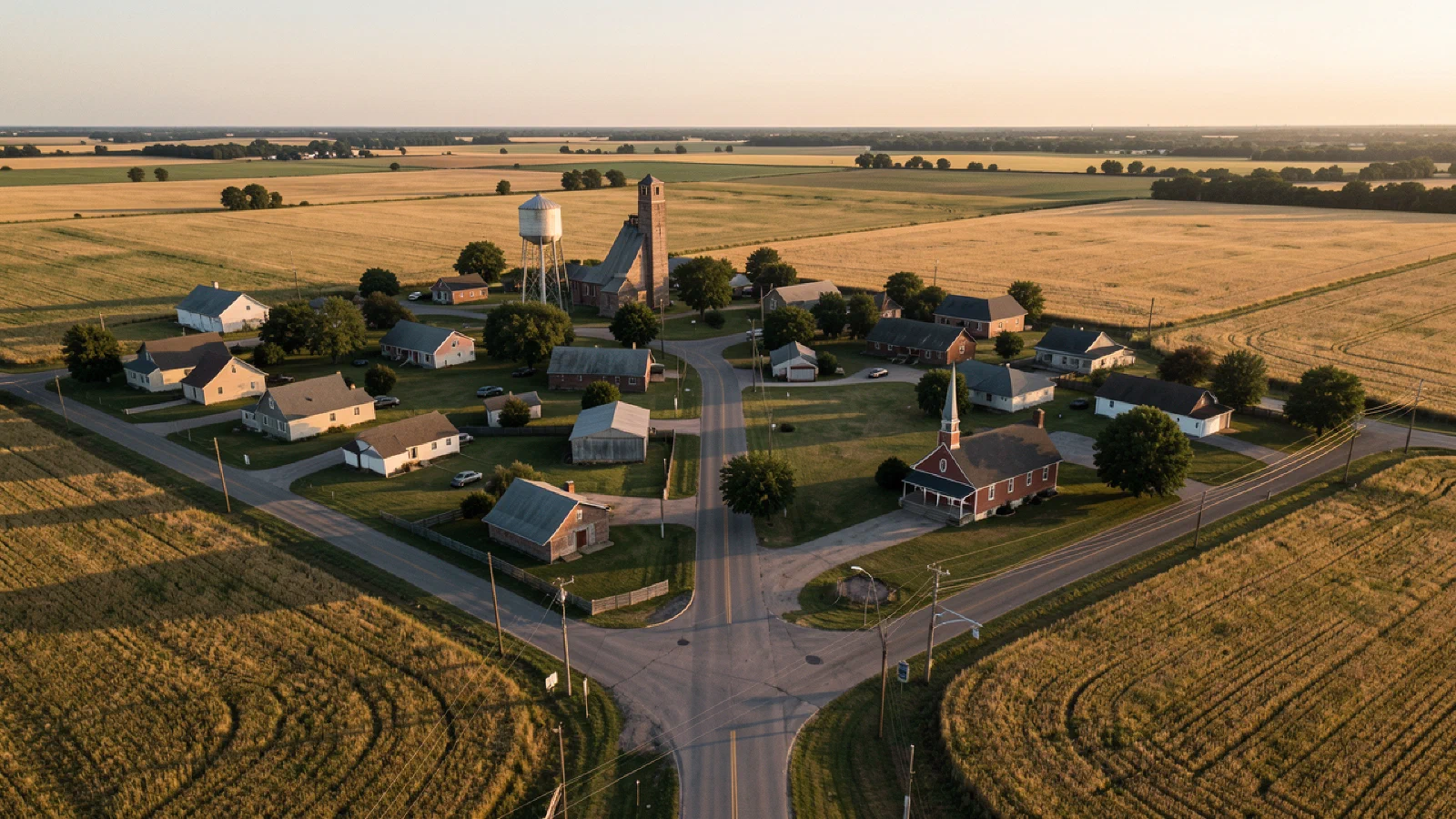
The Terrain of Transformation
Mildred is 72 years old. She lives alone on the farm her husband worked for 47 years before his death. The nearest grocery store is 34 miles away. Her church congregation has shrunk from 120 members to 23 since she joined as a young bride. Her three children moved to cities for college and built lives elsewhere. They call on Sundays. Sometimes.
She manages diabetes with medication she cannot always afford, hypertension with pills she sometimes forgets, and what she suspects is early memory trouble she has mentioned to no one. Her primary care provider retired last year. The replacement is a nurse practitioner she has seen once. The hospital where her husband died closed eighteen months ago. The nearest emergency room is now 41 miles away.
She drives a 2009 Buick with 167,000 miles. When it fails, she does not know what she will do. Her neighbor checks on her weekly, but that neighbor is 78 and not in good health herself. Mildred believes God has a plan. She believes doctors mostly make things worse. She believes in self-reliance because relying on others has never been an option.
She has not told anyone about the falls.
When policymakers in Washington discuss rural health transformation, they are discussing Mildred. When think tanks publish reports on rural decline, they are publishing about her life. When political campaigns invoke “forgotten Americans,” they invoke her. None of them have met her. Most of them have imagined someone quite different.
This synthesis examines the terrain where rural health transformation must occur, the gap between that terrain and how it is perceived, and what understanding both reveals about the work ahead.
A Note on Perspective#
This analysis was written by someone who has spent most of his life in cities and suburbs. That fact matters.
No amount of research substitutes for lived experience. Reading census data is not the same as watching your county’s population decline across your lifetime. Analyzing hospital closure statistics is not the same as driving past the building where your children were born, now dark and empty. Understanding food desert metrics is not the same as knowing that the grocery store your grandmother shopped at closed fifteen years ago and nothing replaced it.
The analysis that follows represents an approximation. It may be a closer approximation than the pastoral fantasies, decline narratives, and political caricatures that dominate metropolitan understanding. It draws on data, research, and the work of scholars who have studied rural America carefully. It attempts to engage multiple frameworks rather than flattening complexity into single narratives.
But the inherent limitation remains. Someone who grew up in rural America, who watched the transformations from inside, who carries the place in their bones rather than their bibliography, would write a different synthesis. They would know things this analysis cannot know. They would feel things this analysis cannot feel. They would catch errors and omissions that outside perspective cannot detect.
This limitation reinforces rather than undermines the core argument. If the author of this analysis cannot fully understand rural America despite sustained attention and genuine effort, then policymakers who have paid far less attention understand far less. The gap between perceived and actual rural America is not a gap that more data closes. It is a gap that requires listening to rural people about their own lives rather than explaining their lives to them.
Mildred knows things about her community, her circumstances, and her needs that this analysis cannot capture. The synthesis that follows is offered not as authoritative account but as attempt to see more clearly from outside, with full acknowledgment that outside vision has limits that humility must respect.
Part I: The Perceived Rural America#
Before examining what rural America is, we must reckon with what Americans think it is. The perception shapes policy, constrains political possibility, and determines which interventions seem plausible. The perception is largely wrong.
The Pastoral Fantasy#
One version of perceived rural America is nostalgic idyll. Small towns where everyone knows everyone. Front porches and fireflies. County fairs and church suppers. Lots of folks sitting down to family dinners. Children playing safely in yards. The America that used to be, preserved in places that resisted change.
This perception contains fragments of truth wrapped in romanticism that obscures material reality. Rural communities do maintain social connections often absent in metropolitan anonymity. Church suppers exist. County fairs persist. But the pastoral fantasy imagines these as sufficient, as if community bonds substitute for healthcare access, as if neighborliness prevents diabetes, as if tradition buffers against economic collapse.
The pastoral fantasy serves metropolitan psychological needs more than rural material needs. It provides a place to imagine escaping to, a simpler life available somewhere else, an alternative preserved for whenever the city becomes too much. Rural America as theme park for urban anxieties.
The Dying Backwater#
The opposite perception frames rural America as terminal decline. Abandoned main streets and boarded storefronts. Methamphetamine and despair. Young people fleeing, old people dying, nothing remaining but the stubborn and the stuck. Flyover country glimpsed from airplane windows, emptiness between the coasts where real life happens.
This perception also contains fragments of truth wrapped in condescension that obscures complexity. Rural communities have experienced genuine decline. Main streets have emptied. Young people have left. Substance use has devastated families. But the dying backwater narrative treats decline as destiny, as if no intervention could matter, as if the places are already gone and only the paperwork remains.
The dying backwater perception serves different psychological needs. It justifies inattention. It explains away inequality as inevitable. It permits metropolitan prosperity to proceed without guilt about what that prosperity extracted from elsewhere. Rural America as lost cause requiring no further investment.
The Political Caricature#
A third perception reduces rural America to political identity. Red state heartland. Trump country. The angry white voters who disrupted political expectations. Culturally conservative, religiously traditional, suspicious of change, hostile to diversity. A voting bloc to be mobilized or overcome depending on which party is strategizing.
This perception flattens tens of millions of people into electoral units. Rural communities include Democrats and independents. Rural populations include Black residents of the Delta, Latino agricultural workers, Native Americans on reservations, and Vietnamese fishing communities on the Gulf Coast. Rural political views span spectrums that aggregate polling cannot capture. The political caricature sees rural America only during election cycles, when pollsters arrive to measure sentiment and candidates arrive to perform authenticity.
The political caricature serves partisan needs regardless of accuracy. It provides explanation for unexpected outcomes. It identifies targets for mobilization or opposition. It reduces complex communities to data points in electoral models. Rural America as demographic category rather than lived place.
What Perception Misses#
All three perceptions share a common failure: they imagine rural America as singular. One pastoral America. One declining America. One political America. The reality is plural.
Rural America contains:
2.6 million American Indians and Alaska Natives living on tribal lands with sovereign governance, distinct health systems, and 8.3 year life expectancy gaps compared to national averages.
Persistent poverty counties in the Black Belt, the Delta, Appalachia, and the colonias of the Texas border where poverty has concentrated for generations across every economic transformation.
Amenity-rich communities in mountain and coastal regions experiencing population growth, rising property values, and displacement of long-term residents by wealthy newcomers.
Agricultural communities adjusting to consolidation that reduced farm employment by 96% over a century while maintaining food production that feeds the nation and the world.
Former manufacturing towns where plants closed and nothing replaced them, where median ages rise as young workers leave, where the remaining economy consists of healthcare, education, and government.
Immigrant destinations where meatpacking plants and agricultural operations drew workers from Latin America and Southeast Asia, creating diversity in places perceived as homogeneous.
No single perception captures this variation. Transformation designed for imagined rural America will fail in actual rural America because actual rural America does not exist as singular entity amenable to singular intervention.
Part II: The Terrain#
Scale and Geography#
46 million Americans live in rural areas as the Census Bureau defines them. This represents 14% of national population spread across 97% of national land area. The disproportion defines rural existence: vast space, sparse population, distance as constant companion.
The 2010 census found 59 million rural residents. The 2020 census found 53 million. The decline continues. People leave because the places they leave offer diminishing reasons to stay. Those who remain are increasingly those who cannot leave or choose not to despite diminishing options.
Geography creates health destiny. Distance to hospital predicts mortality from heart attack and stroke. Distance to specialist predicts cancer outcomes. Distance to pharmacy predicts medication adherence. Distance to grocery store predicts nutrition. Rural geography means distance to everything, compounding disadvantage across every health dimension.
The variation within rural matters as much as the distinction from urban. The Rural-Urban Continuum Code system identifies nine categories from metropolitan-adjacent small towns to frontier counties with fewer than 6 people per square mile. Policy that treats RUCC 4 counties identically to RUCC 9 counties misunderstands both.
Demographics#
The people who remain in rural America are older, poorer, and sicker than metropolitan populations.
Median age in rural areas exceeds metropolitan median age by several years and the gap widens annually. Young adults leave for education and employment. Elderly residents remain. The demographic imbalance strains healthcare systems designed for younger populations and strains social systems that depend on working-age caregivers.
Poverty rates exceed metropolitan rates by significant margins. Persistent poverty counties, defined as poverty rates above 20% for four consecutive census measurements, concentrate in rural regions. The Black Belt, the Delta, Appalachia, the colonias, and tribal lands contain most of America’s persistent poverty. Wealth extracted from these regions for generations now resides elsewhere.
Health status reflects both demographics and access. Rural mortality rates exceed metropolitan rates by 20% and the gap has widened continuously since 1999. Age-adjusted death rates for heart disease, cancer, stroke, chronic lower respiratory disease, and unintentional injury all exceed metropolitan rates. The rural mortality penalty crosses disease categories.
Diversity exists but differs by region. The Black Belt and Delta contain substantial Black populations whose ancestors worked the land as enslaved people and sharecroppers. The Southwest and agricultural regions contain growing Latino populations drawn by employment. Tribal lands contain Native American populations governed by sovereign nations with distinct relationships to federal programs. The assumption of rural whiteness is empirically false and analytically distorting.
Education and Human Capital#
Educational attainment shapes everything that follows. Rural adults hold bachelor’s degrees at roughly 21% compared to 35% metropolitan. The gap persists across generations despite improvements in absolute attainment. The gap matters because education predicts health literacy, employment options, and likelihood of remaining in rural communities.
The brain drain operates through educational success. Rural schools prepare students for futures elsewhere. The more successfully schools educate, the more likely graduates leave for opportunities unavailable locally. Communities invest in young people who depart, transferring human capital to metropolitan areas that did not bear the cost of developing it.
Health literacy affects healthcare utilization and outcomes. Understanding medical information, navigating healthcare systems, and evaluating treatment options require literacy skills that educational systems may not have provided. Patients who cannot understand discharge instructions cannot follow them. Patients who cannot evaluate information sources may follow harmful advice.
Economic Foundations#
Economic transformation has reshaped rural America across multiple waves. Agricultural employment declined from 40% of the workforce to below 2% as mechanization and consolidation replaced labor with capital. Manufacturing arrived in the mid-twentieth century seeking lower wages and weaker unions, then departed for even lower wages overseas. Extraction industries, including mining, timber, and oil, followed boom-bust cycles that enriched investors and left communities with depleted resources.
Healthcare has become the largest employer in many rural counties. The irony is complete: the sector that should serve community health needs instead serves community employment needs. Hospital closure means job loss as much as healthcare loss. Communities fight to preserve hospitals as employers, not only as care sites.
Poverty and wealth distribute unevenly. Some rural communities possess substantial agricultural wealth concentrated among decreasing numbers of landowners. Others possess nothing but depleted extractive sites and abandoned industrial facilities. The variation within rural exceeds the gap between rural and urban averages. Aggregate statistics obscure communities where median household income approaches poverty threshold and wealth accumulation approaches zero.
Healthcare Access#
Provider shortages define rural healthcare. Primary care physicians average 40 per 100,000 rural residents compared to 90 metropolitan. The disparity worsens for specialists. Entire rural regions contain no psychiatrist, no cardiologist, no oncologist. Providers who serve rural areas are themselves aging, and training pipelines do not produce adequate replacements.
Hospital closures have accelerated since 2010. A total of 182 rural hospitals have closed or converted to models excluding inpatient care. Hundreds more have eliminated services, converting from full-service facilities to emergency-only or outpatient-only operations. The closures concentrate in states that declined Medicaid expansion, in regions with high poverty, in communities that were already underserved.
Distance to care translates directly to outcomes. The “golden hour” for trauma and cardiac care becomes unreachable when the nearest appropriate facility requires two hours of driving. Maternal care deserts force pregnant women to travel for delivery, increasing risk and reducing prenatal care. Specialty care requires travel that patients cannot afford in money or time, leading to delayed diagnosis and treatment.
Food and Nutrition#
The agricultural paradox defines rural food reality. Counties that produce food for national and global markets contain residents who cannot afford or access that food. Food deserts, defined as areas without supermarket access within 10 miles, concentrate in rural regions. Dollar stores replace grocery stores, offering processed foods without fresh produce.
Diet-related disease reflects food environments more than individual choice. Diabetes, hypertension, and obesity rates exceed metropolitan rates. The conditions respond to nutrition intervention, but nutrition intervention requires food access that does not exist. Telling rural diabetics to eat more vegetables accomplishes nothing when vegetables are not available.
Food assistance programs reach rural populations imperfectly. SNAP benefits cannot purchase food that stores do not stock. School nutrition programs end at graduation and during summer. Senior nutrition programs have waitlists and transportation barriers. The infrastructure for food security does not match the need.
Social Fabric#
Community bonds genuinely exist in ways metropolitan areas often lack. Churches, volunteer organizations, and informal networks provide social connection and mutual aid. Neighbors help neighbors in ways that substitute for formal services. The reputation for tight-knit community reflects real phenomena observable in crisis response and daily interaction.
Isolation also exists alongside community bonds. The social structures serve insiders but may exclude newcomers, minorities, or those who differ from community norms. Elderly residents living alone may go days without human contact despite living in communities celebrated for social connection. Young people whose age peers have departed may feel profoundly lonely in places where everyone knows their name.
Social capital affects health directly. Isolation predicts mortality as reliably as smoking or obesity. Communities with strong social networks produce better health outcomes than communities without. The erosion of social institutions, including church closures, organization decline, and informal network fraying, damages health through pathways that clinical care cannot address.
Transportation#
Vehicle dependency approaches totality in rural America. Public transportation exists in few rural areas and serves fewer rural residents. The assumption of personal vehicle availability underlies healthcare access, employment access, food access, and social participation. Those who cannot drive face exclusion from community life.
The transportation trap tightens with age. Elderly residents who can no longer drive safely face impossible choices: continue driving despite impairment, become dependent on others for every need, or relocate to places they do not want to live. The absence of transportation alternatives converts driving cessation into life disruption.
Healthcare transportation fails routinely. Patients miss appointments they cannot reach. Patients in crisis face dangerous delays. Non-emergency medical transportation programs have waitlists and eligibility requirements that exclude many who need them. The best healthcare system cannot serve patients who cannot arrive.
Belief Systems#
Faith traditions occupy central position in rural life that metropolitan observers may underestimate. Church membership rates exceed metropolitan rates. Religious identity shapes worldview, community belonging, and decision-making including health decisions. Health interventions that ignore or dismiss faith traditions encounter resistance that faith-concordant approaches would not face.
Self-reliance represents rational adaptation to circumstances where help was never available. Rural residents learned to solve problems themselves because no one else would solve them. The value persists even when help becomes available, creating resistance to intervention that feels like external imposition. Self-reliance is not stubbornness. It is survival strategy in places where depending on others meant going without.
Institutional skepticism reflects institutional failure. Rural residents distrust institutions that abandoned them. Hospitals that closed, employers that left, governments that forgot: the history of institutional failure provides rational basis for skepticism about institutions promising help now. Trust must be earned through demonstrated reliability, not assumed through professional credentials.
Fatalism coexists with agency in ways outsiders find contradictory. Belief that outcomes are determined by forces beyond individual control coexists with determination to work hard and persevere. “What will be will be” does not mean passivity; it means acceptance that effort does not guarantee outcome. Health interventions promising control over uncontrollable processes may seem naive to people whose experience teaches otherwise.
Part III: Three Frameworks for Understanding#
The terrain described above can be interpreted through multiple frameworks, each illuminating different aspects while obscuring others. Understanding requires engaging all three rather than selecting the most comfortable.
Framework 1: Structural Abandonment#
Methodology: Political economy analysis examining policy choices and their distributional consequences
The structural abandonment framework observes that rural decline results from deliberate choices made by actors who benefited from those choices. The terrain is not natural landscape but constructed outcome. Understanding who made which decisions reveals why rural America exists in its current form.
Agricultural consolidation was policy. Federal farm programs advantaged large operations over small. Land-grant universities developed technologies that increased productivity while eliminating labor. Trade policy opened markets that commodity producers could serve and devastated markets that small producers needed. The family farm declined because policy made it decline.
Manufacturing mobility was policy. Trade agreements enabled capital to seek lowest wages globally while workers remained locally. Tax policy subsidized relocation. Labor policy weakened unions that might have retained employer commitment. Rural manufacturing declined because policy enabled employers to leave.
Healthcare collapse was policy. Medicare reimbursement rates that worked for urban hospitals failed for rural hospitals. Medicaid expansion decisions that states controlled determined whether hospitals survived. Certificate-of-need laws that constrained competition could not compel service. Rural hospitals closed because policy did not sustain them.
Extraction without investment was pattern. Mineral wealth left Appalachia while poverty remained. Timber wealth left the Pacific Northwest while unemployment remained. Oil wealth left the Permian Basin while infrastructure needs remained. Rural regions provided resources; metropolitan regions retained value.
The structural abandonment framework reads Mildred’s circumstances as product of decisions made elsewhere. Her hospital closed because reimbursement policy could not sustain it. Her children left because economic policy concentrated opportunity in metropolitan areas. Her food options diminished because retail policy favored chains over local grocers. She did not create these circumstances. She endures what others created.
Strength of this framework: It identifies actionable policy failures that could be reversed. If policy created the problem, policy can address it.
Limitation of this framework: It can deny rural agency, treating rural populations as passive victims rather than actors who made choices within constraints. It can also imply that policy reversal is possible when political economy makes reversal unlikely.
Framework 2: Adaptive Resilience#
Methodology: Sociological and anthropological analysis examining how communities maintain function under pressure
The adaptive resilience framework observes that rural communities have survived continuous pressure through strategies that aggregate statistics cannot capture. Decline narratives miss the adaptation narratives occurring simultaneously. Communities that should have collapsed by every metric have instead transformed and persisted.
Social structures adapt. Churches that lost members found new purposes. Volunteer organizations that lost young people recruited retirees. Informal networks that lost density increased intensity. The social fabric frays but does not tear entirely because people repair it continuously.
Economic survival strategies multiply. Households combine multiple income sources: part-time employment, self-employment, informal economy, barter, and mutual aid. The official economy underestimates rural economic activity because much rural economic activity occurs outside official measurement. People survive because they find ways to survive.
Cultural resources provide meaning. Faith traditions offer framework for understanding suffering and persevering through it. Community identity provides belonging that material conditions do not supply. Attachment to place provides purpose that economic rationality would counsel abandoning. People stay because staying means something to them.
Knowledge persists across generations. How to preserve food when stores are distant. How to repair equipment when mechanics are unavailable. How to help neighbors when services do not exist. The knowledge represents human capital that formal credentials do not measure. Rural people know things metropolitan people do not know because rural life taught them.
The adaptive resilience framework reads Mildred’s circumstances as demonstrating capacity alongside constraint. She manages chronic conditions without adequate medical support. She maintains household function without proximate family. She navigates distance and scarcity through knowledge accumulated over decades. Her survival is achievement, not merely endurance.
Strength of this framework: It recognizes agency and capacity that deficit narratives miss. It identifies resources that interventions could support rather than replace.
Limitation of this framework: It can romanticize hardship, treating survival as success when survival should not require such effort. It can justify inadequate investment by pointing to community coping that fills gaps policy should address.
Framework 3: Diversity and Variation#
Methodology: Geographic and demographic analysis examining differences within rural categories
The diversity framework observes that rural is plural, not singular. The 46 million rural Americans live in thousands of distinct communities shaped by different histories, geographies, economies, and cultures. Aggregation obscures more than it reveals. Policy designed for “rural America” fits no actual rural place.
Regional variation is fundamental. The Black Belt of Alabama differs from the Driftless Area of Wisconsin differs from the Eastern Shore of Maryland differs from the Navajo Nation differs from the Texas Hill Country. Each region has distinct history, economy, demography, and culture. Each requires distinct understanding and distinct approach.
Economic variation exceeds rural-urban gaps. Wealthy agricultural counties with median incomes above national average share “rural” classification with persistent poverty counties where half the population falls below poverty threshold. The variation within rural exceeds the gap between rural and metropolitan averages. Treating rural as single economic category produces policies that help some rural places while failing others.
Cultural variation defies stereotype. Black rural communities in the Delta share few cultural characteristics with white rural communities in Appalachia. Latino agricultural communities in California share few cultural characteristics with Scandinavian farming communities in Minnesota. Native American communities operate under sovereign governance with distinct relationships to state and federal programs. Rural culture is rural cultures, plural.
Demographic variation matters for health. Communities with young agricultural workforces face different health challenges than communities with elderly retired populations. Communities with high minority populations face different access barriers than communities with homogeneous white populations. Aggregate rural health statistics average across populations whose health needs differ fundamentally.
The diversity framework reads Mildred’s circumstances as specific to her place. She lives in a particular county with particular history shaped by particular economic transformations and particular policy decisions. Her experience cannot be extrapolated to represent all rural experience. Understanding her requires understanding her specific place, not “rural America” as abstraction.
Strength of this framework: It prevents overgeneralization and enables locally appropriate intervention. It respects community distinctiveness that standardized programs cannot accommodate.
Limitation of this framework: It can paralyze policy by suggesting that no general approach can work anywhere. It can fragment advocacy by emphasizing differences over common interests.
Part IV: Convergences#
The three frameworks examine the same terrain and reach different emphases. This is appropriate response to complexity, not failure of analysis. Where they converge reveals what any adequate understanding must include.
Convergence 1: Material Conditions Are Inadequate#
All three frameworks agree that resources do not match needs. The structural framework attributes inadequacy to policy failure. The resilience framework documents how communities cope with inadequacy. The diversity framework notes that inadequacy varies by place. None disputes that inadequacy exists.
Healthcare access is inadequate. Provider shortages, hospital closures, and distance barriers limit what rural populations can receive regardless of what they need.
Economic opportunity is inadequate. Employment options, wage levels, and wealth accumulation fall below what populations require for security and health.
Infrastructure is inadequate. Transportation systems, broadband access, and housing stock do not support the needs of current populations, much less enable population growth.
No framework suggests that current conditions are acceptable or that trends are moving toward adequacy. The terrain requires transformation regardless of which interpretation explains why.
Convergence 2: Pace of Change Is Accelerating#
All three frameworks agree that change is speeding up. The structural framework tracks accelerating hospital closures and economic concentration. The resilience framework notes accelerating pressure on coping strategies. The diversity framework observes accelerating divergence between thriving and declining rural places.
Demographic shifts accelerate. Natural decrease, where deaths exceed births, now characterizes most rural counties. Migration patterns concentrate young adults in metropolitan areas at increasing rates.
Economic transformation accelerates. Remaining manufacturing automates or relocates. Agriculture consolidates further. Retail concentration continues. Each transformation eliminates options that previous generations possessed.
Healthcare collapse accelerates. Hospital closures that averaged eight per year before 2010 now exceed a dozen annually. Service reductions at surviving hospitals remove obstetrics, surgery, and specialty care from communities that retained them a decade ago.
No framework suggests that current trajectory is sustainable. Without intervention, the terrain deteriorates further. The question is not whether transformation is needed but what transformation is achievable.
Convergence 3: Local Knowledge Matters#
All three frameworks agree that communities possess knowledge that outside experts lack. The structural framework notes that policy designed without local input fails at implementation. The resilience framework documents knowledge that enables survival despite inadequate formal resources. The diversity framework emphasizes that each community’s specificity requires local understanding.
Implementation knowledge exists locally. Which organizations can actually deliver services. Which leaders carry influence. Which approaches will face resistance. Which adaptations to standard models will work. Outsiders cannot know these things without asking.
Cultural knowledge exists locally. What values matter and how to engage them. What language connects and what language alienates. What history shapes current response to intervention. Generic cultural competence cannot substitute for specific community understanding.
Survival knowledge exists locally. How people actually manage when formal systems fail. What informal arrangements substitute for absent services. What strategies enable survival that statistics predict is impossible. This knowledge represents resource that transformation efforts should support, not replace.
No framework suggests that outside experts alone can transform rural health. Technical knowledge from outside must integrate with local knowledge from inside. Transformation imposed without community partnership fails. Transformation incorporating community partnership has better odds.
Convergence 4: Perception Gap Creates Policy Gap#
All three frameworks illuminate how misperception distorts policy. The structural framework notes that policy designed for imagined rural America fails in actual rural America. The resilience framework notes that deficit narratives miss community assets that policy could leverage. The diversity framework notes that aggregate rural categories obscure variation that policy must address.
The pastoral fantasy produces policy that assumes communities need only preservation of existing institutions. It misses that existing institutions have already failed.
The dying backwater narrative produces policy that assumes transformation is impossible. It misses that transformation occurs continuously as communities adapt to changing circumstances.
The political caricature produces policy that treats rural populations as constituencies to satisfy rather than people to serve. It misses that rural health transcends electoral strategy.
Closing the perception gap is prerequisite to closing the policy gap. Decision-makers who do not understand the terrain cannot transform it. Understanding requires engaging actual rural communities rather than imagined ones.
Part V: Pragmatic Realism#
Mildred does not need a framework. She needs someone to check on her after the falls. She needs transportation to medical appointments. She needs a healthcare provider who understands her conditions and will see her regularly. She needs food that supports her diabetes management. She needs affordable medication. She needs connection that prevents isolation from becoming despair.
Pragmatic realism accepts the terrain as it exists while working to change it.
What Pragmatic Realism Accepts#
The terrain is diverse. Mildred’s county differs from other counties. Interventions that work elsewhere may not work in her community. Local adaptation is necessary, not optional.
The terrain is under-resourced. Available resources cannot address all needs. Prioritization is necessary. Some worthy goals cannot be accomplished given constraints. Honest acknowledgment of limits serves better than false promises.
The terrain contains capacity. Mildred has survived 72 years through strategies that reflect intelligence, adaptation, and persistence. Interventions should support her capacities, not assume she lacks them. Community assets exist alongside community deficits.
The terrain is changing. What exists today will not exist tomorrow. Transformation occurs whether directed or not. The question is whether transformation improves outcomes or worsens them.
Perception shapes possibility. How decision-makers imagine rural America constrains what they will attempt. Changing perception is practical work, not academic exercise.
What Pragmatic Realism Does#
Starts with specific communities, not aggregate categories. Mildred lives in a specific place. Understanding that place precedes designing interventions for it. Aggregate rural data provides context but not guidance.
Engages communities as partners, not recipients. Mildred and her neighbors know things about their community that outside experts cannot know. Transformation designed with them has better odds than transformation designed for them.
Builds on existing capacity rather than replacing it. The informal networks, faith communities, and mutual aid arrangements that enable survival can be supported and expanded. Importing replacement systems may disrupt what already works.
Accepts partial success as success. Mildred’s county will not achieve metropolitan healthcare access. Resources do not permit it. But her county could reduce distance to primary care. It could increase medication access. It could improve nutrition options. Each improvement matters even if comprehensive transformation remains beyond reach.
Maintains honest communication about constraints. Communities that understand what is achievable can participate meaningfully in prioritization. Communities promised comprehensive transformation that never arrives learn to distrust future promises. Honesty serves better than aspiration.
What Pragmatic Realism Asks#
Of policymakers: See actual rural America, not imagined versions. Visit. Listen. Learn what communities need rather than assuming. Design policy flexible enough to accommodate diversity rather than imposing uniformity.
Of healthcare systems: Accept that standard models fail in non-standard contexts. Adapt. Telehealth, mobile services, community health workers, and non-traditional delivery models exist because traditional models cannot reach rural populations. Transformation requires transforming healthcare delivery, not only healthcare payment.
Of communities: Engage with interventions even when past interventions failed. Maintain the organizations and networks that enable survival even when formal systems cannot be trusted. Communicate what works and what does not to those designing transformation efforts.
Of individuals: Continue surviving until survival becomes easier. The adaptations that Mildred employs are not evidence of failure. They are evidence of capacity that transformation efforts should recognize.
Part VI: The Woman on the Farm#
Mildred will not read this article. She does not follow policy analysis. Her concern is whether the Buick will start tomorrow, whether the pharmacy will have her medication, whether the neighbor will stop by this week, whether the chest tightness she felt last night was indigestion or something worse.
The series that precedes this synthesis documented the terrain where she lives. The geography that creates distance to everything. The demographics that concentrate age and illness. The education that prepared her children to leave. The economy that provided diminishing options across her lifetime. The healthcare system that was never adequate and now barely exists. The food environment that makes managing diabetes harder than it should be. The social connections that sustain her and the isolation that frightens her. The transportation she depends on absolutely. The beliefs that give her meaning and shape her choices.
Understanding Mildred’s terrain does not transform it. Understanding enables transformation that ignorance would misdirect.
The pastoral fantasy would preserve her community as it was, not recognizing that what it was has already ended. The dying backwater narrative would write off her community as lost, not recognizing the adaptation and survival occurring daily. The political caricature would see her as voter, not person, and calculate how to mobilize her rather than serve her.
Pragmatic realism sees her as person living in specific place shaped by specific history, possessing specific capacities and facing specific constraints. It asks what would actually help and acknowledges that available resources cannot provide everything that would help. It prioritizes. It adapts. It partners rather than imposes. It maintains honesty about what remains beyond reach while working toward what might be achieved.
Mildred does not need a framework. But those who would help her need to understand the terrain where she lives. They need to close the gap between perceived and actual rural America. They need to hold multiple frameworks simultaneously, recognizing that each illuminates something the others miss. They need to accept constraints while working within them.
She has not told anyone about the falls. Perhaps transformation means creating conditions where she would.
Appendix: Series 1 Summary#
| Article | Topic | Core Finding |
|---|---|---|
| 1A | Geography and Definition | Rural is plural; definitions shape resource allocation |
| 1B | Demographics | 46 million people; older, poorer, sicker than metropolitan |
| 1C | Education | 21% bachelor’s attainment; brain drain through educational success |
| 1D | Economics | Healthcare now largest employer; extraction without investment |
| 1E | Healthcare Access | 182 hospital closures/conversions since 2010; provider shortages across categories |
| 1F | Food and Nutrition | Food deserts in agricultural counties; diet-disease connection |
| 1G | Social Fabric | Community bonds coexist with profound isolation |
| 1H | Transportation | Near-total vehicle dependency; no alternatives for those who cannot drive |
| 1I | Belief Systems | Self-reliance as adaptation; institutional skepticism as rational response |
| 1J | Lifestyles and Culture | Health behaviors shaped by access constraints, not ignorance |
How this article connects to others in Blue Gray Matters.
Sources cited in this article.
- Centers for Disease Control and Prevention. "Rural Health." *CDC*, 2024. https://www.cdc.gov/rural-health/
- Cromartie, John. "Rural America at a Glance, 2024 Edition." *USDA Economic Research Service*, Economic Information Bulletin No. 278, November 2024.
- Feeding America. "Map the Meal Gap 2024." 2024. https://www.feedingamerica.org/research/map-the-meal-gap
- Health Resources and Services Administration. "Designated Health Professional Shortage Areas Statistics." *HRSA Data Warehouse*, 2024.
- Indian Health Service. "Indian Health Disparities Fact Sheet." *IHS*, 2024.
- Meit, Michael, et al. "Rural Health Reform Policy Research Center Final Report." *NORC at the University of Chicago*, RUPRI Center for Rural Health Policy Analysis, 2024.
- Rural Health Information Hub. "Rural Health for the United States." *RHIhub*, 2024. https://www.ruralhealthinfo.org/
- Thomas, Sharita R., et al. "A Comparison of Closed Rural Hospitals and Perceived Impact." *North Carolina Rural Health Research Program*, Cecil G. Sheps Center, 2024.
- U.S. Census Bureau. "American Community Survey 5-Year Estimates, 2019-2023." 2024.
- USDA Economic Research Service. "Rural Classifications: Overview." 2024. https://www.ers.usda.gov/topics/rural-economy-population/rural-classifications/