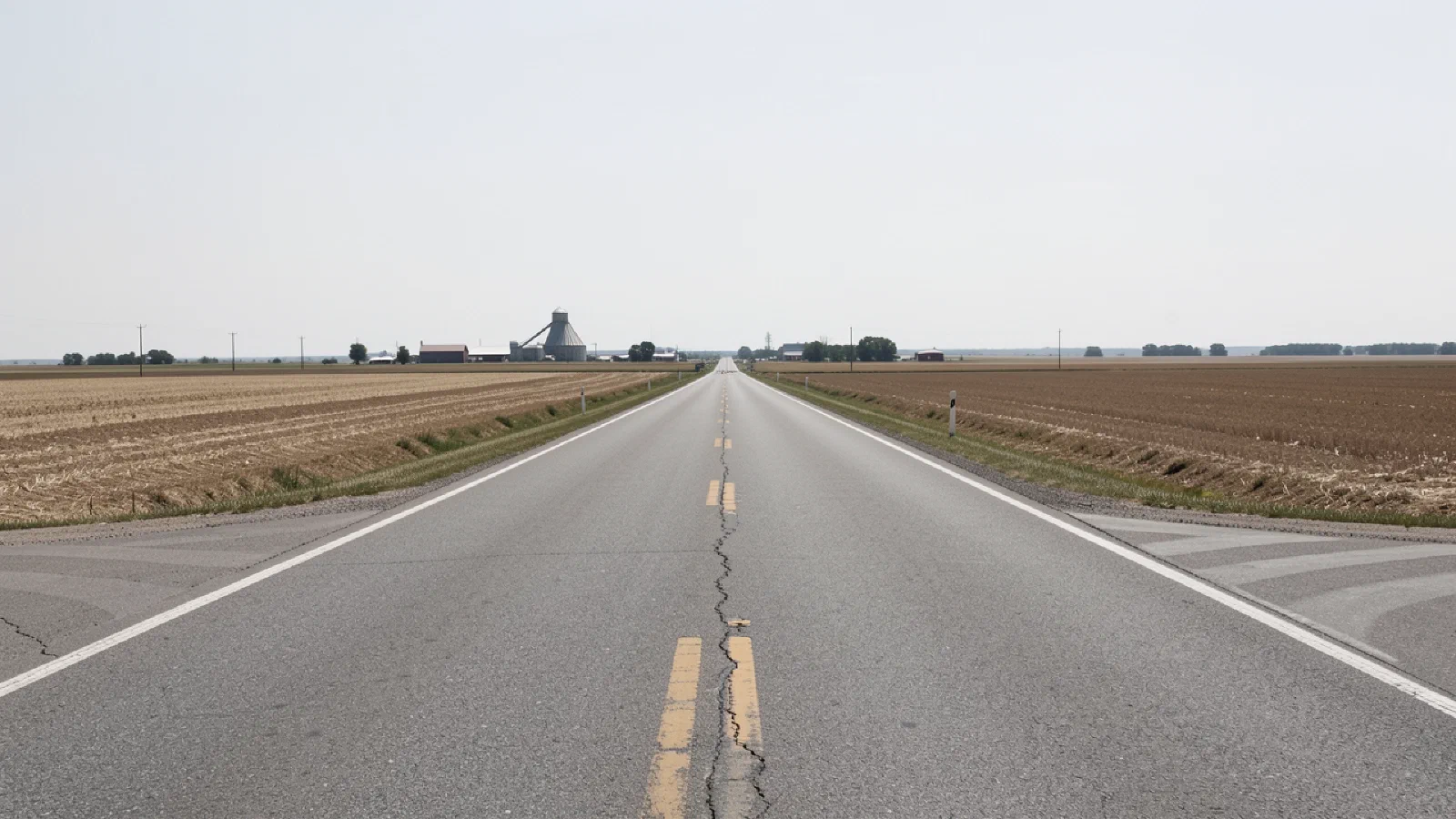
Geography and Rural Definition
Ask ten different federal agencies to define “rural America” and you will receive ten different answers. The Department of Agriculture uses one set of classifications. The Census Bureau employs another. The Office of Management and Budget applies a third framework entirely. This definitional chaos determines which communities receive federal funding, which hospitals qualify for special designations, which populations are counted and which remain invisible in the national conversation.
This first article begins where any honest exploration must: with the recognition that the very category we seek to understand is contested, fluid, and politically constructed. There is no Platonic ideal of “rural” waiting to be discovered. There are only the definitions we create, the boundaries we draw, and the consequences those choices produce.
Approximately 46 million Americans live in areas classified as rural by at least one federal definition, roughly 14 percent of the population. Yet this number shifts dramatically depending on which classification system one employs. Some definitions would place 60 million Americans in rural areas; others would count fewer than 30 million. These are not trivial differences. They represent millions of people who either receive or are denied access to programs designed for rural communities.
Beyond the definitional complexity lies a deeper challenge: the spectrum of rural experience. A small town of 8,000 people situated thirty miles from a metropolitan center bears little resemblance to an isolated community of 200 people located three hours from the nearest hospital. Both may be classified as “rural,” yet their realities diverge profoundly. Any serious engagement with rural health must grapple with this heterogeneity, what we might call the distinction between rural and deep rural America.
The Challenge of Definition#
The federal government maintains no single definition of rural. Instead, multiple agencies have developed classification systems tailored to their specific programmatic needs. Understanding these systems is essential not because any one of them captures the truth of rural life, but because each shapes the flow of resources, the design of policies, and the framing of public discourse.
The USDA Classifications#
The United States Department of Agriculture has developed the most widely used rural classification systems, reflecting agriculture’s historical centrality to rural identity even as that centrality has diminished. The Rural-Urban Continuum Codes, commonly called Beale Codes after their creator, economist Calvin Beale, classify all U.S. counties on a scale from 1 to 9. Codes 1 through 3 designate metropolitan counties of varying sizes. Codes 4 through 9 capture the rural spectrum, distinguishing between counties adjacent to metropolitan areas and those that are not, and between counties with larger urban populations (20,000 or more) and those with smaller or no significant urban concentrations.
This continuum approach captures something important: rurality is not binary but gradational. A county coded as 4 (nonmetropolitan with an urban population of 20,000 or more, adjacent to a metro area) exists in a fundamentally different context than a county coded as 9 (nonmetropolitan with an urban population under 2,500, not adjacent to any metro area). The former may be rural in character but functionally connected to urban labor markets and services. The latter exists in genuine isolation.
The USDA also maintains Urban Influence Codes, which emphasize the degree to which rural counties are influenced by nearby metropolitan centers. These codes recognize that physical adjacency to urban areas shapes economic opportunity, service access, and social networks in ways that raw population counts cannot capture.
The Census Bureau Approach#
The Census Bureau takes a different approach entirely, defining rural as a residual category: whatever is left over after urban areas have been identified. Under this framework, urbanized areas contain 50,000 or more people with a core density of at least 1,000 persons per square mile. Urban clusters contain between 2,500 and 50,000 people meeting similar density thresholds. Everything else is rural.
This residual approach has a certain elegance, but it also reveals an embedded assumption: urban is the norm, rural the exception. The very structure of the classification positions rural America as what remains when the important places have been accounted for. This framing has subtle but significant effects on how policymakers, researchers, and the public perceive rural communities.
Metropolitan Designations#
The Office of Management and Budget contributes yet another framework through its metropolitan statistical area designations. Counties are classified as metropolitan (containing a core urban area of 50,000 or more), micropolitan (containing an urban core of 10,000 to 49,999), or neither. This tripartite division has become increasingly important for federal program eligibility, with “noncore” counties (those in neither metropolitan nor micropolitan areas) often facing the most severe service gaps.
What emerges from this definitional landscape is not confusion for its own sake but a recognition that “rural” is not a single phenomenon. Different classification systems capture different aspects of the rural experience: population size, population density, proximity to urban centers, economic integration, and more. The question is not which definition is correct, but which definition is appropriate for a given purpose.
Deep Rural: A Distinct Reality#
Within the broad category of rural America exists a subset of communities that face challenges of an entirely different magnitude. These are the places where the nearest hospital is two hours away, where the population density drops below six persons per square mile, where multi-generational patterns of isolation have shaped distinct cultures and worldviews. We might call these communities “deep rural” or “frontier”: the terminology varies, but the reality is consistent.
The USDA’s Frontier and Remote Area codes attempt to capture this extreme end of the rural spectrum, measuring distance to services, population sparsity, and geographic isolation. Under these metrics, large swaths of the Great Plains, significant portions of Appalachia, much of the rural West, and substantial areas of the Mississippi Delta qualify as frontier or remote. These are places where standard assumptions about service delivery simply do not apply.
Consider what it means to live in a community where the nearest grocery store is forty-five minutes away by car, assuming one has a car, assuming the roads are passable, assuming weather permits. Consider raising children where the school bus ride exceeds an hour each direction. Consider aging in place when the nearest physician who accepts your insurance practices in a town you can no longer safely drive to reach.
Deep rural communities have developed remarkable adaptations to these challenges. Extended family networks provide care that formal systems cannot. Churches and community organizations fill gaps that government programs do not reach. Informal economies based on barter, mutual aid, and cash exchange supplement formal employment. These adaptations represent genuine resilience, yet they also mask need. When communities adapt to deprivation, that deprivation can become invisible to outside observers.
Regional Variations#
Rural America is not one place but many places, shaped by distinct histories, geographies, economies, and cultures. The rural South differs profoundly from rural New England; the Great Plains have little in common with Appalachian hollows beyond their shared classification as “rural.” Any analysis that treats these regions as interchangeable will miss essential truths about rural life.
The Rural South#
The South’s rural landscape bears the indelible imprint of the plantation economy and its aftermath. The Black Belt, named for its rich, dark soil, stretches across the Deep South from Virginia to Texas, marking communities where enslaved labor once worked the land. Today, many of these counties exhibit persistent poverty, limited economic diversification, and health outcomes that rank among the worst in the nation. The historical extraction of wealth and labor has left legacies that simple policy interventions cannot easily address.
Appalachia#
Appalachian rural communities developed in the folds and hollows of the mountain chain, their isolation reinforced by terrain that resisted easy transportation. The extraction economy, first timber, then coal, brought periodic prosperity followed by inevitable decline, leaving communities dependent on industries that no longer need them. Yet Appalachian culture has also preserved traditions, family connections, and community bonds that more mobile populations have lost. The region defies simple characterization as either victim or exemplar.
The Great Plains#
Across the Great Plains, agricultural consolidation has transformed the landscape. Where thousands of family farms once dotted the prairie, vast mechanized operations now dominate, requiring fewer workers to produce more output. Small towns that served as agricultural service centers have withered as their economic reason for existence disappeared. Some demographers speak of the “depopulating” Plains, entire counties losing residents decade after decade with no clear path to reversal.
The Rural West#
Western rurality contends with vast distances and the dominant presence of federal lands. In some western counties, the federal government owns more than half the land area, a fact that shapes everything from economic opportunity to political identity. Tribal nations occupy significant portions of the rural West, representing sovereign entities with unique legal status, distinct health systems, and complex relationships with federal, state, and local governments.
Other Regions#
The Upper Midwest’s rural communities reflect their Scandinavian and German heritage, with economies built on dairy farming and manufacturing now struggling with both agricultural consolidation and industrial decline. Rural New England grapples with an aging population, seasonal tourism dependence, and the peculiar challenges of small-town life in close proximity to major metropolitan centers. The Mississippi Delta, spanning Mississippi, Arkansas, and Louisiana, ranks among the most persistently poor regions in the nation, its communities shaped by cotton culture, racial inequality, and economic marginalization.
These regional variations matter enormously for health transformation. An intervention that succeeds in rural Minnesota may fail spectacularly in rural Mississippi, not because one community is more capable than another, but because the contexts differ in ways that demand different approaches. Universal solutions imposed without attention to local realities will universally disappoint.
The External View#
How does urban and suburban America perceive these rural places? The honest answer is: poorly, when at all. Rural America occupies a peculiar position in the national consciousness, simultaneously romanticized and dismissed, invoked as the repository of authentic American values while being treated as irrelevant to the nation’s future.
Flyover Country and Other Dismissals#
The term “flyover country” captures something essential about how coastal metropolitan America relates to rural regions. These are places traversed en route to somewhere important, glimpsed from airplane windows but rarely engaged on their own terms. The phrase contains both geographical description and cultural judgment: an implicit assertion that what happens in these places does not matter much.
Media representations reinforce this marginalization. Rural characters in film and television tend toward stereotypes: the bigoted redneck, the simple-minded farmer, the quaint but backward small-town resident. When rural communities appear in news coverage, they often serve as symbols (of economic anxiety, of political resentment, of a vanishing way of life) rather than being examined as complex places inhabited by complex people.
The Pastoral Fantasy#
Alongside dismissal exists its opposite: romanticization. The pastoral fantasy imagines rural America as a simpler, purer, more authentic place, a refuge from urban complexity and corruption. This vision draws on deep cultural wells: Jeffersonian agrarianism, frontier mythology, and perpetual nostalgia for an idealized past that may never have existed.
The pastoral fantasy does rural communities no favors. It substitutes sentiment for understanding, transforming actual places with actual problems into projections of urban longing. When rural communities are seen primarily as repositories of authenticity, their genuine struggles with poverty, isolation, and limited opportunity become invisible or, worse, are reinterpreted as rustic virtues.
The Assumption of Homogeneity#
Perhaps the most damaging external perception is the assumption that rural America is uniform, that knowing one rural place is knowing them all. This assumption manifests in policy interventions designed for a generic “rural community” that exists nowhere in particular. It appears in media coverage that treats rural voters as a monolithic bloc. It underlies research that aggregates diverse communities into a single “rural” sample.
Rural America is not homogeneous. It is not uniformly white, not uniformly conservative, not uniformly agricultural, not uniformly poor, not uniformly anything. The diversity of rural places in demographics, economies, cultures, and challenges exceeds most urban observers’ imaginations. Until this diversity is recognized, external interventions will continue to miss their marks.
Politics & Policy#
The definitional complexity described above has profound political and policy consequences. Who counts as rural determines who receives rural-designated resources, which communities qualify for special programs, and whose voices are heard in debates about rural policy.
Definitions as Political Acts#
Every federal rural program must decide which definition of rural to employ, and these decisions are not neutral. When the Health Resources and Services Administration uses one definition and the Department of Agriculture uses another, communities can be rural for some purposes but not for others. A community might qualify for rural housing assistance while being excluded from rural health programs, not because its needs differ, but because bureaucratic boundaries have been drawn differently.
These definitional choices are political acts, even when they appear technical. Expanding a definition brings more communities into eligibility but dilutes resources across a larger population. Narrowing a definition concentrates resources but excludes communities with genuine need. There is no neutral ground; every boundary drawn includes some and excludes others.
The Rural-Urban Funding Gap#
Despite comprising 14 percent of the national population, rural communities receive disproportionately little federal investment in many areas. Transportation funding formulas favor population density. Research funding flows to institutions concentrated in metropolitan areas. Economic development programs often require matching investments that rural communities cannot provide.
This is not to claim that rural areas receive less per capita than urban areas in all programs; some rural-specific programs do direct resources to underserved communities. But the aggregate pattern suggests systematic underinvestment in rural infrastructure, services, and opportunity. The political power of rural areas, significant in some contexts, has not translated into commensurate investment.
The Census Challenge#
Accurate population counts are essential for political representation and program funding, yet rural areas face systematic undercounting challenges. Populations are dispersed across large areas, making enumeration difficult. Housing situations are more varied, with mobile homes, seasonal residences, and informal arrangements complicating counting. Distrust of government, more pronounced in some rural areas, suppresses response rates.
Census undercounts have cascading consequences. Political representation in state legislatures and Congress depends on census figures. Federal funding formulas allocate billions of dollars based on population counts. When rural populations are undercounted (and evidence suggests they consistently are) these communities lose both voice and resources.
Representation and Power#
Rural political representation has become increasingly complicated. In some respects, rural areas retain disproportionate influence: the Senate gives equal representation to low-population states, and the Electoral College amplifies rural votes in presidential elections. Yet state legislative districts have shifted toward urban and suburban areas as populations have moved, and congressional redistricting has sometimes fragmented rural communities across multiple districts.
The politics of rural America have shifted dramatically in recent decades, with rural communities moving strongly toward the Republican Party while urban areas have trended Democratic. This political sorting has consequences for policy attention: when rural areas are perceived as safely belonging to one party, neither party may have strong incentives to address their concerns. Rural issues can become symbols in culture wars rather than practical challenges requiring practical solutions.
Conclusion: Setting the Stage#
This exploration of rural geography and definition establishes essential foundations for the work ahead. We have seen that “rural” is not a simple category but a contested terrain of competing definitions, each with distinct policy implications. We have distinguished rural from deep rural, recognizing that the spectrum of rural experience ranges from communities with reasonable service access to those facing profound isolation. We have surveyed the regional diversity that makes rural America not one place but many places.
We have also examined how external observers (largely urban) perceive these places, noting the oscillation between dismissal and romanticization that prevents genuine understanding. And we have traced how definitional choices shape political and policy outcomes, determining which communities count and which resources flow where.
What this article has not done, and what this entire first series will not do, is offer solutions. We are not yet ready for solutions. Before we can transform rural health, we must understand the places where rural people live, the conditions they face, and the contexts that shape their lives. This is the work of the articles that follow: demographics, education, economics, healthcare access, food systems, social fabric, transportation, belief systems, and culture.
The journey begins with geography because where we are shapes who we are. The physical landscape of rural America (its distances and densities, its regions and variations) creates the conditions within which everything else unfolds. To understand rural health, we must first understand rural place.
Rural America is not a problem to be solved but a place to be understood. Only after genuine understanding can meaningful transformation begin.
How this article connects to others in Blue Gray Matters.
Sources cited in this article.
- Beale, Calvin L. "Rural-Urban Continuum Codes." *USDA Economic Research Service*, 2023. https://www.ers.usda.gov/data-products/rural-urban-continuum-codes/
- Cromartie, John. "Rural America at a Glance, 2024 Edition." *USDA Economic Research Service*, Economic Information Bulletin No. 278, November 2024.
- Federal Office of Rural Health Policy. "Defining Rural Population." *Health Resources and Services Administration*, 2024. https://www.hrsa.gov/rural-health/about-us/what-is-rural
- Isserman, Andrew M. "In the National Interest: Defining Rural and Urban Correctly in Research and Public Policy." *International Regional Science Review*, vol. 28, no. 4, 2005, pp. 465-499.
- Office of Management and Budget. "Revised Delineations of Metropolitan Statistical Areas." *OMB Bulletin No. 23-01*, July 2023.
- Ratcliffe, Michael, et al. "Defining Rural at the U.S. Census Bureau." *American Community Survey and Geography Brief*, U.S. Census Bureau, December 2016.
- U.S. Census Bureau. "2020 Census: Measuring America's People, Places, and Economy." 2021. https://www.census.gov/programs-surveys/decennial-census/decade/2020/
- U.S. Government Accountability Office. "Rural Hospital Closures: Affected Residents Had Reduced Access to Health Care Services." *GAO-21-93*, December 2020.
- USDA Economic Research Service. "Frontier and Remote Area Codes." 2020. https://www.ers.usda.gov/data-products/frontier-and-remote-area-codes/
- USDA Economic Research Service. "Rural Classifications: Overview." 2024. https://www.ers.usda.gov/topics/rural-economy-population/rural-classifications/
- USDA Economic Research Service. "Urban Influence Codes." 2023. https://www.ers.usda.gov/data-products/urban-influence-codes/