Economics and Employment
The previous articles established where rural America is, who lives there, and how communities educate their young. This article examines what people do for a living, how they sustain themselves, and why economic realities shape health outcomes in ways that policy discussions often ignore.
Rural economies are neither uniform nor static. The cattle rancher in Montana faces different pressures than the tobacco farmer in Kentucky or the laid-off textile worker in rural North Carolina. Yet certain patterns recur across regions: the decline of traditional industries, the struggle to attract new investment, the widening gap between those places that have adapted and those that have not.
Understanding these economic realities is prerequisite to any serious conversation about rural health transformation. Economic security determines whether families can afford insurance, whether communities can sustain hospitals, and whether health itself becomes a priority or a luxury.
Historical Economic Base#
For much of American history, rural economies rested on three pillars: agriculture, extraction, and manufacturing. Each has undergone transformation so profound that communities built around them barely recognize themselves.
Agriculture’s Paradox#
American agriculture produces more food than ever before while employing fewer people than at any point in the nation’s history. In 1900, roughly 40 percent of Americans worked in agriculture. Today, that figure stands below 2 percent. The change reflects not decline but mechanization and consolidation. A single farmer operating GPS-guided equipment can cultivate thousands of acres that once required dozens of families.
This productivity miracle creates economic paradox. Counties that produce enormous agricultural wealth may simultaneously suffer from poverty and depopulation. The profits flow to landowners who may live elsewhere, to equipment manufacturers, to commodity traders. What remains in the community often amounts to seasonal work at minimum wage.
Iowa and Nebraska exemplify this pattern. Both states rank among the nation’s leading agricultural producers. Both contain rural counties losing population decade after decade. The land produces wealth; the communities built around that land struggle to survive.
Extraction’s Boom and Bust#
Mining, logging, and drilling built towns across rural America. Coal camps appeared in the Appalachian hollows of West Virginia and eastern Kentucky. Timber towns arose in the forests of Oregon and the Upper Peninsula of Michigan. Oil patches sprouted in West Texas and the Bakken formation of North Dakota.
Extraction economies share a structural vulnerability: the resource eventually depletes or demand shifts. The coal communities of McDowell County, West Virginia, have been declining for half a century as seams exhausted and markets moved toward other energy sources. Timber towns in the Pacific Northwest watched mills close when old-growth forests disappeared or received protection. Oil communities ride price cycles, booming when crude rises and collapsing when it falls.
The pattern leaves behind communities that invested in schools, infrastructure, and housing for populations that no longer exist. What remains are people too old or too rooted to relocate, living amid the physical remnants of better times.
Manufacturing’s Rural Chapter#
The story of American manufacturing decline is usually told as an urban story: Detroit, Pittsburgh, Cleveland. Less visible is manufacturing’s rural chapter. Textile mills dotted the Piedmont from Virginia through Georgia. Furniture factories clustered in North Carolina. Auto parts suppliers spread through rural Ohio and Indiana.
These factories offered something rare in rural economies: stable, relatively well-paying jobs that did not require college degrees. A high school graduate could hire on at the local plant and expect, with seniority, to earn enough to support a family, buy a home, and retire with a pension.
Trade agreements, automation, and global competition closed thousands of these rural plants. The communities they supported had fewer alternatives than their urban counterparts. A laid-off autoworker in Detroit could at least search for work across a large metropolitan labor market. A laid-off textile worker in rural South Carolina might face a sixty-mile drive to the nearest significant employer.
Contemporary Rural Economies#
The decline of traditional industries forced rural communities to rebuild around different economic activities. Some have succeeded remarkably. Others continue to struggle. The variation is itself significant: rural America increasingly divides between places with functioning economies and places caught in spirals of decline.
Healthcare as Employer#
In a profound irony, healthcare has become the largest employer in many rural counties. The hospital, the nursing home, and the clinic often provide more jobs than any other local institution. This creates circular dependency: the healthcare sector depends on a population large enough to sustain demand, while the population depends on healthcare jobs for economic survival.
When rural hospitals close, the economic impact extends far beyond healthcare. In counties across rural Georgia, Texas, and Tennessee, hospital closures have eliminated the largest single employer. The ripple effects touch every business that served hospital employees, every family that depended on hospital wages.
The Service Sector Shift#
Rural economies have shifted toward services, but the jobs available differ markedly from urban service employment. In cities, the service sector includes finance, technology, professional services, and high-end retail. In rural areas, services more often mean dollar stores, fast food restaurants, and nursing homes.
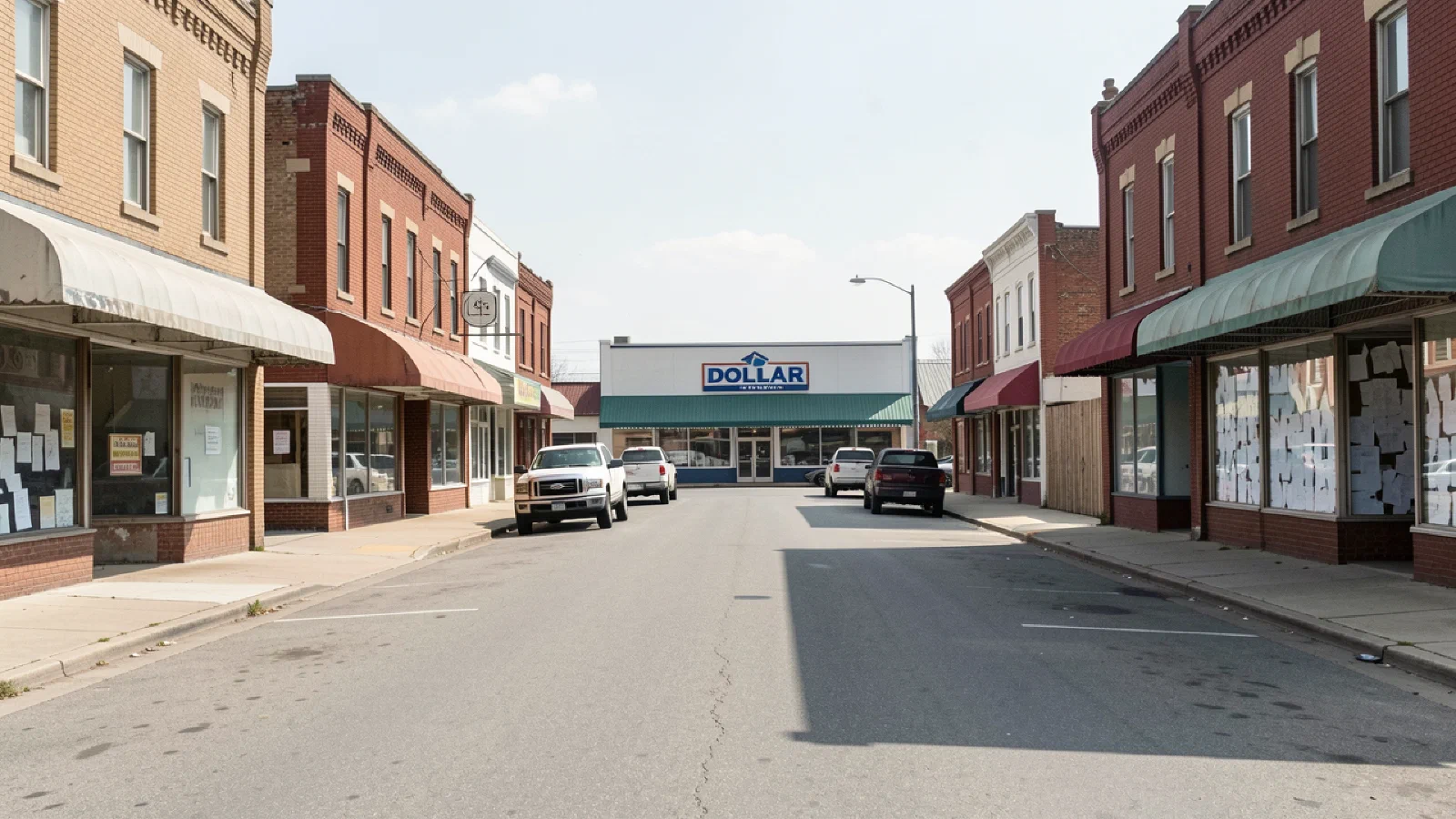
The proliferation of dollar stores across rural America illustrates the shift. Companies like Dollar General have opened thousands of locations in small towns, often becoming the primary retail option after grocery stores and other merchants closed. These stores provide convenience and employment, but the jobs pay minimum wage with few benefits, and the profits flow to distant corporate headquarters.
Tourism and Amenity Economies#
Some rural regions have reinvented themselves around natural beauty and recreational opportunity. Mountain towns in Colorado and Montana, beach communities along the coasts, and scenic areas throughout the country attract tourists and, increasingly, remote workers seeking quality of life.
These amenity economies generate real prosperity but with complications. Property values rise beyond what longtime residents can afford. Seasonal employment patterns create income volatility. Service workers who cater to affluent visitors often cannot afford to live in the communities where they work.
Jackson Hole, Wyoming, represents the extreme version: a rural community with extraordinary wealth and natural beauty where teachers and healthcare workers commute from hours away because local housing costs exceed their salaries.
Government Employment#
Federal, state, and local government provides disproportionate employment in rural areas. Post offices, land management agencies, school systems, and county offices employ significant portions of rural workforces. This public sector employment often offers the stability and benefits that private sector rural jobs lack.
The dependence on government employment creates political tension. Rural communities that vote against government spending may simultaneously depend on government jobs for economic survival. Proposals to reduce the federal workforce or close rural facilities trigger alarm in communities where government is the employer of last resort.
The Remote Work Question#
The pandemic-era expansion of remote work sparked hope for rural economic revival. If location no longer matters for knowledge work, might professionals choose rural areas for their lower costs and higher quality of life?
Some evidence supports this hope. Counties with natural amenities and adequate broadband infrastructure have attracted new residents. Parts of Vermont, rural Colorado, and the mountain West have seen influxes of remote workers.
Yet the promise remains limited. Remote work requires broadband infrastructure that millions of rural Americans still lack. It requires the kinds of professional and technical jobs that rural economies rarely generate locally. And it tends to benefit places that were already attractive rather than the distressed communities most in need of economic revival.
Employment Challenges#
Rural workers face structural disadvantages that compound over time. Lower wages, fewer options, and less mobility combine to constrain life possibilities in ways that affect health both directly and indirectly.
The Wage Gap#
Rural wages average roughly 20 percent below urban wages for comparable work. The gap reflects market forces: fewer employers means less competition for workers, smaller labor markets mean fewer alternatives, and remote locations mean reduced access to the highest-paying opportunities.
Lower wages translate directly into worse health outcomes. Families earning less struggle to afford insurance, preventive care, healthy food, and safe housing. The stress of financial precarity takes its own physiological toll. The connections between income and health are among the most robust findings in public health research.
Limited Mobility#
Urban workers who lose jobs or want better opportunities can search across large labor markets without relocating. Rural workers face a different calculus. The next significant employer might be an hour’s drive away. Pursuing opportunity may require leaving behind family, community, and the only place one has ever known.
This limited mobility traps workers in suboptimal situations. They accept wages below their productivity because alternatives require unbearable tradeoffs. They remain in jobs that damage their health because other options would damage their lives in different ways.
Multiple Job Holding#
To make ends meet, many rural workers hold multiple part-time jobs. A single full-time position with benefits represents an aspiration rather than an assumption. Instead, workers cobble together hours at the dollar store, the gas station, and seasonal agricultural work.
Multiple job holding without benefits has direct health consequences. Workers lack time for medical appointments. They lack coverage for preventive care. They lack the predictable schedules that allow for chronic disease management. The economic necessity that forces this arrangement undermines the health outcomes that economic security might otherwise protect.
The Informal Economy#
Rural economies contain significant informal sectors invisible to official statistics. Barter networks, under-the-table work, and subsistence activities like hunting, gardening, and home repair supplement formal income.
This informal economy represents both adaptation and vulnerability. Families who grow gardens, hunt deer, and trade labor with neighbors stretch limited incomes further than dollars alone would allow. But informal work provides no benefits, no unemployment insurance, no workers’ compensation, no path to social security credits.
Entrepreneurship and Self-Employment#
Rural areas have historically shown high rates of self-employment and small business ownership. This entrepreneurial tradition reflects necessity as much as preference: where jobs are scarce, people create their own.
The Small Business Backbone#
Main streets across rural America, where they survive, consist primarily of small businesses: the hardware store, the feed supply, the diner, the repair shop. These businesses serve local needs and employ local people. Their owners belong to the community in ways that branch managers of chain stores do not.
Yet small businesses face competitive pressures that threaten their survival. Big box stores and online retailers undercut prices. Owners age without successors. Young people with entrepreneurial energy leave for larger markets. The result is a steady erosion of locally owned businesses that hollows out community economic life.
Barriers to Starting Businesses#
Would-be rural entrepreneurs face obstacles their urban counterparts do not. Access to capital is limited: rural banks have consolidated, and those remaining approach small business lending cautiously. Market size constrains growth: a business serving a town of two thousand people has a ceiling on expansion. Broadband gaps prevent participation in e-commerce. Professional isolation means fewer mentors, advisors, and support networks.
These barriers filter who can succeed as rural entrepreneurs. Those with personal wealth, family land, or existing connections can start businesses. Those without such advantages find the path blocked regardless of talent or determination.
Cooperatives and Alternative Models#
Some rural communities have turned to cooperative models that address the failures of conventional business structures. Agricultural cooperatives have long history in rural America, allowing small producers to achieve economies of scale. More recently, cooperative structures have emerged in healthcare, retail, and broadband provision.
In communities across Minnesota and Wisconsin, cooperative models provide services that conventional markets have abandoned. Electric cooperatives deliver power. Food cooperatives ensure grocery access. Healthcare cooperatives have even formed to employ physicians when market-based healthcare has withdrawn.
Poverty and Persistent Poverty#
Rural poverty differs from urban poverty in character and visibility. Geographic isolation hides poverty from view. Cultural values discourage public acknowledgment. The absence of concentrated poverty like urban housing projects creates an illusion that rural poverty is somehow less severe.
The Numbers#
Rural poverty rates exceed urban rates and have for decades. Approximately 15 percent of rural residents live below the federal poverty line, compared to roughly 11 percent of urban residents. The gap understates the difference because poverty thresholds do not adjust for rural circumstances. A car is optional in New York City but essential in rural Kentucky.
More revealing than the overall rate is the concentration of persistent poverty. The federal government identifies persistent poverty counties as those where 20 percent or more of residents have lived in poverty over the past 30 years. Of these counties, 85 percent are rural. They cluster in identifiable regions: the Mississippi Delta stretching through Arkansas, Mississippi, and Louisiana; the Black Belt of Alabama and Georgia; Appalachian eastern Kentucky and West Virginia; the border region of South Texas; and tribal lands across the Southwest and Great Plains.
Wealth Extraction#
Persistent poverty often coincides with historical patterns of wealth extraction. Communities that produced cotton, coal, timber, or oil frequently remained poor while the wealth generated flowed elsewhere. Absentee ownership meant profits accrued to investors in distant cities. The communities bore the environmental costs and received minimal benefit.
This pattern continues. Rural areas contain disproportionate shares of prisons, landfills, factory farms, and energy infrastructure. These facilities generate revenue and profits that largely flow to urban centers. What remains locally amounts to low-wage jobs and externalities like pollution, traffic, and social disruption.
Hidden Poverty#
Rural poverty hides itself. There are no urban landscapes of visible deprivation, no concentrated housing projects, no tent encampments in downtown parks. Instead, poverty disperses along back roads in mobile homes tucked behind tree lines, in small houses that have not seen maintenance in decades, in families stretching inadequate incomes through invisible strategies.
Pride compounds the hiding. Rural culture emphasizes self-reliance and independence. Accepting help signals failure. Families go without rather than admit need. This hidden poverty means that official statistics undercount the problem and that interventions designed around visible need miss those who suffer invisibly.
Key States for Rural Economic Challenge#
Several states exemplify the rural economic challenges most relevant to health transformation:
Mississippi combines agricultural economy, Delta poverty, and healthcare deserts. It ranks among the poorest states, with rural counties that have lost population for decades. Healthcare in rural Mississippi means traveling significant distances, often to facilities that are themselves struggling to survive.
West Virginia represents post-extraction decline. Communities built around coal face economic transition without clear alternatives. The state’s rural areas suffer from compounding crises: economic, health-related, and demographic.
Kentucky, particularly its eastern Appalachian region, illustrates how economic distress translates into health crises. The same counties with the highest poverty rates also have the worst health outcomes and the most severe opioid problems.
Texas contains the largest rural population of any state, with significant variation across regions. The border counties face distinct challenges related to their geography and demographics, while the Panhandle grapples with agricultural transition.
Arkansas spans the Delta, the Ozarks, and the timber regions, each with distinct economic profiles but shared challenges of rural poverty and limited opportunity.
Georgia includes both the prosperity of metropolitan Atlanta and the persistent poverty of the Black Belt counties to the south, where plantation-era economic patterns cast long shadows.
The External View#
Urban and suburban Americans hold distorted views of rural economies, oscillating between nostalgia and dismissal.
The nostalgic view imagines small farms, artisan craft, and authentic community. It pictures farmers’ markets rather than commodity agriculture, craft breweries rather than dollar stores, quaint villages rather than struggling counties. This vision has little connection to economic reality for most rural Americans.
The dismissive view portrays rural residents as victims of their own choices. If the economy has moved on, the argument runs, rural people should move too. This view treats place attachment as irrational, ignores the costs of relocation, and fails to recognize that many rural residents have made calculated decisions that the costs of leaving exceed the benefits.
A more accurate view would recognize rural economies as diverse, adaptable, and connected to national economic systems in complex ways. Rural areas produce the food, energy, and raw materials that urban economies consume. Rural residents subsidize urban areas through resource extraction and waste absorption. The economic relationship runs both directions, though power and benefits flow disproportionately toward metropolitan centers.
Politics and Policy#
Economic development in rural America has become intensely political, tangled with questions of federal investment, trade policy, and the proper role of government in shaping economic outcomes.
Agricultural Policy#
The farm bill, reauthorized roughly every five years, shapes rural economies through subsidies, crop insurance, conservation payments, and nutrition programs. The politics of agricultural policy pits commodity crop interests against specialty crop producers, large operations against small farms, and agricultural regions against one another.
For rural health transformation, agricultural policy matters because it shapes what gets grown, who profits, and whether farming remains economically viable for small and mid-size producers. It also funds nutrition programs that affect food security for millions of rural residents.
Trade Policy#
Trade agreements have transformed rural economies, sometimes for better and often for worse. The opening of foreign markets has benefited some agricultural exporters. The competition from foreign manufacturing and agricultural products has devastated others.
NAFTA’s effects illustrate the complexity. Some rural areas gained from increased agricultural exports to Mexico and Canada. Others lost manufacturing jobs to Mexican competition. The overall assessment depends entirely on which rural places and which rural people one considers.
Infrastructure Investment#
Broadband, roads, and utilities determine which rural areas can participate in the modern economy and which remain excluded. Federal infrastructure investment has historically favored rural areas through programs like rural electrification and the interstate highway system. Recent debates over broadband expansion continue this tradition.
The challenge is ensuring that infrastructure investment reaches the communities most in need rather than flowing to places that would attract private investment anyway. Persistent poverty counties need infrastructure investment most but often lack the capacity to secure competitive grants.
Economic Development Strategies#
Decades of rural economic development policy have produced mixed results. Incentive programs to attract manufacturing often resulted in companies taking subsidies and later relocating. Small business programs reached some entrepreneurs but often missed those without existing resources. Tourism promotion benefited scenic areas while bypassing distressed regions.
What works tends to be comprehensive: combining infrastructure investment with workforce development with small business support with healthcare access. Isolated interventions rarely succeed because rural economic challenges interconnect. A business cannot thrive where workers cannot afford healthcare, where roads are inadequate, where broadband does not exist.
Economic Health and Physical Health#
The connection between economics and health is not merely correlation. Economic insecurity causes poor health through multiple mechanisms.
Financial stress triggers physiological stress responses that, when chronic, contribute to cardiovascular disease, immune dysfunction, and mental health disorders. Poverty constrains health behaviors: fresh food costs more than processed food, gym memberships cost money, preventive care requires time off work that hourly workers cannot afford.
Economic decline also degrades community health infrastructure. When populations shrink and incomes fall, healthcare providers leave, hospitals close, and pharmacies shut down. The economic spiral and the health spiral reinforce each other.
Addressing rural health without addressing rural economics treats symptoms while ignoring causes. Health transformation that does not engage economic transformation will produce limited and temporary results.
Conclusion#
Rural economies are neither dying nor thriving. They are transforming in uneven ways that create vast disparities between successful adaptation and continued decline. Understanding these economic realities is essential for anyone who would improve rural health.
The next article turns to healthcare access directly, examining how rural Americans encounter (or fail to encounter) the healthcare system. Economic context established here will illuminate why healthcare deserts form, why hospitals close, and why health transformation requires more than healthcare interventions alone.
How this article connects to others in Blue Gray Matters.
Sources cited in this article.
- Bureau of Labor Statistics. "Quarterly Census of Employment and Wages: Rural and Urban Areas." *U.S. Department of Labor*, 2024.
- Cromartie, John. "Rural America at a Glance, 2024 Edition." *USDA Economic Research Service*, Economic Information Bulletin No. 278, November 2024.
- Economic Research Service. "Rural Poverty and Well-Being." *USDA*, 2024. https://www.ers.usda.gov/topics/rural-economy-population/rural-poverty-well-being/
- Farrigan, Tracey. "Persistent Poverty Counties." *USDA Economic Research Service*, 2024. https://www.ers.usda.gov/topics/rural-economy-population/rural-poverty-well-being/
- Goetz, Stephan J., et al. "US Commuting Networks and Economic Growth: Measurement and Implications for Spatial Policy." *Growth and Change*, vol. 41, no. 2, 2010, pp. 276-302.
- Holmes, George M., et al. "The Effect of Rural Hospital Closures on Community Economic Health." *Health Services Research*, vol. 41, no. 2, 2006, pp. 467-485.
- Low, Sarah A., and Andrew Isserman. "Where Are the Innovative Entrepreneurs? Identifying Innovative Industries and Placing Entrepreneurs in a Rural Context." *International Regional Science Review*, vol. 38, no. 2, 2015, pp. 171-201.
- Pender, John, et al. "Rural Wealth Creation as a Strategy for Reducing Rural Poverty." *USDA Economic Research Service*, Economic Research Report No. 148, 2013.
- U.S. Census Bureau. "American Community Survey: Income and Poverty in Rural Areas." 2024.
- USDA Economic Research Service. "Rural Employment and Unemployment." 2024. https://www.ers.usda.gov/topics/rural-economy-population/employment-education/rural-employment-and-unemployment/
- Weber, Bruce, et al. "A Critical Review of Rural Poverty Literature: Is There Truly a Rural Effect?" *International Regional Science Review*, vol. 28, no. 4, 2005, pp. 381-414.