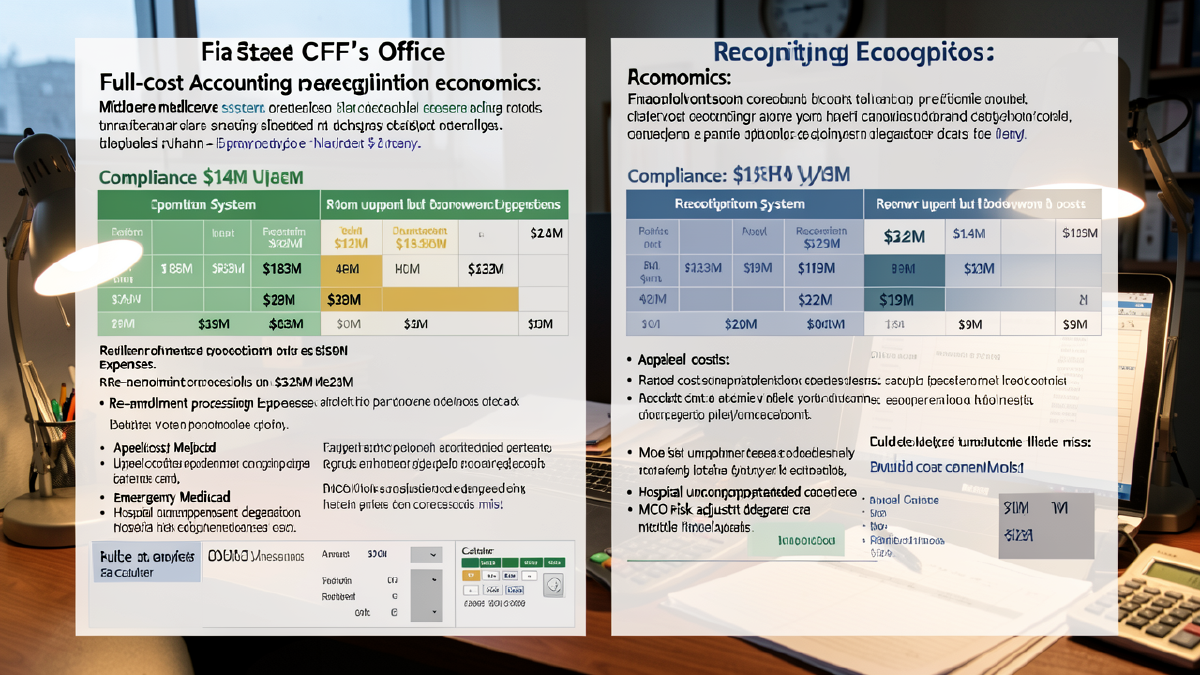
A state chief financial officer reviews two proposals for work requirement verification infrastructure. Vendor A offers a streamlined compliance system: an online portal with automated termination processing, basic phone support, and standard appeal procedures. Total cost: $14 million over three years. The proposal emphasizes efficiency, low per-transaction costs, and rapid implementation. Vendor B offers recognition infrastructure: automated data matching against unemployment insurance, new hire, and cross-program databases, multi-channel verification including phone, mail, in-person, and text, a navigation workforce of 200 community health workers, provider attestation integration, and real-time compliance dashboards. Total cost: $32 million over three years. The proposal emphasizes accuracy, coverage retention, and downstream cost avoidance. The CFO, facing a budget committee that measures fiscal responsibility by line-item expenditure, chooses Vendor A. The $18 million difference is real money. The state controller will note the savings approvingly.
Two years later, the state’s Medicaid program has terminated 78,000 expansion adults for non-compliance. Post-implementation analysis reveals that approximately 65,000 of them were working or qualified for exemptions. Re-enrollment processing for the 45,000 who returned to coverage within six months cost $23 million. Fair hearing and appeals processing for 12,000 contested terminations cost $8 million. Emergency Medicaid for coverage gaps cost $15 million. Hospitals absorbed $42 million in uncompensated care for terminated members who showed up in emergency departments with conditions that Medicaid would have covered. MCOs lost an estimated $95 million in risk adjustment degradation as returning members carried depleted health risk scores.
The neighboring state, which chose Vendor B’s recognition infrastructure, spent $32 million total. It terminated 9,000 people, the vast majority of whom were genuinely non-compliant. It processed 3,000 re-enrollments at $1.6 million. It handled 1,500 appeals at $1 million. Its hospitals absorbed $4 million in related uncompensated care. Its MCOs experienced $12 million in risk adjustment degradation. The compliance system cost $14 million to build and generated $183 million in downstream costs. The recognition system cost $32 million to build and generated $19 million in downstream costs. The cheaper system cost $197 million. The expensive system cost $51 million. This is not a close call but it requires full-cost accounting to see it, and full-cost accounting is precisely what state budget processes are designed to prevent.
Recognition infrastructure costs real money, and those costs appear on specific budget lines that draw scrutiny during appropriation processes. Data matching infrastructure requires investment in secure data transfer systems, identifier matching algorithms, inter-agency agreements, and ongoing maintenance. States that lack modern eligibility systems may need substantial upgrades to process automated verification at scale. The federal government provides 90/10 matching for Medicaid system modernization, meaning states pay only 10 cents of every dollar invested, but even the state share represents a visible appropriation.
Multi-channel verification operations require staffing, training, and infrastructure for phone centers, mail processing, in-person verification sites, and text-based systems. Each channel has fixed costs for infrastructure, technology, training and variable costs for per-transaction processing. Operating five channels costs more than operating one. Navigation workforce investment, community health workers, navigators, and call center staff who assist members with verification, represents the largest visible line item in recognition budgets. A state employing 200 navigators at an average fully loaded cost of $55,000 per navigator spends $11 million annually on a workforce that compliance systems do not require. Provider attestation payments add another visible cost. If a state pays $35 per attestation and processes 100,000 medical exemption attestations, the cost is $3.5 million. Under compliance systems, providers complete exemption documentation without state payment, meaning the cost is borne by providers rather than state budgets.
These costs are visible, quantifiable, and attributable to specific budget lines. They appear in legislative appropriation requests. They draw scrutiny from budget committees. They create political vulnerability for Medicaid directors who must defend them against the obvious question: why are you spending $32 million when you could spend $14 million? The answer requires accounting for costs that the appropriations process systematically ignores.
Compliance systems appear cheaper because their costs are distributed across budgets, agencies, time horizons, and stakeholders in ways that make them invisible to the decision-makers choosing between systems. Re-enrollment processing for wrongly terminated members represents the most direct hidden cost. When a working person loses Medicaid coverage because they failed to submit verification, many will re-enroll within months once they understand what happened or when their next redetermination period arrives. Each re-enrollment requires application processing, eligibility verification, plan selection, and provider network assignment. States estimate processing costs of $400 to $600 per re-enrollment episode. A state that wrongly terminates 50,000 people and processes 35,000 re-enrollments within a year spends $14 to $21 million on administrative churn, processing people out of a program and back into the same program, accomplishing nothing except generating costs.
Appeals and fair hearing costs accumulate when terminated members contest their coverage loss. Each fair hearing requires scheduling, evidence review, adjudicator time, and decision processing. Costs per hearing range from $300 to $1,000 depending on complexity and state hearing infrastructure. Emergency Medicaid for coverage gaps creates costs that appear in a different budget line than the verification system that generated them. When a terminated member arrives at an emergency department with a condition that would have been managed through primary care under continuous coverage, the state pays for emergency services at rates far exceeding what preventive or maintenance care would have cost. A diabetic who loses coverage and develops ketoacidosis generates a $15,000 to $25,000 emergency hospitalization that continuous coverage and $200 monthly medication would have prevented.
Uncompensated care shifted to hospitals represents a cost that exits the Medicaid budget entirely and lands on hospital financial statements, state uncompensated care pools, and ultimately on other payers through cost-shifting. When terminated Medicaid members seek care they cannot pay for, hospitals absorb the loss. Safety-net hospitals in communities with high expansion enrollment face particularly acute financial pressure. These costs are real, measurable, and directly attributable to wrongful terminations, but they never appear in the budget analysis comparing verification systems because they appear in a different entity’s budget.
Risk adjustment degradation for MCOs represents the single largest hidden cost of compliance-oriented systems and operates through a mechanism that most state budget processes do not account for at all. When a member loses coverage, stops receiving care, and returns months later, their health risk score, the basis for MCO capitation payments, no longer reflects their actual clinical needs. A member with diabetes, hypertension, depression, and chronic kidney disease carries a risk score reflecting four to six documented chronic conditions. After a six-month coverage gap during which no conditions were documented through claims encounters, the member returns with a risk score reflecting perhaps one or two conditions. The MCO receives capitation payment appropriate for a relatively healthy member while inheriting a member whose actual healthcare costs reflect severe, now poorly managed, chronic disease.
Given finite resources, states must prioritize recognition investments by expected return. Data matching represents the highest-return investment. The marginal cost of verifying one additional member through automated data matching is near zero once the infrastructure exists. Data sharing agreements, system interfaces, and matching algorithms require upfront investment but can verify hundreds of thousands of members at minimal per-transaction cost. A $5 million investment in data matching infrastructure that automatically verifies 400,000 members costs $12.50 per verified member. No other recognition component approaches this cost-effectiveness.
Navigation investment for high-complexity populations delivers the next highest return. Concentrating navigator resources on the top 15 percent of members by clinical complexity, where risk adjustment degradation exposure is greatest, produces the largest financial return per navigator dollar spent. A navigator helping a complex member with four chronic conditions maintain coverage prevents $5,000 to $8,000 in downstream costs. The same navigator helping a healthy member with straightforward employment documentation prevents perhaps $500 in downstream costs. Multi-channel verification functions as insurance against single-point failures. Each additional channel catches members who would have been missed by existing channels. Provider attestation infrastructure delivers concentrated return in the exemption population.
Recognition costs more upfront and less overall. Compliance costs less upfront and more overall. This is not a close call when full-cost accounting is applied. The difficulty is that state budget processes, legislative appropriation procedures, and political accountability mechanisms all operate on partial accounting that makes the cheaper-looking option appear fiscally responsible and the more expensive-looking option appear wasteful. The accounting that favors compliance is incomplete accounting. Full-cost analysis, across budgets and time horizons, makes the recognition case overwhelming.