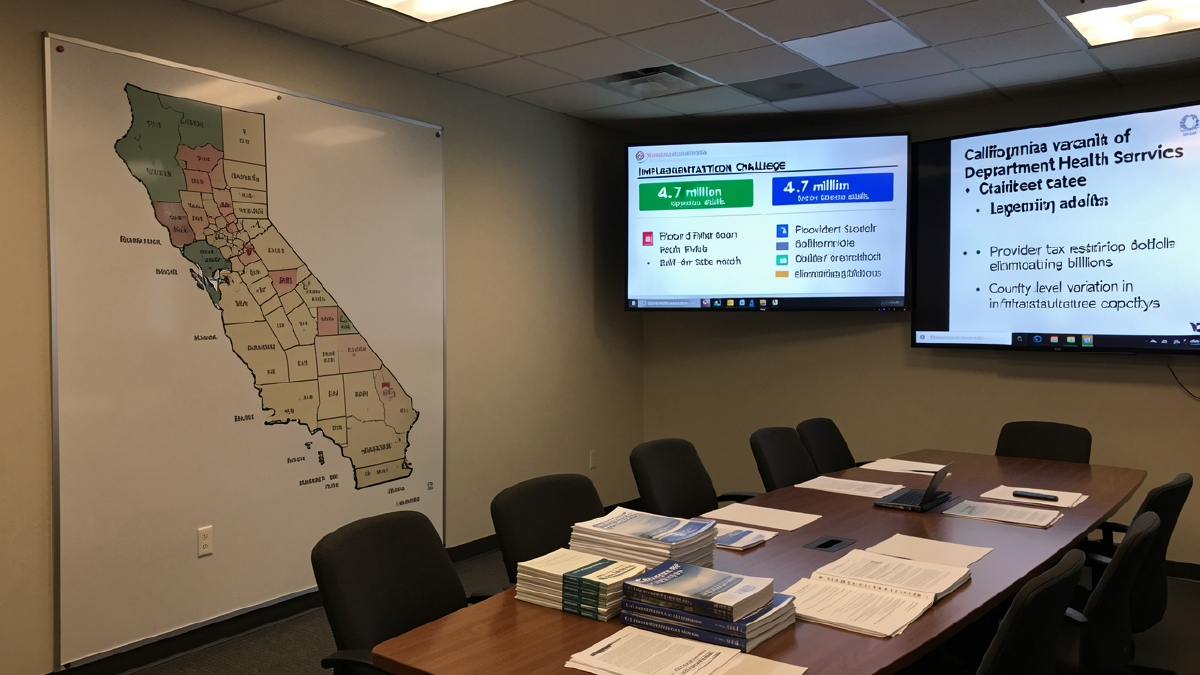
Series 17: Payment Models and Platform Strategy
Opening Narrative#
Maria Elena has worked as a home health aide in Fresno for eighteen years. She enrolled in full-scope Medi-Cal in January 2024, when California completed its phased expansion to all income-eligible adults regardless of immigration status. For the first time in decades, she could see a primary care physician for her diabetes and hypertension rather than waiting for emergencies to force visits to overcrowded emergency departments. The medication adherence and preventive care available through Medi-Cal stabilized conditions that had quietly worsened through years of deferred treatment.
In the same apartment complex lives Roberto Mendoza, sixty-eight years old, a naturalized citizen who retired from restaurant work after forty years. He qualified for Medi-Cal through the Aged program after California eliminated asset limits in 2024. His modest savings of eighty-five thousand dollars, accumulated across decades of careful budgeting, no longer disqualified him from coverage. The elimination of asset testing meant Roberto could maintain both his safety net savings and his healthcare coverage simultaneously.
Roberto’s grandson Miguel, thirty-four, works two part-time jobs totaling about thirty-five hours weekly between a warehouse and a retail store. Neither employer offers health insurance. Miguel enrolled in Medi-Cal as an expansion adult, the population that gained coverage through the Affordable Care Act’s Medicaid expansion. His coverage requires no premium, no asset test, and until now, no work documentation beyond the income verification that established his eligibility.
These three individuals, living in the same community and often seeing the same providers at the neighborhood Federally Qualified Health Center, face December 2026 from entirely different regulatory positions. Maria Elena’s coverage remains intact because she enrolled before the January 2026 freeze on new undocumented enrollees, but she will lose dental benefits in July 2026 and owe thirty dollars monthly starting July 2027. Roberto faces asset verification at his first 2026 renewal, though the $130,000 limit should preserve his eligibility. Miguel confronts federal work requirements demanding eighty hours monthly of documented work or qualifying activities, verified prospectively and redetermined every six months rather than annually.
The community health center serving all three faces its own transformation. Reimbursement rates for Maria Elena’s visits drop in July 2026 when Prospective Payment System rates are eliminated for the undocumented population. The clinic must track which patients fall under which policy regime while managing three distinct compliance documentation streams. Administrative systems built for straightforward income-based eligibility must now accommodate work verification, asset testing, premium collection, and immigration status tracking simultaneously.
California’s Medi-Cal program faces not a single policy change but a collision of federal mandates and state budget constraints that will reshape healthcare access for millions of residents across multiple dimensions during the same implementation window.
Part I: The Policy Collision#
The State Budget Crisis#
California entered 2025 facing a twelve billion dollar budget deficit after projecting a surplus just months earlier. The reversal reflected declining tax revenues, economic uncertainty from federal tariff policies, and program costs exceeding projections across multiple departments. Medi-Cal emerged as a particular pressure point, with a 6.2 billion dollar shortfall requiring emergency appropriations to maintain provider payments through June 2025.
The Medi-Cal cost overrun stemmed from multiple factors. Senior enrollment increased substantially following the 2024 elimination of asset limits, as older Californians with modest savings became newly eligible. Pharmaceutical costs rose across the program, with GLP-1 medications alone accounting for 1.6 billion dollars in 2024 reimbursements. But the politically charged driver was undocumented enrollment, which cost approximately 2.7 billion dollars more than initial projections when California completed its phased expansion to all income-eligible adults regardless of immigration status.
The state spends approximately 8.5 billion dollars annually from the general fund on healthcare for immigrants without legal authorization. This represents state-only funding with no federal match, as federal Medicaid law prohibits using federal dollars for most services to undocumented populations. California chose to fund this coverage expansion using state resources alone, positioning itself as a national leader in immigrant healthcare access.
Governor Newsom’s May 2025 budget revision proposed significant rollbacks to immigrant coverage, including a complete enrollment freeze, one hundred dollar monthly premiums, and elimination of dental and long-term care benefits. The Democratic-controlled legislature pushed back on the most severe proposals, ultimately negotiating a compromise that softened but did not eliminate restrictions on undocumented coverage.
Three Distinct Policy Streams#
California’s Medi-Cal transformation involves three largely separate policy streams affecting different populations through different mechanisms on overlapping timelines.
Federal work requirements under the One Big Beautiful Bill Act affect approximately five million expansion adults, citizens and documented immigrants who gained coverage through the Affordable Care Act’s Medicaid expansion. These individuals face eighty-hour monthly work or qualifying activity requirements with semi-annual verification beginning December 31, 2026. The federal government mandates these requirements, and California cannot waive them regardless of state policy preferences.
State restrictions on undocumented coverage affect approximately 1.6 million individuals enrolled through California’s state-only expansion. These residents face an enrollment freeze for new applicants beginning January 2026, dental benefit elimination in July 2026, and thirty dollar monthly premiums beginning July 2027. Current enrollees are grandfathered but face benefit reductions and new cost-sharing requirements. Federal work requirements do not apply to this population because they are not enrolled through the federally-funded expansion.
Asset limit reinstatement affects approximately 800,000 to one million seniors and people with disabilities enrolled through non-expansion Medi-Cal programs. These individuals face verification of assets at their first 2026 renewal, with limits set at $130,000 for individuals. This population largely qualifies for work requirement exemptions based on age or disability, but faces distinct administrative burdens unrelated to work documentation.
These three streams converge on county eligibility workers, managed care organizations, healthcare providers, and community organizations who must simultaneously implement systems for work verification, asset documentation, premium collection, and immigration status tracking. The administrative burden compounds even when individual enrollees face only one set of requirements.
Part II: State-Only Population Analysis#
The 1.6 Million Undocumented Enrollees#
California’s expansion of Medi-Cal to undocumented immigrants proceeded in phases over nearly a decade. In 2016, the state extended eligibility to undocumented children under age nineteen. Young adults aged nineteen to twenty-five became eligible in 2020. Adults over fifty gained access in May 2022. The final phase, covering adults aged twenty-six to forty-nine, took effect January 1, 2024.
By late 2025, approximately 1.6 million undocumented adults were enrolled in full-scope Medi-Cal. This population concentrates in agricultural regions like the Central Valley, in major metropolitan areas with large immigrant communities, and in border counties where cross-border family and employment ties create distinct healthcare patterns. The population skews toward working-age adults in industries like agriculture, hospitality, domestic work, and construction where documentation requirements have historically been less rigorous.
The annual cost of approximately 8.5 billion dollars reflects comprehensive coverage including primary care, specialty services, hospital care, prescription drugs, behavioral health, and dental services. Per-enrollee costs came in higher than initial projections, reflecting both utilization patterns and the complexity of health needs among populations with histories of deferred care. Many enrollees accessed healthcare for the first time in years or decades after gaining Medi-Cal coverage, generating pent-up demand for diagnostic services, chronic disease management, and treatment of conditions that had progressed without intervention.
The Enrollment Freeze Mechanics#
Beginning January 1, 2026, California will no longer accept new full-scope Medi-Cal enrollments from undocumented adults aged nineteen and older. Individuals who enrolled before this date retain their coverage as long as they complete required renewals and remain otherwise eligible based on income and residency. The freeze does not retroactively remove coverage from existing enrollees.
Several population groups are exempt from the enrollment freeze. Children under nineteen remain eligible for full-scope Medi-Cal regardless of immigration status. Pregnant individuals retain eligibility for comprehensive coverage throughout pregnancy and for twelve months postpartum. Individuals enrolled through trafficking victim or crime victim assistance programs maintain their eligibility pathways. The freeze specifically targets adults who would have qualified through California’s state-funded expansion categories.
For individuals who lose coverage after the freeze takes effect, a ninety-day grace period allows re-enrollment if the coverage loss resulted from paperwork failures, late renewals, or similar administrative issues rather than substantive eligibility changes. After this grace period expires, individuals cannot regain full-scope coverage regardless of circumstances. They become eligible only for restricted-scope Medi-Cal covering emergency services and pregnancy-related care.
The freeze creates urgency for eligible individuals to enroll before January 2026. Immigration advocates and community organizations have mobilized enrollment assistance campaigns, recognizing that anyone who misses the deadline faces permanent exclusion from comprehensive coverage. This urgency may temporarily increase enrollment and costs as individuals rush to secure coverage before the window closes.
The Premium Requirement#
Beginning July 1, 2027, undocumented adults aged nineteen to fifty-nine enrolled in full-scope Medi-Cal must pay thirty dollars monthly to maintain their coverage. Seniors aged sixty and older are exempt, as are pregnant individuals. This premium represents California’s first broad cost-sharing requirement for this population.
The state projects that premiums will generate savings primarily through disenrollment rather than revenue collection. Finance department estimates assume twenty percent of the affected population will lose coverage due to premium nonpayment. However, research on Medicaid premium requirements in other states has documented disenrollment rates as high as fifty percent when premiums are imposed on low-income populations. Even small monthly costs create barriers for individuals living at or near the poverty level, where every dollar has a designated purpose.
A ninety-day grace period applies before coverage downgrades for premium nonpayment. During this period, individuals retain full-scope benefits while the state attempts premium collection. After ninety days without payment, coverage reduces to restricted-scope emergency and pregnancy services only. Re-enrollment in full-scope coverage requires paying outstanding premiums and is subject to the enrollment freeze for new applicants.
The thirty dollar premium resulted from legislative negotiation. Governor Newsom initially proposed one hundred dollars monthly, which advocates argued would effectively eliminate coverage for most of the affected population. The legislature reduced the amount and delayed implementation by six months, but the fundamental tension between cost recovery and coverage access remains unresolved.
Dental Elimination#
Effective July 1, 2026, undocumented adults aged nineteen and older lose coverage for routine dental services. Emergency dental care, including treatment for severe pain, infections, and necessary extractions, remains covered. But preventive services, fillings, crowns, root canals, and other restorative care no longer receive Medi-Cal reimbursement for this population.
Dental coverage elimination affects oral health outcomes directly and medical outcomes indirectly. Untreated dental infections can progress to systemic conditions requiring emergency intervention. Poor oral health correlates with cardiovascular disease, diabetes complications, and other chronic conditions. The cost savings from eliminating dental benefits may partially offset through increased emergency room utilization and medical complications from untreated oral disease.
Pregnant individuals retain dental benefits through pregnancy and twelve months postpartum, recognizing the established links between oral health and pregnancy outcomes. Children under nineteen also retain comprehensive dental coverage regardless of immigration status.
Part III: Asset Limit Population#
Who Is Affected#
Asset limit reinstatement affects Medi-Cal enrollees in non-expansion programs where eligibility historically required both income and asset tests. These programs include Aged, Blind, and Disabled Medi-Cal, Medi-Cal with a Share of Cost for medically needy individuals, the 250% Working Disabled Program, Long-Term Care Medi-Cal, and Medicare Savings Programs that help low-income Medicare beneficiaries with premiums and cost-sharing.
Crucially, asset limits do not apply to expansion adults. The Affordable Care Act’s Medicaid expansion uses Modified Adjusted Gross Income methodology that considers only income, not assets, for eligibility determination. Miguel, the thirty-four-year-old expansion adult in the opening narrative, faces work requirements but not asset testing. His grandfather Roberto, enrolled through the Aged program, faces asset testing but likely qualifies for work requirement exemptions based on age.
This distinction matters for market analysis. The approximately five million expansion adults subject to work requirements represent a different population from the approximately one million aged and disabled individuals subject to asset testing. Overlap exists only for expansion adults who transition to disability-based coverage or who reach age sixty-five during the policy implementation period.
The $130,000 Threshold#
The reinstated asset limit is set at $130,000 for individuals, substantially higher than historical limits and far above the two thousand dollar individual limit Governor Newsom initially proposed. Each additional household member adds $65,000 to the limit, up to ten members. Couples therefore face a $195,000 combined limit.
Countable assets include bank accounts, cash, stocks and investments, and real property beyond one primary residence. Certain assets are excluded from counting, including the primary home regardless of value, one vehicle per household, household goods and personal effects, and retirement accounts. The exclusions protect basic necessities while limiting accumulated wealth.
The legislative negotiation that raised the limit from two thousand to $130,000 reflected recognition that the original proposal would have forced seniors and disabled individuals to spend down modest lifetime savings to qualify for healthcare coverage. At $130,000, most current enrollees likely remain eligible, but the administrative burden of verification and the philosophical shift toward means testing beyond income alone represent significant policy changes.
Verification at Renewal#
Current Medi-Cal enrollees subject to asset limits need not take immediate action. Asset verification occurs at each individual’s first renewal in 2026, not on a universal effective date. Someone whose renewal falls in March 2026 faces verification at that renewal, while someone renewing in October 2026 has several additional months before documentation is required.
The three-year look-back period for asset transfers creates estate planning urgency. Gifts or transfers made after January 1, 2026 may trigger penalties that delay or disqualify Medi-Cal eligibility for long-term care services. Families considering future nursing home needs face incentives to complete asset transfers before this date to avoid look-back complications.
For current enrollees, documentation requirements depend on individual circumstances. County eligibility workers may request bank statements, property records, investment account summaries, and other documentation sufficient to verify that assets fall below applicable limits. The verification burden falls on enrollees to provide requested documentation within specified timeframes.
Part IV: Pharmacy and Benefit Changes#
GLP-1 Elimination#
Glucagon-like peptide-1 receptor agonists, marketed under brand names including Ozempic, Wegovy, and Mounjaro, have transformed diabetes and obesity treatment in recent years. These medications regulate blood sugar and promote weight loss, addressing two interconnected conditions that affect substantial portions of the Medi-Cal population. In 2024, California’s Medi-Cal program reimbursed approximately 1.6 billion dollars for Ozempic and Wegovy alone, representing nearly ten percent of total pharmacy spending.
Effective January 1, 2026, Medi-Cal eliminates coverage for GLP-1 medications when prescribed for weight loss or weight-related indications. Coverage continues for individuals with type 2 diabetes or other approved indications where GLP-1 drugs serve as diabetes treatment rather than weight management. The distinction turns on diagnosis codes submitted with prescriptions, requiring prescribers to document diabetes or other qualifying conditions to obtain coverage.
All previously approved prior authorizations for weight loss indications expire December 31, 2025. Enrollees using these medications for weight management must transition to alternative treatments or pay out-of-pocket for continued access. Given that monthly costs for GLP-1 medications can exceed one thousand dollars without insurance coverage, out-of-pocket payment is unrealistic for the low-income population Medi-Cal serves.
The long-term health implications of this coverage elimination remain contested. GLP-1 medications have demonstrated cardiovascular benefits and may reduce rates of heart disease, stroke, and diabetes-related complications over time. Cost savings from eliminating coverage may partially offset through increased spending on complications from untreated obesity. However, the immediate budget pressure drove the policy decision regardless of longer-term cost-effectiveness considerations.
Continuing Care Elimination#
California’s Medi-Cal Rx program historically allowed continuing care for enrollees taking medications that were subsequently removed from the contracted drug list. Under continuing care provisions, enrollees could continue receiving medications they were already taking even if those drugs lost preferred status or CDL coverage, avoiding treatment disruption from formulary changes.
Effective January 1, 2026, continuing care status is eliminated. When drugs are removed from the contracted drug list or lose preferred status, all enrollees must obtain prior authorization to continue receiving those medications regardless of how long they have been taking them. The prior authorization process requires clinical justification for the specific medication rather than automatic continuation based on prior use.
This change affects treatment continuity for conditions requiring medication stability. Psychiatric medications, where finding effective drugs often involves extended trial periods, present particular concerns. Patients stabilized on specific antidepressants, antipsychotics, or mood stabilizers may face disruption if those medications lose CDL status and prior authorization is denied or delayed.
OTC Restrictions#
Several over-the-counter products face new coverage restrictions effective January 2026. COVID-19 antigen tests now require prior authorization, with approval limited to four tests per month and documentation requirements including diagnosis codes, symptom dates, and medical necessity justification. Multivitamin combination products lose coverage entirely. Certain antihistamines and dry eye products face restrictions.
These changes reduce program costs but shift expenses to enrollees who must pay out-of-pocket for previously covered items or forgo them entirely. For populations living on fixed incomes or at poverty level, even small out-of-pocket costs can force choices between healthcare supplies and other necessities.
Part V: Provider Payment Changes#
FQHC and RHC Rate Cuts#
Federally Qualified Health Centers and Rural Health Clinics serve as the healthcare backbone for millions of Californians, providing comprehensive primary care regardless of patients’ ability to pay. In California, these clinics receive Prospective Payment System reimbursement, a bundled payment for each qualifying visit calculated to cover the full cost of delivering care including overhead, staffing, and infrastructure.
Effective July 1, 2026, PPS reimbursement is eliminated for services provided to individuals with unsatisfactory immigration status. These clinics will instead receive reimbursement at the standard Medi-Cal fee schedule rate in fee-for-service arrangements or at negotiated managed care rates. The difference between PPS rates and fee schedule rates can be substantial, potentially reducing reimbursement by thirty to fifty percent for affected visits.
The policy applies only to visits by patients in the state-only undocumented population, not to all FQHC services. Clinics must track which patients fall under which reimbursement structure, adding administrative complexity to already burdened systems. Some clinics may reduce services to this population if reimbursement drops below the cost of care delivery.
California’s legislature delayed implementation of this cut from January 2026 to July 2026, preserving six additional months of full PPS reimbursement. The ongoing savings projection exceeds one billion dollars annually, representing a substantial reduction in safety net funding that clinics serving immigrant communities must absorb or offset through other revenue sources.
Proposition 35 Dynamics#
California voters approved Proposition 35 in November 2024, making permanent a managed care organization tax that had previously required periodic renewal. The proposition dedicates a portion of tax revenue to provider rate increases, with specific allocation requirements taking effect in 2027.
The Newsom administration’s initial plan uses Proposition 35 funds primarily to cover baseline program growth rather than expanding rates above current levels. This approach manages general fund spending but arguably undercuts the voter intent behind the proposition, which was to increase provider reimbursement above existing baselines.
Rate increases beginning in 2026 target primary care, specialty care, ground emergency medical transportation, and hospital outpatient services. The increases flow through managed care base rates, requiring MCOs to pass additional funding to providers. Actual provider-level impact depends on how managed care plans implement the rate adjustments in their provider contracts.
Skilled Nursing Facility Changes#
The Skilled Nursing Facility Workforce and Quality Incentive Program, a performance-based payment program designed to improve nursing home quality and workforce investment, is eliminated effective 2026. This removes approximately 140 million dollars in ongoing incentive funding that facilities could earn by meeting quality benchmarks.
Additionally, federal provisions in the One Big Beautiful Bill Act block California from implementing new nursing home staffing ratio requirements through 2034. The state had planned to increase minimum staffing levels, but federal law now freezes ratios at current lower levels for nearly a decade. This preemption of state authority over healthcare facility standards represents a significant federal intervention in traditionally state-regulated areas.
The ninety-six hour backup power requirement for skilled nursing facilities is suspended until a reimbursement rate add-on is approved to cover compliance costs. This requirement was designed to ensure facilities could maintain operations during extended power outages, a particular concern in California where wildfire-related grid shutoffs affect vulnerable populations.
Part VI: Federal Overlay#
October 2026 Immigrant Eligibility Changes#
Beyond state budget decisions, federal law under HR1 terminates Medi-Cal eligibility for certain lawfully present immigrant categories effective October 1, 2026. Affected groups include some victims of trafficking and domestic violence who had accessed Medicaid through humanitarian provisions, as well as certain Permanently Residing Under Color of Law categories that previously qualified for state-funded coverage.
These individuals will retain eligibility only for emergency Medi-Cal services, losing access to primary care, preventive services, specialty care, prescription drugs, and other comprehensive benefits. The coverage termination occurs regardless of how long individuals have been enrolled or how stable their health conditions are.
The federal changes intersect with state policy in complex ways. California’s definition of unsatisfactory immigration status includes both undocumented individuals and certain lawfully present immigrants ineligible for federally-funded Medicaid. The state had extended coverage to these populations using state-only funding. Federal termination of eligibility for some categories forces the state to either absorb these individuals into state-only coverage or allow their coverage to terminate.
The Work Requirement Interaction#
Federal work requirements affect a population distinct from those facing state-imposed restrictions on undocumented coverage. The approximately five million expansion adults subject to work requirements are predominantly citizens and documented immigrants enrolled through the federally-funded Medicaid expansion. They face different rules, different timelines, and different exemption categories than the undocumented population facing state-imposed changes.
However, both populations flow through the same administrative systems. County eligibility workers must implement work requirement verification for expansion adults while simultaneously managing the enrollment freeze, premium collection, and benefit changes affecting the undocumented population. Managed care organizations serve members across both categories and must build retention and compliance support systems for distinct but overlapping requirements.
The December 2026 implementation date for work requirements aligns closely with multiple state policy changes taking effect throughout 2026. Administrative systems must absorb all changes simultaneously rather than sequentially, creating implementation risks that would be more manageable if policy changes were staggered across multiple years.
2028 Copayment Requirements#
Beginning October 1, 2028, federal law requires states to impose copayments on expansion adults with incomes above one hundred percent of the federal poverty level. Copayments can range from one to thirty-five dollars per service, with states having discretion within this range. Certain services are exempt from cost-sharing requirements, including primary care, prenatal care, pediatric services, mental health treatment, and substance use disorder services.
The copayment requirement does not apply to services provided at Federally Qualified Health Centers, behavioral health centers, or Rural Health Clinics. These settings can continue providing care without point-of-service cost collection, though the administrative complexity of determining which services at which locations require copayments adds system burden.
For California MCOs, the 2028 copayment requirement represents another layer of member cost-sharing that may affect utilization, retention, and care-seeking behavior. Members already navigating work requirements and verification complexity will additionally face out-of-pocket costs for certain services, potentially creating new barriers to appropriate healthcare utilization.
Part VII: CalAIM Mid-Transformation#
CLRS Requirements#
California’s Advancing and Innovating Medi-Cal initiative launched in January 2022, representing a five-year transformation of the Medi-Cal program toward more coordinated, person-centered care. A central component is the Closed-Loop Referral System requirement, which mandates that managed care plans track, support, and monitor referrals to ensure members actually receive recommended services rather than losing referrals to administrative gaps.
CLRS requirements took effect July 1, 2025, requiring MCPs to implement systems for tracking referrals from initiation through completion. Plans must document referral status, intervene when barriers arise, and report outcomes to the Department of Health Care Services through standardized data formats. The requirement applies particularly to Enhanced Care Management and Community Supports services targeting high-need populations.
Implementation has varied across California’s twenty-five managed care plans operating in different county configurations. Some plans have contracted with vendors like findhelp or Unite Us to provide CLRS technology platforms. Others have built internal systems or adapted existing care management tools. The fragmented approach means that community-based organizations in some counties must interface with multiple different referral platforms depending on which MCO referred each client.
ECM and Community Supports Scaling#
Enhanced Care Management provides intensive care coordination for Medi-Cal members with complex needs, including those experiencing homelessness, serious mental illness, substance use disorders, or multiple chronic conditions. Community Supports offer fourteen categories of services addressing social determinants of health, including housing transition navigation, medically supportive food, and respite care.
Despite the theoretical reach of these programs, utilization remains far below projections. ECM serves approximately 0.9 percent of Medi-Cal members against estimated eligibility of three to five percent. Community Supports uptake has similarly lagged, reflecting provider capacity constraints, member engagement challenges, and referral system limitations.
Work requirement implementation creates both challenges and opportunities for ECM and Community Supports. Care coordinators already engaged with complex members could integrate work requirement navigation into existing workflows. The infrastructure supporting ECM referrals and tracking could extend to compliance documentation support. However, adding work requirement responsibilities to programs still struggling to achieve baseline service delivery targets risks overwhelming systems before they stabilize.
Federal Threats to CalAIM#
Federal policy changes threaten key elements of California’s CalAIM strategy. The Trump administration rescinded Biden-era guidance on health-related social needs that provided the roadmap for states seeking to address social determinants through Medicaid. This guidance removal creates uncertainty about federal approval for California’s ongoing and planned SDOH initiatives.
Additionally, the Centers for Medicare and Medicaid Services announced it will not approve or renew requests for federal matching funds on Designated State Health Programs, limiting California’s ability to leverage federal dollars for state initiatives. Proposed rules on provider taxes could restrict California’s managed care organization tax that funds significant portions of the Medi-Cal program.
These federal pressures arrive as California attempts to sustain CalAIM transformation momentum while simultaneously implementing work requirements and managing budget-driven coverage restrictions. The combination forces difficult prioritization decisions about where to invest limited administrative capacity and political capital.
Part VIII: MCO and Market Implications#
Multi-Population Retention Challenge#
California managed care organizations face retention challenges across multiple distinct populations simultaneously. For expansion adults, retention requires work requirement compliance support, documentation assistance, and navigation through semi-annual redetermination. For undocumented members, retention requires premium payment support, enrollment timing management around the freeze, and service continuity through benefit changes. For aged and disabled members, retention requires asset documentation assistance and verification support.
Each population requires somewhat different interventions, competencies, and systems even though all flow through the same managed care organizations. MCOs serving diverse member populations must build or contract for capabilities spanning all three domains rather than specializing in a single compliance area.
The financial stakes are substantial. Coverage losses from any cause reduce MCO capitation revenue and disrupt risk adjustment documentation that affects future payment rates. Members who cycle in and out of coverage generate administrative costs without corresponding care management returns. Retention across all populations, regardless of the specific compliance challenge each faces, protects MCO revenue and operational stability.
The TAM Clarification#
Market sizing for work requirement navigation services must carefully distinguish between populations subject to different requirements. The approximately five million federally-funded expansion adults represent the core population for federal work requirement compliance services. These individuals face the eighty-hour monthly requirement, semi-annual verification, and prospective compliance documentation that work requirement navigation platforms address.
The approximately 1.6 million state-only undocumented enrollees fall outside federal work requirement scope. They face state-imposed restrictions including enrollment freezes, premium requirements, and benefit reductions, but not the work documentation mandate. Navigation services for this population involve different interventions: premium payment support, enrollment timing, dental transition planning, and emergency-only coverage navigation for those who lose full-scope benefits.
The approximately one million aged and disabled enrollees subject to asset limits represent yet another distinct population. Their compliance challenge involves asset documentation rather than work verification, requiring different expertise and different system capabilities.
Any organization attempting to serve California’s retention challenge must clearly distinguish which populations it addresses. A strategy combining all three populations overstates the addressable scope for any single intervention designed around one population’s specific compliance needs.
Navigation Market Segmentation#
The five million federally-funded expansion adults represent the primary population requiring work requirement navigation, the compliance documentation, exemption identification, and activity verification infrastructure that federal mandates demand. California constitutes the largest single-state market for these services by a substantial margin.
The state-only undocumented population represents a distinct but adjacent challenge. Premium payment support, enrollment retention, and benefit transition assistance require different interventions than work verification but draw on similar community infrastructure and organizational relationships. MCOs serving both populations face pressure to address retention across coverage categories rather than treating each policy stream in isolation.
CalAIM integration adds another dimension. The Closed-Loop Referral System requirements effective since July 2025 created demand for social needs coordination platforms that overlap with work requirement navigation capabilities. Community Supports service delivery and Enhanced Care Management workflows share infrastructure with the community health worker models that effective navigation requires. Organizations capable of integrating work requirement compliance into existing CalAIM architecture hold advantages over those building parallel systems.
The operational implication is that MCOs operating in California need navigation partners who understand the full complexity of the state’s transformation, not vendors focused narrowly on federal work requirements while remaining ignorant of the state-specific policy collision surrounding them.
Part IX: Administrative System Overload#
County Eligibility Worker Burden#
California’s fifty-eight county welfare departments administer Medi-Cal eligibility, creating implementation variation that centralized states avoid. Los Angeles County processes more Medi-Cal applications than most entire states. Rural counties like Sierra or Alpine have eligibility staff in single digits. The same policy must function across this enormous range of administrative capacity.
Work requirement verification adds substantial new responsibilities to county eligibility workers. Each expansion adult requires prospective compliance confirmation before enrollment or renewal can proceed. Documentation must be collected, reviewed, and recorded. Exemption determinations require evaluation against multiple categories. Appeals must be processed when members contest denials.
Simultaneously, these workers must verify assets for aged and disabled populations at each 2026 renewal. They must track premium payment status for undocumented members beginning July 2027 and manage coverage downgrades when premiums go unpaid. They must apply the enrollment freeze accurately, distinguishing between populations subject to freeze and those exempt.
Semi-annual redetermination doubles the frequency of eligibility reviews for expansion adults, compressing the time available to process each case and increasing the total annual workload. A county that previously processed one million renewals annually now processes two million for the expansion population alone, plus all other eligibility categories on existing schedules.
Mixed-Status Family Complexity#
Families with members in different immigration and eligibility categories face multiple policy streams simultaneously. A household might include citizen children with straightforward Medi-Cal eligibility, a documented parent subject to federal work requirements, an undocumented grandparent facing premiums and dental elimination, and an aged relative navigating asset verification.
Navigation for such families requires understanding how different requirements apply to different household members. A single appointment with a benefits counselor might involve explaining work documentation for one adult, premium payment timelines for another, and asset counting rules for a third. Community organizations must build capacity to address all these domains rather than specializing in single policy areas.
The family-level complexity also affects household decision-making. If an undocumented adult faces thirty-dollar premiums while a documented adult faces potential coverage loss from work requirement noncompliance, the household must prioritize which member’s coverage to protect if resources are limited. These forced choices compound the individual-level impacts of each policy change.
Conclusion#
California faces the most complex Medi-Cal transformation in program history. Federal work requirements represent only one dimension of a multi-faceted policy collision that simultaneously affects undocumented populations through state budget restrictions, aged and disabled populations through asset limit reinstatement, and all expansion adults through semi-annual redetermination and eventual copayment requirements.
The timing compounds the challenge. Multiple policy changes take effect between January 2026 and October 2028, with the most concentrated implementation period surrounding December 2026 when federal work requirements activate alongside ongoing state policy changes. Administrative systems must absorb these changes largely in parallel rather than sequentially, creating implementation risks that would be more manageable with staggered timelines.
MCOs, providers, and community organizations must build infrastructure serving populations facing distinct but simultaneous compliance burdens. Work requirement navigation for expansion adults, premium and enrollment support for undocumented members, and asset documentation assistance for aged and disabled populations all require attention during the same implementation window. Organizations positioned to address multiple compliance domains from integrated platforms hold advantages over single-purpose solutions.
California’s progressive coverage expansion is partially reversing under budget pressure even as federal requirements impose new administrative demands. The 1.6 million undocumented adults who gained comprehensive coverage through state action between 2016 and 2024 now face enrollment freezes, premium requirements, and benefit reductions that roll back portions of that expansion. The policy trajectory has shifted from coverage maximization toward cost containment and eligibility restriction.
For organizations serving California’s Medi-Cal population, the coming years require navigating complexity that no other state faces at comparable scale. Five million expansion adults, 1.6 million undocumented enrollees, one million aged and disabled members, and fifteen million total Medi-Cal beneficiaries depend on systems that must simultaneously implement federal mandates, state restrictions, and ongoing transformation initiatives. Success requires understanding not just individual policy requirements but their interactions, overlaps, and cumulative burden on the populations and systems that must absorb them all.