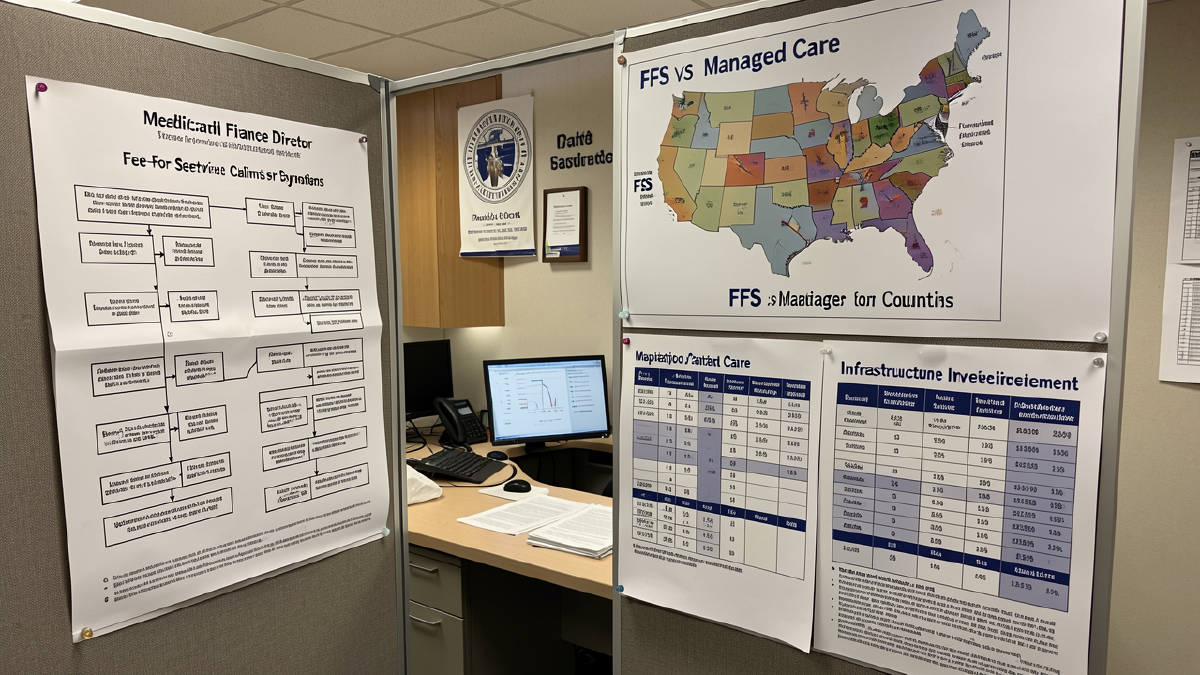
The delivery system through which Medicaid expansion adults receive coverage fundamentally shapes how work requirements will function in practice. States choosing between fee-for-service and managed care models, or combining them through hybrid arrangements, are making architectural decisions that will determine whether compliance infrastructure exists at the point of care or must be constructed from scratch within state agencies. As of July 2024, 42 states contract with managed care organizations to deliver services to at least some Medicaid populations, while five states operate entirely through fee-for-service. This variation creates dramatically different starting points for December 2026 implementation.
The Managed Care Majority#
Comprehensive risk-based managed care now dominates Medicaid delivery nationally. Approximately 72 million enrollees receive services through MCOs, representing roughly 74 percent of total Medicaid enrollment. Among children, the proportion reaches 85 percent. This consolidation accelerated following the Balanced Budget Act of 1997, which eliminated the requirement that federally qualified HMOs maintain a commercial enrollment floor before contracting with Medicaid.
Work requirements arrive in a managed care environment where MCOs already maintain substantial administrative infrastructure for member engagement. Plans operate call centers, member portals, care management programs, and community health worker networks. They conduct outreach for preventive services, chronic disease management, and redetermination support. The question for expansion adults subject to work requirements is whether this existing infrastructure can absorb compliance support functions or whether entirely new systems must be constructed.
MCO contractual relationships create accountability levers unavailable in fee-for-service settings. States can include work requirement support obligations in MCO contracts, specifying member notification protocols, exemption documentation assistance, and community organization partnerships. Performance measures can incorporate compliance rates alongside traditional quality metrics. The financial incentives embedded in capitation create MCO interest in member retention that aligns with compliance support investment.
Thirty MCO states cover at least 75 percent of Medicaid beneficiaries through managed care arrangements. The remaining twelve MCO states either operate regional programs leaving some populations in fee-for-service or maintain specific population carve-outs. Colorado and Nevada represent notable exceptions where MCO coverage is not statewide, though Nevada plans statewide expansion by 2026.
Expansion State Delivery System Summary#
The following table presents delivery system configurations across all 41 expansion jurisdictions, including the District of Columbia. Understanding these arrangements is essential for projecting work requirements implementation capacity.
Table 1: Expansion State Delivery Systems (July 2024)
| State | Primary Model | MCO Coverage | PCCM | Key Carve-Outs |
|---|---|---|---|---|
| Alaska | FFS Only | None | No | N/A |
| Arizona | MCO | Statewide | No | AI/AN FFS opt-out |
| Arkansas | MCO | Statewide | No | BH partial |
| California | MCO (Multi-Model) | Statewide | No | Pharmacy, specialty MH (county) |
| Colorado | MCO/RAE | Regional | No | BH (RAE structure) |
| Connecticut | FFS Only | None | No | N/A |
| Delaware | MCO | Statewide | No | None significant |
| District of Columbia | MCO | Statewide | No | BH (paused carve-in) |
| Hawaii | MCO | Statewide | No | None significant |
| Illinois | MCO | Statewide | No | None significant |
| Indiana | MCO | Statewide | No | None significant |
| Iowa | MCO | Statewide | No | None significant |
| Kansas | MCO | Statewide | No | None significant |
| Kentucky | MCO | Statewide | No | Pharmacy (hybrid PBM) |
| Louisiana | MCO | Statewide | No | Pharmacy (hybrid PBM) |
| Maine | FFS Only | None | No | N/A |
| Maryland | MCO | Statewide | No | None significant |
| Massachusetts | MCO | Statewide | Yes (ACO) | None significant |
| Michigan | MCO | Statewide | No | None significant |
| Minnesota | MCO | Statewide | No | Under FFS review |
| Missouri | MCO | Statewide | No | Pharmacy |
| Montana | MCO | Statewide | Yes | AI/AN FFS significant |
| Nebraska | MCO | Statewide | No | None significant |
| Nevada | MCO | Regional | No | Expanding statewide 2026 |
| New Hampshire | MCO | Statewide | No | None significant |
| New Jersey | MCO | Statewide | No | BH transitioning |
| New Mexico | MCO | Statewide | No | AI/AN FFS (~90% of FFS) |
| New York | MCO | Statewide | No | Pharmacy |
| North Carolina | MCO | Statewide | No | BH transitioning |
| North Dakota | MCO | Statewide | No | Pharmacy |
| Ohio | MCO | Statewide | No | Pharmacy |
| Oklahoma | MCO | Statewide | No | Pharmacy partial |
| Oregon | CCO | Statewide | Yes | Integrated model |
| Pennsylvania | MCO | Statewide | No | BH (county-based) |
| Rhode Island | MCO | Statewide | No | None significant |
| South Dakota | MCO | Statewide | Yes | AI/AN FFS significant |
| Tennessee | MCO | Statewide | No | Pharmacy |
| Utah | MCO | Statewide | Yes | Considering pharmacy carve-out |
| Vermont | FFS Only | None | No | N/A |
| Virginia | MCO | Statewide | No | None significant |
| Washington | MCO | Statewide | No | Integrated BH |
| West Virginia | MCO | Statewide | No | Pharmacy |
| Wisconsin | MCO | Statewide | No | Pharmacy |
| Wyoming | FFS Only | None | No | N/A |
Sources: KFF 50-State Medicaid Budget Survey FY 2024-2025; Georgetown CCF Managed Care in 2024; HMA State Approaches to Managing Medicaid Pharmacy Benefit 2024.
Key to abbreviations: FFS = Fee-for-Service; MCO = Managed Care Organization; PCCM = Primary Care Case Management; BH = Behavioral Health; RAE = Regional Accountable Entity; CCO = Coordinated Care Organization; AI/AN = American Indian/Alaska Native; PBM = Pharmacy Benefit Manager.
States Without Managed Care#
Five states operate Medicaid entirely through fee-for-service: Alaska, Connecticut, Maine, Vermont, and Wyoming. Each has distinct rationales for maintaining traditional payment structures, and each faces fundamentally different work requirements implementation challenges than MCO states.
Connecticut represents the most significant expansion state operating without MCOs. The state terminated managed care contracts in 2012, citing administrative cost concerns and quality performance dissatisfaction. Connecticut’s Department of Social Services now directly administers benefits for approximately 900,000 Medicaid enrollees. For work requirements, this means the state agency must build member notification systems, exemption processing capacity, and community engagement infrastructure that MCO states can partially delegate to contracted plans.
Alaska never implemented managed care due to geographic impossibility. Over 200 communities are accessible only by air or water. The extensive Indian Health Service and tribal health network serves substantial portions of the Medicaid population. Traditional managed care network adequacy requirements cannot function where roads do not exist. Work requirements in Alaska will interact primarily with tribal health systems operating under distinct federal authorities.
Vermont, Maine, and Wyoming maintain fee-for-service for smaller Medicaid populations where MCO administrative overhead would consume disproportionate resources. Each state must construct work requirements compliance systems within state agency capacity rather than leveraging MCO infrastructure.
Primary Care Case Management#
Twelve states continue operating Primary Care Case Management programs, one fewer than 2023 following North Dakota’s December termination. PCCM represents enhanced fee-for-service rather than risk-based managed care. Beneficiaries select or are assigned to a primary care provider who receives a small per-member per-month fee for care coordination while the state continues paying claims on a fee-for-service basis.
PCCM states include both expansion and non-expansion jurisdictions. The model provides some care coordination infrastructure but lacks the comprehensive member services and financial risk transfer characteristic of full managed care. For work requirements, PCCM states occupy middle ground. Primary care providers may serve as compliance touchpoints, but the absence of plan-level member services infrastructure limits delegation opportunities.
Eight states operate both MCOs and PCCM programs simultaneously, creating hybrid arrangements where different populations receive different delivery system models. Work requirements implementation in these states must accommodate both pathways without creating coverage gaps at system boundaries.
Benefit Carve-Out Complexity#
The managed care versus fee-for-service distinction oversimplifies actual state arrangements. Most MCO states carve specific benefits out of managed care contracts, creating hybrid systems where some services flow through capitated plans while others remain in fee-for-service. These carve-outs matter for work requirements because they fragment member relationships across multiple administrative systems.
Table 2: Benefit Carve-Out Status by Expansion State (July 2024)
| State | Pharmacy | Behavioral Health | Dental | MLTSS |
|---|---|---|---|---|
| Alaska | N/A (FFS) | N/A (FFS) | N/A (FFS) | N/A (FFS) |
| Arizona | Carved In | Carved In | Carved In | Carved In |
| Arkansas | Carved In | Partial Carve-Out | Carved Out | Carved In |
| California | Carved Out | County Carve-Out (SMI) | Carved Out | Partial |
| Colorado | Carved In | RAE Model | Carved Out | Carved In |
| Connecticut | N/A (FFS) | N/A (FFS) | N/A (FFS) | N/A (FFS) |
| Delaware | Carved In | Carved In | Carved In | Carved In |
| District of Columbia | Carved In | Carved Out | Carved In | Carved In |
| Hawaii | Carved In | Carved In | Carved In | Carved In |
| Illinois | Carved In | Carved In | Carved Out | Carved In |
| Indiana | Carved In | Carved In | Carved Out | Carved In |
| Iowa | Carved In | Carved In | Carved In | Carved In |
| Kansas | Carved In | Carved In | Carved Out | Carved In |
| Kentucky | Hybrid PBM | Carved In | Carved Out | Carved In |
| Louisiana | Hybrid PBM | Carved In | Carved Out | Carved In |
| Maine | N/A (FFS) | N/A (FFS) | N/A (FFS) | N/A (FFS) |
| Maryland | Carved In | Carved In | Carved In | Carved In |
| Massachusetts | Carved In | Carved In | Carved Out | Carved In |
| Michigan | Carved In | Carved In | Carved Out | Carved In |
| Minnesota | Carved In | Carved In | Carved Out | Carved In |
| Missouri | Carved Out | Carved In | Carved Out | Carved In |
| Montana | Carved In | Carved In | Carved Out | Partial |
| Nebraska | Carved In | Carved In | Carved Out | Carved In |
| Nevada | Carved In | Carved In | Carved Out | Partial |
| New Hampshire | Carved In | Carved In | Carved Out | Carved In |
| New Jersey | Carved In | Transitioning | Carved In | Carved In |
| New Mexico | Carved In | Carved In | Carved Out | Carved In |
| New York | Carved Out | Carved In | Carved In | Carved In |
| North Carolina | Carved In | Transitioning | Carved In | Carved In |
| North Dakota | Carved Out | Carved In | Carved Out | Partial |
| Ohio | Carved Out | Carved In | Carved Out | Carved In |
| Oklahoma | Partial | Carved In | Carved Out | Partial |
| Oregon | Carved In | Integrated (CCO) | Integrated (CCO) | Carved In |
| Pennsylvania | Carved In | County Carve-Out | Carved Out | Carved In |
| Rhode Island | Carved In | Carved In | Carved Out | Carved In |
| South Dakota | Carved In | Carved In | Carved Out | Partial |
| Tennessee | Carved Out | Carved In | Carved In | Carved In |
| Utah | Carved In | Carved In | Carved Out | Carved In |
| Vermont | N/A (FFS) | N/A (FFS) | N/A (FFS) | N/A (FFS) |
| Virginia | Carved In | Carved In | Carved Out | Carved In |
| Washington | Carved In | Integrated | Carved In | Carved In |
| West Virginia | Carved Out | Carved In | Carved Out | Carved In |
| Wisconsin | Carved Out | Carved In | Carved Out | Carved In |
| Wyoming | N/A (FFS) | N/A (FFS) | N/A (FFS) | N/A (FFS) |
Sources: KFF 50-State Medicaid Budget Survey FY 2024-2025 (Pharmacy, Delivery Systems); KFF Behavioral Health Survey 2022; HMA Medicaid Rx Survey 2024; ADvancing States MLTSS Analysis 2024.
Bold text indicates full or significant carve-out from MCO contracts. “Hybrid PBM” indicates MCOs remain at risk but must contract with state-designated pharmacy benefit manager. “Partial” indicates limited carve-in or mixed arrangements.
Pharmacy Carve-Out Implications#
Pharmacy carve-outs have expanded significantly. As of July 2024, eight states carve pharmacy benefits out of MCO contracts: California, Missouri, New York, North Dakota, Ohio, Tennessee, Wisconsin, and West Virginia. Three additional states (Kentucky, Louisiana, Mississippi) use hybrid models where MCOs remain at risk for pharmacy but must contract with a single state-designated pharmacy benefit manager.
The pharmacy carve-out trend reflects state efforts to capture greater negotiating leverage with manufacturers and address pharmacy benefit manager spread pricing concerns. However, carve-outs create work requirements complications. Pharmacy encounters represent the most frequent healthcare touchpoint for chronic disease populations. A member with diabetes, hypertension, and depression may visit their MCO-contracted physician quarterly but their pharmacy monthly. If pharmacy operates separately from the MCO, coordination between medication adherence monitoring and work requirements compliance support requires cross-system data sharing that carve-out structures complicate.
Half of MCO states carve out specific high-cost drug classes even when general pharmacy remains carved in. Common carve-outs include hemophilia products, spinal muscular atrophy agents, hepatitis C treatments, and recently approved gene therapies for sickle cell disease. These selective carve-outs primarily function as MCO risk mitigation strategies rather than delivery system architecture.
Behavioral Health Integration Trends#
Behavioral health carve-outs have declined dramatically. In 2004, more than twenty states carved behavioral health out of comprehensive MCO contracts. By 2019, only six states maintained full behavioral health carve-outs. The trend toward carve-in reflects growing evidence that clinical integration of physical and behavioral health improves outcomes, though research on financial integration effects shows mixed results.
The behavioral health carve-in trend carries particular significance for work requirements. Individuals with serious mental illness represent the population most likely to face compliance barriers due to executive function limitations, housing instability, and documentation capacity constraints. States where behavioral health remains carved out must coordinate between physical health MCOs and behavioral health organizations for members whose exemption eligibility may depend on mental health documentation while their compliance outreach flows through a separate plan.
California’s county-administered specialty mental health carve-out creates particularly complex work requirements dynamics. Mental health services for Medi-Cal beneficiaries with serious mental illness flow through county mental health departments rather than the state’s managed care plans. These county systems hold clinical relationships with precisely the populations facing highest compliance barriers, yet verification and exemption processing will operate through state eligibility systems or MCO member services infrastructure.
Pennsylvania’s county-based behavioral health managed care organizations represent another significant variation. The state contracts with county behavioral health MCOs that manage services separately from physical health MCOs. This arrangement preserves local mental health system relationships but fragments member administrative touchpoints for work requirements purposes.
Regional and Population-Specific Models#
Several states employ delivery models that complicate the simple MCO versus FFS distinction.
California operates three distinct managed care models across its 58 counties. County Organized Health Systems provide single-plan coverage in 22 counties, eliminating beneficiary choice but simplifying coordination. The Two-Plan Model in 14 counties offers choice between a local initiative plan and a commercial plan. Geographic Managed Care in Sacramento and San Diego counties provides multiple plan options with maximum market competition. Each model creates different work requirements implementation contexts within a single state.
Oregon’s Coordinated Care Organizations represent provider-led regional entities that integrate physical, behavioral, and oral health under global budgets with quality incentives. The CCO model’s emphasis on social determinants of health and community benefit reinvestment creates infrastructure potentially adaptable to work requirements support, though CCOs serve defined geographic regions with varying capacity.
Minnesota’s county-based purchasing organizations operate alongside commercial MCO contracts, with some counties maintaining local control over Medicaid administration. The state has begun examining potential return to fee-for-service for certain populations, creating uncertainty about future delivery system direction as work requirements approach.
Ohio introduced OhioRISE in July 2022 as a specialized managed care program for youth with complex behavioral health and multisystem needs. This prepaid inpatient health plan creates dedicated infrastructure for high-barrier populations, though its focus on youth limits direct work requirements relevance for adult expansion populations.
Work Requirements and Delivery System Alignment#
The fundamental question is whether delivery system design correlates with work requirements implementation capacity. MCO infrastructure provides several advantages.
Member services capacity: MCOs operate call centers, maintain member portals, and employ community health workers. Compliance inquiries, exemption documentation assistance, and deadline reminders can route through existing channels rather than requiring state agency capacity expansion.
Financial alignment: Capitation creates MCO interest in member retention. Coverage loss means lost premium revenue. The retention economics documented elsewhere in this series translate into MCO willingness to invest in compliance support infrastructure that state agencies may view as pure administrative cost.
Provider network relationships: MCOs maintain contracts with provider networks that create care coordination touchpoints. Physicians, behavioral health providers, and community organizations within MCO networks can incorporate work requirements awareness into existing member interactions.
Data integration: MCOs collect encounter data, pharmacy claims, and care management information that can identify members at compliance risk. Predictive analytics can target outreach toward members approaching deadlines without documented activity, though such targeting requires data infrastructure investment.
Fee-for-service systems lack these structural advantages. State Medicaid agencies must build member notification systems, exemption processing workflows, and community engagement partnerships that MCO states can partially delegate. However, fee-for-service also avoids certain complications.
Direct state control: Fee-for-service states retain unilateral authority over compliance processes without negotiating MCO contract terms or monitoring plan performance. Implementation decisions require only agency action rather than procurement amendments and plan operational changes.
Simplified coordination: Without multiple MCOs serving different members, fee-for-service eliminates cross-plan coordination challenges. A single statewide system can maintain consistent member experience rather than plan-specific variation in compliance support quality.
Provider relationship preservation: Fee-for-service maintains any-willing-provider access without MCO network restrictions. Members facing compliance barriers need not navigate plan network limitations when seeking exemption documentation.
Work Requirements Readiness by Delivery System#
The following table compares FFS and MCO capabilities across dimensions relevant to work requirements compliance support. These comparisons reflect structural characteristics rather than individual state performance.
Table 3: Work Requirements Readiness by Delivery System
| Capability Dimension | Fee-for-Service | Managed Care (MCO) | Work Requirements Relevance |
|---|---|---|---|
| Member Notification Infrastructure | Limited; requires state agency capacity building | Established call centers, portals, mailings | Essential for deadline awareness and reporting reminders |
| Proactive Outreach Capacity | Minimal existing infrastructure | Care management programs, CHW networks | Critical for reaching members before non-compliance |
| Exemption Documentation Support | Requires new partnerships with providers | Care coordinators can assist members | Reduces verification failure among qualifying members |
| Data Analytics for Risk Identification | Claims data only; limited real-time capability | Encounter data, pharmacy, care management integration | Enables targeted intervention for at-risk members |
| Community Organization Integration | State must build partnerships directly | Network contracts, SDOH partnerships | Connects members to qualifying activities and support |
| Performance Accountability | State agency self-monitoring | Contract requirements, quality measures, withholds | Creates consequences for inadequate compliance support |
| Financial Incentive Alignment | None; compliance support is pure cost | Capitation creates retention interest | Motivates MCO investment in member compliance |
| Provider Network Engagement | Any-willing-provider; limited coordination | Network contracts enable coordinated messaging | Facilitates provider awareness and documentation |
| Multi-Language Capacity | Variable by state | Federal requirements mandate language access | Essential for LEP populations facing compliance barriers |
| Speed of Implementation | Requires new capacity construction | Can leverage existing infrastructure | Affects readiness for December 2026 deadline |
| Consistency Across State | Single statewide system | Varies by plan; multi-MCO coordination challenges | Affects member experience and equity |
| Flexibility for Special Populations | Direct state authority to modify | Requires contract amendments | Important for populations with complex barriers |
Assessment based on structural delivery system characteristics. Individual state and MCO performance varies significantly.
MCO Readiness Advantages: Managed care states begin implementation with substantial infrastructure already in place. MCOs can add work requirements support functions to existing member services operations, care management programs, and community partnerships. The financial alignment between capitation and retention creates natural incentives for compliance support investment.
FFS Readiness Challenges: Fee-for-service states must construct compliance support infrastructure within state agency capacity. This requires hiring, training, system development, and community partnership building that MCO states can partially delegate. The absence of external contractors also means state agencies bear full accountability for implementation quality.
Hybrid Complications: States with significant benefit carve-outs face coordination challenges regardless of primary delivery system. Members receiving pharmacy through FFS and medical through MCO, or physical health through one entity and behavioral health through another, experience fragmented relationships that complicate compliance support delivery.
Native American FFS Opt-Out#
Federal law protects American Indian and Alaska Native individuals from mandatory managed care enrollment. Under 42 CFR 438.14, AI/AN beneficiaries can opt out of MCO enrollment and receive services through Indian Health Service facilities, tribal health programs, or urban Indian organizations on a fee-for-service basis.
This protection creates substantial FFS populations in states with large Native American populations even where managed care otherwise dominates. Arizona operates the American Indian Health Program as a dedicated FFS carve-out alongside its AHCCCS managed care system. New Mexico’s fee-for-service population is approximately 90 percent Native American. Oklahoma, South Dakota, Montana, and North Dakota all have significant AI/AN populations exercising opt-out rights.
For work requirements, the AI/AN FFS population operates under distinct considerations. Tribal consultation requirements mandate state engagement with tribal governments on implementation affecting Native populations. Indian Health Care Improvement Act protections may interact with work requirements verification in ways requiring federal clarification. Services delivered through IHS and tribal facilities generate documentation within healthcare systems with varying connectivity to state Medicaid data systems.
Long-Term Services and Supports Integration#
Managed long-term services and supports (MLTSS) arrangements add another layer of delivery system complexity. Twenty-five states now integrate some LTSS benefits into MCO contracts, creating comprehensive care management for high-cost, high-need populations. These arrangements typically serve disabled individuals, dual eligibles, and elderly populations through specialized programs with enhanced care coordination requirements.
The MLTSS trend matters for work requirements because expansion adults with disabilities who do not qualify for SSI or SSDI represent a significant at-risk population. These individuals face barriers to employment while lacking the categorical exemptions that federal disability programs would provide. MLTSS programs may serve some of these individuals, creating care coordination infrastructure that could support work requirements navigation.
States with robust MLTSS programs have developed expertise in managing complex populations with multiple system touchpoints. This expertise could translate to work requirements implementation for expansion adults facing similar navigation challenges, though MLTSS populations and expansion adults subject to work requirements may not overlap substantially.
Value-Based Payment Overlay#
Value-based payment arrangements increasingly overlay managed care contracts regardless of underlying delivery system structure. States are requiring MCOs to implement alternative payment models with contracted providers, shifting from fee-for-service within capitation toward shared savings, bundled payments, and capitated specialty arrangements.
Oregon’s CCO model exemplifies this approach, with global budgets and quality incentives creating accountability for population health outcomes. Colorado’s Regional Accountable Entities similarly combine managed care administration with value-based provider payment. These arrangements create provider-level financial interest in member retention that could support work requirements compliance efforts.
The value-based overlay matters because it shifts provider incentives toward the MCO retention interest pattern. Physicians and health systems receiving shared savings payments or capitated amounts have financial stakes in member coverage continuity that fee-for-service billing does not create. This alignment could translate to provider engagement with work requirements compliance support, though evidence on whether value-based payment affects provider behavior around administrative requirements remains limited.
Emerging Delivery System Questions#
Minnesota’s examination of fee-for-service return merits attention. The state legislature directed the Medicaid agency to develop an implementation plan for returning children, families, and adults without children to direct state payment. The plan is due January 2026, just months before work requirements implementation begins. If Minnesota proceeds with FFS transition while simultaneously implementing work requirements, it would face the unusual challenge of dismantling MCO infrastructure while building compliance systems.
The Minnesota examination reflects dissatisfaction with MCO profits during the pandemic continuous coverage period and broader questions about whether managed care delivers value commensurate with administrative costs. Whatever Minnesota decides, the analysis will generate evidence relevant to other states questioning their delivery system choices.
Connecticut’s managed care resumption study moves in the opposite direction. Having terminated MCO contracts in 2012, Connecticut periodically evaluates whether circumstances warrant reconsideration. Work requirements implementation challenges may strengthen arguments for managed care infrastructure that did not exist when the state made its original decision.
CMS 2024 Managed Care Rule Implications#
The May 2024 CMS Medicaid managed care final rule introduces requirements with work requirements implementation relevance. Network adequacy provisions strengthen access standards through secret shopper surveys, appointment wait time maximums, and provider directory accuracy requirements. These requirements apply regardless of work requirements but create infrastructure states can leverage for compliance support.
Prior authorization timing requirements reduce maximum decision timeframes from 14 to 7 days for standard requests. For expansion adults seeking exemption documentation, this acceleration could reduce delays in obtaining clinical support for disability or medical condition exemptions.
Medical loss ratio enforcement received permanent statutory backing through the Continuing Appropriations Act. States must now collect remittances from MCOs failing to meet 85 percent MLR thresholds. This provision constrains MCO profit margins, potentially limiting resources available for compliance support investment, though it also creates pressure for administrative efficiency that could incentivize automation of member outreach processes.
The rule’s health equity requirements mandate MCO health equity plans, staff training on implicit bias, and disparities data reporting. These requirements align with work requirements implementation because coverage loss will disproportionately affect populations experiencing health disparities. MCO equity infrastructure could support targeted compliance support for high-barrier populations.
Conclusion#
The 18.5 million expansion adults subject to work requirements will experience implementation through whatever delivery system their state employs. Managed care states can leverage MCO infrastructure for compliance support but must align contracts, measure performance, and coordinate across plans serving different members. Fee-for-service states maintain direct control but must build capacity that MCO states can delegate. Hybrid arrangements with benefit carve-outs create coordination challenges regardless of the primary delivery system.
The delivery system question matters less than the investment question. States committed to minimizing coverage loss will construct adequate compliance support infrastructure whether through MCO contract requirements, state agency capacity expansion, or community organization partnerships. States prioritizing administrative simplicity over retention may find that delivery system choice merely determines who bears blame when compliance failures occur.
Work requirements may accelerate delivery system evolution. Fee-for-service states facing implementation without MCO infrastructure may reconsider managed care transitions. MCO states finding contracted plans unable or unwilling to provide adequate compliance support may strengthen contract requirements or explore direct state intervention. The December 2026 deadline creates pressure for delivery system decisions that states might otherwise defer.
No delivery system optimally positions states for work requirements. MCOs provide infrastructure advantages but create coordination complexity. Fee-for-service preserves state control but requires capacity construction. Hybrid arrangements combine complications from both models without capturing either’s full benefits.
The fundamental reality is that work requirements impose administrative burden regardless of delivery system. Someone must build member notification systems, exemption processing workflows, and community engagement infrastructure. Whether that burden falls on MCOs, state agencies, or some combination, the construction must occur within the implementation timeline.
References#
Kaiser Family Foundation. “50-State Medicaid Budget Survey, Fiscal Years 2024-2025: Delivery Systems.” KFF.org, July 2024.
Kaiser Family Foundation. “50-State Medicaid Budget Survey, Fiscal Years 2024-2025: Pharmacy.” KFF.org, July 2024.
Georgetown University Center for Children and Families. “Medicaid Managed Care in 2024: The Year That Was.” CCF.Georgetown.edu, 3 Jan. 2025.
Kaiser Family Foundation. “10 Things to Know About Medicaid Managed Care.” KFF.org, Dec. 2024.
Health Management Associates. “State Approaches to Managing the Medicaid Pharmacy Benefit: 2024 Medicaid Rx Survey.” HMA, Feb. 2024.
McConnell, K. John, et al. “Access, Utilization, and Quality of Behavioral Health Integration in Medicaid Managed Care.” JAMA Health Forum, vol. 4, no. 12, Dec. 2023, e234593.
Horvitz-Lennon, Marcela, et al. “Carve-In Models for Specialty Behavioral Health Services in Medicaid: Lessons for the State of California.” RAND Corporation, 2023.
Georgetown University Center for Children and Families. “Minnesota Medicaid Revisits the Question: Managed Care or Fee-for-Service?” CCF.Georgetown.edu, 6 Feb. 2024.
Centers for Medicare and Medicaid Services. “2024-2025 Medicaid Managed Care Rate Development Guide.” CMS.gov, 22 Jan. 2024.
Centers for Medicare and Medicaid Services. “Managed Long Term Services and Supports.” Medicaid.gov, 2024.
MACPAC. “Managed Long-Term Services and Supports: Status of State Adoption and Areas of Program Evolution.” Medicaid and CHIP Payment and Access Commission, 2022.
MACPAC. “Integration of Behavioral and Physical Health Services in Medicaid.” Medicaid and CHIP Payment and Access Commission, Mar. 2016.
ADvancing States. “Managed Long-Term Services and Supports (MLTSS).” ADvancingStates.org, 2024.
National Association of Medicaid Directors. “Why Did They Do It That Way? Understanding Managed Care.” NAMD Resource, 2024.
National Academy for State Health Policy. “States Leverage Medicaid Managed Care to Foster Behavioral Health Integration.” NASHP.org, 2024.
National Academy for State Health Policy. “State Oversight and Innovations in Medicaid-Managed Long-Term Services and Supports.” NASHP.org, Mar. 2024.
Center for Health Care Strategies. “Behavioral Health Integration in Medicaid Managed Care: Evidence Roundup.” BetterCarePlaybook.org, Jan. 2024.
Kaiser Family Foundation. “How Do States Deliver, Administer, and Integrate Behavioral Health Care? Findings from a Survey of State Medicaid Programs.” KFF.org, Dec. 2022.
42 CFR 438.14. “Requirements that Apply to MCO, PIHP, PAHP, PCCM, and PCCM Entity Contracts Involving American Indians and Alaska Natives.” Electronic Code of Federal Regulations.
Health Affairs Forefront. “Is Carve-In Financing of Medicaid Behavioral Health Services Better Than Carve-Out?” HealthAffairs.org, Mar. 2023.