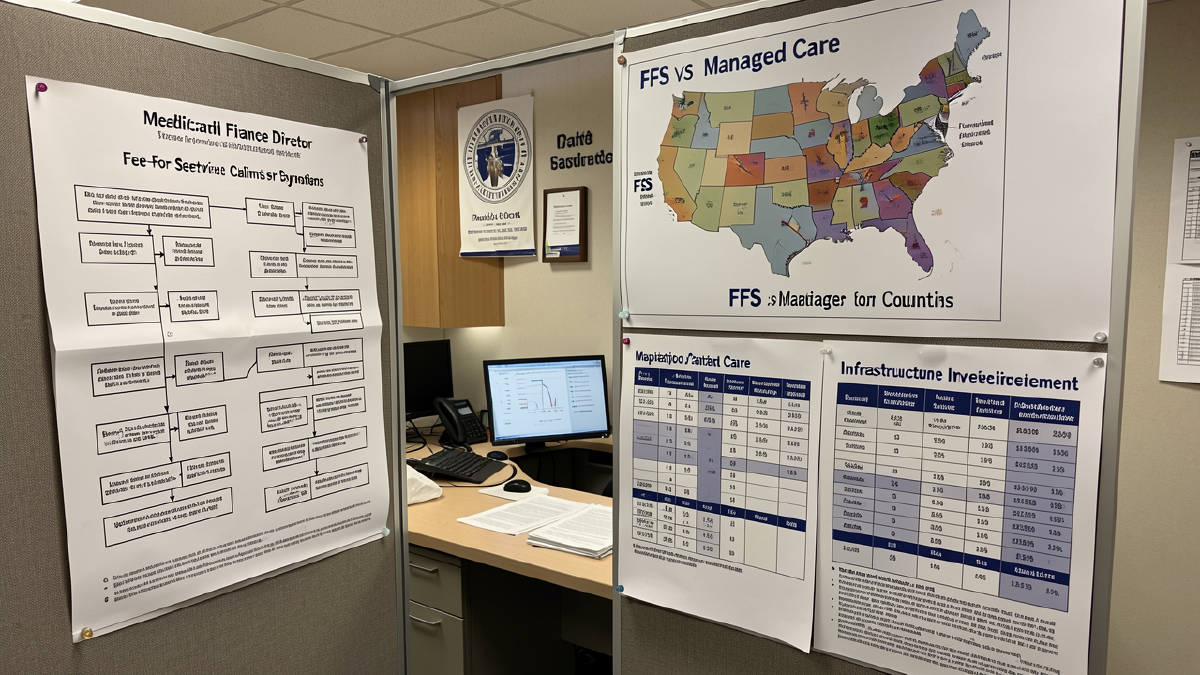
The delivery system through which Medicaid expansion adults receive coverage fundamentally shapes how work requirements will function in practice. States choosing between fee-for-service and managed care models, or combining them through hybrid arrangements, are making architectural decisions determining whether compliance infrastructure exists at the point of care or must be constructed from scratch within state agencies. As of July 2024, 42 states contract with managed care organizations to deliver services to at least some Medicaid populations, while five states operate entirely through fee-for-service. This variation creates dramatically different starting points for December 2026 implementation affecting 18.5 million expansion adults.
Comprehensive risk-based managed care now dominates Medicaid delivery nationally. Approximately 72 million enrollees receive services through MCOs, representing roughly 74 percent of total Medicaid enrollment, reaching 85 percent among children. Among the 41 expansion jurisdictions including the District of Columbia, 36 operate statewide MCO programs, while five maintain fee-for-service systems: Alaska, Connecticut, Maine, Vermont, and Wyoming. This consolidation accelerated following the Balanced Budget Act of 1997, which eliminated the requirement that federally qualified HMOs maintain commercial enrollment floors before contracting with Medicaid.
Work requirements arrive in a managed care environment where MCOs already maintain substantial administrative infrastructure for member engagement. Plans operate call centers, member portals, care management programs, and community health worker networks conducting outreach for preventive services, chronic disease management, and redetermination support. The question for expansion adults subject to work requirements is whether this existing infrastructure can absorb compliance support functions or whether entirely new systems must be constructed regardless of delivery model.
MCO contractual relationships create accountability levers unavailable in fee-for-service settings. States can include work requirement support obligations in MCO contracts, specifying member notification protocols, exemption documentation assistance, and community organization partnerships. Performance measures can incorporate compliance rates alongside traditional quality metrics. The financial incentives embedded in capitation create MCO interest in member retention that aligns with compliance support investment, particularly given risk adjustment dynamics generating $2,000 to $4,000 monthly premiums for complex members whose retention justifies substantial navigation investment.
Fee-for-service states face fundamentally different implementation challenges. Connecticut represents the most significant expansion state operating without MCOs, having terminated managed care contracts in 2012 citing administrative cost concerns and quality performance dissatisfaction. The Department of Social Services now directly administers benefits for approximately 900,000 Medicaid enrollees. For work requirements, this means the state agency must build member notification systems, exemption processing capacity, and community engagement infrastructure that MCO states can partially delegate to contracted plans.
Alaska operates the nation’s smallest Medicaid program serving approximately 240,000 total enrollees with roughly 46,000 in expansion, spread across 663,000 square miles creating geographic barriers that compound administrative challenges. Maine covers approximately 381,000 Medicaid beneficiaries including roughly 94,000 expansion adults through fee-for-service, while Vermont serves approximately 264,000 with roughly 67,000 in expansion. Wyoming’s program covers approximately 87,000 total enrollees with expansion population estimated at 28,000. Each state must develop work requirements implementation capacity through state agency infrastructure alone, without MCO administrative systems to leverage.
Hybrid delivery arrangements introduce coordination complexity beyond pure MCO or fee-for-service models. Thirty-two states maintain some form of behavioral health carve-out, either through specialized managed behavioral health organizations, regional administrative organizations, or continued fee-for-service payment for mental health and substance use services. Pennsylvania’s county-based behavioral health system exemplifies this fragmentation, with 67 counties managing behavioral health alongside statewide MCO physical health coverage. For expansion adults with serious mental illness or substance use disorders requiring work requirements exemptions, this creates split accountability where neither the MCO nor the behavioral health entity maintains complete responsibility for compliance support.
Pharmacy carve-outs represent another major fragmentation pattern. Twenty-four states manage prescription drugs through fee-for-service payment or separate pharmacy benefit managers rather than through MCO capitation. This split creates verification challenges when work exemptions depend on chronic condition documentation requiring prescription medication as evidence, since the MCO may lack comprehensive pharmaceutical data supporting exemption determinations. California’s transition to pharmacy carve-in through the CalRx program scheduled for completion by 2026 reflects state recognition that fragmented benefit administration complicates both care integration and administrative functions.
American Indian and Alaska Native populations receive special carve-out protections under 42 CFR 438.14, with rights to remain in fee-for-service or switch between MCO and Indian Health Service facilities at will. New Mexico’s Medicaid program shows roughly 90 percent of remaining fee-for-service expenditures attributable to AI/AN populations, while Montana and South Dakota maintain significant AI/AN fee-for-service cohorts. These populations face unique work requirements challenges combining employment barriers on reservations with delivery system fragmentation and complex federal-state-tribal coordination requirements.
Primary care case management models in Massachusetts, Montana, Oregon, South Dakota, and Utah create additional architectural variation. These arrangements combine fee-for-service payment with enhanced care coordination and value-based incentive structures. Oregon’s Coordinated Care Organizations exemplify this approach, with global budgets and quality incentives creating accountability for population health outcomes. The value-based overlay matters because it shifts provider incentives toward the MCO retention interest pattern, though evidence on whether value-based payment affects provider behavior around administrative requirements remains limited.
Minnesota’s current examination of fee-for-service return merits attention. The state legislature directed the Medicaid agency to develop an implementation plan for returning children, families, and adults without children to direct state payment, due January 2026 just months before work requirements implementation begins. If Minnesota proceeds with FFS transition while simultaneously implementing work requirements, it would face the unusual challenge of dismantling MCO infrastructure while building compliance systems. The Minnesota examination reflects dissatisfaction with MCO profits during the pandemic continuous coverage period and broader questions about whether managed care delivers value commensurate with administrative costs.
The May 2024 CMS Medicaid managed care final rule introduces requirements with work requirements implementation relevance. Network adequacy provisions strengthen access standards through secret shopper surveys, appointment wait time maximums, and provider directory accuracy requirements. Prior authorization timing requirements reduce maximum decision timeframes from 14 to 7 days for standard requests, potentially accelerating exemption documentation for disability or medical condition claims. Medical loss ratio enforcement received permanent statutory backing, constraining MCO profit margins and potentially limiting resources available for compliance support investment while creating pressure for administrative efficiency that could incentivize automation of member outreach processes.
The 18.5 million expansion adults subject to work requirements will experience implementation through whatever delivery system their state employs. Managed care states can leverage MCO infrastructure for compliance support but must align contracts, measure performance, and coordinate across plans serving different members. Fee-for-service states maintain direct control but must build capacity that MCO states can delegate. Hybrid arrangements with benefit carve-outs create coordination challenges regardless of the primary delivery system. No delivery system optimally positions states for work requirements. The fundamental reality is that work requirements impose administrative burden regardless of delivery system architecture, with someone required to build member notification systems, exemption processing workflows, and community engagement infrastructure within the compressed implementation timeline.