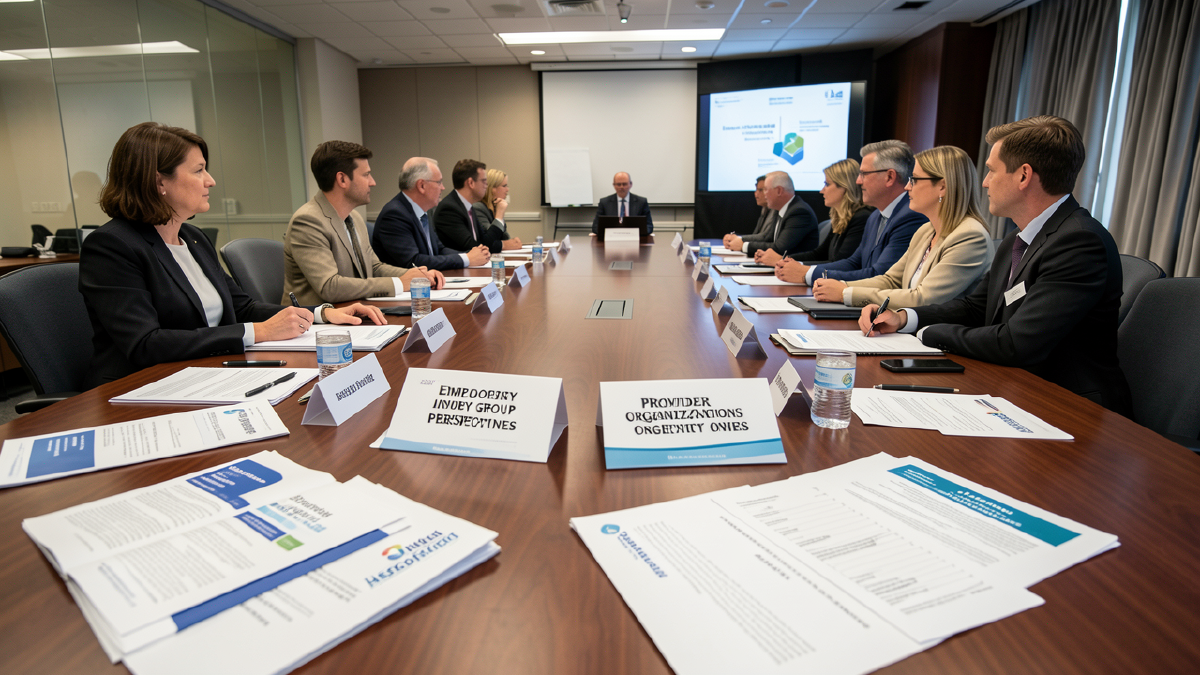
Behind the ideological conflict over work requirements, a complex web of organized interests shapes implementation through mechanisms more subtle than position statements and rallies. Managed care organizations calculate whether quiet influence serves their interests better than public opposition. Hospital associations weigh uncompensated care exposure against political capital preservation. Employer groups discover stakes in Medicaid policy they never anticipated. These stakeholders operate with mixed incentives that defy simple categorization, and their crosscutting pressures explain why coalitions around work requirements are fragile and political outcomes often surprise observers expecting interest groups to follow apparent economic interests.
MCOs: Maximum Stake, Maximum Constraint#
MCOs have perhaps the clearest financial interest in outcomes while facing the greatest political constraints on expressing it. The arithmetic is straightforward: capitated payments for enrolled members mean every termination is lost revenue. With 18.5 million expansion adults subject to requirements and coverage loss projections of 15 to 25 percent annually, MCOs face potential revenue declines measured in billions. Centene alone, with 13 million Medicaid members nationally, has more at risk than most industries in any single policy decision.
Yet MCOs operate through state contracts that governors and legislators control. Overt opposition to a signature priority risks contract nonrenewal, procurement disadvantage, or regulatory retaliation. The result is quiet advocacy: lobbying for generous good cause exceptions, extended cure periods, automated verification systems, and navigation funding. Each position serves MCO financial interests while avoiding the liability of opposing requirements directly. National companies like Centene, UnitedHealthcare, Molina, Anthem, and Humana could potentially coordinate approaches through AHIP or state managed care associations, but their influence varies enormously by state market presence and political culture.
Hospitals: Financial Exposure and Strategic Silence#
Hospitals face a different calculus. Emergency departments must treat anyone with emergency conditions regardless of insurance. Every coverage termination potentially shifts costs from Medicaid payment to uncompensated care. Safety-net hospitals with high Medicaid volumes face the largest exposure, and 46 percent of rural hospitals already report negative operating margins before work requirements add pressure. The 182 rural hospital closures since 2010 demonstrate that financial stress translates into community access losses.
Hospital associations have demonstrated formidable political influence. The Montana Hospital Association’s successful 2025 campaign to extend Medicaid expansion, defeating conservative legislative opposition, illustrates available resources. Lobbying expenditures by hospitals and nursing homes increased from $35 million in 2000 to over $133 million in 2024. Yet associations show division on work requirements specifically. A Health Affairs analysis found chambers of commerce often favoring requirements while hospital associations split among those opposing, supporting, and expressing implementation concerns. In Ohio, individual hospitals lobbied against requirements even as the state association supported them. The pragmatic pattern is that hospitals prioritize protecting Medicaid coverage broadly, accepting work requirements as the political price for expansion rather than risking the whole program on ideological opposition.
Rural hospital vulnerability adds geographic dimension. Rural hospitals depend heavily on Medicaid, with 47 percent of rural births covered by the program. Rural legislators, including conservative Republicans whose local hospital is the largest employer, face constituent pressure to protect healthcare access even when ideologically opposed to expansion. Work requirements threatening rural hospital finances create crosscurrents that complicate simple partisan positioning.
Employers: Unexpected Stakeholders#
Work requirements create Medicaid policy stakes for employers who never considered themselves healthcare lobbyists. When states require employer verification of work hours, businesses face administrative obligations with real costs. Large employers with sophisticated payroll systems can automate verification through one-time investments of $500 to $5,000. For small employers, a restaurant owner with 20 employees must personally respond to verification requests, maintain documentation, and potentially appear at proceedings if accuracy is challenged. Industry associations representing small businesses may advocate for simplified verification, and industry variation shapes exposure: retail, food service, and hospitality face high verification volume; agricultural employers encounter timing conflicts with growing seasons; gig platforms resist employer classification entirely.
Providers and State Workers#
Provider associations bring professional credibility to the debate. When a state medical association raises patient welfare concerns, the voice carries different weight than an MCO expressing the same concern. Physicians face a specific burden as exemption systems increasingly rely on provider attestation, making doctors gatekeepers whose documentation timeliness determines patient coverage. State employees who process verifications, evaluate exemptions, and issue terminations face both workload concerns and moral injury from processing terminations they perceive as unjust. AFSCME and other unions representing these workers have interests in sustainable caseloads that effectively advocate for implementable approaches.
Coalition Possibilities#
The stakeholder landscape reveals potential alliances crossing traditional lines. A “coverage maintenance coalition” could unite MCOs, hospitals, providers, and progressive advocates around automated verification, generous exemptions, extended cure periods, and navigation support. Each element serves multiple interests simultaneously. An “efficiency and burden coalition” could unite employers and libertarian conservatives around simplified verification and reduced documentation requirements, framing advocacy as implementing requirements efficiently rather than bureaucratically.
But formation faces obstacles. Stakeholders must recognize common interests despite different motivations. MCOs fearing contract retaliation, hospitals preserving political capital, and providers focused on their own burden may each have reasons not to invest in coalition building even when success would serve them. The inactive majority, employers who do not yet realize verification obligations, providers who have not anticipated documentation demands, community organizations that have not recognized their navigation role, represents uncommitted political resources whose mobilization could shift dynamics.
The Bottom Line#
Much stakeholder influence operates through channels invisible to public observation: private meetings between MCO executives and agency directors, lobbyist suggestions to legislative staff, testimony in technical rulemaking proceedings. This quiet influence allows nuanced engagement impossible in polarized public debate but carries democratic costs when accountability diminishes. The revolving door between government and industry, with one in three HHS appointees from 2004 to 2020 exiting to private industry, amplifies these dynamics. When implementation begins in December 2026, abstract stakeholder calculations become concrete positions on real choices, and coalitions that seemed impossible may form when financial stakes become immediate.
Source: MRWR-16H_Interest_Group_Dynamics.md Series 16: The Politics of Implementation GroundGame.Health Research Series on Medicaid Work Requirements