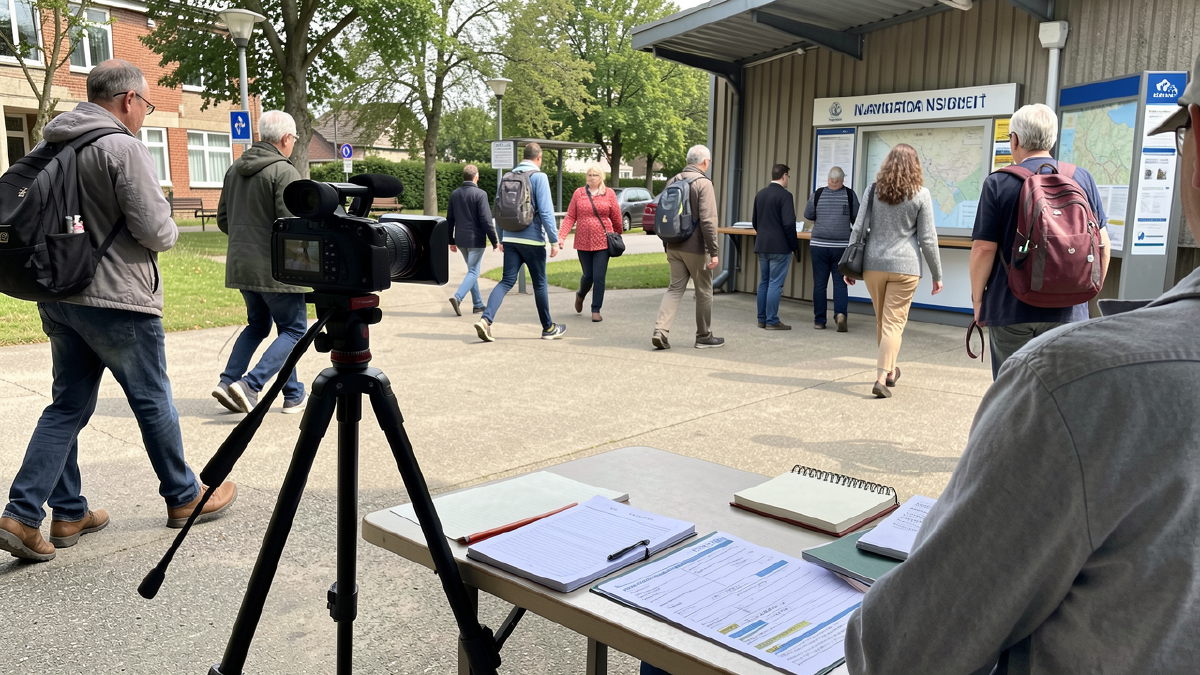
The Waiting Room at 8:15 AM
The county benefits office opens at 9:00, but seventeen people are already in line. They’ve learned the system. If you’re not here before opening, you won’t be seen today.
An older woman, maybe sixty, helps a younger one understand the forms she’s been mailed. “This one they want first,” she says, pointing. “Don’t give them the second page until they ask for it. If you give them everything at once, they’ll lose something.” The younger woman nods, reorganizing her folder.
Two men near the middle of the line compare notes about what their employers will and won’t provide in writing. One works construction; his boss pays cash and won’t acknowledge him on paper. The other does warehouse work through a temp agency that never returns calls. “I asked three times,” he says. “They said they’d email it. Nothing.” His friend shrugs. “My cousin had the same thing. She just wrote it herself and had the boss sign it. They didn’t check.”
A mother near the back manages two children while scrolling through documents on her phone. She’s looking for a screenshot she took of something important. She can’t remember exactly what. The notice she received wasn’t clear about which documents she needed, so she’s brought everything she has.
None of this is visible in administrative data. The official system will record seventeen appointments. What it won’t record is the community of practice that has formed in this waiting room: the accumulated knowledge about how to survive bureaucracy, the informal teaching that happens between strangers who recognize themselves in each other, the careful strategies developed through trial and error and shared across acquaintance networks. The anthropologist sees not individuals navigating alone but a culture adapting to an environment.
Policy analysis typically asks whether a program achieves its objectives. Ethnography asks a different question: what are people actually doing? What meanings do they construct? What strategies do they develop? What does “compliance” look like from inside the experience rather than from administrative datasets? These questions matter for work requirements because the gap between policy design and lived reality often determines who maintains coverage and who loses it.
The Gap Between Design and Reality
Policy assumes rational actors responding to clear incentives. A notice is sent; a deadline is set; requirements are specified; people comply or face consequences. The logic is simple. But ethnography reveals something messier: confusion, incomplete information, competing priorities, distrust, resignation, and constant improvisation.
Consider how people actually understand what is being asked of them. Work requirement regulations specify activities that count toward the 80-hour monthly obligation: employment, job search, education, training, community service, caregiving for certain dependents. These categories seem clear in regulatory text. In lived experience, they are anything but.
A woman works 30 hours weekly at a restaurant but picks up irregular shifts at a second job when available. Does the irregular work count? How does she document hours that vary week to week? Her cousin was told one thing by a caseworker; she heard something different from a friend who went through the process last year. The official guidance she found online uses language she doesn’t fully understand. She’s working, but she’s not certain she’s complying.
Folk theories develop to fill informational gaps. People construct explanations for why things work the way they do, explanations that may or may not match official rationales. Some believe the system is designed to make people fail, to create justifications for terminating coverage. Others believe individual caseworkers have vast discretion and that success depends on being assigned a sympathetic one. Still others believe that persistence pays, that showing up repeatedly demonstrates the worthiness that unlocks assistance.
These vernacular interpretations shape behavior. Someone who believes the system is adversarial may approach interactions defensively, volunteering nothing that might be used against them. Someone who believes caseworkers have discretion may invest energy in relationship-building rather than documentation. Someone who believes persistence matters may return again and again, consuming time they cannot afford to spend but believing it necessary.
The official system sees only outputs: application submitted, documents received, compliance verified or unverified. It doesn’t see the interpretive work that precedes each interaction, the theories of the system that guide behavior, the social learning that happens in waiting rooms and across kitchen tables and in text messages between people trying to figure out what the government wants from them.
Cultural Models of Work, Deservingness, and Obligation
People don’t encounter work requirements in a cultural vacuum. They bring frameworks for understanding work, government, and their own worthiness. These frameworks shape how they interpret requirements and how they respond to them.
Carol Stack’s classic ethnography All Our Kin documented how poor Black communities developed elaborate networks of reciprocal exchange as survival strategies. What policy might interpret as instability was actually adaptive flexibility: sharing children across households, circulating resources through kin networks, maintaining obligations that could be called upon in crisis. The “disorganized” families that concerned policymakers were, from inside the community, highly organized systems for pooling risk and distributing resources.
Similar dynamics shape how people subject to work requirements understand what they’re being asked to do. The policy definition of “work” corresponds imperfectly to how people experience their own labor. A grandmother raising grandchildren while their mother recovers from addiction is working constantly but may not qualify for the caregiving exemption because she lacks formal custody. A man who helps neighbors with car repairs in exchange for meals and occasional cash is engaging in productive activity that the verification system cannot recognize. A woman who spends hours each week managing her mother’s healthcare, coordinating appointments, fighting with insurance companies, is performing labor that is real but invisible.
The gap between “work” as policy defines it and “work” as people live it creates moral friction. People know they are contributing, but the system tells them their contributions don’t count unless properly documented in forms the system recognizes. This is experienced not merely as administrative inconvenience but as moral insult, a denial of the reality of their effort.
Moral economies of the poor operate according to logics that don’t always match middle-class assumptions or policy frameworks. Anthropologist James Scott documented how peasant communities developed their own standards of fairness, their own judgments about legitimate authority and illegitimate extraction. Contemporary poverty involves similar moral reasoning. People distinguish between the benefits they’ve earned and those they haven’t, between requirements that seem fair and those that seem designed to exclude, between bureaucratic processes that respect them and those that demean them.
Work requirements activate these moral frameworks. Some people accept the legitimacy of requiring work in exchange for benefits, viewing it as fair reciprocity. Others reject the legitimacy entirely, viewing it as punishment for circumstances beyond their control. Most occupy a middle ground: willing to comply with requirements they understand as reasonable but resistant to requirements that seem arbitrary, disproportionate, or designed for people whose lives don’t resemble their own.
These moral judgments shape compliance behavior. People who believe requirements are legitimate may invest considerable effort in meeting them, viewing compliance as morally appropriate. People who view requirements as illegitimate may comply instrumentally while preserving internal resistance, doing what is necessary while rejecting the moral framework that justifies it. People who occupy the middle ground may comply with some requirements while gaming or ignoring others, making their own judgments about which demands deserve respect.
Bureaucratic Encounters as Cultural Performances
The waiting room is theater. People learn how to present themselves, what to say and what not to say, how to dress and how to behave. These performances are not deception but adaptation, survival skills developed through experience with systems that make judgments about worthiness.
Joe Soss’s research on welfare participation documented how different programs teach different lessons about citizenship. Means-tested programs like AFDC communicated to recipients that they were suspected of laziness or fraud, that their claims required constant verification, that they existed under surveillance. Social insurance programs like disability insurance communicated different messages: that recipients had earned their benefits, that their claims deserved respect, that they were citizens exercising rights rather than supplicants begging favor.
Work requirement verification carries similar communicative content. The requirement to document hours through employer attestation, educational enrollment records, or other official channels says something about trust. The penalties for documentation failure say something about the presumed disposition of recipients. The verification processes themselves communicate moral messages about who is believed and who is suspected.
People read these messages and respond strategically. They learn what caseworkers want to hear. They learn which personal details generate sympathy and which generate suspicion. They learn how to present their situations in ways that fit bureaucratic categories, even when those categories don’t quite match reality. This is not fraud but translation, the work of rendering complex lives into forms the system can process.
Some people perform these translations fluently. They’ve had experience with systems, they speak the language of bureaucracy, they understand how to present themselves as worthy. Others struggle. Their authenticity becomes a liability. They tell their stories in ways that don’t fit templates. They express emotions that caseworkers interpret as hostility. They fail to perform the appropriate deference, the grateful humility that signals acceptance of institutional authority.
Success in navigating bureaucracy is a skill unevenly distributed across populations. It correlates with education, with prior system experience, with the social capital that provides coaching and models. Those who most need benefits may be least equipped to perform the worthiness that systems implicitly demand.
The performances required in bureaucratic encounters are exhausting. Each interaction demands emotional labor: managing one’s own anxiety while projecting appropriate demeanor, suppressing frustration while maintaining pleasantness, treating indignity as routine. Celeste Watkins-Hayes documented how welfare caseworkers themselves develop typologies of clients, distinguishing the “deserving” from the “undeserving” based partly on how clients present themselves. Clients who seem grateful, who don’t argue, who accept decisions without complaint, who dress and speak in ways that signal respectability, receive different treatment than those who challenge, who express anger, who seem entitled or demanding.
These distinctions may seem like simple professionalism: reward good behavior, discourage bad. But what counts as “good behavior” reflects cultural assumptions that disadvantage some populations. The deference expected in welfare offices may feel natural to people accustomed to institutional encounters. It may feel degrading to people whose cultural backgrounds emphasize directness, or who have learned that assertiveness is necessary for survival, or who are simply having a bad day in a life filled with bad days.
What “Failure to Comply” Actually Means
Administrative data records outcomes: terminated for non-response, terminated for failure to verify work hours, terminated for missing deadline. These categories are precise. They are also misleading.
Consider what ethnography reveals behind a termination for non-response. The notice arrived during a week when the recipient was dealing with a family crisis, a hospitalization, an eviction threat. It went into a pile of mail that accumulated while survival consumed available attention. By the time the pile was sorted, the deadline had passed. The non-response wasn’t refusal; it was overwhelm.
Or the notice arrived but the language was unclear. The recipient thought she was already complying; the notice seemed to confirm this rather than demand additional action. She didn’t realize until weeks later that what she read as confirmation was actually a request. By then the deadline had passed.
Or the notice arrived and was understood, but compliance required actions the recipient couldn’t take. The employer wouldn’t provide documentation. The educational program had lost her enrollment records. The childcare arrangement that would enable work had fallen through. She intended to comply but couldn’t secure the materials compliance required.
Or the notice never arrived at all. It was sent to an old address. It was stolen from a mailbox. It was delivered but to a neighbor who forgot to pass it along. The system recorded notification; the person was never notified.
The distance between “didn’t comply” and “chose not to comply” is vast. Administrative categories collapse this distance. A termination for non-response looks the same whether it resulted from deliberate refusal or circumstances entirely outside the individual’s control. The system cannot distinguish, so it doesn’t try.
Kathryn Edin and Laura Lein’s ethnographic research on how single mothers survive on low wages documented the constant precarity that shapes their lives. Survival required juggling: patching together income from multiple sources, managing crises as they arose, making tradeoffs between competing demands. In this context, compliance with bureaucratic requirements is one demand among many, often displaced by demands more immediately pressing. Missing a deadline may mean choosing to address an emergency that couldn’t wait rather than neglecting a form that seemed like it could.
The accumulation of small obstacles into insurmountable barriers is characteristic of poverty navigation. Any individual obstacle might be overcome with sufficient time and resources. But time and resources are precisely what people in poverty lack. When multiple systems simultaneously demand attention, something must give. Work requirement verification systems assume a stability of circumstance and an availability of administrative capacity that poverty systematically undermines.
System Distrust and Rational Disengagement
For some populations, engagement with state systems has historically meant harm. Surveillance. Child removal. Immigration enforcement. Incarceration. What looks like noncompliance may be protective avoidance, a rational response to experience.
Indigenous communities have particular reason for wariness. Historical policy toward Native peoples ranged from genocide to forced assimilation to removal of children to boarding schools designed to destroy cultural identity. Trust, once broken at this scale, does not rebuild quickly. When tribal members encounter state systems demanding documentation, requiring verification, threatening consequences for non-compliance, they encounter echoes of systems that were designed to harm them.
Immigrant communities face different but related dynamics. The “chilling effect” is well-documented in research on immigrant use of public benefits. Fear of deportation, fear of affecting immigration status, fear that interaction with any government agency might expose family members to enforcement, all lead to avoidance of systems that might help. Even immigrants who are legally eligible for Medicaid may avoid enrollment because the bureaucratic interactions feel dangerous. They have learned that visibility to the state carries risks that invisibility avoids.
Communities with heavy experience of criminal justice involvement bring different associations. For people who have been incarcerated, for families with incarcerated members, for neighborhoods where police presence means threat rather than protection, government requests for documentation and verification feel continuous with surveillance and control. The work requirement system asks questions similar to those parole officers ask. The verification process resembles the monitoring that characterizes post-incarceration supervision. Participation triggers trauma associations that make engagement itself costly.
From inside these experiences, disengagement is not irrational. It is a calculated response to historical and contemporary evidence about what government engagement means for people like them. The system assumes that people want to maintain benefits and will do what is necessary to do so. But for some people, the costs of engagement exceed the benefits of coverage. They make choices that policy designers might not understand but that make sense given what they know.
Mixed-status families face particularly acute dilemmas. A citizen child is eligible for Medicaid. An undocumented parent must provide information to enroll that child. The act of engagement creates a record that could, in the parent’s understanding, be shared with immigration authorities. The parent weighs the child’s healthcare against the family’s integrity. Some choose visibility; some choose invisibility. Neither choice is wrong. Both respond rationally to circumstances no family should face.
The fear is not always based on accurate understanding of law. Medicaid enrollment doesn’t automatically trigger immigration consequences. But the fear is based on accurate understanding of experience: that government agencies share information, that enforcement priorities shift, that promises of confidentiality have been broken before. When trust has been violated, technically accurate reassurance doesn’t restore it. People believe what they’ve learned from experience over what officials tell them.
Return to the Waiting Room
At 9:45, the older woman who was helping others understand forms emerges from her appointment. Her face reveals the outcome before she speaks. She’s been terminated for missing a deadline. She didn’t know there was a deadline. She thought she was already in compliance. She’s been submitting documents for months. Nobody told her there was an additional requirement with a specific date.
She joins others outside, waiting for rides or buses. She shares what she learned so they won’t make the same mistake. There was a notice, she was told. It was sent two months ago. She doesn’t remember receiving it. Maybe she did and didn’t understand it. Maybe it never came. It doesn’t matter now.
Her daughter gets Medicaid through the same system. She needs to warn her about this deadline thing. Her neighbor is going through the work requirement process too. She should tell her about the form she didn’t know she needed. Knowledge circulates through informal channels because the official channels failed.
This is how communities adapt to systems that don’t work for them. They develop their own information networks, their own strategies, their own collective intelligence about bureaucratic survival. The expertise is distributed across people rather than located in any individual. The woman who just lost coverage will help someone else maintain theirs. The knowledge generated by her failure becomes a resource for others.
Policy evaluation typically asks whether work requirements increase employment among Medicaid recipients. This is an important question. But anthropology suggests additional questions equally important. What meanings do people construct around these requirements? How do they experience verification processes? What cultural resources do they draw upon to navigate systems? What happens to community trust when compliance is impossible for reasons beyond individual control? How does the experience of navigating work requirements shape people’s understanding of their relationship to government?
The waiting room empties by afternoon. Tomorrow it will fill again. The same teaching will happen, the same strategies will circulate, the same community of practice will reconstitute itself. The system sees individuals; the culture sees relationships. Both perspectives are necessary for understanding what work requirements actually mean in the lives of the people subject to them.
Toward an Ethnographic Policy Imagination
Anthropology doesn’t provide policy answers. It provides ways of seeing that complicate simple answers. Ethnographic attention to what people actually do, how they make meaning, what strategies they develop, reveals dimensions of policy implementation that administrative data cannot capture.
Work requirements will affect millions of people beginning December 2026. Their success or failure will be measured in employment statistics and coverage numbers. These measurements matter. But they will not capture everything that matters. They will not show the waiting room at 8:15, the grandmother translating forms for strangers, the fear that keeps people from engaging, the terminations that result from chaos rather than choice.
An ethnographic imagination would design systems with attention to how people actually live rather than how policy assumes they live. It would recognize that compliance capacity is socially distributed, that community infrastructure matters as much as individual motivation, that the meanings systems communicate shape the behaviors they elicit. It would take seriously what people know about their own lives rather than assuming that policy designers know better.
The seventeen people in line at 8:15 are not waiting to be processed. They are working, in a sense the verification system cannot recognize, to maintain connection to healthcare they need. Their labor is real. Their expertise is valuable. Their community is a resource. Whether policy will recognize any of this remains to be seen.
References
Auyero, J. (2012). Patients of the State: The Politics of Waiting in Argentina. Duke University Press.
Edin, K., & Lein, L. (1997). Making Ends Meet: How Single Mothers Survive Welfare and Low-Wage Work. Russell Sage Foundation.
Geertz, C. (1973). The Interpretation of Cultures. Basic Books.
Herd, P., & Moynihan, D. P. (2018). Administrative Burden: Policymaking by Other Means. Russell Sage Foundation.
Lipsky, M. (1980). Street-Level Bureaucracy: Dilemmas of the Individual in Public Services. Russell Sage Foundation.
Scott, J. C. (1976). The Moral Economy of the Peasant: Rebellion and Subsistence in Southeast Asia. Yale University Press.
Soss, J. (2000). Unwanted Claims: The Politics of Participation in the U.S. Welfare System. University of Michigan Press.
Stack, C. (1974). All Our Kin: Strategies for Survival in a Black Community. Harper & Row.
Watson, T. (2014). Inside the Refrigerator: Immigration Enforcement and Chilling Effects in Medicaid Participation. American Economic Journal: Economic Policy, 6(3), 313-338.
Watkins-Hayes, C. (2009). The New Welfare Bureaucrats: Entanglements of Race, Class, and Policy Reform. University of Chicago Press.