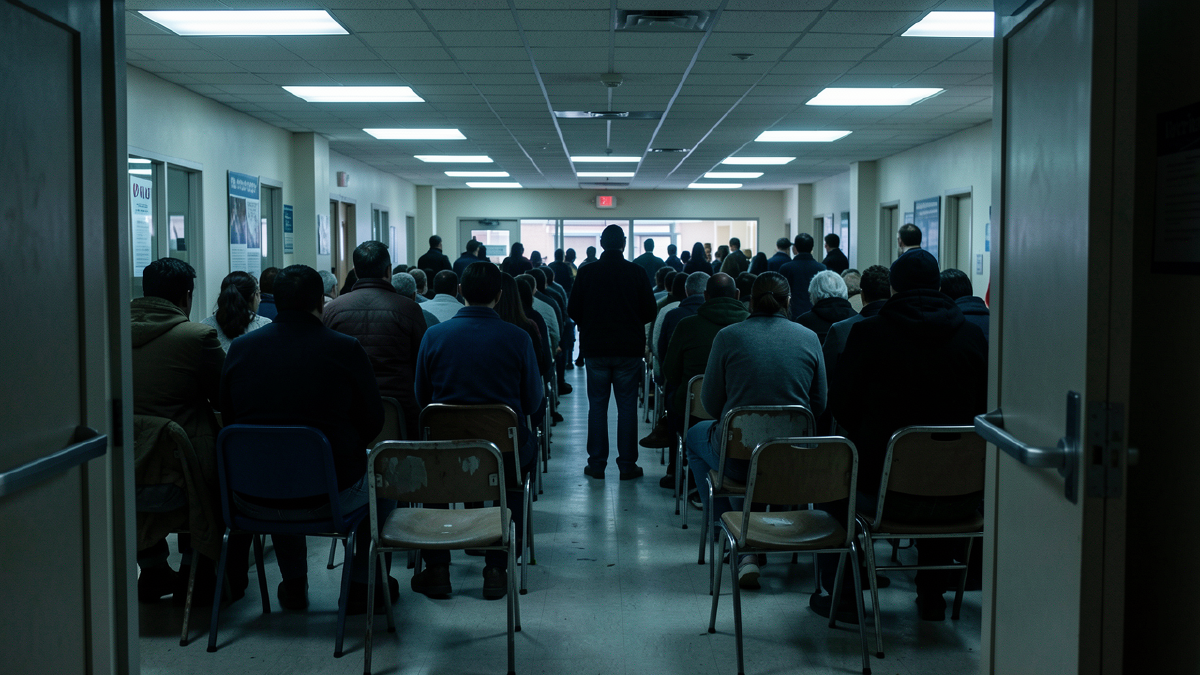
California’s DHCS released its H.R. 1 Implementation Plan on January 29, 2026, detailing how it will condition Medicaid access on work requirements for approximately 5 million expansion adults. This represents 20.5% of all expansion adults nationally, exceeding the combined expansion populations of the next three largest states. Urban Institute projects 1.2 to 1.4 million Californians could lose coverage, while UC Berkeley’s Labor Center estimates 8 million total Medi-Cal enrollees face risk when accounting for simultaneous federal and state policy changes. California confronts federal work requirements it philosophically opposes and cannot legally avoid, implemented atop state-level budget cuts creating unprecedented policy collision. Among expansion adults, 68% already work (42% full-time, 26% part-time), meaning the challenge centers on documentation and verification rather than employment creation.
Infrastructure at Breaking Point#
California’s administrative complexity exceeds any comparable state. Fifty-eight county welfare departments administer Medi-Cal eligibility with Los Angeles County alone processing more applications than most entire states, while rural counties like Alpine have eligibility staff in single digits. The same policy must function consistently across this enormous range. Approximately 24 MCOs operate under six different managed care models: County Organized Health Systems in 22 counties, Two-Plan Model covering Los Angeles and 13 other counties, Geographic Managed Care in Sacramento and San Diego, and Regional, Single Plan, and Kaiser limited-eligibility arrangements filling remaining areas. L.A. Care serves over 2.8 million members as the largest Medi-Cal plan nationally, CalOptima covers approximately 900,000 in Orange County.
DHCS centers strategy on automated verification through Employment Development Department wage data rather than member self-reporting. Ex parte renewal rates dropped back to pre-unwinding levels after federal flexibilities expired in July 2025, meaning administrative machinery already strains. Automated matching has sharp limits for gig economy workers, cash-paid labor, self-employed individuals, and California’s enormous informal economy. The state’s 500,000 to 800,000 farmworkers face seasonal employment patterns fundamentally incompatible with 80-hour monthly requirements. Central Valley farmworkers may log 50 to 60 hours weekly during July through November harvest but have limited agricultural employment during winter, easily exceeding annual thresholds while failing specific monthly compliance periods.
CalAIM infrastructure launched January 2022 includes Enhanced Care Management and 14 Community Supports addressing social determinants. The problem is utilization: ECM and Community Supports reach only 0.9% of members against estimated eligible population of 3 to 5%. Adding work requirement responsibilities risks overwhelming infrastructure that has not demonstrated it can handle its original mission.
Compounding State-Level Changes#
Federal work requirements arrive atop concurrent state policy transformations. Asset limits of $130,000 per person were reinstated January 2026. Enrollment freeze for undocumented adults took effect simultaneously; the 1.6 million undocumented Medi-Cal enrollees enrolled before January 2026 maintain coverage through renewals, but no new undocumented adults can enroll. Dental benefit elimination for undocumented adults scheduled for July 2026, with $30 monthly premiums for undocumented adults ages 19 to 59 following in July 2027. Each layer adds processing time, error potential, and member confusion.
Trump administration’s phase-out of Designated State Health Programs funding and rescission of Biden-era HRSN guidance further pressure California’s financing model. County eligibility workers must simultaneously verify assets for aged and disabled populations, track premium payment status for undocumented members, apply enrollment freeze accurately, manage work requirement verification for expansion adults, and process semi-annual rather than annual redeterminations.
California’s Democratic trifecta centers on harm reduction: automated verification, maximum exemption definitions, extended timelines if CMS grants them, and navigation support to prevent procedural disenrollment. But November 2026 gubernatorial election introduces uncertainty. Governor Newsom cannot seek reelection due to term limits, meaning implementation planning proceeds under current administration while enforcement begins under a successor whose priorities may differ. The election occurs barely one month before January 1, 2027 requirements take effect.
What California Reveals About Implementation at Scale#
California demonstrates that conventional implementation models built for states with 150,000 to 400,000 affected populations break catastrophically at 5 million. Error rates that seem acceptable at 2% become devastating when applied to California’s denominator. Systems that function for hundreds of thousands fail at orders of magnitude difference. The state’s linguistic diversity compounds every challenge: an estimated 900,000 to 1.2 million Limited English Proficiency individuals among expansion adults speak Spanish, Mandarin, Cantonese, Vietnamese, Korean, Tagalog, Russian, Armenian, Farsi, Arabic, and indigenous Mexican languages including Mixtec, Zapotec, and Triqui where interpreters remain scarce even in California.
The marketplace exclusion eliminating premium tax credits for individuals losing Medicaid specifically for work requirement noncompliance removes the safety valve California’s robust Covered California marketplace might have provided. For those below 138% FPL who lose Medi-Cal, there was never a marketplace alternative. For those slightly above the threshold, the exclusion ensures noncompliance creates a coverage cliff with no landing.
California represents approximately 20% of the national financial exposure from work requirements while facing state-specific compounding factors no other jurisdiction confronts at comparable scale. What happens in California will determine whether recognition-based approaches can reduce projected 25 to 30% coverage loss rates to something substantially lower, and whether “substantially lower” is achievable when dealing with populations measured in millions rather than thousands.
The Bottom Line#
Coverage losses are inevitable regardless of implementation quality given the magnitude of simultaneous policy changes and administrative complexity. The fundamental question is whether California’s automated verification strategy and navigation infrastructure investment can reduce Urban Institute projections of 1.2 to 1.4 million coverage losses to something meaningfully smaller. At this scale, reducing coverage loss from 28% to 20% still means over 900,000 people losing Medi-Cal. California’s experience will reveal whether work requirements can be implemented with recognition-based systems at population scales where no precedent exists, or whether the administrative machinery simply cannot function when the affected population exceeds what any state has previously managed. The gubernatorial transition one month before implementation creates political uncertainty around enforcement priorities. The state’s approach prioritizes harm reduction, but whether harm reduction at this scale is operationally achievable remains the defining implementation question for 2026 and 2027.