No vendor category in the work requirement technology market offers both deep state implementation experience and purpose-built verification capability. States face a fragmented landscape where eligibility system incumbents understand government procurement but have troubled track records, SDOH platforms excel at member engagement but lack state integration experience, and specialized startups have purpose-built solutions but limited financial stability and customer bases. The $100 million Congress allocated for all fifty states to build verification systems roughly equals what Georgia spent to serve fewer than 8,000 enrollees. With procurement timelines of eight to fourteen months from initiation to signed contract, states that have not yet begun face near-certain deadline violations for December 2026.
The Vendor Categories#
Eligibility system incumbents dominate state Medicaid technology infrastructure. Deloitte alone holds contracts in 25 states worth at least $6 billion. These vendors understand procurement requirements, possess established agency relationships, and have navigated CMS certification repeatedly. But a 2024 KFF Health News investigation documented widespread problems: Florida’s Deloitte system erroneously cut benefits for new mothers, Kentucky needed ten months and $522,455 to fix a single problem, Rhode Island’s implementation led to class-action lawsuits, and Tennessee’s system remains subject to ongoing litigation over wrongful terminations. The incumbent advantage is real but carries significant implementation risk.
SDOH platforms represent a second category. Unite Us facilitated over 60 million connections to social care services by end of 2024, growing nearly 60 percent year-over-year. Findhelp has earned Best in KLAS for SDOH networks for four consecutive years. These platforms connect individuals to community resources and track referrals through completion, but most have limited experience with state government procurement and legacy Medicaid system integration.
A distinct hybrid subcategory combines technology with navigation services and community-based organization partnerships. This model addresses the reality that technology alone cannot reach populations struggling with digital access, documentation, and system navigation. When a member cannot navigate a web portal, the platform routes them to a community health worker who speaks their language. When documentation requirements exceed member capacity, navigators help gather and submit materials. This approach may require different procurement structures blending technology licensing with service delivery agreements, but may deliver better coverage retention outcomes than pure technology solutions.
Specialized work requirement vendors have built systems specifically for verification, exemption processing, and compliance tracking, incorporating lessons from Arkansas’s failure and Georgia’s struggles. But limited track records and uncertain financial positions create procurement risk that state agencies struggle to accept.
Capability Requirements and Gaps#
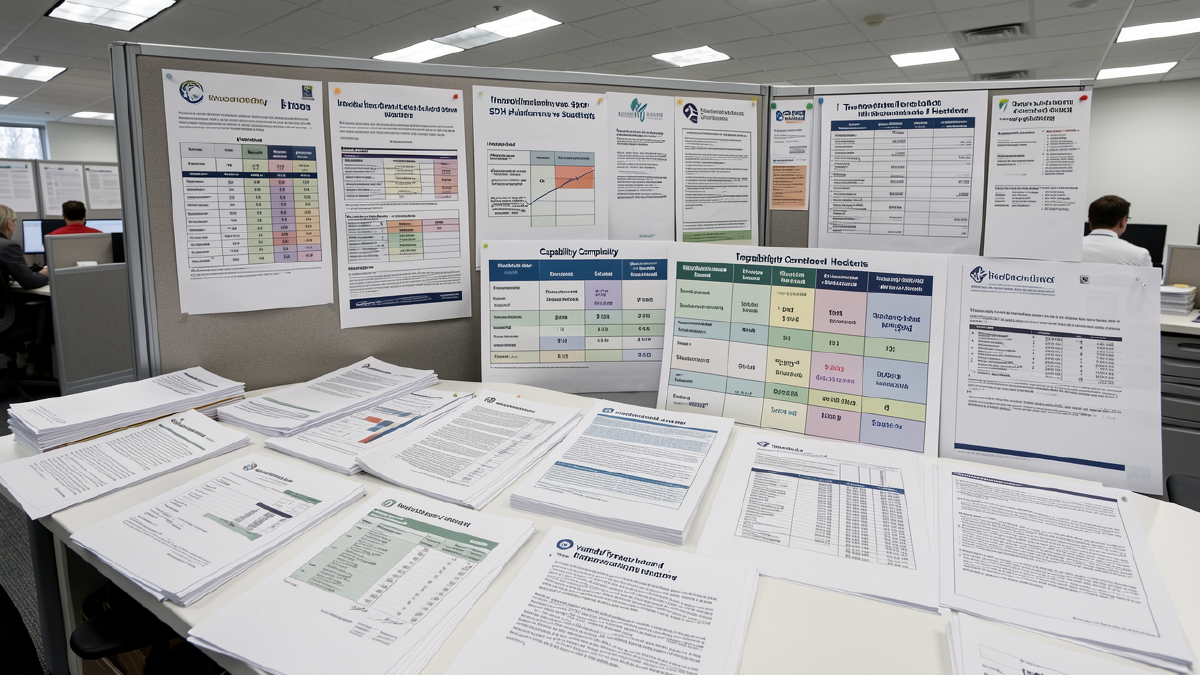
Work requirement verification demands nine interconnected capability domains: member-facing portals and mobile applications, employer verification interfaces, provider attestation integration, document processing with OCR and classification, automated data matching against wage and benefits databases, exemption workflow management across twelve-plus federal categories, appeals tracking, reporting and analytics for CMS, and MCO and CBO integration APIs.
The capability gaps vary systematically by vendor category. Incumbents have strong data matching and federal compliance experience but limited mobile capability and community organization relationships. SDOH platforms excel at member engagement and navigation coordination but lack eligibility system integration and federal certification familiarity. Hybrid platforms bridging technology with human infrastructure can handle the technology-to-human handoffs that pure technology solutions miss, though they require different contracting structures.
Automated data matching may be the most critical capability. Arkansas successfully exempted approximately two-thirds of enrollees through data matching with employer payroll and unemployment insurance records, avoiding the reporting burden that caused coverage losses for those who had to self-report. But data matching capabilities vary dramatically across states, and many expansion adults work for employers who do not report to state wage databases in real time.
Build, Buy, or Decompose#
Building internally offers maximum control and avoids vendor lock-in but requires capacity most state IT departments lack. Purchasing offers proven solutions but creates costly dependencies: Georgia spent over $55 million on its Deloitte-built system, and states report that even minor modifications take months and cost hundreds of thousands of dollars. Cost comparisons should extend beyond initial implementation to ten-year total cost of ownership, as initial development typically represents only 30 to 40 percent of lifecycle costs.
The decomposition approach may prove most realistic. Rather than seeking a single vendor to solve the complete problem, states can assign core verification to the eligibility system incumbent, navigation coordination to an SDOH platform with CBO partnerships, and data matching to internal teams retaining control over sensitive integrations. The approach is messier than a single integrated solution but may actually work within the available timeline.
Cooperative purchasing across states deserves attention. Fifty states building separate systems represents massive duplication of effort. State consortiums jointly procuring and sharing implementation costs could achieve better outcomes through collective negotiating power, though political dynamics may limit cooperation.
The Bottom Line#
The community health worker who testified at a state stakeholder session captured the essential insight: the technology will not reach many expansion adults. Only people will. Whatever technology states deploy, navigation investment should exceed systems investment. Technology is perhaps 25 percent of the solution. The other 75 percent is helping people understand their obligations, gather their documentation, and demonstrate compliance they are already achieving but cannot prove. The vendor selection matters, but it matters less than building the human infrastructure that makes any technology work.
Source: MRWR-13F_Technology_Vendor_Landscape.md Series 13: When Compliance Meets Reality GroundGame.Health Research Series on Medicaid Work Requirements