MCOs analyzing work requirement financial exposure typically understate it by an order of magnitude. Conventional analysis treats work requirements as an enrollment management challenge, projecting how many members will disenroll and calculating the net margin impact. This analysis ignores the mechanism that actually determines financial outcomes: risk adjustment degradation when complex members lose coverage and return with stale documentation but escalated care needs. The retention paradox is that the members who cost the most to serve are the ones MCOs cannot afford to lose.
The mechanism is rooted in how Medicaid managed care payment works. MCOs receive risk-adjusted capitation that increases with documented chronic conditions through Hierarchical Condition Category coding. A healthy 28-year-old generates perhaps $380 monthly. Add diabetes and it becomes $520. Add hypertension: $630. Depression: $740. Chronic kidney disease: $890. Each documented condition increments the payment because each condition implies higher expected costs. Critically, risk scores are calculated from diagnosis codes submitted during healthcare encounters over a 12-24 month lookback period. Every gap in care is a gap in documentation.
When a member loses coverage, chronic conditions persist but documentation stops. Emergency department visits during gaps capture presenting complaints but miss the diabetes, depression, and chronic pain a primary care physician would have documented. Upon return to coverage, the MCO receives capitation based on a degraded risk score that no longer reflects actual health status. A member whose pre-gap risk score generated $870 monthly might return generating only $450, while their actual care costs, elevated by medication non-adherence and disease progression during the gap, run $1,100 monthly. The MCO absorbs this $650 monthly underpayment for 12-24 months as new documentation accumulates, generating roughly $5,000 in aggregate loss per returning complex member.
In aggregate, an MCO with 500,000 expansion adults experiencing 15% coverage loss at each semi-annual redetermination, with half involving complex cases, faces HCC recapture lag costs approaching $40-60 million annually once the pattern stabilizes. Arkansas MCOs reported precisely this pattern during 2018-2019, when the state’s capitation rate-setting process, built on stable enrollment data, systematically underestimated costs from coverage volatility.
Against this backdrop, navigation investment transforms from charity into core business strategy. Intensive professional navigation costs approximately $400-500 per member. For a complex member generating $870 monthly capitation, this represents six weeks of premium. The return appears in prevented revenue loss, avoided cost escalation from disease progression, and protected care management investments. The combined value of prevented losses runs $3,000-6,000 over 18-24 months, generating returns of 6:1 to 13:1. Few healthcare interventions offer comparable ROI.
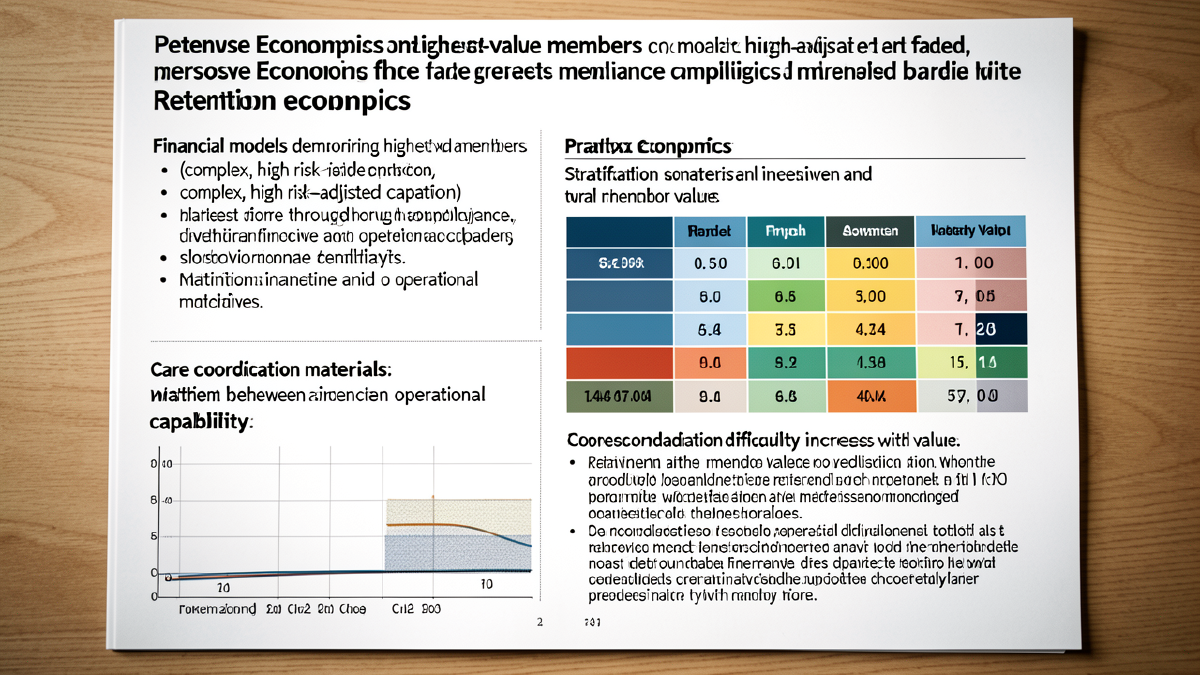
Strategic resource allocation requires risk stratification across three tiers. Tier 1 members with risk scores above $750 monthly, indicating three or more chronic conditions, warrant intensive professional navigation at $400-500 per member with returns of 6:1 to 13:1. Tier 2 members with risk scores of $500-750 warrant CISE microenterprise navigation at $100-150 per member with returns of 3:1 to 5:1. Tier 3 members below $500, predominantly healthy expansion adults, warrant automated outreach and self-service tools at $15-25 per member. This stratification concentrates resources where financial returns are highest while providing baseline support across the entire at-risk population.
The implications for MCO leadership extend across multiple strategic domains. Rate negotiations must incorporate risk corridors sharing volatility between MCO and state, because standard actuarial models built on stable enrollment will systematically underestimate costs. Care management and navigation functions should merge organizationally, since the same complex members needing disease management are the ones needing documentation support. Provider networks should include community-based navigation organizations as essential rather than peripheral infrastructure. Technology investments should prioritize real-time risk score visibility and documentation gap identification to enable targeted intervention.
The uncomfortable question arises with low-complexity members where retention investment may generate negative financial returns. A member generating $380 monthly with no chronic conditions has minimal risk adjustment value to protect. If navigation costs $450, the pure financial return is negative. The tension between financial logic and mission commitment is genuine. MCOs are businesses that must maintain solvency, but they operate in a sector where purely profit-maximizing behavior generates regulatory intervention. The practical resolution is allocating retention resources proportional to financial return while maintaining a floor of basic support for all members.
The retention paradox reveals a deeper truth about risk-adjusted payment systems: they reward documentation continuity as much as health status. Coverage volatility that interrupts documentation destroys value having nothing to do with actual health changes. MCOs that recognize this transformation will integrate navigation with care management and target resources by retention value. Those that treat navigation as peripheral will absorb HCC recapture losses undermining financial performance for years.