The single mother sits in her community college advisor’s office trying to understand how three different policy changes will hit her household simultaneously. She works 25 hours weekly at a retail job while completing her associate degree in early childhood education. Her two children have Medicaid coverage. She receives a small housing voucher that covers part of her rent. Her marketplace health insurance currently costs $68 monthly with enhanced premium tax credits.
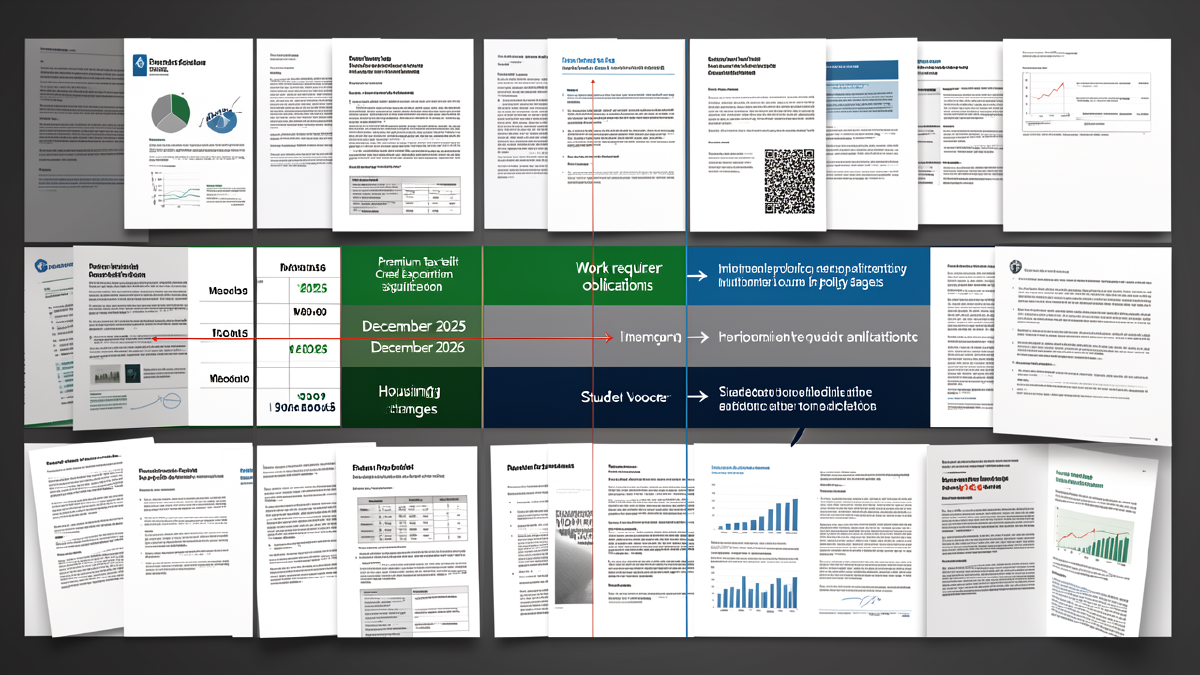
The advisor walks her through the timeline. On December 31, 2025, the enhanced premium tax credits expire. Her marketplace premium will jump to $487 monthly starting January 2026, an amount she cannot possibly afford on her income. She will need to enroll in her employer’s health plan, which costs $210 monthly with a $4,000 deductible, or go uninsured. Six months later in June 2026, her children face their first work requirement redetermination. She must document 80 hours monthly of combined work and school to maintain their coverage. Her 25 work hours plus 12 credit hours should meet the requirement, but the documentation system requires verification from both her employer and the college every six months.
Meanwhile, Congress has been debating housing assistance restructuring. While the most severe cuts were rejected, her local housing authority has already reduced voucher payment standards by 12% due to funding uncertainty. Her rent portion increased $140 monthly as of October 2025. And student loan repayment for her undergraduate debt, paused during the pandemic and restarted in 2023, continues with $180 monthly payments that offer no credit toward work requirements despite representing 30 hours monthly of work to earn that payment.
She does the math. Her marketplace premium increases by $419 monthly. Her housing costs rise by $140 monthly. Student loan payments continue at $180 monthly. If employer health insurance is her only option, that costs $210 monthly, replacing the $68 marketplace premium. Her net monthly increase is at minimum $530, and potentially $739 if she switches to employer coverage. This represents 40% of her net monthly income. Something has to give: reduce work hours and risk losing children’s Medicaid, drop out of school and lose her pathway to better employment, defer student loans and damage her credit, or move to cheaper housing farther from campus and work.
None of these choices leads to better outcomes. Each represents a step backward from the stability she has fought to build. And she is far from alone. Millions of households navigating the intersection of marketplace coverage, Medicaid, housing assistance, student debt, and educational pathways face similar cascading decisions as multiple federal policy changes compress into a 12-month window.
The Enhanced Premium Tax Credit Cliff#
The American Rescue Plan Act of 2021 enhanced ACA marketplace premium tax credits by eliminating the 400% federal poverty level income cap and reducing required premium contributions across all income levels. These enhancements, extended through December 31, 2025 by the Inflation Reduction Act, have expanded marketplace enrollment from 11 million in 2020 to over 24 million in 2025. Most of this growth came from enhanced subsidies making coverage affordable for people who previously found marketplace premiums prohibitive.
Starting January 1, 2026, these enhancements expire. The income cap at 400% FPL returns, immediately eliminating premium assistance for roughly 3 million enrollees earning above that threshold. For everyone else receiving premium tax credits, required premium contributions increase substantially. Someone at 150% FPL who paid nothing for benchmark silver coverage in 2025 will pay $1,107 annually in 2026. Someone at 250% FPL paying $888 annually will pay $1,904. The average increase across all subsidized enrollees is projected at 114%, roughly $1,016 annually.
These calculations assume premiums remain constant, which they will not. Insurers filing 2026 rates anticipate that higher net premiums will cause healthier enrollees to drop coverage while sicker enrollees retain it. This adverse selection drives gross premiums upward beyond underlying cost trends. Early rate filings suggest an additional 4-7 percentage point premium increase attributable solely to enhanced tax credit expiration, on top of baseline medical cost inflation of 7-10%. The combination could produce marketplace premium increases of 15-20% for plan year 2026.
The populations most affected by enhanced tax credit expiration overlap substantially with populations subject to Medicaid work requirements. Someone earning $25,000 annually is above Medicaid income thresholds in most states but relies on enhanced tax credits for marketplace affordability. When those credits expire in January 2026 and work requirements take effect in December 2026, this person faces two coverage disruption risks in a single calendar year. If they lose marketplace coverage due to affordability in Q1 2026, they may apply for Medicaid if their income qualifies, only to face work requirement compliance six months later.
The timing creates a coverage crisis that states and MCOs are unprepared to manage. Enhanced tax credit expiration will push 3-4 million people off marketplace coverage or make that coverage economically burdensome. Some portion of these individuals will seek Medicaid if their incomes qualify or if they reduce work hours to fall below income thresholds. States implementing work requirements in December 2026 will face this influx of formerly marketplace-covered individuals just as they are operationalizing work requirement verification systems.
The Housing Assistance Uncertainty#
Federal housing assistance operates through multiple programs with different structures and funding mechanisms. Section 8 Housing Choice Vouchers provide rental assistance to approximately 2.3 million households. Public housing serves roughly 950,000 households. Project-based rental assistance supports 1.2 million units. Together these programs represent the primary federal safety net for housing affordability among low-income households.
The 2025 budget debates included proposals for dramatic restructuring: 43% cuts to rental assistance, Section 8 block grants to states, two-year time limits for able-bodied adults, and Emergency Housing Voucher elimination. While Congress rejected the most severe provisions in July 2025, the uncertainty has already affected local housing authorities. Many reduced voucher payment standards in anticipation of budget cuts. When those cuts were not enacted, the payment reductions largely remained because restoring higher standards would require budget commitments housing authorities cannot make given funding unpredictability.
The result is that housing voucher recipients saw their housing costs increase 8-15% during 2025 even though the threatened federal cuts did not materialize. Someone paying $450 monthly for housing with a voucher covering the rest might now pay $510-520. This $60-70 monthly increase compounds with other policy changes occurring simultaneously.
Housing assistance populations overlap substantially with Medicaid expansion populations. Roughly 40% of Housing Choice Voucher recipients have Medicaid coverage. Among expansion adults subject to work requirements, perhaps 15-20% receive some form of housing assistance. For these households, housing cost increases from voucher payment reductions and potential Medicaid loss from work requirement non-compliance represent compounding financial pressures.
The work requirement itself creates housing stability challenges beyond direct cost impacts. Someone experiencing homelessness or housing instability faces enormous barriers to work requirement documentation. They may lack stable addresses for correspondence, reliable phone numbers for verification calls, or secure storage for employment documentation. Article 11E examined these barriers in detail. The convergence of housing assistance uncertainty with work requirement implementation amplifies these challenges for the populations least equipped to manage documentation complexity.
Housing authorities are not coordination partners in most state work requirement implementation plans. This represents a structural gap. Someone whose housing voucher requires 30 hours weekly of work or approved activities for voucher eligibility should be able to use that verification for Medicaid work requirement compliance. But housing authorities and Medicaid programs operate in separate administrative silos. Data sharing would require legal authorities and technical infrastructure that largely do not exist.
The Student Loan Repayment Complexity#
Federal student loan repayment restarted in October 2023 after a three-year pandemic pause. The One Big Beautiful Bill Act consolidates income-driven repayment plans into two options starting July 2028, and makes loan forgiveness after repayment periods taxable for debt forgiven after December 31, 2025. Borrowers in repayment face monthly obligations averaging $200-300 that represent 10-15% of income for many expansion adult borrowers.
Student loan repayment does not count as work activity under Medicaid work requirements. Someone paying $250 monthly in student loans is dedicating substantial time to earning that payment, but work requirements count only the hours worked, not the financial obligations those hours support. This creates financial pressure that constrains work hour availability.
A student loan borrower working 80 hours monthly at $12 hourly earns roughly $960 gross or $800 net. Student loan payment of $250 claims 31% of that net income. Work requirement verification every six months adds administrative burden. If employment becomes irregular or documentation fails, coverage loss eliminates access to healthcare while student loan obligations continue unabated. The borrower cannot reduce student loan payments to afford medical care, cannot pause loans to focus on work requirement compliance, and receives no work hour credit for the income used to repay education debt.
Expansion adults with student debt face higher rates of degree non-completion and longer repayment timelines than traditional students. Many attended college during periods of life instability, accumulated debt without completing credentials, and carry that debt into employment that does not require degrees. Their education generated debt but not the income premium that debt was meant to enable. Work requirements that count educational attendance as qualifying activities but not the subsequent debt repayment create an asymmetry that borrowers experience as punishment for having attended college.
The intersection becomes even more complex for people attempting to use current education as work qualifying activity. Someone enrolled in community college while working part-time might have both current enrollment counting toward work requirements and past student debt requiring repayment. If their combined work hours and credit hours meet work requirements but their student debt payment constrains their ability to afford medical expenses, they face work requirement compliance while struggling with healthcare access despite Medicaid coverage.
The Overlapping Population Mathematics#
Estimating how many individuals face multiple simultaneous policy impacts requires understanding population overlap patterns. Start with the 18.5 million expansion adults subject to work requirements. Layer on housing assistance recipients at 15-20% overlap, yielding roughly 2.8-3.7 million individuals. Layer on student debt holders at 25-30% of expansion adults, yielding 4.6-5.6 million. Layer on individuals who lost marketplace coverage or saw premiums become unaffordable after enhanced tax credit expiration, perhaps 8-10% of expansion adults who previously held marketplace coverage before qualifying for Medicaid.
These populations are not independent. Someone with student debt is more likely to have held marketplace coverage before Medicaid. Someone receiving housing assistance is more likely to face income volatility that creates coverage transitions. The actual population facing multiple simultaneous impacts is smaller than the sum of individual populations but larger than any single category.
A conservative estimate suggests 1.5-2.5 million expansion adults face at least two of these policy impacts in the 12-month window from January 2026 to December 2026. Perhaps 400,000-800,000 face three or more simultaneous impacts. These are the households navigating marketplace premium increases in January, housing cost increases throughout the year, student debt obligations continuously, and work requirement compliance starting in June or December depending on their redetermination cycle.
For this multiply-burdened population, each individual policy might be manageable in isolation. Premium increases of $100 monthly are affordable if other costs remain stable. Housing cost increases of $60 monthly are manageable if healthcare and education expenses do not rise. Student debt payments of $200 monthly fit budgets if housing and health insurance stay constant. But simultaneous increases of $100 for premiums, $60 for housing, and ongoing $200 student debt obligations represent $360 monthly, or $4,320 annually. For someone earning $18,000 annually, this represents 24% of gross income dedicated to policy-driven cost increases beyond their control.
The State Planning Implications#
States implementing work requirements in December 2026 confront a healthcare coverage landscape already disrupted by enhanced tax credit expiration. From January through November 2026, states will observe:
Marketplace enrollment declines of 10-15% as premiums become unaffordable. Some formerly marketplace-covered individuals will qualify for Medicaid income-wise and will apply. States see Medicaid applications increase 3-8% above baseline during Q1 and Q2 2026, straining eligibility systems already preparing for work requirement implementation.
Uninsured rates rising 1.5-2.5 percentage points during the first half of 2026 as people lose marketplace coverage but do not qualify for Medicaid or cannot afford employer coverage. Hospital uncompensated care begins increasing after three years of decline, creating political pressure for coverage solutions.
MCO rate negotiations for 2027 contract years occurring during mid-2026 when marketplace disruption is visible but work requirement impacts remain uncertain. Actuaries struggle to model population changes when two major policy disruptions overlap within 12 months. MCO bids for 2027 rates incorporate substantial risk margins or request risk corridors broader than states want to accept.
States with aggressive work requirement timelines face December 2026 implementation deadlines while managing the aftermath of January 2026 marketplace disruption. The verification systems, call centers, and appeals infrastructure must be operational for work requirements while also processing increased Medicaid applications from people losing marketplace coverage. Some states will request implementation delays or phase-in periods, citing administrative capacity constraints from managing dual coverage transitions.
States with more gradual implementation timelines can observe marketplace disruption patterns and adjust work requirement policies accordingly. A state implementing work requirements in June 2027 can analyze the January 2026 marketplace transition, measure how many people shifted to Medicaid, assess documentation failure patterns, and refine exemption categories before their own work requirements take effect. The temporal separation provides learning opportunities, though it does nothing to help individuals facing both transitions in states with aggressive timelines.
The MCO Response Challenge#
MCOs operating in states implementing December 2026 work requirements must prepare for multiple simultaneous challenges. First, enhanced tax credit expiration creates marketplace enrollment volatility that may shift populations toward Medicaid. Plans operating both marketplace and Medicaid lines of business see enrollment shifts between product lines. The people losing marketplace coverage are not random; they are disproportionately lower-income marketplace enrollees for whom pre-enhancement tax credits were insufficient. These individuals trend toward higher healthcare utilization than marketplace averages because they delayed care during periods of uninsurance before ACA implementation.
MCOs must incorporate these enrollment shifts into work requirement planning. If 50,000 additional people enroll in a state’s Medicaid program during H1 2026 due to marketplace unaffordability, those individuals face work requirements at their first redetermination, which occurs in December 2026 for June enrollees or June 2027 for December enrollees. These new enrollees have limited time to understand work requirements before redetermination. They likely lack community connections that long-term Medicaid enrollees have. Navigation investment must account for this influx of marketplace-transition members who need intensive support.
Second, MCOs must manage the care continuity disruption that enhanced tax credit expiration creates. Someone who had marketplace coverage through November 2025, lost it in January 2026, became uninsured for five months, then enrolled in Medicaid in June 2026 has a six-month gap in their care management record. Their risk scores reflect incomplete documentation. Their chronic conditions may have worsened during the uninsured period. The care management investment made during their marketplace enrollment is lost. The MCO inherits someone with degraded health status, inadequate risk adjustment, and urgent care needs, all while preparing them for December 2026 work requirement redetermination.
Third, MCOs must coordinate with community partners experiencing their own resource constraints. Housing assistance uncertainty creates financial pressure on Housing Choice Voucher recipients who are disproportionately represented among complex Medicaid populations. Food assistance has its own policy debates. Transportation vouchers face budget constraints. The community resource network that MCOs rely on to address social determinants of health is itself under stress from multiple policy changes, reducing its capacity precisely when navigation needs increase.
The Individual Decision Framework#
For individuals facing multiple simultaneous policy impacts, decision frameworks developed for single-policy changes become inadequate. Someone evaluating whether to work additional hours to meet work requirements must now consider:
Will additional work hours disqualify me from housing assistance that operates on different income thresholds than Medicaid? Housing programs often have lower income limits than Medicaid. Increasing earnings to ensure work requirement compliance might push income above housing assistance thresholds, converting a gain of healthcare coverage into a loss of housing stability.
Will additional work hours affect my student loan repayment calculations? Income-driven repayment plans adjust monthly payments based on income. Increasing work hours increases income which increases required loan payments. The additional income from working 80 hours monthly instead of 60 might generate $240 additional gross income but $90 additional net income after taxes and a $40 increase in loan payments, yielding only $50 net benefit while adding administrative burden of work requirement verification.
Can I afford marketplace coverage if I lose Medicaid, given that enhanced tax credits have expired? This calculation requires understanding 2026 marketplace premiums without enhanced tax credits, comparing against employer coverage if available, and deciding if uninsurance is the least-bad option. Many individuals will conclude that losing Medicaid means becoming uninsured because no affordable alternative exists.
Should I reduce work hours or drop out of school to qualify for Medicaid exemptions? Some exemption categories activate based on inability to work. If someone is struggling to manage work, school, housing, and health simultaneously, intentionally qualifying for an exemption by reducing employment might be rational. This creates exactly the perverse incentive that work requirements are designed to prevent, but the incentive emerges from policy convergence rather than individual character.
These decision frameworks require information most individuals do not have and analytical capacity that social services do not provide. Navigators can help with work requirement verification. Financial aid offices can explain student loan options. Housing counselors can address voucher eligibility. But few resources exist to help someone optimize across all of these programs simultaneously when policy changes create conflicting incentives.
The Provider and Community Organization Burden#
Healthcare providers and community organizations become the de facto coordinators for people navigating multiple simultaneous policy impacts. Someone presenting at a community health center with uncontrolled diabetes and high blood pressure might have lost marketplace coverage in January 2026, been uninsured for five months, enrolled in Medicaid in June 2026, and now faces December 2026 work requirement redetermination. The clinician must address urgent medical needs while also recognizing that this person needs navigation support, housing stability resources, food security interventions, and care coordination across a fragmented system.
Community health centers are equipped to handle complex medical and social needs. They are not equipped to handle the administrative complexity of multiple federal programs changing simultaneously. Adding work requirement navigation to existing responsibilities of scheduling appointments, managing chronic diseases, addressing food and housing insecurity, coordinating behavioral health services, and maintaining quality metrics creates capacity constraints that affect the organization’s ability to serve all patients well.
Faith-based organizations and community groups find themselves explaining policy interactions they do not fully understand themselves. A church volunteer helping someone with work requirement documentation might learn that the person is also facing marketplace premium increases, housing cost increases, and student loan obligations. The volunteer can offer moral support and perhaps connect the person to other resources, but cannot provide the sophisticated benefits counseling that the situation requires.
Professional social workers and navigators have frameworks for addressing multiple needs, but those frameworks were developed for relatively stable policy environments. When housing policy, healthcare policy, education policy, and income support policy all change within a 12-month window, the frameworks break down. Social workers must simultaneously become experts on marketplace subsidy rules, work requirement exemptions, housing assistance changes, student loan repayment options, and how these interact. No training program prepares for this level of cross-program complexity.
The Political Economy of Convergence#
The December 2025 convergence creates political dynamics that neither party fully controls. Republicans supporting work requirements and marketplace deregulation can point to Medicaid enrollment reductions and reduced federal healthcare spending. Democrats opposing both policies can highlight coverage losses and healthcare access problems. But neither can claim complete control over outcomes because the policies interact in ways that produce effects neither side intended.
Enhanced tax credit expiration pushes people off marketplace coverage, some of whom enroll in Medicaid, temporarily increasing Medicaid enrollment even as work requirements take effect. Work requirements then cause Medicaid coverage losses six months later, but some people who lose Medicaid cannot afford marketplace coverage without enhanced tax credits. The uninsured rate increases more than either policy alone would predict because the safety valves that normally cushion coverage transitions are unavailable.
Congressional offices receive constituent complaints that cross policy boundaries. Someone who lost marketplace coverage in January, enrolled in Medicaid in June, then lost Medicaid in December due to work requirement documentation failure has experienced three coverage transitions in 12 months. The constituent cannot separate these experiences into distinct policy debates. Their complaint combines marketplace affordability, work requirement implementation, and coverage stability into a single narrative of system failure. Congressional staff struggle to route such complaints to appropriate committees because healthcare, housing, education, and income support policies interact in ways committee jurisdictions were not designed to address.
State legislators face similar complexity. Someone testifying at a state hearing about work requirement impacts might describe how marketplace premium increases, housing cost increases, and work requirement implementation have combined to destabilize their household. State legislators have authority over work requirement implementation but not marketplace subsidies or federal housing policy. They can modify exemption categories or extend implementation timelines but cannot prevent the other policy changes driving constituent hardship. The disconnect between problems and available solutions frustrates legislators regardless of party.
The Temporal Cascade#
The specific timeline of policy changes matters enormously for how effects compound. Enhanced tax credit expiration on December 31, 2025 creates coverage disruption starting January 1, 2026. People make open enrollment decisions in November-December 2025 based on 2026 premiums. Many will choose to drop coverage rather than pay premiums that have more than doubled. Uninsurance increases in Q1 2026, perhaps 4-6 weeks before the full magnitude becomes apparent in enrollment data.
This uninsurance peak occurs six months before work requirement implementation in states with December 2026 effective dates. Some newly uninsured people qualify for Medicaid and enroll during spring 2026. Their first work requirement redetermination occurs in December 2026, giving them only six months to understand requirements and establish compliance documentation patterns. The short timeline between enrollment and redetermination creates documentation failure risk even among genuinely compliant members.
States with June 2027 work requirement effective dates have a different experience. They observe the January 2026 marketplace disruption and the December 2026 work requirement experience in early-implementing states. They can adjust exemption categories, verification timelines, and navigation investment based on observed patterns. But they cannot prevent their residents from experiencing marketplace disruption in January 2026. The learning opportunity comes too late to help people facing premium increases that have already occurred.
Housing cost increases from voucher payment standard reductions occurred throughout 2025 and early 2026. By the time work requirements take effect in December 2026, housing-vulnerable populations have already absorbed 12-18 months of increased housing costs. Their financial reserves are depleted. Their ability to weather additional shocks is reduced. Work requirement implementation hits households already financially stressed from housing costs, potentially triggering homelessness among people who were housing-stable before the cascade of policy changes began.
Student loan repayment obligations are continuous throughout this entire period. Unlike the discrete policy change points of enhanced tax credit expiration and work requirement implementation, student debt creates constant monthly financial pressure. This steady drain on resources reduces the financial cushion available to manage other policy transitions. Someone paying $200 monthly in student loans has $200 less monthly to absorb marketplace premium increases or housing cost increases, making them more vulnerable to coverage loss from affordability pressures.
The Counterargument: Forcing Necessary Transitions#
Defenders of this policy convergence might argue that the simultaneous pressure creates incentives for beneficial transitions that would not occur under more gradual implementation. Enhanced tax credit expiration pushes people toward employer coverage. Work requirements push people toward employment. Housing assistance time limits push people toward self-sufficiency. Student loan obligations enforce responsibility for education choices. The convergence of pressures, while uncomfortable, might accelerate transitions that are ultimately desirable.
This argument has force if the transitions it envisions are available and achievable. Someone losing marketplace coverage who can obtain affordable employer coverage has made a transition to more stable coverage. Someone who increases work hours to meet requirements and improves their long-term employment prospects has achieved the policy’s goal. Someone who transitions off housing assistance into self-sustaining housing has improved their situation. The question is what proportion of affected people can actually make these transitions versus what proportion simply loses assistance without replacing it.
The Arkansas work requirement experience suggests that most coverage losses were not successful transitions. People lost coverage, became uninsured or sporadically insured, and experienced worse health outcomes. Employment did not increase measurably. The hypothesis that removing assistance would push people toward self-sufficiency was not validated. Coverage loss appeared to be pure loss rather than transition to better alternatives.
The enhanced tax credit expiration evidence is still emerging, but early patterns suggest similar dynamics. People dropping marketplace coverage are not all transitioning to employer coverage. Many are becoming uninsured. The premium increases are too large relative to income for many households to absorb even if they value coverage highly. When premiums consume 25-30% of income, coverage becomes unsustainable regardless of health needs.
The honest assessment is that policy convergence creates transitions for some people and destabilization for others. The distribution depends on individual circumstances, local labor markets, state implementation choices, and community support infrastructure. Policy analysis that assumes all pressure creates productive transitions rather than system failure ignores the substantial evidence that marginal populations lose assistance without successfully replacing it.
Conclusion: When Safety Valves Close Simultaneously#
The budget director preparing her state’s December 2026 work requirement implementation encounters a healthcare landscape already destabilized by marketplace disruption. From January through November 2026, she observes hospitals reporting uncompensated care increases, emergency departments seeing more uninsured patients, and Medicaid applications rising as people lose marketplace coverage. The verification systems her state is building must launch into this environment of existing disruption.
She cannot delay implementation; the federal legislation mandates December 2026 for expansion adults. She cannot prevent enhanced tax credit expiration; that is federal policy beyond state control. She cannot stabilize housing assistance; that is federal and local policy beyond her authority. She can only manage her state’s work requirement implementation as carefully as possible while recognizing that populations facing multiple simultaneous shocks will struggle to comply regardless of verification system quality.
The December 2025 convergence represents a policy choice to close multiple safety valves simultaneously rather than sequencing transitions to allow adjustment periods. Enhanced tax credits could have been extended while work requirements were being implemented, giving people time to adapt to each change separately. Housing assistance changes could have been delayed until work requirement effects were observable. Student loan repayment could have incorporated work requirement compliance considerations. None of these happened. The policies proceed independently, creating convergence by accident rather than design.
For the millions of households navigating this convergence, the experience is not one of distinct policy changes but rather of continuous instability where one shock follows another before recovery from the previous shock is possible. The single mother in the opening vignette faces premium increases, housing cost increases, work requirement compliance, and continuing student debt obligations as a unified experience of system failure rather than a series of separable policy changes. From her perspective, the question is not whether each individual policy is justified but whether the system as designed is compatible with human thriving.
The honest answer is that for substantial numbers of people, it is not. Some individuals have the resources, capabilities, and circumstances to navigate complex bureaucratic requirements across multiple systems while managing work, family, health, housing, and education simultaneously. Others do not. The convergence of multiple policy changes within a compressed timeline separates those who can manage complexity from those who cannot, allocating hardship based on administrative capacity rather than work ethic or moral worth.
What the December 2025 convergence reveals is that policy interactions matter as much as policies themselves. Each individual policy might be defensible in isolation. Enhanced tax credit expiration reduces federal spending. Work requirements enforce reciprocity norms. Housing assistance limitations address budget constraints. Student loan obligations enforce educational accountability. But the convergence of these policies within a 12-month window creates effects that none of them generate individually, and those effects fall disproportionately on populations least equipped to manage administrative complexity.
The question is not whether any single policy is justified. The question is whether the system created by multiple overlapping policies functions adequately for the people it affects, or whether policy convergence creates a level of complexity that exceeds human and organizational capacity to navigate successfully. The evidence emerging from the December 2025 convergence increasingly suggests the latter.