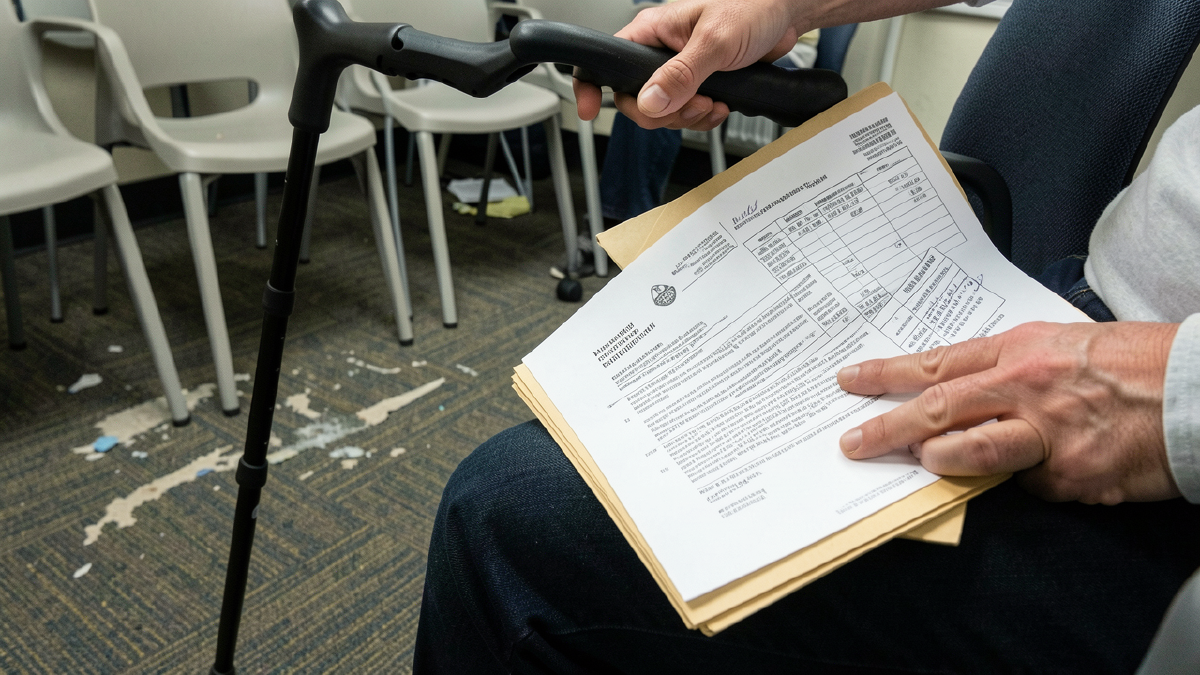
Jordan Mitchell, 29, sustained a traumatic brain injury in a car accident five years ago. A pickup truck ran a red light, impacting the driver’s side door. Jordan woke up three days later in the ICU, not yet understanding how much had changed permanently.
The TBI damaged executive function, the brain’s capacity to plan, organize, manage complex tasks, and maintain attention across extended periods. Before the injury, Jordan worked as a retail manager handling inventory systems, supervising employees, managing scheduling conflicts, and making rapid decisions across competing priorities. After the injury, those tasks became impossible. Jordan tried returning after three months of medical leave. Simple stocking tasks that used to be automatic kept getting lost mid-sequence. By hour three of the first shift back, Jordan was crying in the break room from overwhelming cognitive fatigue. The neurologist explained it as diffuse axonal injury damaging the white matter connections enabling different brain regions to communicate.
Jordan can work 15-20 hours weekly at jobs with clear routines and minimal decision-making. For three years, Jordan cleaned hotel rooms following standardized procedures: 20 hours weekly, four 5-hour shifts. But Jordan cannot work 40 hours weekly. The cognitive fatigue accumulates. By hour 20 each week, concentration fails. Push to 25 hours and fatigue carries into the next day. The neuropsychologist tested this pattern. Jordan’s work capacity plateaus at approximately 70 hours monthly.
The Medicaid work requirement is 80 hours monthly. The 10-hour gap between capacity and requirement creates a coverage problem. Jordan tried finding supplemental employment. Most positions wanted 20-hour minimum commitments. One hotel offered 8 hours but on Friday evenings when weekly fatigue makes even simple tasks difficult. The employment market doesn’t offer 10-hour monthly positions structured for Jordan’s capacity pattern.
Jordan applied for SSI disability benefits two years ago. Eight months of exhaustive evaluation: neuropsychological testing showing processing speed in the 15th percentile, executive function indicating moderate impairment, functional capacity evaluation concluding Jordan can perform simple repetitive tasks for up to 5 hours daily but cognitive fatigue limits sustained capacity to approximately 20 hours weekly. The application was denied. The denial letter explained that while Jordan has functional limitations, partial work capacity disqualifies from SSI, which requires inability to engage in substantial gainful activity. Jordan appealed. The administrative law judge agreed: genuine cognitive deficits but residual functional capacity for simple work at reduced hours. Claim denied.
Jordan now faced work requirements designed assuming full capacity. The state’s medical exemption application asked whether the applicant was unable to work. Jordan wasn’t unable to work. Jordan was working 20 hours weekly. Just not 21 hours. The case manager was clear: medical exemptions are for people who can’t work at all. If SSI said Jordan could engage in substantial gainful activity, the state wasn’t overriding that determination.
Coverage terminated in October. Without medications managing TBI symptoms, functioning deteriorated. The headaches returned. Mood dysregulation came back. Sleep deprivation compounded cognitive fatigue. Jordan made mistakes at work, cleaning rooms that guests still occupied, forgetting supply restocking sequences. The supervisor let Jordan go in April. Jordan lost the apartment in May, moving to a shelter, then friends’ couches.
Jordan sits now in the Medicaid office appealing the second coverage termination. The appeals examiner asks why inability to work 80 hours monthly warrants exemption when SSI determined Jordan could work. Jordan tries explaining the cognitive fatigue, the employment market realities, the deterioration when pushing beyond sustainable capacity. The appeal is denied.
Jordan isn’t exceptional among people with partial work capacity. The experience reflects structural patterns affecting 900,000 to 1.5 million expansion adults who fall into the disability gap: too disabled for full-time work, not disabled enough for SSI. The question isn’t whether Jordan should work. Jordan was working at maximum sustainable capacity before coverage loss triggered the cascade of medication discontinuation, job loss, and housing loss. The question is whether work requirements should accommodate functional limitations that prevent meeting 80 monthly hours but don’t qualify for SSI.
Demographics and Scope#
Functional limitations significant enough to limit work capacity but insufficient to qualify for SSI/SSDI represent 900,000 to 1.5 million expansion adults, approximately 5-8% of those subject to work requirements. These individuals occupy the disability gap between full work capacity and SSI-qualifying complete work inability.
SSI denial rates reveal the scale of partial capacity populations. Approximately 62% of SSI/SSDI applications are denied at initial application, with 84% denied at reconsideration. Many denials occur because applicants have partial work capacity that SSI’s substantial gainful activity standard doesn’t accommodate. Substantial gainful activity in 2025 is defined as earning $1,470 monthly or approximately 100 hours at federal minimum wage. Individuals who can work 40-60 hours monthly at minimum wage jobs earn $580-870 monthly, clearly below substantial gainful activity thresholds, yet don’t qualify for SSI because they retain partial work capacity.
The partial capacity population includes diverse conditions. Traumatic brain injuries with executive function deficits affect approximately 150,000 expansion adults, creating cognitive limitations that reduce work capacity without eliminating it. Learning disabilities affecting processing speed and workplace functioning affect approximately 200,000. Chronic pain conditions including fibromyalgia, chronic fatigue syndrome, and back pain without objective imaging findings affect approximately 300,000, limiting sustained physical activity without eliminating all work capacity. Mental health conditions like anxiety and depression not severe enough for SMI classification but significantly impairing workplace performance affect approximately 250,000. Post-injury recovery with incomplete functional restoration affects approximately 100,000 as people regain substantial function but not complete capacity.
Cognitive impairments without intellectual disability create work limitations that SSI often doesn’t recognize. Traumatic brain injuries, strokes with partial recovery, and learning disabilities not meeting intellectual disability criteria all create cognitive limitations affecting work capacity without eliminating it. These individuals can work but need simplified tasks, structured environments, reduced hours, and ongoing support. Their cognitive functioning isn’t normal but doesn’t meet SSI thresholds requiring inability to work.
Chronic pain without objective measures creates particular challenges for disability determination. Back pain, fibromyalgia, and chronic fatigue syndrome create real functional limitations that don’t show on imaging or testing. SSI denies many chronic pain applications because medical evidence shows no objective impairment correlating with reported pain levels. MRI scans show normal spine structure. Blood tests show no inflammatory markers. Physical examinations reveal no observable dysfunction. Yet pain limits work capacity regardless of whether imaging confirms severity. The disconnect between subjective pain experience and objective testing creates credibility challenges. Someone reporting daily pain level 8 out of 10, unable to sit for more than an hour without standing, unable to stand for more than 30 minutes without sitting, experiences real work limitations even when all tests come back normal.
Mental health conditions below SSI severity thresholds affect substantial populations. Anxiety disorders, moderate depression, and PTSD not meeting severe criteria create workplace limitations without eliminating all work capacity. Individuals can work reduced hours in low-stress environments but cannot handle full-time hours or high-stress positions. SSI requires marked limitations in multiple functional areas. Moderate limitations in some areas don’t qualify.
Multiple moderate conditions create cumulative limitations that SSI evaluates condition-by-condition rather than assessing combined impact. Diabetes requiring careful management plus arthritis limiting physical stamina plus anxiety affecting concentration creates combined limitations preventing full-time work even though no single condition qualifies for SSI. The cumulative burden across multiple conditions produces functional limitations that SSI’s single-condition evaluation framework doesn’t capture.
Age intersecting with conditions creates a specific gap population. Adults approaching 60 with multiple chronic conditions experience work capacity limitations that will qualify for age exemption at 60 but don’t qualify for disability exemption at 57. SSI rules recognize that age affects work capacity through different standards applying over age 55, but Medicaid work requirements often don’t accommodate age-related capacity decline before age exemption thresholds.
Workplace accommodations enable partial work for many in this population. Flexible schedules, reduced hours, simplified tasks, supportive supervision, and assistive technology all help people with limitations maintain employment. But accommodations enable partial work, not full-time employment. The Americans with Disabilities Act requires reasonable accommodations but doesn’t require employers to create part-time positions or reduce job requirements below essential functions. Individuals can find part-time work with accommodations but cannot reach 80 monthly hours when their capacity plateaus at 60 or 70 hours.
Failure Modes: When Partial Capacity Creates Systematic Exclusion#
The interaction between SSI’s all-or-nothing disability determination, work requirements’ uniform hour thresholds, and employment market realities creates systematic exclusion for populations with partial work capacity. These failures aren’t individual employment inadequacies. They’re structural mismatches between policy assumptions and partial disability realities.
The SSI denial creating verification impossibility manifests because SSI denial becomes evidence against medical exemption. When someone applies for SSI claiming inability to work 80 hours monthly, undergoes extensive medical evaluation, and receives denial determining they can engage in substantial gainful activity, that denial undermines later claims that medical conditions prevent meeting requirements. State Medicaid systems reasonably question why someone denied SSI should receive medical exemptions. The SSI denial letter specifically states the applicant can work, creating documentation that contradicts exemption claims.
But SSI denial doesn’t mean full work capacity. It means capacity exceeding $1,470 monthly earnings or approximately 100 hours at minimum wage. Someone capable of 60 hours monthly gets the same denial as someone capable of 100 hours. The binary determination collapses diverse partial capacities into a single “not disabled” category, erasing functional distinctions between people who can almost meet requirements and people who can fully meet them.
The capacity-requirement mismatch creates uniform non-compliance despite varying effort levels. Work requirements typically specify 80 hours monthly. Individuals with partial capacity might sustainably work 40, 50, 60, or 70 hours monthly depending on condition severity. The gap between capacity and requirement varies but creates uniform non-compliance. Someone working 70 hours monthly terminates coverage the same as someone working 40 hours monthly. The verification system measures compliance against requirements, not effort against capacity.
This mismatch penalizes partial capacity the same as no capacity. Someone with TBI working maximum sustainable 70 hours monthly experiences the same coverage termination as someone choosing not to work at all. The system can’t distinguish between won’t work and can’t work enough because verification measures binary compliance, not functional capacity or maximum effort.
The employment market inability to provide gap hours creates practical impossibility. When someone can work 70 of 80 required hours, finding 10 more hours seems simple logically but proves impossible practically. Employment markets don’t operate in 10-hour monthly increments. Most positions require either 15-20 hours weekly (60-80 monthly), or full-time 40 hours weekly. Few employers hire for precisely 10 hours monthly. Those that do typically need concentrated hour blocks that individuals cannot sustain due to cognitive fatigue or physical limitations.
Volunteer coordinator positions might accept 10 hours monthly but usually require 3-4 hour blocks weekly rather than fragmented 1-2 hour blocks that partial capacity populations can manage. The structural mismatch between how employment markets organize work and how partial capacity populations can sustain effort creates practical impossibility of filling small hour gaps.
The exemption documentation paradox occurs because medical exemptions traditionally require proving inability to work, but partial capacity populations can work. Documentation shows work capacity through actual employment, making exemption approval difficult. Yet capacity limitations are real and documented: neuropsychological testing shows cognitive deficits, functional capacity evaluations document hour limitations, physician statements confirm partial disability.
States face documentation interpretation challenges: does capacity for 60 hours monthly mean capacity for 80 hours with more effort, or does it mean genuine limitation at 60 hours? Without clear functional capacity assessment frameworks, states default to SSI standards: if someone didn’t qualify for SSI, they don’t qualify for medical exemption. This reasonable heuristic systematically excludes partial capacity populations whose limitations are real but don’t meet SSI thresholds.
The reduced requirement absence creates binary choices: meet full requirements or lose coverage. Most state work requirement programs specify 80 hours monthly uniformly. Few states implement graduated requirements accommodating partial capacity. Without graduated requirements (40 hours for severe partial capacity, 60 hours for moderate limitations, 80 hours for full capacity), systems force binary compliance: meet full requirements or fail. The absence of middle-ground requirements reflects administrative preference for simplicity over accommodation.
State Policy Choices: Accommodation or Binary Compliance#
The policy architecture states construct around partial work capacity reveals fundamental choices about disability recognition, graduated requirements, and whether systems should accommodate capacity between extremes or apply uniform standards designed for full capacity.
The first choice involves graduated hour requirements based on functional capacity assessment. Should states implement tiered requirements reflecting assessed capacity (40 hours for severe limitations, 60 hours for moderate limitations, 80 hours for full capacity), or should they maintain uniform 80-hour requirements regardless of capacity? Graduated requirements match expectations to capacity rather than forcing everyone to meet requirements designed for full capacity. States refusing graduated requirements create systematic non-compliance for populations working at maximum capacity that falls short of uniform thresholds.
The second choice involves functional capacity assessment protocols. Should states accept provider-based functional capacity assessments asking “how many hours monthly can this person sustainably work?” or should they rely solely on SSI determinations asking “can this person engage in substantial gainful activity?” Functional capacity assessment differs from SSI disability determination. Someone denied SSI for capacity above substantial gainful activity thresholds might have functional capacity of 60 hours monthly, below work requirements but above SSI thresholds. States refusing functional capacity assessment force binary categories that don’t capture partial capacity realities.
The third choice involves vocational rehabilitation integration. Should individuals enrolled in VR services receive presumptive compliance during service periods, with VR assessment, training, and job placement hours counting toward requirements? VR coordination prevents coverage loss during months-long processes that produce employment outcomes. States refusing VR integration terminate coverage before VR can facilitate the employment work requirements supposedly promote.
The fourth choice involves workplace accommodation documentation recognition. Should individuals working with ADA accommodations receive credit for accommodation effort when reduced hours reflect documented capacity limits? Employers providing accommodations can attest that reduced hours reflect genuine functional limits rather than work availability choices. States refusing accommodation documentation as evidence of capacity limits treat accommodated employment as insufficient effort rather than maximum capacity.
The fifth choice involves presumptive partial exemption pending SSI appeals. Should individuals with SSI applications pending or appealing SSI denials receive presumptive hour reductions during application periods that often span 12-18 months? Presumptive accommodation prevents coverage loss during determination processes. States refusing presumptive accommodation terminate coverage while SSI evaluates whether the person can work, creating medical crisis during evaluation periods.
The fundamental tension is between administrative simplicity and capacity accommodation. Systems designed for full work capacity assume conditions that partial capacity populations violate. Binary compliance measures cannot capture effort maximization within constrained capacity. The policy question is whether states will build functional capacity assessment infrastructure and implement graduated requirements, or whether they will maintain uniform requirements and accept systematic exclusion of people working at maximum capacity that falls short of uniform thresholds.
Stakeholder Roles in Supporting Partial Capacity Populations#
The structural failures in verification systems for partial capacity populations require multiple stakeholders to adapt their operations. Each occupies different positions in the ecosystem and can address different failure modes.
State Medicaid agencies must build functional capacity assessment procedures, graduated hour requirement tracking, provider assessment acceptance protocols, and coordination with vocational rehabilitation systems. This requires technical infrastructure tracking variable requirements by member, training eligibility workers in functional capacity concepts distinct from disability determination, and managing exemption transitions when capacity improves or declines.
Medical providers and specialists must develop functional capacity assessment expertise distinct from disability determination. Rather than answering “can this patient work?” providers answer “how many hours monthly can this patient sustainably work?” This requires clinical judgment about fatigue patterns, cognitive limitations, pain tolerance, and accommodation effectiveness distinct from medical diagnosis.
Vocational rehabilitation systems become critical assessment and support infrastructure. VR counselors have expertise in functional capacity assessment, job matching to capacity, and supported employment. States should expand VR eligibility to include partial capacity populations currently excluded because they don’t meet VR disability thresholds while also not meeting SSI standards.
Disability rights organizations and legal services must provide advocacy for partial capacity populations applying for graduated requirements. These populations lack organized advocacy presence: they’re not in developmental disability systems, not SSI recipients, not established disability community members. They need advocates who understand partial capacity distinctions and can articulate differences between SSI determinations and functional capacity assessments.
Employers and workforce development systems should recognize partial capacity workers as valuable workforce members. Someone sustainably working 60 hours monthly provides reliable part-time labor. Workforce systems focusing exclusively on full-time placement miss partial capacity populations who need part-time positions matching their capacity rather than full-time positions they cannot sustain.
The common thread across stakeholders is creating frameworks that recognize capacity exists between extremes. Jordan’s cascade, from TBI creating executive function deficits to SSI denial for partial capacity to inability to meet uniform 80-hour requirements to coverage termination to medication discontinuation to functional deterioration to job loss, could have been interrupted at multiple points by any stakeholder building accommodation infrastructure.
Jordan’s Situation as Structural Pattern#
Jordan Mitchell’s experience wasn’t exceptional among people with partial work capacity. It was representative of structural patterns affecting hundreds of thousands. The TBI creating executive function deficits represents conditions that limit capacity without eliminating it. The neuropsychological testing documenting 70-hour monthly capacity represents objective assessment that SSI doesn’t recognize as qualifying for benefits. The SSI denial based on partial capacity represents binary determinations that collapse varied capacities into single categories. The inability to find employment filling 10-hour gaps represents employment market realities that verification systems ignore. The coverage termination despite maximum effort represents systematic exclusion when requirements don’t accommodate partial capacity.
Jordan’s TBI didn’t cause the catastrophe. Administrative rigidity did. A work requirement that couldn’t recognize 70 hours of maximum effort as compliance. An SSI system that denied benefits because Jordan could work some without recognizing Jordan couldn’t work enough. A medical exemption process requiring proof of inability to work when documentation showed partial ability. A verification system measuring binary compliance rather than capacity maximization. The combination transformed manageable disability into cascading losses.
The financial calculus exposes the policy’s counterproductive nature. Jordan’s Medicaid coverage cost approximately $350 monthly. The coverage termination led to functional deterioration, job loss, and housing instability. Emergency room visits, psychiatric hospitalization for mood dysregulation, and intensive case management to re-establish housing and employment will cost approximately $45,000 over the next year. The termination that was supposed to encourage work instead destroyed the employment Jordan was maintaining at maximum capacity.
The human cost exceeds financial accounting. Jordan lost not just coverage but the functional stability built over three years since the accident. The confidence that despite TBI, employment was possible. The independence of supported living. The dignity of working at capacity even when capacity was limited. The identity of being a productive worker rather than a failed disability applicant.
The policy question is whether work requirements should apply uniform hour thresholds to populations whose defining characteristic is capacity below thresholds but above zero, or whether requirements should accommodate documented partial capacity through graduated requirements and functional capacity assessment.
December 2026 implementation will reveal which approach states choose. The choices will manifest through outcomes: either verification systems accommodate partial capacity through graduated requirements and functional assessment, or they demand uniform compliance that partial capacity makes impossible. Jordan’s situation, multiplied across 900,000 to 1.5 million partial capacity expansion adults, will demonstrate whether work requirements can accommodate disability realities between extremes or whether binary compliance measures will systematically exclude people in the gap between “can’t work at all” and “can work full-time.”