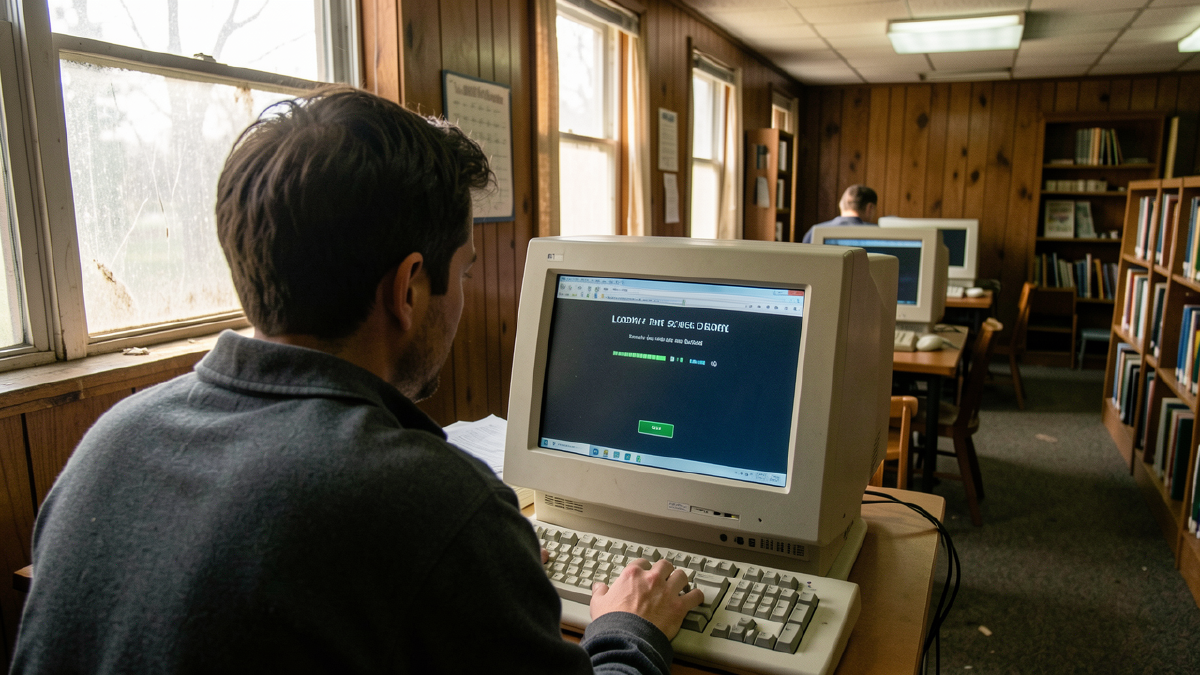
Tom Henderson, 47, lives in Willow Creek, Montana, population 312, surrounded by 60 miles of ranch land in every direction. The nearest town with more than one stoplight is Havre, 75 miles north. The nearest city with multiple employers is Great Falls, 140 miles south. He works 28 hours weekly at Dawson’s Feed & Supply, the only employer within walking distance. The store is open Tuesday through Saturday. Mr. Dawson, age 71, runs it alone except for Tom.
Twenty-eight hours weekly is already stretching the business beyond what sales justify. Tom asked about more hours, about getting to the 80 monthly hours that Medicaid work requirements demand. Mr. Dawson was apologetic but clear. He can’t afford it. The store doesn’t generate enough business to justify full-time help.
Tom doesn’t have a car. His license was revoked six years ago after his third DUI. He’s been sober four years now, attends AA meetings at the Methodist church. Montana requires five years alcohol-free before license reinstatement after three DUIs. One more year. August 2026.
The nearest potential second employer is County Line Truck Stop, 35 miles east. They’re hiring. Tom called. The manager said come in for an interview but suggested he get transportation sorted out first. There’s no public transportation in this part of Montana. The nearest Greyhound stop is in Great Falls, 140 miles away. Uber doesn’t operate in Willow Creek.
The work verification compounds his geographic isolation. Montana’s work requirement portal is entirely online. Tom doesn’t have internet at home. His apartment above the hardware store gets no broadband service. The nearest provider terminates 12 miles outside Willow Creek where population density drops below profitable thresholds. Cell service is spotty. He can load text-only websites sometimes. File uploads fail repeatedly or timeout before completing.
The county library in Havre, 75 miles away, has public computers with reliable internet. Four desktops available for two-hour blocks. The library is open Monday, Wednesday, Friday from 10am to 6pm, and Saturday from 10am to 2pm. Tom works Tuesday through Saturday. He can’t get to the library during hours he’s not working because he can’t get there at all without a car.
The deadline for monthly verification arrived in October. Tom called the Medicaid helpline from the spot near the post office where calls usually work. After 34 minutes on hold, the representative was sympathetic but clear. Verification must be submitted through the portal. Phone verification isn’t available. Mail verification isn’t accepted. Montana’s system modernization eliminated paper channels to reduce administrative costs.
He explained his situation: no internet at home, no car, no way to reach the library, working during library hours anyway. The representative said she’d make a note but couldn’t approve an extension or exemption. His coverage terminated November 15th for failure to verify October hours.
Six weeks without coverage, his blood pressure medication ran out. He has hypertension, diagnosed four years ago during alcohol treatment when the doctor found his blood pressure at 165/98. The medication brought it down to 128/82. The pharmacy wanted $280 for a 30-day supply without insurance. Tom had $63. He started splitting his remaining pills, making them last two weeks instead of one. His blood pressure rose.
At work in late December, he was restocking fifty-pound feed sacks. He lifted one and felt the room tilt. Mr. Dawson noticed him holding the shelf and breathing hard.
“Blood pressure’s been high. Haven’t had my medication.”
Mr. Dawson sent him home. That evening, the Methodist pastor drove Tom to Havre’s hospital, where the emergency room measured his blood pressure at 188/102. Hypertensive crisis. The ER physician explained that untreated, this could cause stroke, heart attack, or kidney damage. Tom was lucky this time. The blood vessels in his brain hadn’t ruptured. His heart hadn’t been damaged. His kidneys still functioned normally, though labs showed early stress markers. Another few weeks without medication might have produced different outcomes.
The hospital social worker found a medication assistance program requiring online enrollment, which she completed on the hospital’s computer. The bill was $4,200. She gave Tom information about reapplying for Medicaid, all the applications online. She circled the login button and wrote “Create Account” on hospital letterhead. Tom folded the paper and put it in his pocket, knowing he had no way to access that website.
The pastor drove him back to Willow Creek, 75 miles in winter darkness. They didn’t talk much. The pastor said the church had been talking about getting internet installed for community use. Satellite internet was getting cheaper. If five or six church families split the cost it might work. Tom said that would help a lot of people.
Tom’s situation represents structural patterns affecting 2 to 3.7 million people living in areas where employment scarcity and internet infrastructure absence make standard compliance literally unachievable.
Tom called the Medicaid helpline again in January, after the 30-day medication supply from the assistance program ran out. He needed to reapply. The representative walked him through the steps: create an online account, fill out the application, upload verification documents, wait for approval. Tom explained he couldn’t do any of that because he had no internet access. The representative asked if he could go to a library. Tom explained the geography: 75 miles, no transportation, library hours during his work schedule. The representative said she understood but the system required online application. There was no paper alternative anymore.
Could a case worker help? The representative said the nearest county office was in Havre. They had one eligibility worker covering three counties. Appointments were available Monday through Friday, 9am to 3pm. Tom worked Tuesday through Saturday. He’d have to take unpaid time off, arrange transportation somehow, and hope he could complete everything in one visit because a second 150-mile round trip would be nearly impossible.
Demographics and Scope#
Rural Medicaid expansion adults number 3.7 to 4.6 million across expansion states. Not all rural residents face significant isolation barriers, but geographic and digital isolation affect 2.0 to 3.7 million of these expansion adults, approximately 11-20% of the total population subject to work requirements. These populations overlap substantially, with rural areas experiencing both employment scarcity and internet access barriers simultaneously.
North Carolina’s 2024 expansion data showed 40% of new enrollees came from rural counties, despite rural residents comprising only 38% of the state’s population. Montana experienced a 57% disenrollment rate during unwinding, with rural populations particularly affected by administrative barriers.
Digital exclusion creates additional layers of isolation. Between 19.6 and 26 million Americans lack access to fixed broadband meeting minimum FCC standards of 100/20 Mbps. Rural areas experience disproportionate exclusion, with 28% of rural residents lacking broadband compared to 4% of urban residents. Independent audits found FCC maps understating the problem by 6.4 million people, with discrepancies concentrated in rural Plains states, Mountain West, and Sunbelt regions. Tribal lands experience comparable isolation, with 23% lacking broadband access.
The overlap between rural residence and digital exclusion creates the most severely isolated population. Among the 2.0-3.7 million geographically isolated expansion adults, approximately 740,000 to 1.4 million face both employment limitations and digital verification impossibility simultaneously. These numbers underestimate the problem because they measure only complete absence of broadband, not functionally inadequate service. Many rural areas have nominal broadband availability that fails under real-world conditions due to data caps, unreliable connections, or speeds insufficient for document uploads.
Seasonal employment concentration intensifies compliance challenges in agricultural regions. California’s Central Valley, Eastern Washington, Texas Rio Grande Valley, Florida’s agricultural counties, and Georgia’s rural counties employ substantial numbers of expansion adults in agriculture and food processing where work concentrates March through October with minimal employment November through February. Tourism-dependent areas show inverse patterns. Monthly verification requirements cannot accommodate these seasonal realities without systematic failure.
Transportation deserts create absolute barriers to employment and verification access. Greyhound serves approximately 2,400 locations nationwide, leaving most rural areas without intercity bus service. Ride-sharing services don’t operate profitably in low-density areas. When the nearest potential employer is 35 miles away and no transportation options exist, employment becomes literally impossible without personal vehicle access.
Frontier counties, defined as having six or fewer people per square mile, comprise 45% of U.S. land area but less than 1% of population. These areas have employment density so low that meaningful employer choice is structurally impossible. Montana, Wyoming, North Dakota, South Dakota, and Alaska have substantial frontier populations. Agricultural states including Iowa, Nebraska, Kansas, and Arkansas have seasonal employment patterns concentrated in specific months. Appalachian regions spanning Kentucky, West Virginia, and Tennessee combine geographic isolation with limited broadband and depressed employment markets.
Failure Modes: When Geography Creates Impossibility#
The interaction between rural employment scarcity, seasonal work patterns, transportation limitations, and digital infrastructure gaps creates systematic compliance impossibility rather than mere difficulty.
The geographic employment scarcity failure emerges because rural areas often have one or two employers within reasonable commuting distance. When those employers can’t offer 80 monthly hours, when they’re not hiring, or when their business is seasonal, no alternative exists. The standard work requirement assumption of employer choice becomes meaningless when choice doesn’t exist. Tom employed at the only walkable employer offering 28 weekly hours cannot find a second job when the next employer is 35 miles away with no transportation available.
The seasonal employment misalignment failure creates automatic non-compliance for populations whose regional economies operate on seasonal cycles. Agricultural employment might offer 160 hours monthly March through October and zero hours November through February. Monthly requirements designed for stable year-round employment create automatic failure for members whose regional economy is fundamentally seasonal. Annual averaging would solve this: 960 hours annually distributed however work is available. But monthly requirements create systematic failure for agricultural workers who meet annual requirements through concentrated seasonal work.
The transportation impossibility failure manifests as absolute barriers when personal vehicles aren’t available and public transit doesn’t exist. Asking about alternative transportation reveals the structural problem: there are no alternatives. Suggesting ride-sharing ignores that Uber and Lyft don’t operate in towns of 300 people. Mentioning bus service ignores that most rural areas have none.
The transportation problem compounds verification barriers. Even if members reach distant employment, they still need monthly internet access for verification. When the nearest library with reliable internet is 75 miles away, open limited hours during the workweek, and members work schedules preventing access during those hours, no solution exists. The member cannot simultaneously hold employment and access verification infrastructure.
The digital verification impossibility failure occurs because online-only systems assume universal broadband that doesn’t exist in rural America. Tom with no home internet, unreliable cell service insufficient for document uploads, and no transportation to the nearest public computer faces verification impossibility regardless of employment status. The digital divide isn’t about technology adoption failure. It’s about infrastructure absence. When broadband providers terminate service 12 miles outside town because extending infrastructure to 300 people doesn’t generate sufficient return, residents face impossibility they cannot overcome.
The portal-only verification failure compounds digital exclusion. States eliminating phone and mail verification created single-point failure systems. Montana’s modernization improved efficiency for people with internet access while creating impossibility for people without it. The phone helpline directs callers to the online portal. Representatives cannot process verification over the phone. Mail isn’t accepted. The system has one door, and that door requires infrastructure many rural members don’t have.
The administrative capacity failure emerges because rural county offices serve enormous geographic areas with minimal staff. When the nearest county office is 75 miles away, open Monday through Friday 9am to 3pm with one eligibility worker serving three counties, getting in-person assistance requires taking unpaid time off for a 150-mile round trip. Members employed Tuesday through Saturday cannot reach offices during office hours.
The infrastructure failure compounding occurs because these barriers multiply rather than add. A member without transportation cannot reach distant employers or verification sites. A member without internet cannot verify employment even when achieved. A member in seasonal employment cannot meet monthly requirements even when exceeding annual requirements. A member needing county office assistance cannot reach offices during working hours. Each barrier makes the others worse.
The critical insight: these aren’t problems individuals can solve through better planning or improved job search. They’re structural impossibilities created by geographic and infrastructure realities. When the system requires 80 monthly hours and online verification but the member lives where neither is physically possible, no amount of individual responsibility can create compliance.
State Policy Choices: Accommodation or Exclusion#
The policy architecture states construct reveals fundamental choices about whether requirements should match circumstances or circumstances should match requirements.
The first choice involves hour requirement differentiation. Should states require uniform 80 monthly hours regardless of location, or should requirements reflect regional employment density? Frontier counties might require 60 monthly hours. Rural counties might require 70 hours. Urban counties maintain 80 hours. This recognizes that employment availability correlates with population density, not individual effort.
The second choice involves seasonal employment accommodation. Should states accept annual averaging for regions with documented seasonal economies? Annual requirements of 960 hours would accommodate agricultural workers employed 160 hours monthly during growing season and zero hours during winter. States refusing seasonal accommodation systematically terminate coverage for people meeting annual work expectations.
The third choice involves verification channel diversity. Should states maintain mail and phone alternatives alongside digital systems? Maintaining multiple channels costs more but prevents single-point failure for populations without internet access.
The fourth choice involves community hub infrastructure. Should states establish credentialed verification sites at libraries, post offices, extension offices, and faith organizations where trained staff can accept documentation? Community hubs bring verification to members who cannot reach distant county offices.
The fifth choice involves mobile services. Should states deploy mobile enrollment units visiting rural communities on predictable schedules? A state worker traveling to Willow Creek monthly would eliminate members’ need to travel 140 miles. Mobile services cost more than centralized services but less than systematic coverage loss followed by emergency utilization.
The fundamental tension is between administrative simplicity and geographic diversity. Systems optimized for suburban contexts with multiple employers, reliable transportation, and universal broadband create systematic exclusion when applied to rural contexts lacking those infrastructure characteristics. The policy question is whether states will accommodate geographic diversity through tiered requirements, seasonal averaging, verification channel diversity, community infrastructure, and mobile services, or maintain uniform requirements accepting systematic rural disenrollment as the cost of administrative simplicity.
Stakeholder Roles in Supporting Geographically Isolated Populations#
State Medicaid Agencies and MCOs must build verification systems accommodating geographic diversity. This means maintaining mail and phone channels alongside digital portals, establishing community hub verification sites, deploying mobile enrollment services to frontier areas, implementing annual averaging for seasonal employment, and creating tiered hour requirements reflecting regional density. MCOs operating in rural areas must invest in member services infrastructure reaching geographically isolated populations, not just concentrated urban populations where per-member outreach costs are lower.
Rural Community Health Workers and Extension Services become critical navigation infrastructure. Community health workers, agricultural extension agents, and rural health clinic staff can provide verification assistance and serve as verification proxies for members experiencing barriers. USDA extension services present in almost every rural county could extend to work requirement support.
Libraries and Community Hubs must expand from passive internet provision to active verification assistance. This means training librarians as verification assistants who can help members upload documents, establishing verification site certification where library staff accept paper documentation for system upload, extending hours to accommodate working members, and deploying bookmobile services with verification capability. The bookmobile that visits Willow Creek monthly could include verification support if the librarian were trained and equipped.
Faith Organizations and Community Institutions serve as trusted intermediaries where government systems have limited presence. Rural churches and community centers can host monthly verification assistance events, provide transportation to members needing to reach distant services, offer space for mobile enrollment units, and serve as verification proxy organizations where staff receive training and credentialing authority. The Methodist church in Willow Creek that hosts Tom’s AA meetings could become a verification hub if equipped with internet access and trained volunteers.
Employers in Seasonal Industries must participate in employment pattern documentation. Agricultural employers, tourism operators, and resource extraction companies can provide seasonal attestations documenting that work concentrates in specific months, creating verification safe harbors for employees working seasonal patterns. This acknowledges employer reality: when harvest work employs hundreds August through October and zero November through July, workers aren’t choosing unemployment, they’re experiencing their industry’s economic cycle.
The common thread across stakeholders is building infrastructure that brings verification to members rather than demanding members reach verification. Tom’s cascade, from employment insufficiency to digital exclusion to coverage termination to medication non-adherence to hypertensive crisis, could have been interrupted at multiple points. A community hub verification site at the Methodist church. A mobile verification unit visiting Willow Creek monthly. A mail verification option for members documenting infrastructure absence. An MCO care coordinator recognizing that verification failure in frontier counties might reflect infrastructure barriers rather than non-compliance. The absence of any stakeholder building that bridging infrastructure left Tom navigating impossible requirements alone.
Tom’s Situation as Structural Pattern#
Tom Henderson’s experience represents structural patterns affecting millions. His 28 weekly hours at Dawson’s represents limited rural employment. His license revocation represents transportation barriers affecting substantial rural populations. His lack of internet represents digital exclusion affecting 28% of rural Americans. His inability to reach verification sites represents geographic isolation inherent to low-density areas.
His hypertension didn’t cause the crisis. Administrative rigidity did. A verification requirement that couldn’t accept mail or phone alternatives. A system that eliminated paper channels without recognizing that efficiency gains for majority populations create impossibility for minority populations. The combination transformed manageable chronic disease into acute crisis.
The financial calculus exposes counterproductive policy. Tom’s Medicaid coverage cost approximately $600 monthly. His emergency room visit cost $4,200. The medication assistance program costs $380 monthly until he reestablishes coverage. His inability to work full shifts during the blood pressure crisis cost Dawson’s approximately $300 in lost productivity. The coverage termination supposed to encourage work instead generated healthcare costs seven times what maintained coverage would have cost, while undermining work capacity through untreated conditions.
The human cost exceeds financial accounting. Tom lost not just coverage but the health stability he’d built over four years of sobriety. The confidence that he could manage his chronic disease. The predictability of medication access enabling work. The dignity of maintaining employment without health crises interrupting productivity. The emergency room visit carried shame, feeling like he’d failed to manage his situation when the system designed the impossibility he couldn’t overcome.
The policy question is whether work requirements should apply uniform verification to populations whose defining characteristic is infrastructure absence, or whether requirements should accommodate geographic reality through reduced hour requirements, seasonal averaging, verification channel diversity, community infrastructure, and mobile services. December 2026 implementation will reveal which approach states choose. Tom’s situation, multiplied across millions of geographically isolated expansion adults, will demonstrate whether work requirements can coexist with rural residence or whether administrative systems designed for suburban circumstances will systematically exclude those for whom distance creates impossibility.