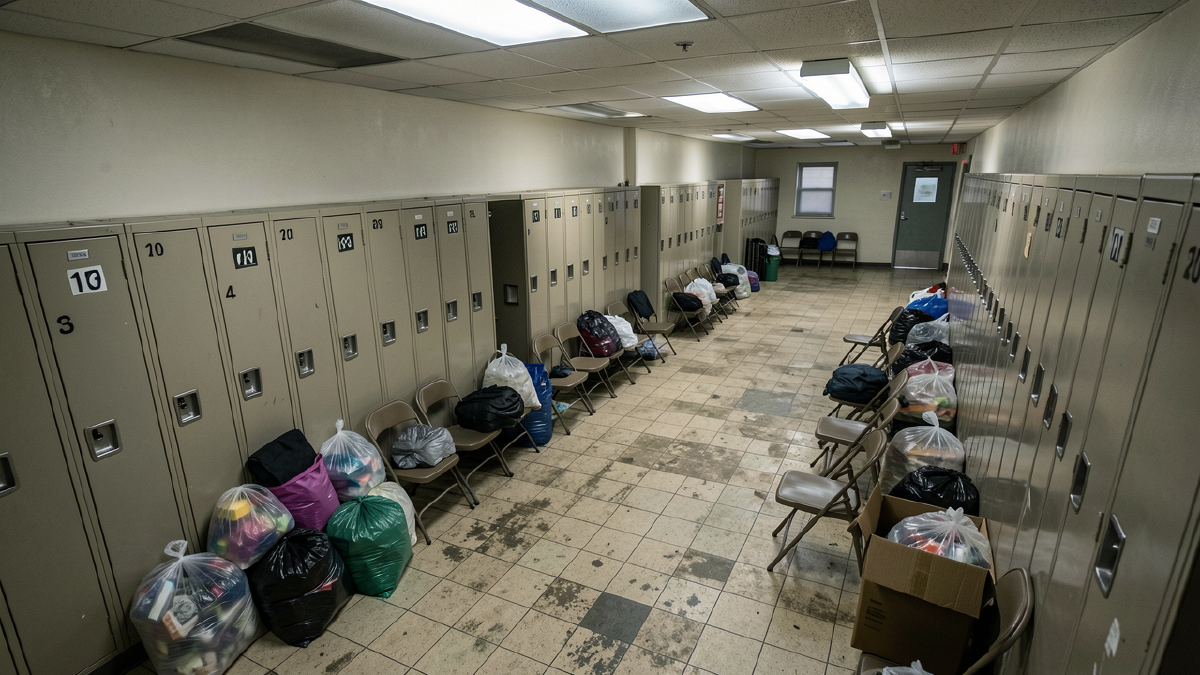
People experiencing homelessness represent 370,000 to 550,000 expansion adults, approximately 2-3% of those subject to work requirements. The January 2024 point-in-time count found 771,480 people experiencing homelessness on a single night, an 18% increase from 2023. This population faces barriers not to working but to documenting work and navigating verification systems that assume housed stability while they manage daily survival without the infrastructure housing provides: stable addresses for mail, phones for portal access, document storage, cognitive bandwidth beyond crisis response.
The fundamental challenge is that every system assumption underlying work requirements proves false for homeless populations. Work verification systems assume stable addresses for correspondence, phones for two-factor authentication and eligibility worker contact, document storage for paystubs and notices, and cognitive capacity for deadline tracking while managing predictable life. Homeless populations lack all of these prerequisites automatically. The result is systematic verification failure among people who are working but cannot prove it through systems designed for housed worlds.
The Infrastructure Collapse#
The address assumption fails immediately. Work requirement notices require mailing addresses. Shelters often prohibit using their address for official mail. Post office boxes require fees homeless individuals cannot afford and identification many have lost. General delivery exists but requires awareness of the option and proximity to post offices. Notices mailed to last known addresses never reach people who moved months ago. The verification deadline arrives, the person never receives notice, coverage terminates. The system interprets non-response as noncompliance when the actual problem is communication impossibility.
Phone access compounds address problems. Work requirement systems assume phone access for reminders, two-factor authentication, and eligibility worker contact. Homeless individuals lose phones to theft, damage, or inability to maintain service. A stolen phone means losing all saved numbers, missing all calls, and inability to access portals requiring SMS verification codes. Library computers provide limited access but require remembering passwords set months ago on phones no longer possessed. The eligibility worker calls, gets no answer, sends texts reaching no one, and documents failed contact that looks like disengagement when the actual problem is infrastructure absence.
The documentation deadlock creates impossible verification requirements. Day labor employers pay cash at shift end with no paystubs. Gig economy work requires smartphones homeless people don’t maintain. Under-the-table employment provides no verification trail. Community service at meal programs or shelters generates no official documentation. The homeless person who works three days weekly has nothing to submit as proof. The system demands documentation their employment pattern cannot produce, then terminates coverage for failure to verify work that actually occurred.
The survival bandwidth collapse explains cognitive capacity limitations that housed people systematically underestimate. Where will I sleep tonight. Where can I charge my phone. Where will meals come from. How do I stay safe. These questions consume mental capacity constantly. Adding work requirement deadlines, portal navigation, document maintenance, and appointment schedules exceeds available bandwidth. The housed person juggles administrative tasks alongside stable housing. The homeless person juggles them alongside survival and loses.
Health Status and Mortality Risk#
The health profile of people experiencing homelessness explains why Medicaid access matters urgently and why coverage loss carries severe consequences. Between 45-50% have serious mental illness. Between 50-60% have substance use disorders, with alcohol affecting 38% and drugs 26%. Co-occurring mental illness and substance use disorders affect 40-45%. Chronic physical health conditions affect 75-85%, with over one-third reporting difficulty with activities of daily living. The mortality consequences are devastating: average life expectancy for chronically homeless individuals ranges from 42 to 52 years, compared to 78 for housed populations. Homelessness is lethal.
Tuberculosis, hepatitis, and HIV rates run higher in homeless populations due to crowded shelter conditions, shared needles, and barriers to treatment. Skin infections become chronic. Respiratory conditions worsen without shelter from weather. The cascade of health problems makes employment increasingly difficult, which makes housing increasingly unattainable, which worsens health further. The spiral operates in one direction without intervention. Coverage loss during homelessness eliminates the one stabilizing intervention breaking this cycle.
The episodic capacity pattern reflects how homelessness affects work capacity inconsistently. Someone works steadily for three weeks, then chronic health conditions flare and work becomes impossible for two weeks, then capacity returns. Monthly requirements of 80 hours don’t accommodate this pattern. Systems designed for consistent monthly activity fail people whose capacity fluctuates with health status, shelter availability, weather exposure, and crisis events. The person who works 100 hours in good months and zero in crisis months averages adequate activity across time but fails monthly verification repeatedly.
Exemption Frameworks Acknowledging Street Reality#
Accommodating homeless populations requires fundamentally different verification approaches that work within street-world constraints rather than demanding housed-world capacities. Automatic exemption triggered by homelessness status represents the most effective approach. States with integrated HMIS systems can identify Medicaid members enrolled in homeless services and process exemptions without requiring any member action. Someone entering a shelter generates HMIS enrollment. That enrollment triggers automatic Medicaid exemption through data matching. The member never navigates administrative processes because the processes happen automatically based on service engagement.
Trusted intermediary verification authorizes shelter case managers, street outreach workers, and Continuum of Care staff to submit exemptions and work verification on members’ behalf. The outreach worker who finds someone under a bridge documents homelessness and initiates exemption during the encounter. The shelter case manager submits monthly work hours for residents engaged in shelter work programs. Navigation happens through existing service relationships rather than requiring separate administrative engagement.
Simplified self-attestation accepts member statements about work hours and homelessness status with spot verification rather than universal documentation. The person experiencing homelessness submits monthly verification stating they worked day labor three days, approximately 24 hours total, and signs under penalty of perjury. The state samples 5-10% of attestations for verification but presumes the other 90-95% are accurate. This shifts administrative burden from individuals without verification infrastructure to state systems with unlimited administrative capacity.
MCO Capabilities and HMIS Integration#
Managed care organizations serving areas with significant homeless populations must build partnerships with Continuum of Care agencies, HMIS administrators, and homeless service providers that standard MCO operations don’t typically include. Claims-based homelessness identification proves limited because people experiencing homelessness often use emergency services that don’t generate reliable homelessness indicators. HMIS integration becomes critical, allowing MCOs to identify members enrolled in homeless services through data matching.
The per-member-per-month cost for intensive homeless population support ranges from $18 to $30, reflecting both the complexity of barriers and the street outreach required to engage people lacking stable addresses or phones. Street medicine teams, community health workers conducting outreach at meal programs and shelter sites, and care coordinators embedded in homeless service settings all represent essential infrastructure. The return on investment becomes clear when examining the costs of emergency interventions. Emergency department visits by homeless individuals average $1,800 to $3,500 per visit. Psychiatric crisis interventions cost $8,000 to $15,000. Preventable hospitalizations from untreated chronic conditions generate $25,000 to $75,000 in costs.
Technology platforms must accommodate homeless population realities through alternative verification methods that don’t assume smartphone access, stable addresses, or digital literacy. Telephonic verification allows people to call from borrowed phones or shelter phones. Paper verification mailed to shelter addresses or held for pickup accommodates populations without mail access. In-person verification at homeless service sites brings the system to where people are rather than requiring them to come to county offices 15 miles away.
Intersection with Other Vulnerable Populations#
Homelessness rarely occurs in isolation. Serious mental illness affects 45-50% of the homeless population (MRWR-11B), with psychiatric crises both precipitating and perpetuating housing loss. Substance use disorders affect 50-60% (MRWR-11C), with addiction destroying employment and relationships that provided housing stability. Justice involvement affects substantial portions (MRWR-11D), with incarceration creating housing loss and release creating immediate homelessness without reentry support. Domestic violence survivors (MRWR-11H) frequently experience homelessness after fleeing abusive relationships.
The intersectionality examined in MRWR-11L reveals that someone experiencing homelessness while also managing mental illness, substance use disorder, and recent justice involvement faces barriers that accumulate exponentially. Shelter rules prohibit certain medications. Mental health appointments require transportation homeless people cannot afford. Probation reporting requires stable addresses homeless people don’t possess. Single-barrier accommodations cannot address this compound reality. Comprehensive trusted intermediary support addressing all barriers simultaneously becomes essential.
Financial Exposure and Emergency Care Costs#
The financial consequences of homeless population coverage losses manifest through emergency care utilization that far exceeds managed care costs. Emergency department use runs 3 to 6 times higher among homeless populations than housed populations. Hospital admissions from preventable conditions occur at rates 4 to 8 times higher. Psychiatric crisis interventions through mobile crisis teams and emergency screening occur frequently. Each emergency intervention costs multiples of what preventive care through maintained coverage would have cost.
The mortality risk makes coverage loss for homeless populations particularly consequential. Someone loses coverage, cannot afford medications for diabetes or hypertension, experiences crisis requiring emergency hospitalization, may die from conditions that managed care would have controlled. The preventable mortality from coverage loss among homeless populations potentially exceeds any other Series 11 group given their baseline health vulnerabilities and lack of alternative care access.
Housing First programs demonstrate that providing housing with support services costs less than cycling homeless individuals through emergency systems. Supportive housing costs approximately $15,000 to $25,000 annually. Emergency care costs for chronically homeless individuals average $35,000 to $65,000 annually. The coverage terminations that work requirements create eliminate the medical stability required for housing program success, undermining both health and housing outcomes while increasing costs.
Implementation Implications for December 2026#
States implementing work requirements beginning December 2026 face fundamental choices about homeless population accommodation. HMIS integration enabling automatic exemptions requires data sharing agreements and technical infrastructure that takes months to build. Trusted intermediary credentialing for homeless service providers requires establishing authority, training, oversight, and liability protections. Alternative verification methods require portal modifications and staff training on procedures that differ from standard processes.
States beginning this work in mid-2026 cannot complete it before December implementation. The predictable result is coverage losses concentrated among homeless populations during the earliest implementation months. Someone experiencing homelessness in December 2026 encounters verification requirements before homeless-appropriate infrastructure exists. The emergency care costs from these coverage losses will appear in 2027 budgets long after the coverage terminations that caused them.
The question is whether states will design verification systems that work for homeless populations through automatic exemptions, trusted intermediaries, simplified attestation, and graduated requirements. Or whether they will apply standard processes and accept that thousands will lose coverage, generate emergency costs, experience health deterioration, and potentially die from conditions that Medicaid would have managed. The choice determines not whether states pay for homeless healthcare but whether they pay through managed coverage or emergency crisis response. The emergency response costs 3 to 8 times more while producing far worse health outcomes.