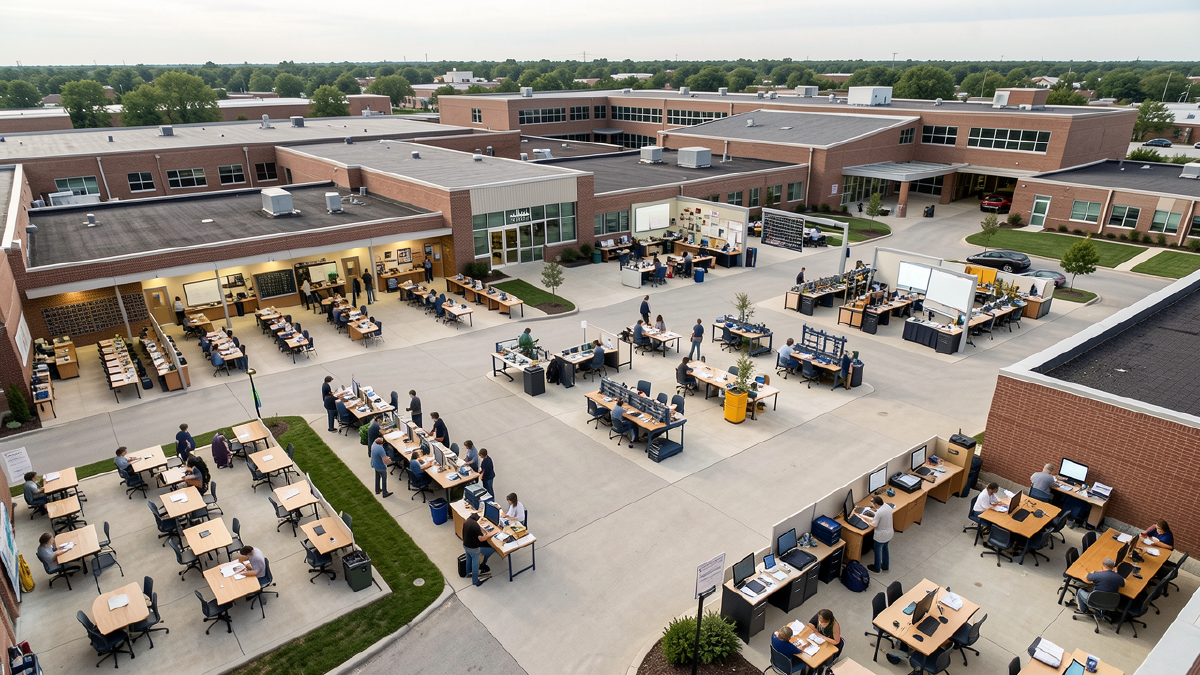
Education occupies paradoxical space in work requirement implementation. It simultaneously represents genuine human capital development enabling economic mobility and bureaucratic compliance activity satisfying eligibility obligations. The distinction matters philosophically but collapses operationally when someone enrolls in community college both to build skills for better employment and to maintain healthcare coverage through qualifying activity credits.
Nine articles examining higher education infrastructure, vocational training, adult basic education, navigator training, technical frameworks, ecosystem support, financing pathways, for-profit predation, and education-employment transitions reveal the complexity of converting educational institutions into compliance infrastructure. Educational pathways work better than most alternatives for enabling sustainable rather than transactional compliance. But educational institutions were not designed for the administrative verification burden work requirements impose, students face barriers that pedagogy alone cannot address, and gaps in the education-employment transition create coverage loss risk precisely when people have done everything policy encourages.
The Infrastructure That Exists#
Community colleges (MRWR-10A) represent the central hub because their student population and Medicaid expansion adults are substantially the same people. Both groups are predominantly working-age adults with incomes below 138 percent of federal poverty level. Both juggle employment, family responsibilities, and other obligations while pursuing credentials. The Venn diagram showing community college students and expansion adults isn’t two overlapping circles but nearly a single circle with modest divergence at the edges.
This demographic overlap creates opportunity and burden. Full-time enrollment at 12 or more credit hours likely counts as full compliance with 80-hour monthly requirements in most states. Part-time students can combine education hours with employment or other qualifying activities. Education becomes pathway to both compliance and genuine economic mobility. But community colleges already operate at capacity limits with inadequate state funding, deferred facility maintenance, and faculty workloads that don’t accommodate additional administrative functions. Adding verification coordination, exemption support, and compliance counseling to institutional responsibilities requires resources that state appropriations don’t provide.
Regional public universities, online degree programs, and specialized training providers extend educational infrastructure beyond community colleges. Regional comprehensive universities serve transfer students and adult learners needing bachelor’s degree pathways. Online programs at institutions like Southern New Hampshire University, Western Governors University, and Arizona State Online offer scale and flexibility that physical campuses cannot match. Workforce development programs through WIOA infrastructure connect training to employment services. Together these institutions create ecosystem capable of serving millions of expansion adults pursuing education as compliance pathway.
But infrastructure fragmentation complicates verification. Each institutional type operates under different regulatory frameworks, uses different academic calendars, measures progress through different metrics, and connects to state systems through different technical pathways. Building comprehensive verification infrastructure requires accommodating this diversity rather than imposing standardization that wouldn’t fit institutional reality.
The Foundational Gap Population#
GED preparation, English as Second Language programs, and adult basic education (MRWR-10C) serve expansion adults facing the steepest barriers. Approximately 10 percent of expansion adults lack high school diplomas or equivalents. Millions more have limited English proficiency restricting employment options. Without foundational skills, traditional employment remains inaccessible regardless of motivation or effort.
The foundational education sector operates with the least institutional infrastructure, most fragmented delivery systems, and greatest reliance on volunteer instructors. Programs funded through the Adult Education and Family Literacy Act provide some stability, but community-based programs, library literacy initiatives, and volunteer tutor networks fill gaps that formal programs cannot address. This fragmentation creates verification challenges when small programs lack sophisticated administrative capacity for documentation.
Digital literacy emerges as foundational skill prerequisite to both employment and compliance in contemporary contexts. Work requirement verification increasingly requires navigating online portals, electronic communication from MCOs and state agencies, and digital job search. Expansion adults lacking digital literacy face compliance barriers regardless of their work activity because they cannot navigate systems documenting that activity.
Foundational education verification requires infrastructure development addressing the sector’s unique characteristics. State-provided verification templates enable smaller programs to participate without building sophisticated systems. Standardized protocols for AEFLA-funded programs leverage existing reporting infrastructure. Technical assistance helps programs meet verification obligations without being overwhelmed. The investment recognizes that adult education programs serve essential compliance functions and deserve support rather than simply burden.
The Training-to-Employment Pipeline#
Vocational training and workforce development programs (MRWR-10B) create pathways from skill acquisition to employment more direct than academic degree programs. A Certified Nursing Assistant completes 120-hour training program, passes competency exam, and begins employment within weeks. A commercial truck driver completes CDL training and enters transportation industry. An HVAC technician finishes apprenticeship and joins construction trades.
These credential programs align with work requirement policy goals by combining skill development with near-term employment outcomes. But training programs face accreditation complexity, coordination challenges with WIOA systems, and quality variation that policy must address. The for-profit vocational training sector (MRWR-10H) includes legitimate programs preparing students for viable careers and predatory operators extracting tuition from vulnerable populations while providing minimal education value.
The documented history of predatory for-profit colleges targeting low-income populations suggests work requirements could attract similar exploitation. Programs advertising quick certification, guaranteed employment, and easy enrollment may deliver poor training, no job placement, and debt burdens exceeding benefit. States need quality assurance frameworks screening educational providers before they harm students while avoiding barriers that exclude legitimate non-traditional training.
Navigator and volunteer training programs (MRWR-10D) occupy unique position in the educational ecosystem by simultaneously building individual human capital and creating system capacity. Someone completing 120-hour navigator certification is engaged in genuine educational activity with clear labor market value while producing capacity to help others navigate requirements. The virtuous cycle is significant. An expansion adult facing work requirements enrolls in navigator training counting toward compliance. Upon completion they can work as navigator with employment hours continuing to satisfy requirements. Their work helps other expansion adults maintain coverage and comply. Each trained navigator both satisfies their own requirements and builds capacity serving others.
The Calendar Problem#
Academic calendars create systematic compliance gaps (MRWR-10E) that verification systems must address deliberately. A student maintaining full-time enrollment during 15-week fall and spring semesters faces compliance gaps during winter break, spring break, and summer months when they’re not enrolled. If verification treats each calendar month independently, the student loses coverage during breaks despite continuous educational engagement during academic terms.
The calendar challenge intensifies for students in accelerated programs, competency-based education, and vocational training with non-standard schedules. Western Governors University operates competency-based model where students progress by demonstrating mastery rather than completing credit hours. How do competency achievements translate to monthly hour requirements? Coding bootcamps run intensive 12-week programs with full-time engagement that doesn’t align with semester calendars. How does bootcamp participation count during months where the program spans partial periods?
Technical solutions include annualization approaches averaging hours over academic years, good student provisions protecting full-time students during breaks, enrollment status protection maintaining coverage for defined periods regardless of monthly activity, and academic term alignment treating educational enrollment as qualifying activity throughout academic terms including breaks. Each approach addresses calendar gaps but introduces verification complexity.
The sweet spot involves rules simple enough to communicate clearly while sophisticated enough to address academic calendar complexity. Overly complex rules that students can’t understand fail regardless of technical elegance. Overly simple rules that don’t address calendar realities create compliance traps for students following rules as they understand them. Finding that balance requires deliberate attention to technical details that might otherwise be treated as administrative afterthoughts.
The Transition Gap#
The education-employment transition creates coverage loss risk precisely when people have done everything policy encourages (MRWR-10I). Maria completes CNA training, passes her competency exam in the month following completion, spends two weeks waiting for her license number and employer background check, and starts employment in her third post-completion month. If policy treats each month independently, Maria loses coverage during her license processing period despite being on the exact pathway work requirements encourage.
The post-completion gap reflects bureaucratic processing times beyond individual control. Nursing licenses require state board processing. Background checks for healthcare employment take weeks. Employers coordinate start dates with orientation schedules creating lag between offer acceptance and actual employment. These delays are normal parts of training-to-employment transitions but create coverage loss risk when verification treats each month independently.
Grace periods protecting coverage during transitions would prevent this absurd outcome. A 90-day post-completion grace period means someone finishing training maintains coverage while securing employment. The grace recognizes that the pathway from credential to employment involves processing time that is not about compliance failure but about how systems actually work. The policy change is simple. The benefit to people doing exactly what work requirements encourage is substantial.
The Support Ecosystem#
Educational success for expansion adults depends on support extending beyond instruction (MRWR-10F). Managed care organizations have financial stakes in student member retention and could fund campus-based navigator support, tuition assistance programs, proactive outreach during academic transitions, network inclusion of campus health centers, and CHW training pipeline partnerships. Hospital systems and ACOs need workforce pipelines that educational partnerships can provide through clinical site expansion, scholarship programs, and recruitment pathways.
Employers benefit from trained workers and could support educational pathways through tuition assistance, paid educational leave, flexible scheduling during academic terms, credential program sponsorship, and preferential hiring of completers. Faith-based and community organizations bring trusted relationships that institutional settings lack, providing satellite instruction hosting, volunteer tutor training, navigator training delivery, digital literacy support, and partnerships for embedded instruction.
State governments bear ultimate responsibility for work requirement implementation and for educational infrastructure making compliance pathways viable. Funding technical assistance for educational institutions, clearinghouse integration investment, credentialing infrastructure for non-traditional programs, coordination across Medicaid/workforce/higher education agencies, quality assurance frameworks protecting against predatory programs, and data systems connecting educational and Medicaid status all require state investment.
No single stakeholder can build effective educational compliance infrastructure alone. Educational institutions provide core academic programming but lack resources for comprehensive student support. MCOs have financial incentives but limited educational expertise. Healthcare organizations need workers but don’t operate educational programs. Employers benefit from trained workers but can’t build training infrastructure independently. Faith and community organizations bring relationships but limited technical capacity. States coordinate but don’t deliver services directly.
The ecosystem works when stakeholders invest according to their capabilities and interests while coordinating toward shared goals. MCO navigator funding supplements institutional advising. Healthcare system clinical sites enable nursing program expansion. Employer tuition assistance supports student persistence. Faith community facilities host satellite instruction. CBO wraparound services address barriers institutions can’t resolve. State technical assistance builds capacity across providers.
The Financing Complication#
The One Big Beautiful Bill Act creates new financing challenges while expanding some opportunities (MRWR-10G). Workforce Pell provisions enable Pell Grants for short-term credential programs, potentially supporting CNA training, commercial truck driver licensing, and other vocational pathways serving work requirement compliance. But graduate student loan limits, institutional accountability metrics, and endowment taxes on wealthy institutions create pressures affecting student access and institutional capacity.
The expansion of federal support for short-term training could accelerate credential acquisition pathways enabling quicker transitions to employment. But implementation complexity around eligible programs, institutional participation requirements, and student eligibility determination may delay benefits beyond the December 2026 work requirement implementation date.
Private financing through income share agreements, employer-sponsored education benefits, and training program payment plans creates alternatives to traditional student loans but introduces questions about predatory practices and appropriate consumer protection. The financing landscape is shifting in ways that affect educational access for work requirement populations without yet creating clear pathways replacing what earlier systems provided.
The Recognition Versus Compliance Paradigm#
Throughout Series 10, a tension emerges between education as genuine human capital development and education as compliance activity. The distinction matters philosophically. Someone enrolling in community college to build skills for better employment is engaged in fundamentally different activity than someone enrolling primarily to maintain healthcare coverage. But the distinction collapses operationally because motivation doesn’t determine educational quality or employment outcomes.
The policy question is whether to design educational pathways that recognize existing motivation and effort or compliance pathways that police participation and verify activity. Recognition approaches assume students pursuing education are engaged in legitimate qualifying activity deserving support. Compliance approaches assume verification is necessary to prevent abuse and ensure only genuine educational activity counts.
This recognition versus compliance tension mirrors the broader verification architecture examined in Series 2 but manifests distinctly in educational contexts. Educational institutions resist becoming surveillance infrastructure monitoring student engagement for government compliance purposes. Students resent requirements converting education into administrative burden. Yet verification enabling coverage retention serves legitimate state and student interests.
The resolution involves verification approaches that balance accountability with recognition of genuine educational engagement. Enrollment verification confirming students are pursuing credentials in good academic standing provides adequate accountability without requiring detailed attendance monitoring or engagement tracking that would convert institutions into compliance police. Trust in educational institutions to maintain academic standards enables verification focusing on enrollment status rather than daily participation.
What Educational Infrastructure Reveals#
Educational pathways work better than most alternatives for work requirement compliance because they combine current activity satisfaction with future capability building. Someone enrolled full-time in community college both meets monthly requirements and develops skills enabling better employment. Someone completing vocational training satisfies compliance during training and acquires credentials opening employment pathways. Someone pursuing GED meets requirements while addressing foundational gap preventing traditional employment.
But educational infrastructure was not designed for compliance verification burden work requirements impose. Community colleges lack resources for expanded navigation, exemption support, and verification coordination. Adult education programs operate with volunteer instructors and minimal administrative capacity. Vocational training quality varies dramatically with legitimate programs mixed among predatory operators. The calendar structures that serve pedagogical purposes create verification gaps requiring technical solutions.
Educational institutions can serve work requirement compliance functions effectively if states provide adequate support, verification infrastructure reduces burden, financing pathways remain accessible, quality assurance protects against predation, and transition gaps get addressed through grace periods protecting coverage during normal processing delays.
The stakes are substantial. Education represents the highest-value compliance pathway because it builds capability for sustainable rather than transactional compliance. Someone completing an associate degree or vocational certificate moves toward employment that could eventually lift them above Medicaid eligibility, achieving the economic mobility that work requirements notionally encourage. Educational success for expansion adults serves both individual and policy goals.
Series 10 has examined educational infrastructure from community colleges through adult basic education, vocational training through navigator certification, technical verification frameworks through stakeholder support ecosystems. The analysis reveals that education can function as work requirement infrastructure if policy addresses the barriers, gaps, and resource constraints that currently prevent educational institutions from serving implementation roles they are theoretically well positioned to fill.