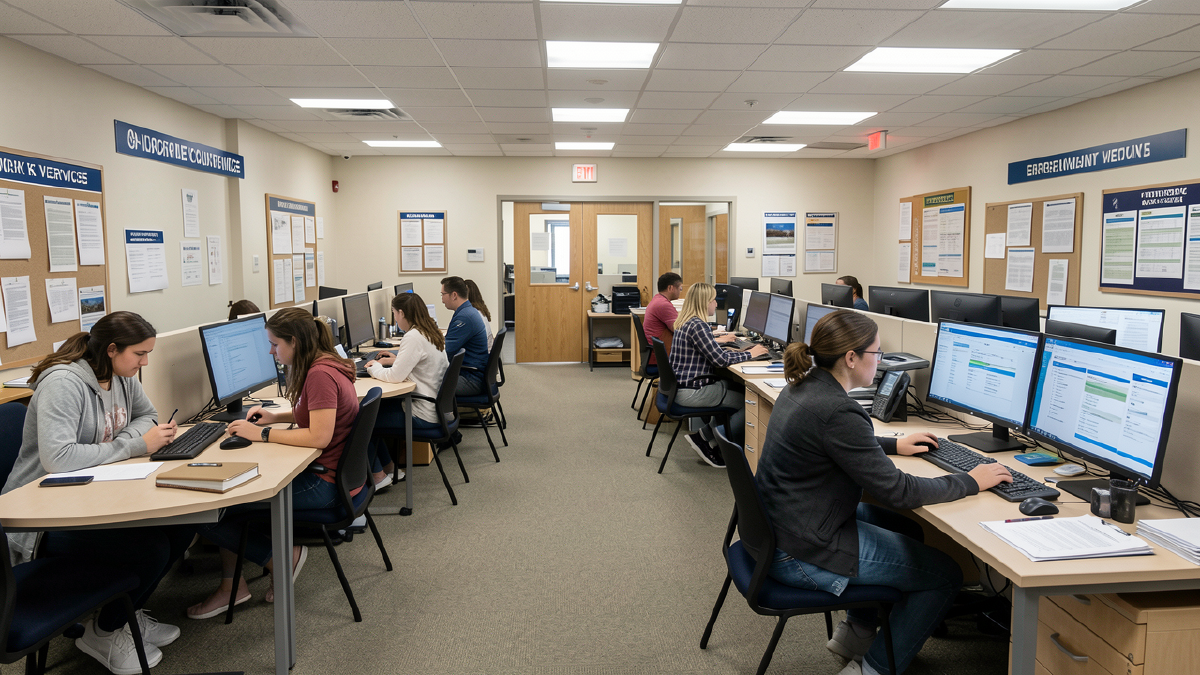
How Community Colleges, Public Universities, and Online Programs Become Essential Work Requirement Pathways
Community colleges occupy the central position in the work requirement education landscape, but they aren’t the only higher education institutions serving expansion adults. Regional public universities enroll substantial Pell-eligible populations. Online degree programs offer scale that physical campuses cannot match. Understanding the full higher education ecosystem reveals both the opportunities and constraints shaping education as a compliance pathway for the 18.5 million expansion adults facing work requirements beginning December 2026.
The scale is significant. Approximately 5.4 million community college students receive some form of federal financial aid, and roughly 30% of community college students are already enrolled in Medicaid. But another 3.2 million Pell Grant recipients attend public four-year institutions, many at regional comprehensive universities serving similar demographics to community colleges. Online programs at institutions like Southern New Hampshire University, Western Governors University, and Arizona State Online enroll hundreds of thousands of working adults seeking credentials while managing employment and family responsibilities. When expansion adults look to education as their compliance pathway, they have more options than the local community college alone.
Community Colleges: The Central Hub#
Community colleges remain the primary educational infrastructure for work requirement compliance. They serve the demographic most likely to be Medicaid expansion adults, operate in virtually every county in America, and already navigate complex relationships with financial aid systems, workforce development boards, and employer partnerships.
Community college students and Medicaid expansion adults are substantially the same population. Both groups are predominantly working-age adults with incomes below 138% of the federal poverty level. Both groups often juggle employment, family responsibilities, and education simultaneously. Both groups face transportation barriers, childcare challenges, and housing instability at rates far exceeding the general population. The Venn diagram showing community college students and expansion adults isn’t two overlapping circles; it’s nearly a single circle with modest divergence at the edges.
This overlap creates both opportunity and burden. The opportunity: students already engaged in qualifying educational activity can maintain Medicaid coverage while building human capital. Full-time enrollment at 12 or more credit hours will likely count as full compliance with 80-hour monthly requirements in most states. Part-time students can combine education hours with employment or other qualifying activities. Education becomes a pathway to both compliance and genuine economic mobility.
The burden falls on institutions. Community colleges will face verification requests, documentation demands, and student support needs they weren’t designed to handle. Registrar offices built for enrollment verification will confront Medicaid compliance inquiries. Academic advisors will field questions about which courses count toward work requirements. Financial aid offices will navigate the intersection of Pell Grant eligibility and Medicaid status. None of this was in the institutional job description, but all of it is coming.
Institutional Capacity Gaps#
Community colleges are chronically underfunded institutions serving populations with intensive support needs. Per-student funding at two-year institutions runs roughly half what four-year universities receive, despite community college students often requiring more wraparound services. Counselor-to-student ratios at many community colleges exceed 1:1,000, compared to 1:300 at well-resourced four-year institutions. These capacity constraints existed before work requirements; they will intensify dramatically after December 2026.
The registrar function illustrates the challenge. Registrar offices currently handle enrollment verification for employers conducting background checks, lenders verifying student status for loan deferment, and various government agencies confirming educational activity. This volume is manageable. When Medicaid agencies, MCOs, and individual students all begin requesting verification for work requirement compliance, volume could increase by orders of magnitude. A registrar office processing 500 verification requests monthly might suddenly face 5,000.
The National Student Clearinghouse offers a potential solution. Most community colleges already report enrollment data to the Clearinghouse for financial aid purposes. Extending this infrastructure to Medicaid verification could automate much of the burden. But this requires data sharing agreements between states and the Clearinghouse, technical integration with state Medicaid systems, and institutional confidence that automated reporting serves student interests. None of these prerequisites exist universally today.
Student Services Under Strain#
Academic advising will bear substantial new weight. Students navigating work requirements need guidance on course selection that maximizes both educational value and compliance hours. They need information about how credit hours translate to work requirement hours. They need understanding of what happens during breaks, when they withdraw from courses, or when they fail to maintain satisfactory academic progress. Academic advisors weren’t trained for this; most lack any familiarity with Medicaid eligibility rules.
Financial aid offices face compound complexity. Pell Grant eligibility and Medicaid eligibility use different income definitions, different household composition rules, and different verification processes. A student might qualify for one program but not the other, or qualify for both but face different compliance obligations. Financial aid staff already spend substantial time helping students navigate federal aid requirements; adding Medicaid navigation to their portfolio without additional resources creates impossible workloads.
Student health services present a different set of questions. Many community colleges operate campus health centers serving enrolled students. When those students are Medicaid enrollees, billing and care coordination questions emerge. Does the campus health center bill Medicaid directly? Does the student’s MCO have network relationships with campus providers? Can campus health services help students document medical exemptions from work requirements? These questions lack clear answers at most institutions.
The Dual Compliance Pathway#
Community colleges offer students something powerful: the ability to accumulate work requirement hours through both education and employment simultaneously. A student enrolled in nine credit hours (roughly 27 compliance hours monthly using standard multipliers) who also works 15 hours weekly in the campus bookstore accumulates approximately 87 compliance hours monthly. This exceeds the 80-hour threshold through combined activity at a single institution.
Campus employment creates particular advantages. Federal Work-Study positions, institutional employment in dining services or facilities, and student worker roles in academic departments all generate verifiable work hours. The institution serves as employer and can provide work verification through the same administrative infrastructure handling enrollment verification. Students avoid the documentation burden of coordinating between separate educational institutions and employers.
This dual pathway has policy implications. States designing work requirement rules should explicitly recognize combined educational and employment activity at single institutions. Verification systems should accommodate consolidated reporting where one entity documents both types of qualifying hours. Institutions willing to provide integrated verification should receive streamlined credentialing rather than navigating separate processes for educational and employment documentation.
Work-Study as Strategic Asset#
Federal Work-Study programs take on new significance under work requirements. Work-Study positions provide employment that counts toward compliance, typically at the same institution where students are enrolled, with wages subsidized by federal funds. A student combining Work-Study employment with course enrollment can meet work requirements entirely within the community college ecosystem.
But Work-Study slots are limited. Federal appropriations constrain total Work-Study funding, and institutional allocations determine local availability. Community colleges historically receive smaller Work-Study allocations than four-year institutions despite serving students with greater financial need. The combination of limited slots and increased demand from students seeking work requirement compliance will intensify competition for Work-Study positions.
Institutions should consider whether Work-Study allocation priorities need adjustment. If some students need Work-Study for work requirement compliance while others simply want supplemental income, should compliance needs receive priority? This raises equity questions about which students deserve institutional support, but it also reflects the reality that coverage loss has more severe consequences than foregone income.
The Financial Aid Intersection#
Pell Grant receipt and Medicaid enrollment create overlapping but distinct compliance obligations. Students receiving Pell Grants must maintain satisfactory academic progress, typically defined as completing 67% of attempted credits with a cumulative GPA above 2.0. Students subject to work requirements must document qualifying activity monthly. A student can satisfy one requirement while failing the other, or fail both simultaneously through academic struggles that trigger loss of both financial aid and healthcare coverage.
This creates compound jeopardy for vulnerable students. Consider a student who experiences a family crisis mid-semester. They withdraw from courses to manage the emergency. This withdrawal triggers loss of satisfactory academic progress, jeopardizing future Pell Grant eligibility. If the withdrawal also drops them below full-time status, they may simultaneously fail work requirement compliance for that month. The same life event that caused the crisis now threatens both their ability to pay for education and their access to healthcare.
States should consider whether Pell Grant receipt could serve as automatic verification of educational activity. If federal financial aid systems have already confirmed enrollment and satisfactory progress, requiring separate Medicaid verification creates redundant burden. Data sharing between Department of Education systems and state Medicaid agencies could eliminate duplicate documentation while providing reliable verification. The technical infrastructure exists; the policy frameworks and data sharing agreements do not.
When Students Lose Financial Aid#
Students who lose Pell Grant eligibility face difficult decisions with Medicaid implications. Some will continue enrollment despite losing federal aid, paying tuition through loans, savings, or institutional aid. These students remain engaged in qualifying educational activity and can document compliance through enrollment verification. Others will reduce enrollment to part-time status or stop out entirely, needing alternative compliance pathways through employment or other qualifying activities.
The transition period is particularly dangerous. A student losing financial aid may not immediately understand the Medicaid implications. They may assume that having been enrolled qualifies them for ongoing coverage without recognizing that changed enrollment status requires changed compliance strategies. By the time they understand the situation, they may have already accumulated non-compliant months triggering coverage termination.
Community colleges should integrate Medicaid guidance into financial aid counseling for students experiencing eligibility changes. When a financial aid counselor explains satisfactory academic progress appeals, they should simultaneously explain work requirement implications. When a student receives notification of aid suspension, accompanying materials should address healthcare coverage considerations. This integration requires training financial aid staff on Medicaid basics and developing communication templates addressing both programs.
Geographic Variation and Rural Challenges#
Community college capacity varies enormously by geography. Urban community colleges often have sophisticated student information systems, multiple campus locations, extensive support services, and administrative infrastructure capable of absorbing new functions. Rural community colleges may serve entire counties from single facilities with minimal administrative staff and technology systems dating from previous decades.
This variation matters because rural areas often have the highest concentrations of Medicaid expansion adults relative to population. A rural community college with 2,000 students might have 800 Medicaid enrollees, while an urban institution with 20,000 students might have 4,000. The absolute numbers favor urban institutions, but the proportional burden falls heavier on rural colleges with less capacity to absorb it.
Rural community colleges also face the reality that they may be the only educational option for expansion adults in their service areas. An urban Medicaid enrollee choosing education as their compliance pathway can select among multiple institutions. A rural enrollee may have exactly one community college within reasonable commuting distance. If that institution lacks capacity to support work requirement compliance, the education pathway becomes unavailable regardless of individual preference.
State policy should address geographic equity in educational compliance pathways. Technical assistance for rural institutions, shared infrastructure across community college systems, and recognition that rural colleges need proportionally greater support per student could help address capacity disparities. Without deliberate attention to geographic variation, work requirements will inadvertently disadvantage rural expansion adults whose local institutions lack sophisticated compliance support infrastructure.
Regional Public Universities: The Overlooked Resource#
Community colleges dominate discussions of higher education for low-income adults, but regional public universities serve substantial Medicaid-eligible populations that policy discussions often overlook. The Cal State system, CUNY and SUNY, directional state universities (Western Michigan, Eastern Kentucky, Southern Illinois), and similar institutions enroll millions of students with demographic profiles closer to community college populations than to flagship research universities.
These institutions occupy a middle position in the higher education landscape. They lack the research focus and selective admissions of flagship universities. They offer bachelor’s degrees that community colleges cannot. They serve students who may have started at community colleges and transferred, students who enrolled directly but needed developmental coursework, and working adults returning to complete degrees interrupted years earlier. Many of these students qualify for Medicaid under expansion criteria.
Regional public universities offer bachelor’s degree pathways that community colleges cannot provide. For expansion adults seeking credentials beyond associate degrees, these institutions represent the accessible route to four-year completion. A student who completes an associate degree at a community college while maintaining Medicaid coverage through educational compliance can transfer to a regional public university and continue that compliance pathway toward a bachelor’s degree. The educational progression continues; the compliance mechanism remains consistent.
The institutional capacity question differs from community colleges. Regional public universities typically have more robust administrative infrastructure, better-resourced student services, and more sophisticated information systems. They also have less experience serving the specific population that work requirements affect. Community colleges have decades of experience with low-income adult learners managing complex life circumstances. Regional universities may have enrolled such students but often treated them as exceptions rather than core constituencies.
Regional universities should assess their Medicaid-enrolled populations and prepare verification infrastructure accordingly. Students transferring from community colleges will arrive expecting similar compliance support. Students enrolling directly may not realize they need to navigate work requirements alongside academic requirements. Institutional preparation involves the same elements as community college preparation: staff training, communication development, verification process establishment, and partnership building with MCOs and community organizations.
Online Education at Scale#
Physical campuses constrain educational capacity. A community college can only serve students who can travel to its location. A regional university draws from a broader geographic area but still requires physical presence for most instruction. Online education eliminates geographic constraints entirely, creating theoretical capacity to serve millions of students regardless of location.
Several institutions have built substantial online operations deliberately targeting working adults. Southern New Hampshire University enrolls over 150,000 online students, many seeking credentials while managing employment and family responsibilities. Western Governors University serves over 150,000 students through competency-based programs allowing rapid progress for students with existing knowledge. Arizona State Online and Purdue University Global enroll tens of thousands more. These institutions have built infrastructure specifically designed for adult learners who cannot attend traditional campus-based programs.
The scale opportunity is significant. If even 5% of the 18.5 million expansion adults facing work requirements pursued online education as their compliance pathway, that represents nearly one million students. The large online providers have demonstrated capacity to absorb enrollment growth that would overwhelm individual community colleges. A single community college adding 500 Medicaid-enrolled students faces substantial strain. SNHU or WGU adding 50,000 students represents normal growth within existing operational models.
Online programs offer particular advantages for expansion adults. Asynchronous instruction allows students to complete coursework around irregular work schedules, caregiving responsibilities, and other obligations that make fixed class times impossible. Year-round enrollment eliminates the semester boundaries that create compliance gaps during summer and winter breaks. Competency-based progression at institutions like WGU allows students with existing knowledge to advance rapidly, potentially completing credentials faster than traditional programs allow.
But online education creates verification challenges that physical attendance doesn’t. Article 10E addresses these technical issues in detail, but the core tension involves ensuring that enrollment reflects genuine educational engagement rather than nominal registration without participation. Learning management systems can track login frequency, time in course materials, assignment submissions, and other engagement metrics. States must decide whether enrollment alone satisfies compliance or whether demonstrated engagement is required.
The completion rate concern is real. Online programs historically show lower completion rates than campus-based alternatives. Students enroll with good intentions, engage minimally, and withdraw or fail. If work requirements credit enrollment without completion, they may incentivize nominal participation rather than genuine education. If they require completion, they may penalize students whose life circumstances interrupt academic progress. Policy design must balance accessibility with accountability.
The Associate Degree Online Pathway#
Online associate degrees deserve particular attention as work requirement infrastructure. Community colleges increasingly offer online programs, but their online capacity remains limited compared to institutions built for online delivery. Large online providers have developed associate degree programs that could theoretically serve expansion adults at scale far exceeding what community college online programs can accommodate.
The verification advantage of established online providers matters. Institutions like SNHU and WGU have sophisticated systems tracking student activity in detail. They can document not just enrollment but engagement, progress, and completion with precision that smaller institutions cannot match. If states require engagement verification for online education, large providers with robust learning management systems can comply more readily than community colleges stretching limited technology resources.
Tuition costs create accessibility questions. Large online providers charge tuition that, while often lower than traditional four-year institutions, exceeds community college rates. A student eligible for Pell Grants may find online tuition affordable. A student ineligible for federal aid faces costs that community college students don’t. The financial accessibility of online education as compliance pathway depends heavily on federal aid eligibility and institutional pricing decisions.
Employer partnerships have emerged connecting large online providers with major employers. Amazon’s Career Choice program, Walmart’s Live Better U, and similar initiatives pay tuition for employees at partner institutions. Expansion adults employed by participating companies can access online education at no cost while meeting work requirements through combined employment and education. These partnerships create pathways that wouldn’t exist through individual student enrollment alone.
Student Navigator Programs#
Peer navigation offers community colleges a potentially powerful model for work requirement support. Students who successfully navigate work requirements develop expertise valuable to other students facing the same challenges. Hiring these students as peer navigators creates both employment (counting toward their own compliance) and support infrastructure (helping other students maintain coverage).
Work-Study funding could support peer navigator positions. A community college allocating Work-Study slots to peer navigation creates employment meeting work requirement compliance for navigator students while providing services helping other students achieve compliance. The model is self-reinforcing: navigators maintain their own coverage through employment that helps others maintain coverage through education.
Training requirements for peer navigators need careful design. They need sufficient knowledge of Medicaid eligibility, work requirement rules, exemption categories, and institutional resources to provide accurate guidance. They should not provide advice beyond their competency or attempt to serve students with complex situations requiring professional intervention. The boundary between peer support and professional navigation must remain clear to protect both navigators and the students they serve.
MCO partnerships could enhance peer navigator programs. Managed care organizations serving community college students have financial incentives to prevent coverage loss among their members. Providing funding, training, or supervision for campus-based peer navigators allows MCOs to extend their reach while leveraging trusted peer relationships. Students may accept guidance from fellow students more readily than from insurance company representatives.
Institutional Incentives and Resistance#
Community colleges face a fundamental question: why should they invest in work requirement compliance infrastructure? The most compelling answer involves student retention. Students who lose Medicaid coverage are more likely to withdraw from enrollment. Healthcare crises disrupt academic progress. Medication access affects cognitive function and classroom attendance. Mental health services enable persistence through challenging coursework. When students lose coverage, they lose the supports enabling educational success.
Completion rates and enrollment stability are metrics community colleges already track and value. If work requirement compliance support improves these metrics, investment becomes defensible within existing institutional frameworks. The challenge is demonstrating connection between compliance support and outcomes institutions care about. Early adopter institutions documenting their experience will provide evidence for others considering similar investments.
Some institutions will resist involvement on principled grounds. Community colleges exist to provide education, not to serve as government compliance intermediaries. Entangling academic institutions in benefit eligibility verification may compromise institutional missions and burden staff with responsibilities outside their expertise. Students may experience their colleges as extensions of government surveillance rather than supportive educational environments.
These concerns deserve serious engagement. Community colleges should not become enforcement arms of work requirement policy. The appropriate institutional role involves supporting students who choose education as their compliance pathway, not policing compliance or reporting non-compliance. Institutions can help students succeed without becoming surveillance infrastructure. Drawing that distinction clearly and maintaining it consistently will determine whether compliance support serves students or undermines institutional trust.
Building Institutional Capacity#
Community colleges preparing for work requirements should begin with assessment of current capabilities. What enrollment verification processes exist? How quickly can the registrar respond to verification requests? What student information systems are in place, and can they generate compliance documentation? What relationships exist with state Medicaid agencies, MCOs, or community organizations providing navigation support? Understanding current state enables realistic planning for required enhancements.
Staff training represents an early priority. Financial aid counselors, academic advisors, student services staff, and front-line administrative personnel will all field questions about work requirements. Basic training covering Medicaid eligibility, work requirement rules, exemption categories, and available resources enables staff to provide accurate initial guidance and appropriate referrals. Training need not create Medicaid experts; it should create staff who understand enough to help students access expert assistance.
Communication infrastructure matters significantly. Students need to understand that education counts toward work requirements, how credit hours translate to compliance hours, what documentation they need, and where to seek help. Orientation materials, advisor talking points, website content, and outreach campaigns all require development. The information exists; delivering it to students who need it requires deliberate communication strategy.
Partnership development extends institutional capacity. Community organizations providing Medicaid navigation can establish campus presence. MCOs can station navigators at community colleges or provide dedicated support lines for student members. Workforce development boards can coordinate education and employment pathways. State Medicaid agencies can provide technical assistance for verification processes. No community college needs to build all capacity internally; partnerships leverage external resources while maintaining institutional focus on education.
The Higher Education Ecosystem#
Higher education institutions across the spectrum will function as work requirement infrastructure regardless of whether they embrace or resist that role. Community colleges bear the primary burden given demographic overlap with expansion adults. Regional public universities serve transfer students and adult learners who need bachelor’s degree pathways. Online providers offer scale and flexibility that physical campuses cannot match. Together, these institutions create an ecosystem capable of serving millions of expansion adults pursuing education as their compliance pathway.
The question is whether institutions engage deliberately, building capacity to support students effectively, or react passively, leaving students to navigate compliance challenges without institutional assistance. Deliberate engagement serves institutional interests. Students maintaining coverage persist at higher rates. Institutional investment in compliance support demonstrates commitment to student success. Partnerships with MCOs and community organizations create resources benefiting students across multiple dimensions. Early preparation positions institutions to manage volume rather than being overwhelmed by it.
The months before December 2026 offer preparation time that institutions should use wisely. Assessing current capabilities, training staff, developing communications, building partnerships, and establishing verification processes all require lead time. Institutions that wait until work requirements take effect will find themselves managing crisis. Those that prepare will find themselves providing support that enables both compliance and educational success for the students they exist to serve.