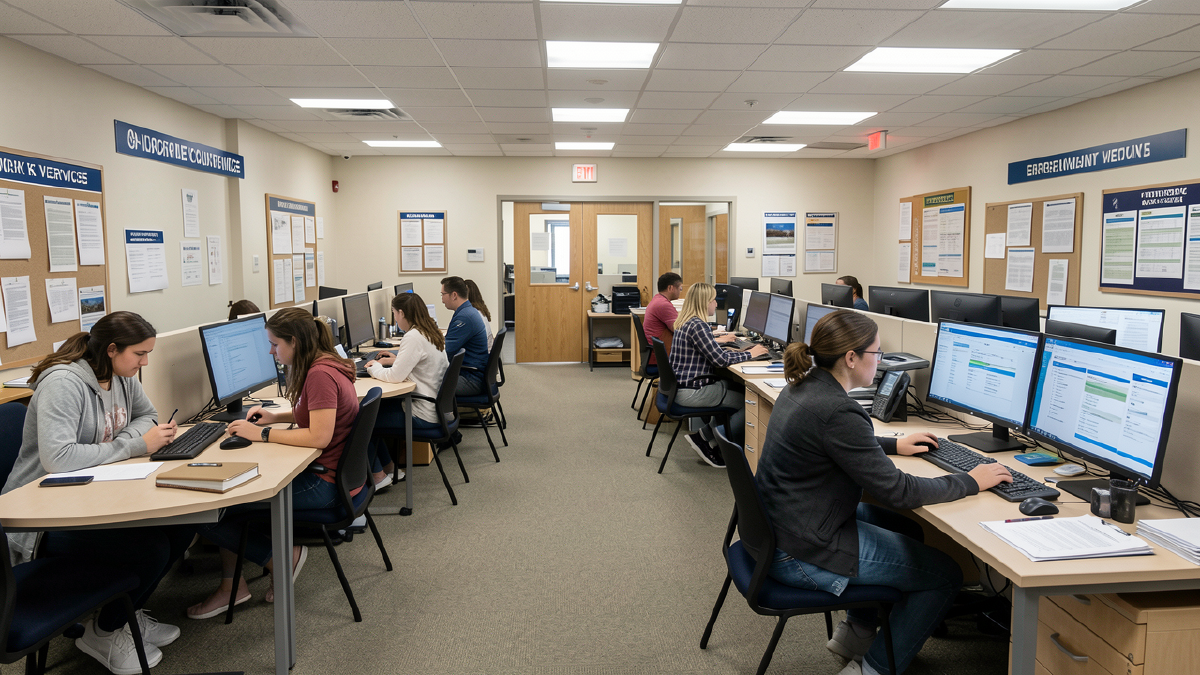
Community colleges and Medicaid expansion adults are substantially the same population. Both groups are predominantly working-age adults with incomes below 138 percent of the federal poverty level, juggling employment, family responsibilities, and education simultaneously. When 18.5 million expansion adults face work requirements beginning December 2026, community colleges will serve as the central compliance infrastructure whether or not they are prepared for that role. Roughly 30 percent of community college students are already enrolled in Medicaid, and approximately 5.4 million community college students receive some form of federal financial aid. The demographic overlap is not two overlapping circles but nearly a single circle with modest divergence at the edges.
Full-time enrollment at 12 or more credit hours will likely count as full compliance with 80-hour monthly requirements in most states, using the standard 3:1 conversion ratio where each credit hour equals three hours of qualifying activity per week. This means a full-time student accumulates approximately 144 hours monthly, well above the threshold. Part-time students face more complex calculations. Someone enrolled in six credit hours generates roughly 72 hours monthly, falling short of 80 and requiring supplemental employment or other qualifying activity. The compliance math for part-time students demands precise understanding of conversion ratios and careful coordination of multiple activities.
The opportunity is real but the burden is institutional. Registrar offices built for standard enrollment verification will confront Medicaid compliance inquiries at potentially ten times current volume. A registrar processing 500 verification requests monthly might suddenly face 5,000. Academic advisors will need familiarity with Medicaid eligibility rules they were never trained on. Financial aid offices must navigate the intersection of Pell Grant eligibility and Medicaid eligibility, which use different income definitions, different household composition rules, and different verification processes. Student health services face questions about Medicaid billing and MCO network participation that lack clear answers at most institutions.
Community colleges are chronically underfunded for the populations they serve. Per-student funding at two-year institutions runs roughly half what four-year universities receive, despite community college students requiring more wraparound services. Counselor-to-student ratios at many community colleges exceed 1:1,000, compared to 1:300 at well-resourced four-year institutions. These capacity constraints existed before work requirements and will intensify dramatically after implementation.
The National Student Clearinghouse offers a potential solution for automated verification. Most community colleges already report enrollment data to the Clearinghouse for financial aid purposes, and extending this infrastructure to Medicaid verification could automate much of the burden. But this requires data sharing agreements between states and the Clearinghouse, technical integration with state Medicaid systems, and institutional confidence that automated reporting serves student interests. None of these prerequisites exist universally today.
Campus employment creates particular compliance advantages worth noting. Federal Work-Study positions, institutional employment in dining services or facilities, and student worker roles all generate verifiable work hours through the same administrative infrastructure handling enrollment verification. A student combining nine credit hours with 15 hours of weekly campus employment accumulates approximately 87 compliance hours monthly, exceeding the threshold through combined activity at a single institution. But Work-Study slots are limited, and community colleges historically receive smaller allocations than four-year institutions despite serving students with greater financial need.
Regional public universities and online programs extend the higher education ecosystem beyond community colleges. Another 3.2 million Pell Grant recipients attend public four-year institutions, many at regional comprehensive universities serving similar demographics. Online providers like Western Governors University, Southern New Hampshire University, and Arizona State Online enroll hundreds of thousands of working adults who may also be expansion adults seeking compliance pathways.
The strategic implications cut across stakeholder groups. States must invest in verification infrastructure connecting educational systems to Medicaid eligibility platforms or accept that students will bear documentation burdens educational institutions cannot manage. MCOs should evaluate campus-based navigator investments and network inclusion of campus health centers serving significant member populations. Educational institutions face a choice between deliberate preparation and reactive crisis management when volume overwhelms systems designed for different purposes.
The fundamental question is whether educational institutions engage deliberately in building compliance support capacity or react passively, leaving students to navigate challenges without institutional assistance. Students maintaining coverage persist at higher rates. Institutional investment in compliance support demonstrates commitment to student success. The months before December 2026 offer preparation time that institutions should use wisely, because those that wait until work requirements take effect will find themselves managing crisis rather than providing support.