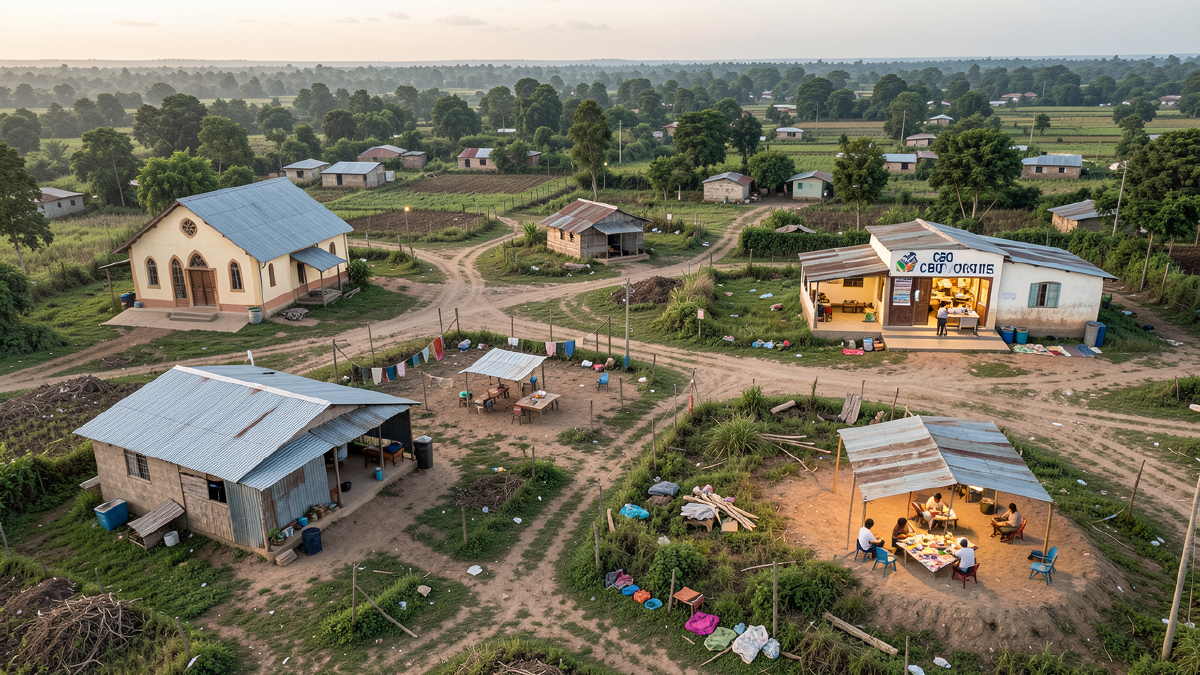
Work requirement navigation depends on an ecosystem that policy discussions assume and implementation reality must somehow conjure into existence. Across eight articles examining community-based organizations, faith communities, peer support models, and informal mutual aid networks, a pattern emerges: every organizational model contributes something essential, none provides comprehensive coverage alone, and the coordination infrastructure connecting them barely exists outside policy imagination.
The challenge is not theoretical. 18.5 million expansion adults will begin facing compliance verification in December 2026. Some percentage will need help gathering documentation from multiple employers, understanding exemption criteria, or navigating the state systems where verification happens. Professional community health workers can serve perhaps 10 to 15 percent of this population if every conceivable funding source materialized and workforce pipelines accelerated dramatically. The gap between professional capacity and actual need must be filled by some combination of faith volunteers, peer navigators, community-based organizations, and informal mutual support that policy has named but not built.
The Architecture of Distributed Capacity#
The series opened with faith-based organizations (MRWR-8A) providing trusted relationships grounded in weekly connection and spiritual authority. Congregations exist everywhere, know their members intimately, and operate from missions of service rather than contractual obligation. But churches cannot become compliance agencies without losing what makes them valuable. The volunteer coordinator who helps with verification paperwork between Sunday school and worship provides something government cannot replicate, but cannot scale to serve the hundreds needing help across a multi-county region.
Grant-funded CBOs (MRWR-8B) bring professional staffing, established relationships with government agencies, and infrastructure for service documentation. They can contract with states, handle sophisticated case management, and demonstrate outcomes to funders. But they also face mission drift pressures, funding dependencies that shape priorities, and capacity constraints that make serving entire populations impossible. The CBO that excels at youth development or food security must decide whether adding work requirement navigation serves its core mission or dilutes organizational focus in ways that ultimately weaken both the original work and the compliance support.
Community Inclusive Social Enterprise models (MRWR-8C) transform the equation by compensating peer navigators for expertise gained through lived experience. Someone who successfully navigated multi-employer verification while managing chronic illness possesses knowledge worth paying for. CISE models recognize this value, creating microenterprise opportunities that simultaneously build community capacity and generate income for people facing barriers in traditional labor markets. But CISE providers operate independently, lack collective bargaining power with institutional purchasers, and face credentialing requirements that may protect quality or may protect established organizations from competition.
Decentralized Autonomous Organizations (MRWR-8D) represent the speculative edge of this ecosystem, using blockchain and smart contracts to coordinate peer navigation at scale without centralized hierarchical control. DAOs promise permissionless participation, transparent operations, efficient micropayments, and multi-stakeholder governance. They also require technical sophistication that most communities lack, operate under regulatory frameworks that don’t yet exist, and face institutional resistance from organizations that prefer contractors they can control over distributed networks they cannot. The DAO vision remains compelling; the implementation timeline intersects poorly with December 2026 deadlines.
These organizational models were examined individually to illuminate their distinct characteristics. But competency-based matching (MRWR-8E) revealed that organizational affiliation matters less than specific capabilities when connecting people to appropriate support. The faith volunteer who personally navigated serious mental illness while maintaining employment brings competencies many professional CHWs lack. The CISE peer navigator with clinical background possesses medical knowledge exceeding standard certification. The matrix approach matches provider competencies to member needs regardless of organizational identity, recognizing that expertise derives from lived experience, training, and demonstrated capability rather than institutional badge.
This competency framework assumes matching infrastructure that barely exists. Who maintains the registry of navigator capabilities? Who facilitates warm handoffs when cases exceed provider competency? Who ensures quality across providers operating independently? The competency insight is sound; the implementation infrastructure is absent.
When Theory Meets Geography#
Article 8G shifted from organizational models to geographic reality through the lens of Petroleum County, Montana, where 487 people occupy 1,654 square miles and formal CBO infrastructure simply does not exist. The director of a two-person county health department listened politely to state presentations about community-based organization partnerships and navigator networks, knowing these discussions described a different country than the one she inhabited.
Rural areas lack the population density that supports formal nonprofit structures. The organizational models this series described assume concentrations of people that enable sustainable operations. Community colleges, health centers, faith congregations, and social service agencies all require minimum viable scales that rural populations cannot support. The places where navigation infrastructure is most needed are precisely the places where it cannot be built using urban implementation models.
This is not a problem that better outreach will solve. The conditions creating need for services simultaneously prevent the development of organizations to provide those services. Rural CBO capacity gaps reflect structural features of rural geography rather than organizational failure or insufficient investment. Policy must accommodate this reality or accept rural coverage disparities as the cost of implementing requirements that identical populations can meet in cities but not in counties.
What exists in rural areas instead of CBOs includes county government default infrastructure, churches functioning as only consistent community institutions, agricultural extension offices with community development missions, and public libraries serving as de facto service centers. These institutions were not designed for Medicaid navigation, but they represent deployable infrastructure in counties where nothing else exists. The question is whether states will resource these alternative pathways or design implementation around CBO partnerships that rural areas cannot provide.
The Informal Economy Recognition Problem#
Article 8H introduced Keisha, Marquita, and Denise, three women in Memphis public housing who keep each other employed through arrangements that no system recognizes. Marquita watches Keisha’s children at 5 AM enabling Keisha’s distribution center job. Denise provides after-school care enabling both women’s late shifts. Keisha drives Marquita when her car breaks down. This mutual aid has sustained their survival for seven years through organic arrangements outside any organizational structure.
Work requirements demand that these women translate their survival into bureaucratic categories. Marquita needs to document caregiving hours. Keisha needs verification of community service. Denise needs attestation for after-school care. The help is real, substantial, and what makes work possible. But it exists entirely outside systems designed to see only what fits their forms.
The informal mutual aid that holds low-income communities together could count toward work requirements if states developed verification approaches accepting community attestation rather than requiring documentation from authoritative institutional sources. The alternative is excluding precisely the productive activity that enables employment, effectively penalizing people for solving problems informally that formal systems cannot address.
Recognition of informal support creates authentication challenges that formal employment verification avoids. Auditing employer payroll records is straightforward; auditing community attestation of informal caregiving has no comparable verification pathway. States must choose between trusting communities in ways bureaucracies resist or maintaining verification approaches designed for formal employment that systematically exclude how low-income communities actually function.
The Coordination Gap Nobody Owns#
Article 8F examined the ecosystem in practice from the perspective of members trying to navigate it. The faith volunteer doesn’t know the CBO case manager. The CISE provider has no relationship with the state hotline. The competency matrix assumes matching infrastructure that doesn’t exist. The warm handoffs between providers when cases exceed competency require connective tissue that nobody has built.
Who builds this connective tissue? Not state Medicaid agencies designing eligibility systems but rarely investing in navigation coordination. Not MCOs contracting with specific vendors rather than convening ecosystem-wide infrastructure. Not individual congregations, CBOs, or CISE providers lacking resources and authority to coordinate beyond immediate networks. Not foundations funding programs but not the permanent infrastructure connecting programs to each other.
Regional backbone organizations could fill this coordination role, maintaining relationships across faith communities, CBOs, and independent CISE providers. Such organizations exist for other purposes in some communities through collective impact initiatives, community health improvement partnerships, and United Way structures. But extending these models to work requirement navigation requires investment nobody has committed and authority nobody possesses.
The coordination gap manifests predictably. A faith volunteer encounters someone whose employer verification keeps getting rejected. She lacks technical expertise to diagnose the problem and knows a CBO that might help but has no warm contact there. She tells the person to call directly. The person calls, gets voicemail, never calls back, misses verification deadline, and loses coverage. The volunteer never learns what happened. The CBO never knew the person needed help. The system failed through nobody’s fault and everybody’s.
Conflict Within Cooperation#
The series has assumed that different organizational models will cooperate, complement each other, and coordinate handoffs. This assumption deserves scrutiny because organizational models bring competing interests into the same space serving the same population.
Faith organizations may resist their members receiving help from secular CBOs. Theological concerns about government entanglement may lead congregations to refuse participation in state credentialing systems, isolating volunteers from broader coordination infrastructure. CBOs may view CISE providers as unqualified competition. Organizations that invested in professional staff, case management systems, and quality assurance infrastructure watch untrained community members hang out shingles offering similar services. CISE providers may resent credentialing barriers that established organizations control. State administrators may favor contractors they can monitor over distributed networks they cannot control.
These conflicts don’t emerge from bad actors but from legitimate interests in tension. Faith leaders genuinely want to serve congregations. CBO directors genuinely care about service quality. CISE providers genuinely have expertise to offer. State administrators genuinely need accountability mechanisms. The ecosystem brings competing interests together without structures for resolving conflicts when they arise.
Community convening processes could surface and address these tensions. Regional backbone organizations could facilitate dialogue across organizational boundaries. Shared governance structures could enable collective decision-making about resource allocation and coordination protocols. But building these structures requires time, trust, and investment that fourteen-month implementation timelines do not permit.
Accountability Without Hierarchy#
When participants operate independently across organizational boundaries, traditional accountability structures don’t apply. Employees are accountable to supervisors. Organizations are accountable to funders. Contractors are accountable to agencies holding their contracts. But faith volunteers have no quality assurance function. CISE providers without professional credentials face no licensing oversight. The competency-based matching approach assumes outcome tracking, but when a volunteer shows poor outcomes, who intervenes?
Professional accountability operates through licensing, certification, and scope of practice enforcement. These mechanisms apply to portions of the ecosystem but not to faith volunteers operating informally or CISE providers without professional credentials. Reputational accountability functions in small communities where everyone knows each other but fails at scale, in transient populations, or in urban areas where anonymity protects poor performers.
The honest assessment is that comprehensive accountability does not exist and may not be achievable. The ecosystem includes participants ranging from licensed professionals subject to regulatory oversight to informal volunteers operating through purely relational networks. Creating uniform accountability across this range would require either professionalizing informal helpers and destroying what makes them valuable or extending informal accountability to professional settings and degrading professional standards. The ecosystem will include accountability gaps. The question is whether those gaps are smaller than the alternative of providing no navigation support at all.
What Realistic Success Looks Like#
The ecosystem described in this series will not reach everyone. It will not operate seamlessly. It will not eliminate coverage losses due to verification failures. It will not resolve the fundamental tension between work requirements as policy and the capacity of affected populations to comply.
Realistic success looks more modest. Some communities will develop functional coordination across faith organizations, CBOs, and CISE providers, with backbone organizations facilitating handoffs and shared infrastructure enabling information flow. Other communities will have fragmented support where people get help if they happen to find the right volunteer, CBO, or peer navigator but where systematic access doesn’t exist. Rural areas will make do with county employees, church volunteers, and informal community networks that cannot replicate urban infrastructure but provide what limited assistance geography permits.
Verification assistance for those with straightforward single-employer documentation might take fifteen minutes monthly. Assistance for someone with three income sources might take ninety minutes. If each volunteer or CISE provider can sustainably help twenty people monthly, reaching 13 million people requires 650,000 active helpers. Where do they come from? Churches already struggle recruiting volunteers for existing ministries. Building CISE practices requires entrepreneurial initiative that not everyone possesses. Professional CHW positions at scale require funding that doesn’t exist.
The honest answer is that verification assistance will remain undersupplied relative to need. Some people will get help through faith communities, peer networks, CISE providers, or professional navigators. Some will manage on their own despite the burden. Some will fail verification and lose coverage despite doing everything required of them because documentation didn’t happen correctly. The ecosystem this series describes improves outcomes compared to leaving everyone entirely alone. It does not solve the fundamental capacity problem.
The Infrastructure Imperative#
Work requirement policy cannot succeed without the community navigation infrastructure this series examined. The state eligibility systems, MCO care coordination programs, and provider documentation portals all assume that members can successfully navigate verification when help is needed. But help capacity remains theoretical rather than actual across most of the ecosystem.
Building this capacity in fourteen months requires recognizing what exists rather than assuming what policy imagines. Faith organizations bring trusted relationships but limited technical capacity and appropriate resistance to becoming government compliance agencies. CBOs bring professional infrastructure but face capacity constraints, mission alignment tensions, and geographic gaps. CISE models create peer-driven support but operate independently without coordination mechanisms. Informal mutual aid sustains communities but exists outside bureaucratically legible frameworks.
States that enable rather than prescribe organizational participation might build workable ecosystems. Credentialing frameworks that accommodate faith volunteers, professional CHWs, and CISE providers while maintaining quality standards. Verification approaches that accept community attestation for informal mutual aid while managing fraud risk through pattern verification rather than impossible documentation demands. Technical infrastructure shared across organizational boundaries enabling information flow without requiring sophisticated systems at every individual organization. Regional coordination structures convening stakeholders to address conflicts before they undermine cooperation.
The coordination infrastructure enabling this ecosystem to function remains the part nobody has committed to building. Individual organizational models can operate independently. The ecosystem cannot function without someone creating the connective tissue enabling handoffs, maintaining quality, resolving conflicts, and filling gaps. That backbone infrastructure represents essential investment for which responsibility is unclear and funding uncommitted.
Series 8 has examined the organizational models, geographic realities, competency frameworks, and coordination challenges defining community navigation infrastructure. The next critical question is how healthcare providers fit into this ecosystem (Series 9), not as navigators but as documentation sources enabling exemptions and as touchpoints where navigation support becomes essential. The community ecosystem this series described must interface with medical infrastructure that brings its own constraints, incentives, and implementation challenges.