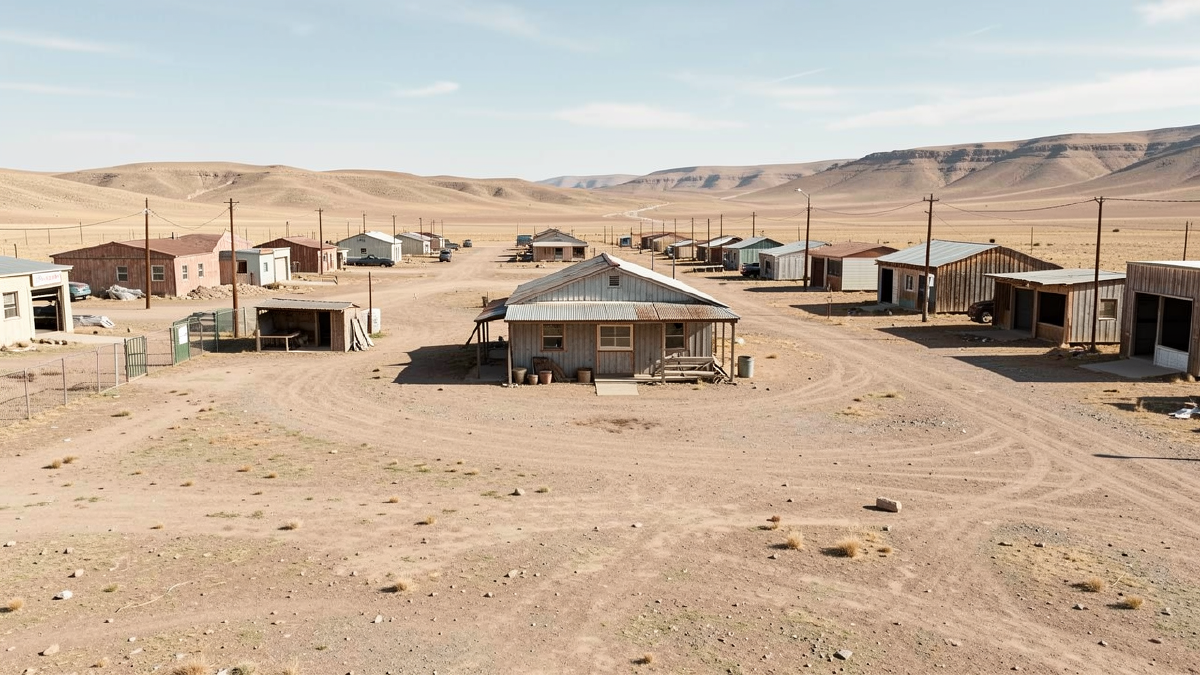
Rural areas facing work requirements often lack the community organization infrastructure that urban implementation models assume
Linda Becker has directed the Petroleum County Health Department in central Montana for eleven years. Her jurisdiction covers 1,654 square miles, an area larger than Rhode Island, with a population of 487 people. The county seat of Winnett has 182 residents, a post office, a bar, and her two-person health department office. The nearest hospital is 85 miles away in Lewistown. The nearest community health center is 90 miles in the other direction.
When Linda attends state meetings about Medicaid work requirement implementation, she listens to discussions about community-based organization partnerships, navigator networks, and stakeholder engagement strategies. The presenters reference models from Billings and Missoula, where multiple CBOs compete for navigation contracts and specialized organizations serve distinct populations. They talk about warm handoffs between navigators and case managers, about multilingual outreach, about community health worker programs embedded in trusted neighborhood organizations.
Linda takes notes politely, but the gap between these discussions and her reality is so vast it feels like they’re describing a different country. Petroleum County has no CBOs. Zero. The term “community-based organization” assumes a population density that can sustain formal nonprofit structures, and Petroleum County has 0.3 people per square mile. There is no neighborhood organization to embed community health workers in because there are no neighborhoods. The county’s entire Medicaid expansion population is perhaps forty adults, scattered across ranches and small clusters of houses along dirt roads that become impassable in winter.
When the state asks who will provide navigation support for work requirement compliance, Linda has no answer. Her health department has two employees: herself and a part-time clerk. The county DHS worker covers three counties and visits Winnett twice monthly. The churches, such as they are, have volunteer pastors who drive in from elsewhere. The library operates twelve hours per week. There is no organizational infrastructure to mobilize because organizational infrastructure requires population concentrations that Petroleum County does not have.
Linda’s situation is extreme but not unique. Across rural America, work requirement implementation collides with the fundamental reality that the community organizations policy assumes simply do not exist.
The Geography of CBO Absence#
The distribution of nonprofit organizations across American geography follows population density with remarkable consistency. Urban counties average dozens to hundreds of registered nonprofits per 10,000 residents. Suburban counties maintain somewhat lower but still substantial nonprofit presence. Rural counties see sharp declines. And frontier counties, those with fewer than six people per square mile, often have effectively zero community-based organizations beyond churches and volunteer fire departments.
National Center for Charitable Statistics data reveals the pattern starkly. Counties with populations under 10,000 average fewer than 15 registered nonprofits total, most of which are churches, cemeteries, or social clubs rather than service-providing organizations. Counties under 5,000 population frequently have no social service nonprofits at all. The organizations that Medicaid navigation assumes, community health centers, social service agencies, immigrant assistance organizations, workforce development nonprofits, food banks with case management capacity, exist in cities and suburbs and largely do not exist in rural America.
The difference between “underserved” and “unserved” matters enormously for policy design. An underserved community has organizations that lack sufficient funding, staff, or capacity to meet need. Investment can expand their capacity. An unserved community has no organizations to invest in. The gap cannot be filled by increasing funding to entities that do not exist. Building organizational infrastructure from nothing requires years of development that cannot happen in the months before work requirement implementation.
Mapping the navigation desert reveals patterns that track poverty, age, and isolation. The counties with the highest proportions of Medicaid expansion adults per capita are often the same counties with the lowest nonprofit density. Eastern Montana, the Dakotas, rural Appalachia, the Mississippi Delta, the Texas borderlands, and Alaska’s vast rural expanses all combine high Medicaid reliance with minimal organizational infrastructure. These are precisely the places where navigation support is most needed and least available.
Why Rural CBOs Don’t Exist#
The absence of rural CBOs reflects structural economics rather than community deficits. Formal nonprofit organizations require minimum viable scales that rural populations cannot support.
Population thresholds for organizational sustainability set floors below which formal structures cannot survive. A food bank needs enough donors to fund operations, enough volunteers to staff distribution, and enough clients to justify the infrastructure. A community health center needs patient volume to support clinical staff, billing operations, and facility costs. A workforce development organization needs employer relationships, training program scale, and client flow that justify programmatic investment. These thresholds typically require catchment populations of 20,000 to 50,000 or more, populations that rural counties simply do not have.
Grant funding operates at minimum scales that exclude small rural organizations. Federal grants for navigation programs often require matching funds, data systems, and administrative infrastructure that organizations serving 500 people cannot maintain. Foundation grants target organizations with professional staff, audited financials, and track records that volunteer-run rural entities lack. The paradox is brutal: the communities with greatest need have least access to the funding that could address that need because they lack the organizational prerequisites funders require.
Professional staff recruitment creates insurmountable challenges for rural organizations. A social worker or case manager living in rural Montana faces limited housing options, no professional peer community, reduced career advancement opportunities, and salaries that cannot compete with urban alternatives. Organizations that cannot recruit staff cannot provide services regardless of funding availability. Rural health provider shortages are well documented; rural social service provider shortages follow identical patterns but receive less attention.
The paradox of greatest need and least capacity defines rural community infrastructure. Counties with high poverty rates, limited employment, aging populations, and elevated health needs are precisely the counties where organizational development is most difficult. The conditions creating need for services simultaneously prevent the development of organizations to provide those services. This is not a problem that market dynamics or voluntary sector growth will solve; it is a structural feature of rural geography that policy must explicitly address.
What Does Exist#
Rural communities are not devoid of institutions. They simply lack the formal CBO infrastructure that urban navigation models assume. Understanding what actually exists in rural areas is essential for designing navigation approaches that work.
County government becomes default infrastructure in rural areas where no other institutions operate. The county health department, the county DHS office, the county extension agent, and the county clerk may constitute the entirety of formal service capacity. These offices typically operate with minimal staff covering broad responsibilities across large geographic areas. They are not specialized navigators; they are generalists handling everything from birth certificates to septic permits to Medicaid questions. But they exist, they have relationships with community members, and they represent the only consistent institutional presence in many rural counties.
Churches function as the only consistent community institutions across much of rural America. Where no CBOs exist, churches provide social connection, mutual aid, emergency assistance, and informal support networks. Rural congregations are typically small, led by part-time or volunteer clergy, and lack the organizational capacity for formal programming. But they have something CBOs cannot replicate: trusted relationships built over generations in communities where everyone knows everyone. The question is whether and how to leverage church infrastructure for navigation support without imposing burdens these institutions cannot bear or entangling religious organizations in government programs in problematic ways.
Agricultural extension offices maintain presence in almost every rural county through the land-grant university system. Extension agents historically focused on agricultural education but have expanded into community development, family finance, and health education in many states. They have existing relationships with rural families, infrastructure for community outreach, and institutional support from state universities. Extension offices are not designed for Medicaid navigation, but they represent deployable infrastructure in counties where nothing else exists.
Public libraries serve as de facto community centers in many rural areas, providing internet access, meeting space, and reference assistance. Rural libraries operate with minimal staff and limited hours but maintain consistent community presence. Librarians already help patrons navigate government websites and complete forms. Extending this assistance to work requirement verification builds on existing capacity rather than creating new infrastructure.
Rural health clinics and critical access hospitals, where they exist, provide healthcare touchpoints that could incorporate navigation support. Montana’s 50 critical access hospitals, more than any other state, exist precisely because rural populations cannot support conventional hospital economics. These facilities maintain community relationships and could serve navigation functions if resourced and trained to do so. But many rural counties lack even these minimal healthcare facilities.
Alternative Navigation Models#
If traditional CBO-based navigation cannot function in rural areas, what alternatives might work?
Regional hub-and-spoke approaches concentrate navigation expertise in larger communities while extending services to surrounding rural areas. A hub organization in a regional center like Billings or Great Falls might employ navigators who travel to rural counties on rotating schedules, provide phone and video consultation to remote residents, and train local contacts to handle basic questions. The hub maintains professional capacity while spokes provide local presence. This model requires investment in hub infrastructure and travel systems that most rural navigation programs currently lack.
Mobile navigation brings services to communities rather than expecting community members to travel to services. A navigation van visiting Petroleum County monthly could provide in-person assistance to residents who cannot travel 90 miles to the nearest service center. Mobile models work for populations too dispersed for permanent facilities but concentrated enough to justify scheduled visits. They fail for populations so scattered that even mobile services cannot reach them efficiently.
Training community members without organizational affiliation creates navigation capacity outside formal structures. A ranch wife who understands Medicaid paperwork could help neighbors navigate verification requirements. A retired schoolteacher in a small town could staff weekly office hours at the library. A church deacon could add navigation assistance to existing pastoral care responsibilities. These informal navigators lack the credentials and supervision of professional staff but have something professionals lack: existing trusted relationships in communities where outsiders are viewed with suspicion.
County government navigator positions formalize what county employees already do informally. Adding a navigation function to county health department responsibilities, with appropriate training and state support, creates accountable infrastructure using existing institutional frameworks. The county employee helping residents with Medicaid questions today could be formally designated, trained, and compensated as a work requirement navigator. This approach works in counties with sufficient staff capacity; it fails in counties where a two-person office cannot absorb additional responsibilities.
Technology as Substitute and Limitation#
Technology solutions promise to bridge rural infrastructure gaps by providing digital access to navigation resources regardless of location. The promise collides with the reality that technology access is itself a rural infrastructure gap.
Digital navigation tools assume connectivity that rural areas often lack. FCC data acknowledges that rural broadband availability lags far behind urban areas, with approximately 17 percent of rural Americans lacking access to fixed broadband meeting minimum speed standards. Independent assessments suggest the actual gap is significantly larger because FCC data relies on provider reporting that systematically overstates coverage. A navigation app is useless to someone whose home has no internet service and whose town has no public wifi.
When technology solutions require technology access, they replicate rather than solve geographic disparities. Online verification portals, mobile apps for hour tracking, video consultations with remote navigators all assume digital infrastructure that correlates with the same population density that supports CBO infrastructure. The places without CBOs are often the same places without broadband. Technology substitutes one infrastructure gap for another rather than solving the underlying problem.
The assumption of connectivity pervades policy design in ways that disadvantage rural populations. State Medicaid agencies building online-first verification systems create efficient processes for connected populations while erecting barriers for unconnected populations. The efficiency gain from digital systems comes partly from excluding people who cannot use them. When those excluded people lose coverage for failing to complete online verification, the system has not failed; it has worked exactly as designed, prioritizing administrative efficiency over universal access.
Satellite internet and cellular connectivity offer partial solutions for some rural areas, but coverage remains inconsistent and costs exceed what low-income households can afford. The promise of Starlink and similar services may eventually transform rural connectivity, but that transformation has not yet occurred and cannot be assumed for work requirement implementation beginning in December 2026.
State Responsibility#
States bear responsibility for ensuring that Medicaid requirements are actually achievable regardless of where enrollees live. This responsibility does not disappear because rural areas lack the CBO infrastructure that urban implementation models assume.
The legal framework for Medicaid includes equal access requirements that geographic variation in navigation support may implicate. If urban enrollees have multiple navigation options while rural enrollees have none, the resulting coverage disparities reflect policy choices about infrastructure investment rather than individual compliance failures. States cannot disclaim responsibility for coverage losses that result from navigation deserts they chose not to address.
Funding models for areas without implementation partners require state creativity. Standard approaches contracting with CBOs to provide navigation services fail when CBOs do not exist. States must either build navigation capacity directly through state employees and county partnerships, invest in organizational development creating CBOs where none exist, provide individual rather than organizational funding allowing community members to serve as navigators, create regional structures concentrating capacity in hubs serving larger areas, or accept that rural enrollees will have reduced access to navigation support and design systems accordingly.
The timeline for work requirement implementation creates particular pressure. Building CBO capacity requires years of organizational development. States have months. The organizations that will provide navigation in December 2026 are organizations that exist today. New organizational infrastructure cannot be created fast enough to serve initial implementation. States must work with what exists, which in rural areas means county government, churches, extension offices, libraries, and informal community networks rather than the CBO ecosystems that urban implementation assumes.
The policy choice is whether to invest in rural navigation infrastructure or to accept rural coverage losses as the cost of implementation. Both choices have consequences. Investment requires funding and creativity that states may lack or be unwilling to provide. Acceptance means that identical work requirements produce systematically different outcomes based on geography, with rural Americans facing higher coverage loss rates than urban Americans despite facing harder compliance challenges.
The Infrastructure Imperative#
Work requirement policy cannot succeed in rural America using implementation models designed for urban contexts. The CBOs that urban models assume do not exist in communities too small to sustain formal nonprofit structures. The navigation networks that policy discussions reference cannot be built in counties with 500 people spread across 1,500 square miles. The technology solutions that promise to bridge gaps assume connectivity that rural areas lack.
Linda Becker in Petroleum County will do what she can with what she has. She will answer questions when residents come to her office. She will make phone calls to help confused neighbors understand verification requirements. She will drive to ranches when weather permits to help elderly residents with paperwork. She will do this in addition to her actual job responsibilities, without additional funding or support, because there is no one else.
Whether this improvised, inadequate response will prevent coverage losses among Petroleum County’s forty expansion adults depends on how much those residents can figure out on their own, how forgiving the verification system is of documentation problems, and how lucky they are in avoiding the administrative barriers that cause coverage loss even among people meeting work requirements. It does not depend on the CBO partnerships, navigator networks, and stakeholder engagement strategies discussed at state implementation meetings, because none of those things exist in Petroleum County.
The rural CBO capacity crisis is not a problem to be solved through better outreach to existing organizations. It is a structural feature of rural geography that policy must accommodate or accept as a source of systematic coverage disparities. The choice belongs to states. The consequences belong to rural Americans whose healthcare depends on infrastructure that does not exist.