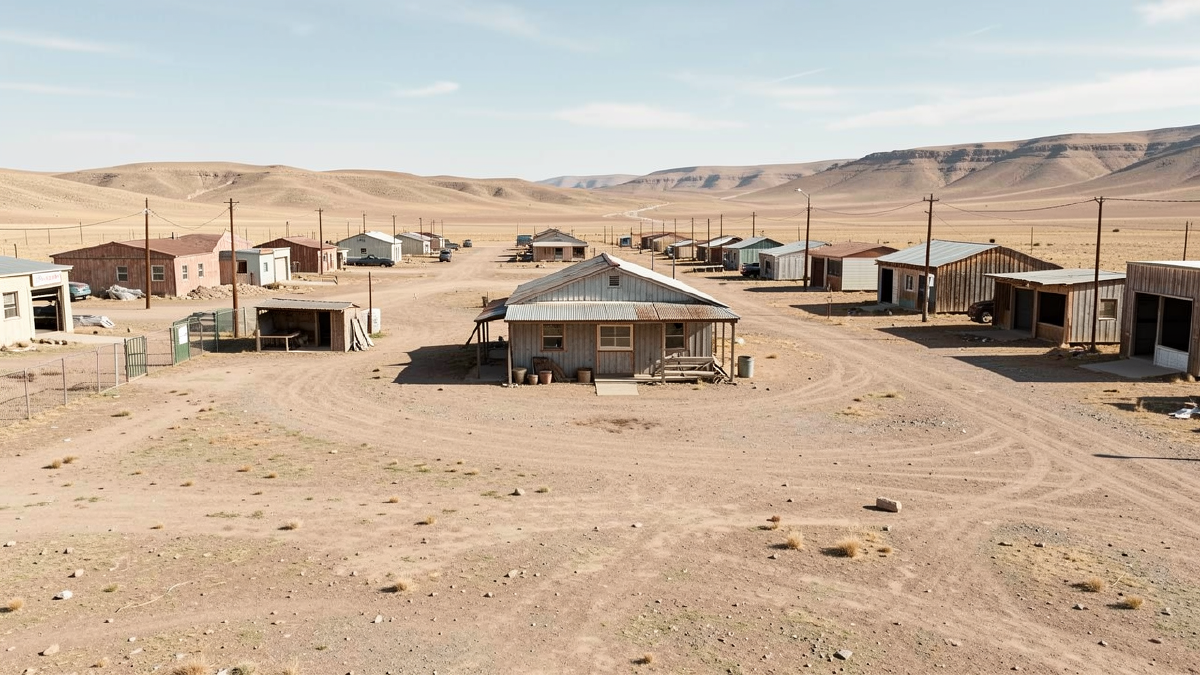
Work requirement navigation assumes community-based organizations providing professional support, infrastructure for service documentation, and established relationships with government agencies. This assumption holds reasonably well in urban and suburban contexts where dozens to hundreds of nonprofits operate per county. It fails completely across rural America where the community organizations policy discussions reference simply do not exist. Counties with populations under 10,000 average fewer than 15 registered nonprofits total, most of which are churches, cemeteries, or social clubs rather than service providers. Counties under 5,000 frequently have no social service nonprofits at all. The navigation infrastructure implementation plans assume exists only in imagination.
The fundamental insight: rural CBO absence reflects structural economics rather than community deficits. Formal nonprofit organizations require minimum viable scales that rural populations cannot support. A food bank needs enough donors to fund operations, enough volunteers to staff distribution, and enough clients to justify infrastructure. A social service agency needs caseloads supporting professional staff, operating budgets covering facilities and systems, and geographic density enabling efficient service delivery. These thresholds set floors below which organizations cannot survive. Many rural counties fall below these thresholds not because communities lack commitment but because population density makes formal organizational infrastructure economically impossible.
Geographic Distribution of Nonprofit Capacity#
National Center for Charitable Statistics data reveals the pattern starkly across American geography. Urban counties average dozens to hundreds of registered nonprofits per 10,000 residents. Suburban counties maintain somewhat lower but still substantial nonprofit presence. Rural counties see sharp declines. Frontier counties with fewer than six people per square mile often have effectively zero community-based organizations beyond churches and volunteer fire departments.
Mapping the navigation desert reveals patterns tracking poverty, age, and isolation. The counties with highest proportions of Medicaid expansion adults per capita are often the same counties with lowest nonprofit density. Eastern Montana, the Dakotas, rural Appalachia, the Mississippi Delta, the Texas borderlands, and Alaska’s vast rural expanses all combine high Medicaid reliance with minimal organizational infrastructure. These are precisely the places where navigation support is most needed and least available.
The difference between “underserved” and “unserved” matters enormously for policy design. An underserved community has organizations lacking sufficient funding, staff, or capacity to meet need. Investment can expand their capacity. An unserved community has no organizations to invest in. The gap cannot be filled by increasing funding to entities that do not exist. Building organizational infrastructure from nothing requires years of development that cannot happen in months before work requirement implementation.
Why Rural CBOs Do Not Exist#
Population thresholds for organizational sustainability set floors below which formal structures cannot survive. Counties need minimum populations supporting donor bases, volunteer pools, client volumes, and revenue streams. Research suggests community-based human service organizations require approximately 25,000-50,000 population to maintain sustainable operations with professional staff and formal infrastructure.
Many rural counties fall well below these thresholds. Montana has 14 counties with populations under 5,000 and another 16 under 10,000. The Dakotas, Wyoming, Nebraska, and Kansas all contain numerous counties where population cannot support formal social service organizations. These counties may have active churches, dedicated volunteers, and strong community commitment. They cannot support the professional CBOs that navigation policy assumes.
Geographic distance compounds population sparsity. A county with 8,000 people spread across 2,500 square miles faces service delivery challenges different from a county with 8,000 people in 50 square miles. Travel time between clients affects caseload capacity. Fuel costs affect operating budgets. Isolation affects recruitment of professional staff. The geography that makes organizational infrastructure uneconomical also makes individual service delivery inefficient.
Workforce availability creates additional constraints. Rural areas face shortages across professional categories including social workers, case managers, community health workers, and nonprofit administrators. Someone with social work credentials can earn more in urban areas with lower housing costs. Recruiting and retaining professional staff in remote communities requires compensation premiums that nonprofit budgets cannot support.
The Broadband Gap Compounding Service Gaps#
Work requirement verification assumes online portals, digital documentation submission, and electronic communication between navigators and clients. This assumption requires broadband connectivity that substantial portions of rural America lack. FCC data suggests 14.5 million rural Americans lack access to fixed broadband service meeting minimum speed thresholds. Actual unavailability exceeds official statistics because FCC methodology overstates coverage.
The places without CBOs are often the same places without broadband. Technology substitutes one infrastructure gap for another rather than solving underlying problems. State Medicaid agencies building online-first verification systems create efficient processes for connected populations while erecting barriers for unconnected populations. The efficiency gain from digital systems comes partly from excluding people who cannot use them.
When excluded people lose coverage for failing to complete online verification, the system has not failed. It has worked exactly as designed, prioritizing administrative efficiency over universal access. The tradeoff may be defensible in contexts where most people have connectivity. It becomes less defensible when systematic exclusion affects communities already facing multiple infrastructure deficits.
Satellite internet and cellular connectivity offer partial solutions for some rural areas, but coverage remains inconsistent and costs exceed what low-income households can afford. The promise of Starlink and similar services may eventually transform rural connectivity, but that transformation has not yet occurred and cannot be assumed for work requirement implementation beginning December 2026.
State Responsibility for Equal Access#
States bear responsibility for ensuring Medicaid requirements are actually achievable regardless of where enrollees live. This responsibility does not disappear because rural areas lack CBO infrastructure that urban implementation models assume. The legal framework for Medicaid includes equal access requirements that geographic variation in navigation support may implicate.
If urban enrollees have multiple navigation options while rural enrollees have none, resulting coverage disparities reflect policy choices about infrastructure investment rather than individual compliance failures. States cannot disclaim responsibility for coverage losses resulting from navigation deserts they chose not to address.
Funding models for areas without implementation partners require state creativity. Standard approaches contracting with CBOs fail when CBOs do not exist. States must either build navigation capacity directly through state employees and county partnerships, invest in organizational development creating CBOs where none exist, provide individual rather than organizational funding allowing community members to serve as navigators, create regional structures concentrating capacity in hubs serving larger areas, or accept that rural enrollees will have reduced access and design systems accordingly.
The timeline for work requirement implementation creates particular pressure. Building CBO capacity requires years of organizational development. States have months. The organizations that will provide navigation in December 2026 are organizations that exist today. New organizational infrastructure cannot be created fast enough to serve initial implementation.
Alternative Infrastructure in Rural Communities#
Some rural communities maintain alternative infrastructure that could support navigation despite lacking formal CBOs. Cooperative Extension offices exist in nearly every county, employ professionals with community connections, and provide education and assistance programs. They typically do not provide health-related services but have infrastructure that could potentially expand to include navigation support.
County health departments provide public health services in many rural areas and maintain relationships with Medicaid populations. Their capacity varies dramatically, with some counties operating robust programs while others maintain minimal presence. Expansion into work requirement navigation would require additional funding and staffing most county budgets cannot accommodate.
Libraries serve as community hubs in rural areas, providing public internet access, assistance with online applications, and connections to social services. Library staff are not trained navigators but could potentially receive basic training enabling them to help with straightforward verification while referring complex cases. This model leverages existing infrastructure and community presence.
Critical access hospitals serve as employers, healthcare providers, and community anchors in rural areas. They have patient relationships and community trust but typically lack capacity for extensive social service provision. Modest investments could potentially enable hospital community health workers to add navigation support to existing outreach activities.
None of these alternatives substitutes for professional CBO infrastructure. Each provides partial capacity that could contribute to navigation ecosystem if appropriately supported. But none exists at scale sufficient to reach all rural Medicaid populations needing support.
Bottom Line#
Rural CBO capacity crisis reflects structural reality rather than implementation failure that better planning could solve. The community organizations that work requirement navigation policy assumes simply do not exist across substantial portions of rural America because population density cannot support formal organizational infrastructure. States face choices about building alternative capacity through direct provision, investing in organizational development requiring years implementation timelines do not permit, accepting coverage disparities between urban and rural populations, or fundamentally rethinking verification approaches to accommodate areas lacking navigation infrastructure. The coordination mechanisms, stakeholder partnerships, and ecosystem integration discussed in implementation plans all assume organizations that do not exist in Petroleum County Montana, rural Appalachia, the Mississippi Delta, and countless other places where Medicaid expansion adults live. Policy must accommodate this reality or accept that coverage losses will concentrate in communities already facing multiple infrastructure deficits.