How spiritual authority, regular connection, and congregational life create unique capacity for work requirement navigation
The Trust Advantage#
Faith-based organizations occupy distinctive space in the work requirements ecosystem. Unlike government agencies, they carry no enforcement authority. Unlike healthcare organizations, they impose no clinical distance. Unlike social service providers, they require no intake forms before offering help. People walk through their doors for worship, community meals, pastoral care, or simple human connection. In this context, conversations about Medicaid coverage and work requirements emerge naturally from relationships already grounded in trust.
This trust operates at multiple levels. Pastoral authority carries weight when clergy explain exemption categories or encourage someone to seek medical documentation. Congregational relationships provide accountability that bureaucratic systems cannot replicate. When someone commits to meeting work requirements in front of their faith community, peer support and gentle reminders carry moral weight beyond compliance obligation. When someone struggles with mental health barriers or substance use recovery, faith communities often know before formal systems do and can mobilize support or facilitate exemption applications.
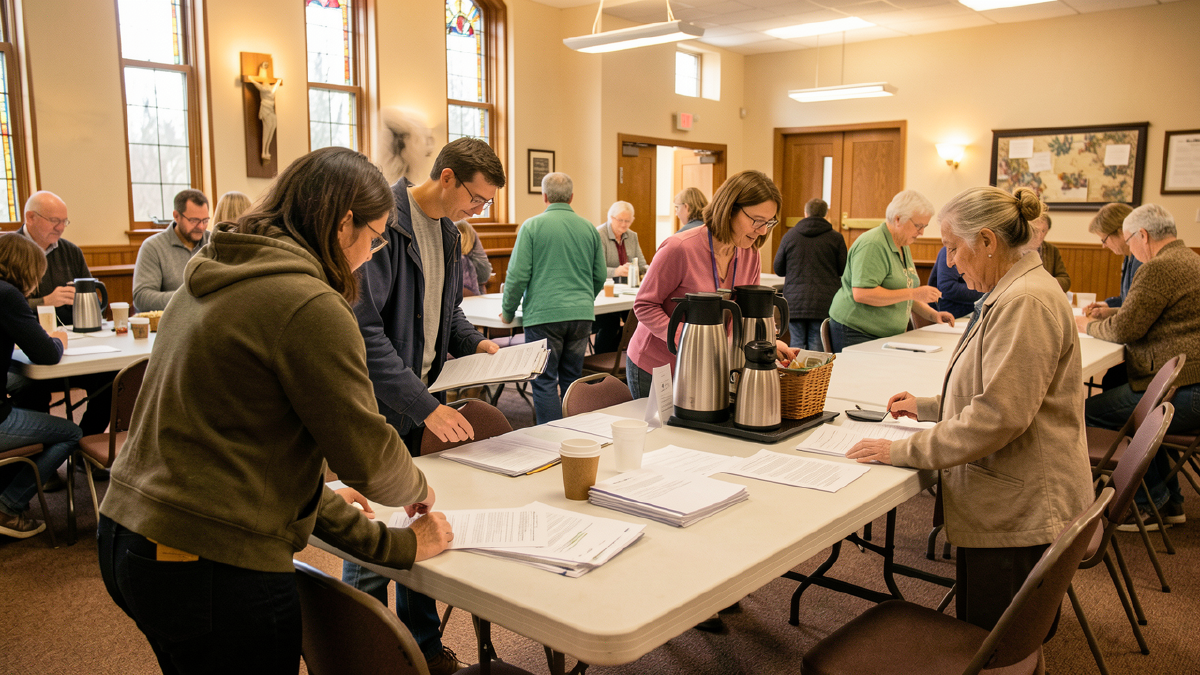
The physical space of religious institutions matters. Someone attending weekly services sees familiar faces who can help with verification paperwork between Sunday school and worship. The church secretary who answers phones during the week knows which congregation members face Medicaid work requirements and can connect them with volunteer coordinators or peer navigators. The building hosting AA meetings creates natural pathways to document recovery program participation qualifying for exemptions.
Geographic reach extends beyond what government programs can achieve. Rural communities with limited social service infrastructure still have churches. Immigrant communities skeptical of government systems trust their mosques and temples. Urban neighborhoods where residents avoid formal institutions maintain connection to their spiritual homes. Faith organizations exist in every community serving 18.5 million Medicaid expansion adults, creating potential navigation infrastructure at scale that no government program could replicate.
Theological Diversity and Implementation Approaches#
Different faith traditions approach work requirements through different theological lenses, shaping their participation decisions and implementation approaches.
Some traditions emphasize stewardship, viewing work as faithful use of gifts and contribution to community. These congregations see work requirements aligning with religious teaching about responsibility and mutual obligation. They readily provide volunteer opportunities counting toward requirements, helping members find meaningful ways to contribute while meeting compliance obligations. They frame navigation support as helping people live out their calling, not merely avoiding coverage loss.
Justice-oriented traditions approach work requirements through prophetic critique, viewing them as systems burdening the vulnerable. These congregations may simultaneously help individuals comply while organizing advocacy for policy change. They document implementation failures, support legal challenges, and mobilize political pressure. Their navigation support explicitly acknowledges philosophical opposition while recognizing that refusing to help individuals doesn’t change policy but does harm people.
Care-focused traditions emphasize mercy and meeting human need regardless of worthiness determinations. These communities resist categorizing people by compliance status, instead providing support to anyone who asks. Their navigation assistance sits alongside food pantries, temporary housing, and emergency financial assistance. Work requirements become one more challenge requiring community response, not fundamentally different from other barriers their members face.
Community-oriented traditions focus on relationship and mutual aid. Work requirements become opportunities to strengthen local bonds through neighbors helping neighbors. Someone who successfully navigated requirements mentors others facing similar challenges. Congregation members with flexible work schedules volunteer as navigators. The faith community becomes mutual support network where compliance assistance flows naturally from existing relationships.
These are not exclusive categories. Many congregations blend multiple approaches, with individual clergy and lay leaders navigating philosophical tensions while providing practical support. A congregation might oppose work requirements philosophically while building robust navigation infrastructure, believing that helping individuals navigate unjust systems while working for systemic change represents faithful witness.
What Faith Organizations Uniquely Contribute#
Beyond general trust and geographic reach, faith organizations provide specific capabilities that formal systems lack.
Regular in-person connection creates natural accountability and support structures. Someone attending weekly worship sees the same peer navigator who helped them last month, making follow-up organic rather than scheduled. Pastoral care visits to homebound elderly members include checking whether caregiver exemptions are documented. Youth group volunteers earn qualifying hours while the adult coordinator ensures proper documentation. Bible study groups include brief work requirement updates, normalizing conversations about compliance challenges and exemptions.
Community attestation provides verification that formal systems cannot easily capture. When verification systems struggle with informal caregiving arrangements, faith leaders can attest to caregiving relationships they observe directly. When someone volunteers irregularly across multiple community organizations without centralized tracking, their congregation can confirm cumulative hours. When barriers exist that don’t fit neat exemption categories, pastoral attestation provides human witness that algorithms cannot generate.
Cultural and linguistic access breaks down barriers formal systems create. Immigrant congregations provide navigation in languages state systems don’t support. Cultural interpreters explain work requirements in contexts state communications cannot address. Trust relationships overcome skepticism of government programs in communities with legitimate reasons for wariness.
Crisis response activates when formal systems move too slowly. When someone faces imminent coverage loss due to missing documentation, congregational networks mobilize quickly. Someone with transportation offers rides to document appointments. Someone with childcare enables attendance at navigation sessions. Someone with employer connections helps find qualifying work. These emergency responses prevent coverage loss that formal systems would process after termination.
Holistic support addresses barriers beyond work requirements themselves. The same community providing navigation support also offers food assistance, utility payment help, addiction recovery, and mental health support through pastoral care. Work requirement compliance doesn’t happen in isolation from other life challenges. Faith communities address multiple needs simultaneously in ways that compartmentalized formal systems cannot.
The Capacity Question#
Despite these unique strengths, faith organizations face substantial capacity constraints. Most congregations lack paid staff beyond clergy and perhaps administrative support. Volunteer leaders juggle multiple responsibilities. Technical sophistication varies enormously. Some megachurches employ professional social workers and operate sophisticated case management systems. Small rural churches rely entirely on volunteer efforts with minimal infrastructure.
State systems requiring sophisticated technology integration systematically exclude most faith-based capacity. If verification submission requires API connections or specialized software, the vast majority of congregations cannot participate. If documentation standards require professional credentials beyond pastoral authority, volunteer coordinators cannot help. If liability concerns require insurance coverage or legal review, small congregations withdraw from participation.
Training requirements must respect congregational capacity constraints. A four-hour training session works for employed staff but excludes volunteer coordinators juggling work and family obligations. Complex verification procedures requiring detailed understanding of eligibility rules exceed what most congregational volunteers can master. Requirements that work for professional navigators fail when applied to faith communities operating on volunteer energy and goodwill.
The sustainable model for faith organization participation recognizes these capacity constraints rather than ignoring them. Simple web forms for volunteer hour verification work. Paper-based backup options work. Phone confirmation works. Fifteen-minute training videos accessible at flexible times work. Systems designed for professional implementation fail when faith organizations are expected to use them.
Partnerships with community-based organizations with greater technical capacity can bridge gaps. A regional nonprofit provides case management platform that multiple congregations use. A national faith-based network offers shared technology infrastructure. Local foundations fund coordinating staff serving multiple small congregations. These intermediary structures enable faith organization participation without requiring individual congregations to build sophisticated infrastructure.
The Mission Drift Problem#
When states offer funding for navigation services, faith organizations face the same mission drift concerns that grant-funded CBOs encounter. Organizations founded to provide spiritual care, worship space, and community connection gradually become work requirements implementation contractors. State funding comes with reporting requirements, service specifications, and performance metrics that reshape organizational priorities.
The pastor who entered ministry to provide spiritual guidance now spends time tracking verification submission rates. The church secretary answering phones focuses on work requirement questions rather than pastoral care needs. Sunday announcements prioritize compliance deadlines over worship and fellowship. The organization remains faith-based in name but functions increasingly as government contractor.
Some congregations accept this transformation intentionally, viewing professional navigation services as legitimate ministry expression. Others resist state funding specifically to maintain organizational independence and theological identity. The healthiest approach often involves clear separation between funded professional services and organic congregational support, with explicit communication distinguishing contracted obligations from voluntary community care.
Diversified funding models protect against mission drift. State contracts support professional navigator positions while congregational budgets fund volunteer coordination. Foundation grants enable technology infrastructure while earned revenue from fee-for-service provides sustainability. Individual donations support advocacy work that state contracts cannot fund. Multiple funding streams preserve organizational autonomy while enabling scale.
The collaboration versus resistance tension exists in faith communities as in secular organizations. Some congregations refuse state funding on principle, believing that helping individuals comply legitimizes harmful policy. Others embrace funding as necessary to provide adequate support, separating service provision from advocacy. Many attempt both, helping individuals navigate while simultaneously working for policy change through denominational advocacy networks.
The Reciprocal Model: Volunteers Meeting Their Own Requirements#
Faith organizations offer unique opportunity for members facing work requirements to meet compliance obligations while serving their communities. The volunteer coordinator tracking hours for congregants helping with food pantry, nursery care, worship setup, or community outreach simultaneously helps those volunteers meet their own work requirements.
This reciprocal model transforms work requirements from individual burden into community organizing opportunity. Someone subject to work requirements volunteers twenty hours monthly at their mosque helping refugee families navigate social services. These hours count toward their eighty-hour requirement while providing valuable community support. Another person spends fifteen hours monthly coordinating youth programs at their church, meeting part of their compliance obligation while building community capacity.
State verification systems enabling faith organizations to submit volunteer hours for congregants create this pathway. The organization credentials volunteer coordinators as authorized submitters following simple registration and training processes. Coordinators document volunteer activities through existing systems already used for volunteer management. Monthly submission to state verification portals happens through web forms requiring minimal technical sophistication.
The activities qualifying as work vary by state rulemaking decisions from Article 7B. Direct service hours including food distribution, childcare, elder care, facility maintenance, and community outreach typically qualify. Administrative support like event planning, database management, communication coordination, and fundraising assistance often count. Some states include religious education teaching, choir direction, and worship service support while others exclude activities primarily benefiting the religious community itself.
The distinction matters because work requirements aim to promote economic contribution and self-sufficiency. Activities serving broader community beyond congregation members clearly qualify under this framework. Teaching English to immigrant families at church building counts regardless of religious affiliation. Organizing food pantry serving entire neighborhood qualifies. Leading Bible study exclusively for congregation members sits in gray area where state interpretations vary.
Faith organizations navigating these distinctions document volunteer activities with attention to community impact. Volunteer hour logs specify who was served, what service was provided, and how many people benefited. Someone volunteering at church food pantry documents that two hundred families received assistance including members and non-members. Someone coordinating youth mentoring program notes that fifteen young people from the congregation and neighborhood participated. This documentation demonstrates community benefit justifying work requirement credit.
The peer support pathway creates particularly valuable reciprocal model. Someone successfully navigating work requirements themselves volunteers to help others facing similar challenges. They spend twelve hours monthly as peer navigator helping congregation members with verification documentation, exemption applications, and compliance questions. These hours count toward their own work requirements while building community navigation capacity. Article 8C examined paid CISE models for this peer support. Faith organizations enable unpaid volunteer versions where people prefer community contribution over income generation.
Training and skill development through volunteer activities create additional pathways for meeting requirements while building employment capacity. Someone volunteers helping with congregation website and social media, learning digital marketing skills applicable to paid employment. Another volunteers coordinating facility maintenance, developing property management capabilities. A third assists with financial record-keeping, gaining bookkeeping experience. These volunteer activities simultaneously meet work requirements, provide community service, and develop marketable skills.
The administrative infrastructure supporting this reciprocal model need not be sophisticated. Volunteer coordinators maintain simple spreadsheets recording volunteer names, activities, hours, and dates. Monthly reporting to state systems happens through web portal submissions taking minutes. The coordinator receives confirmation numbers documenting successful submission. Volunteers can check compliance status through state member portals seeing their verified hours.
States enabling this pathway must address several policy questions. Do volunteer hours at faith organizations count equally to employment hours or face monthly caps? Arkansas limits volunteer and job search activities to combined maximum protecting against people meeting requirements entirely through unpaid activity. Georgia counts volunteer hours equally to employment recognizing community contribution as legitimate work. These policy choices reflect different philosophical views about work requirement purposes.
Religious activity boundaries require clear guidance. States typically exclude worship attendance, personal spiritual practice, and activities primarily benefiting the volunteer’s own spiritual development. They include community service, outreach to populations in need, facility maintenance, administrative support, and educational programming serving broader community. The principle distinguishing qualifying activities from religious practice focuses on community benefit rather than personal spiritual growth.
Documentation standards must accommodate faith organization capacity while preventing fraud. Simple hour logs with coordinator attestation suffice for most purposes. States conduct random audits selecting percentages of reported hours for verification. Coordinators provide supporting documentation like volunteer schedules, attendance sheets, or project completion records. This audit approach balances integrity concerns against excessive burden that would prevent participation.
The reciprocal model enables faith organizations to support members facing work requirements without requiring paid staff, sophisticated technology, or substantial budgets. Volunteer coordinators already tracking hours for other purposes add work requirement verification to existing responsibilities. Members gain pathway to compliance through community contribution aligned with religious values. The congregation builds capacity through increased volunteer engagement. Everyone benefits when compliance obligations align with community service.
Technical Infrastructure for Faith Organizations#
If faith organizations will participate meaningfully in work requirement navigation, supporting infrastructure must respect their capacity constraints and organizational culture.
The technology model should provide maximum functionality with minimum sophistication requirements. Web-based platforms accessible through any browser without special software installation. Mobile-responsive design allowing coordinators to document volunteer hours from phones. Paper backup options for congregations without reliable internet access. Phone-based verification for communities preferring human interaction over digital interfaces.
Training should be modular and accessible. Short video tutorials available on demand rather than required in-person sessions. Written guides at accessible reading levels in multiple languages. Peer learning opportunities where congregations with experience help those just starting. Office hours where coordinators can ask questions rather than formal training requirements. Regional workshops bringing multiple congregations together for shared learning.
Credentialing should verify organizational legitimacy without imposing excessive burden. Simple registration confirming 501(c)(3) status or religious organization exemption. Designation of authorized submitters with basic identity verification. Brief orientation to submission protocols and audit procedures. Recognition that faith organizations already have internal accountability structures through denominational hierarchies or congregational governance.
Data requirements should respect privacy concerns and minimize administrative burden. Verification submissions include only essential information—name, ID number, hours, dates, activity type. No detailed personal information about spiritual beliefs, denominational affiliation, or religious practice. Clear limitations on information sharing and explicit consent processes. Recognition that some individuals may not want employers or government agencies knowing about religious participation.
Liability protection must enable participation without exposing congregations to excessive risk. Good faith provisions protecting volunteer coordinators from penalties for unintentional errors. Clear guidance distinguishing honest mistakes from fraud. Safe harbor for pastoral attestations made based on direct observation without formal verification. Indemnification for congregations participating in state-sanctioned verification networks.
Geographic and Demographic Reach#
Faith organizations provide navigation capacity in communities that formal systems struggle to reach.
Rural areas with limited social service infrastructure maintain church presence. Small-town congregations know everyone in their community and can identify members subject to work requirements. Volunteer coordinators can provide personalized support in communities where traveling to distant county offices creates substantial barriers. Regional denominational networks can provide training and coordination that individual congregations cannot achieve alone.
Immigrant communities trust religious institutions when they avoid government systems. Mosques and temples provide culturally appropriate navigation in languages state systems don’t support. Religious leaders understand immigration concerns and can facilitate verification without triggering enforcement fears. Congregations become trusted intermediaries enabling participation despite legitimate wariness of government programs.
Urban neighborhoods with strong congregational life but weak institutional infrastructure use churches as community hubs. Storefront churches in low-income communities provide navigation access without appointments or intake requirements. Historically Black churches with deep community roots and social justice traditions combine advocacy with practical support. Urban megachurches with substantial resources can provide professional-quality navigation alongside spiritual community.
Native American communities where tribal sovereignty complicates state system implementation often maintain strong religious community presence through Native American Church and Christian denominations with indigenous leadership. These faith communities can provide navigation respecting cultural contexts and tribal authority while interfacing with state verification systems.
The Coordination Challenge#
Faith organizations operate independently without centralized authority. Catholic parishes answer to diocesan bishops, Protestant congregations to denominational hierarchies or local autonomy, mosques to community governance structures, synagogues to rabbinical authority and lay leadership. No single entity coordinates faith-based navigation across traditions or communities.
This independence creates challenges for state systems designed for centralized coordination. States cannot contract with one entity to provide faith-based navigation statewide. They must credential hundreds or thousands of individual congregations with varying capacity and sophistication. They must provide training accessible to diverse traditions with different theological frameworks and organizational cultures. They must build verification systems accommodating different documentation practices.
National faith-based networks can provide coordination infrastructure that individual congregations lack. Catholic Charities, Lutheran Social Services, Jewish Family Service, Islamic Relief USA, and similar organizations have professional staff, established relationships with government programs, and capacity for sophisticated system integration. They can serve as intermediaries connecting local congregations to state systems while respecting congregational independence and theological diversity.
Regional ecumenical organizations bring together multiple traditions for shared learning and coordination. Interfaith councils facilitate peer support across denominational lines. Local ministerial associations provide informal networks where clergy share resources and best practices. These existing structures can support work requirement navigation without requiring new organizational infrastructure.
Technology platforms provided by national networks or foundations can enable local implementation without requiring individual congregations to build systems. A shared case management system allows volunteer coordinators to track navigation support. A common portal for volunteer hour verification serves congregations across traditions. Coordination tools enable referrals between congregations when capacity or expertise varies. These shared platforms respect congregational independence while enabling coordination.
When Faith Organizations Cannot or Should Not Participate#
Despite unique strengths, faith organizations are not universal solutions to navigation challenges.
Some communities lack active faith-based presence. Secular populations in urban areas may have minimal connection to religious institutions. Young adults with Medicaid expansion coverage often have weak religious affiliation. Individuals alienated from religious communities due to identity conflicts, past harms, or theological disagreements cannot access faith-based navigation.
Some faith traditions maintain strict separation between religious and civil functions. Congregations may view work requirement navigation as inappropriate mixing of spiritual and governmental authority. Concerns about government regulation, reporting requirements, or mission drift may lead organizations to refuse participation. These decisions deserve respect rather than pressure to conform.
Liability concerns may prevent participation despite safe harbor provisions. Small congregations with limited resources fear legal exposure from verification errors. Denominations with decentralized governance cannot provide institutional support individual congregations need. Insurance requirements or indemnification concerns create barriers regardless of good faith protections.
Theological objections to work requirements themselves may prevent cooperation. Justice-oriented congregations may refuse participation viewing it as complicity with harmful policy. Civil disobedience traditions within some faith communities include refusing cooperation with systems they view as unjust. These principled objections represent legitimate faith witness.
Technical barriers may prove insurmountable for some congregations. Aging clergy comfortable with paper-based administration cannot navigate digital systems. Small rural churches without internet access cannot use web-based platforms. Volunteer leadership turnover creates training challenges when coordinators change frequently. Languages not supported by state systems create documentation barriers.
The sustainable approach recognizes that faith-based navigation complements rather than replaces other infrastructure. Professional navigators serve individuals without faith community connections. Community-based organizations provide secular alternatives to religious navigation. State systems accommodate individuals unable to access faith-based support for any reason. Faith organizations contribute significant capacity but cannot reach everyone needing assistance.
The Path Forward#
Faith-based organizations bring unique strengths to work requirement navigation: trust relationships, regular connection, geographic reach, cultural access, crisis response capacity, and holistic support. These strengths can substantially improve implementation outcomes if supporting infrastructure respects congregational capacity and organizational culture.
States building this infrastructure should prioritize simplicity over sophistication, accessibility over uniformity, and flexibility over standardization. Simple verification processes work better than complex systems requiring professional expertise. Accessible training accommodating volunteer schedules and diverse learning styles works better than mandatory in-person sessions. Flexible approaches respecting theological diversity and organizational independence work better than standardized protocols assuming professional implementation.
National faith-based networks, denominational organizations, and regional interfaith councils provide coordination infrastructure that states cannot build and individual congregations cannot achieve alone. Investment in these intermediary structures enables local participation without imposing unrealistic expectations on individual congregations.
Recognition that faith-based capacity complements rather than replaces professional navigation and community-based organization infrastructure prevents over-reliance on volunteer systems. Faith organizations provide substantial capacity in many communities but cannot serve everyone needing support. Multiple pathways ensure navigation access regardless of religious affiliation, geographic location, or organizational capacity.
The next article examines grant-funded CBOs facing different capacity constraints and mission drift pressures while providing essential navigation infrastructure for populations without strong faith community connections.
Next in series: Article 8B, “Grant-Funded CBOs and the Mission Drift Problem”
Previous in series: Article 7D, “The Delegation Architecture”