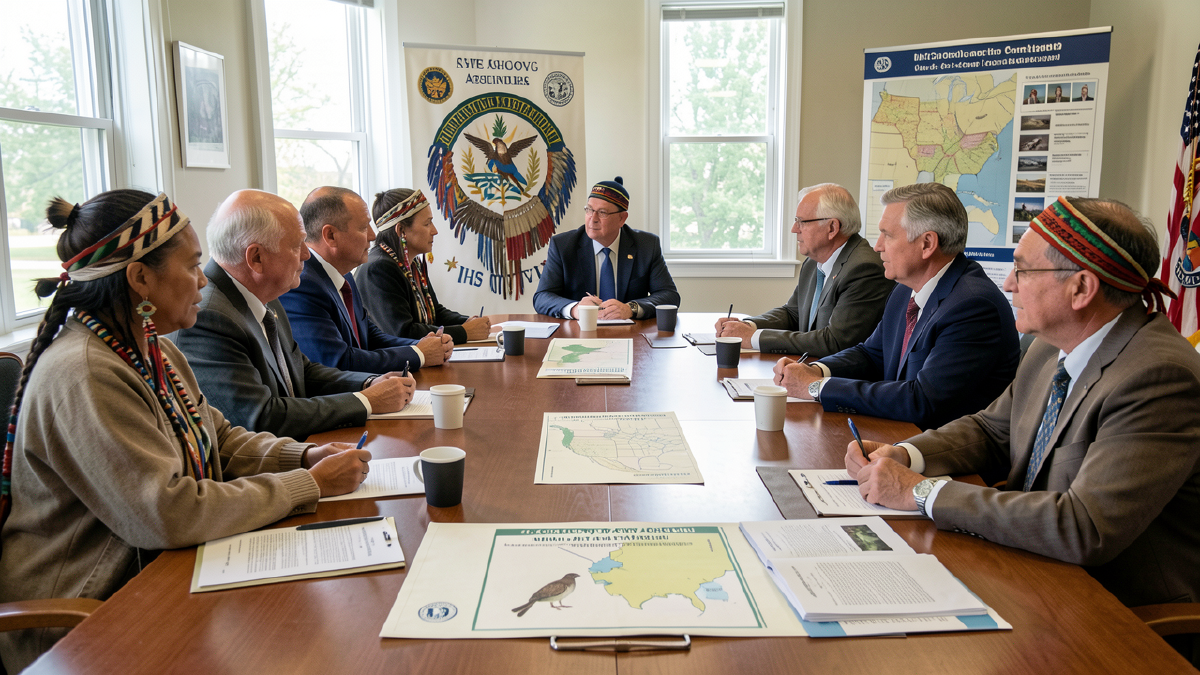
Tribal populations present unique rulemaking challenges that transcend the special population framework, demanding policy architecture that states cannot design unilaterally
Sarah Whitehorse has directed Montana’s Medicaid program for six years. She knows her enrollment numbers intimately: 96,000 expansion adults, distributed across a state larger than all of New England combined. But as she prepares for work requirement implementation, one statistic dominates her planning: 18 percent of those expansion adults are Native American, most residing on or near one of Montana’s seven reservations.
Sarah cannot simply apply the verification systems her team is building to these populations. Last month, the chairman of the Fort Peck Tribes made this clear in terms that left no room for misunderstanding. Any data sharing involving tribal members requires formal government-to-government agreement. The tribes will not permit state agencies to access tribal employment records, health information, or enrollment data without negotiated consent. The chairman reminded Sarah that the tribes are sovereign nations, not subdivisions of Montana state government, and that their relationship with the state operates through treaty and federal law rather than administrative convenience.
The complications multiply from there. Many tribal members receive healthcare through Indian Health Service facilities that operate on federal timelines disconnected from Montana’s Medicaid cycles. IHS providers document care differently than Medicaid managed care organizations. The eligibility systems don’t talk to each other automatically. And then there’s the fundamental question Sarah keeps returning to: what does “work” mean on a reservation where formal unemployment exceeds 45 percent, where the largest employers are the tribal government and the casino, where subsistence activities like hunting, fishing, and gathering have sustained families for generations but generate no pay stubs?
Sarah’s counterpart in Arizona faces these questions multiplied by twenty-two tribes. New Mexico’s Medicaid director navigates relationships with twenty-three sovereign nations. South Dakota, with nine reservations and Native Americans comprising nearly 9 percent of the population, confronts similar complexity. Each state must somehow reconcile federal work requirement mandates with federal trust responsibilities, state administrative systems with tribal sovereignty, and hour-counting frameworks with economic realities that bear no resemblance to the suburban employment markets the policy assumes.
The Federal Trust Relationship#
The relationship between the federal government and tribal nations rests on a legal foundation fundamentally different from any other domestic policy domain. Treaties signed between sovereign nations, the Constitution’s recognition of tribal authority, and two centuries of federal Indian law create obligations that work requirement policy cannot ignore.
The federal trust responsibility for Indian health care emerged from this legal framework. When tribes ceded lands to the United States, treaty provisions frequently included federal commitments to provide healthcare services. The Snyder Act of 1921 formalized federal authority to provide health services to American Indians and Alaska Natives. The Indian Health Care Improvement Act of 1976 declared it federal policy to provide the highest possible health status to Indians and to provide existing Indian health services with all resources necessary to effect that policy.
Indian Health Service operates as the primary healthcare system for approximately 2.6 million American Indians and Alaska Natives across 574 federally recognized tribes. IHS operates hospitals, clinics, and health stations, though chronic underfunding means that per-capita spending remains roughly one-third of Medicare and Medicaid levels. Many tribal members rely on Medicaid to supplement IHS services, accessing care that IHS facilities cannot provide due to resource constraints.
The 100 percent Federal Medical Assistance Percentage for services provided to tribal members through IHS facilities creates powerful financial incentives for states to maintain tribal Medicaid enrollment. When a tribal member receives care at an IHS facility and bills Medicaid, the federal government reimburses the full cost rather than the standard state-federal split. States lose nothing and tribal health programs gain revenue that supports expanded services. Coverage losses from work requirements would eliminate this revenue stream, potentially forcing IHS facilities to reduce services that Medicaid currently funds.
This financial reality means states have pragmatic reasons to minimize tribal coverage losses beyond their legal obligations. But the legal obligations themselves are substantial. Federal trust responsibility, treaty rights, and self-determination principles all constrain what states can require of tribal populations without tribal consent.
The IHS Exemption Under OB3#
The One Big Beautiful Bill Act includes an automatic exemption from work requirements for individuals eligible for services through the Indian Health Service. This federal exemption recognizes both the trust relationship and the practical reality that applying standard work requirements to tribal populations would raise insurmountable legal and administrative challenges.
Understanding who qualifies for this exemption requires distinguishing between tribal enrollment and IHS service eligibility. Tribal enrollment is determined by each tribe according to its own criteria, typically involving blood quantum requirements or lineal descent from historical tribal rolls. IHS service eligibility is broader, extending to members of federally recognized tribes and their descendants who reside in IHS service areas. Someone might be eligible for IHS services without being enrolled in any tribe, and someone enrolled in a tribe might live outside any IHS service area.
Operationalizing the exemption presents verification challenges that mirror the broader tensions between state administrative systems and tribal sovereignty. How does a state Medicaid agency confirm IHS eligibility? IHS maintains its own enrollment and eligibility systems, but automatic data sharing with state agencies is not standard practice. States could require individuals to document their IHS eligibility, but this imposes burden on a population the exemption was designed to protect. States could request IHS eligibility data directly, but such requests implicate federal privacy rules and tribal data sovereignty concerns.
The gap between legal exemption and administrative reality means that tribal members entitled to exemption may nonetheless face verification demands, coverage disruptions, and administrative burden unless states affirmatively design systems that identify and protect exempt populations. An exemption that exists on paper but requires extensive documentation to claim is not truly automatic; it is merely available to those who can navigate the process.
Data Sovereignty and Information Sharing#
Tribal governments exercise sovereignty over member data in ways that fundamentally constrain state administrative systems. This data sovereignty is not merely a preference but a legal principle rooted in tribal self-governance authority recognized by federal law.
State Medicaid agencies cannot access tribal records without negotiated consent. Tribal enrollment data, employment records from tribal enterprises, health information from tribal health programs, and participation in tribal social services all reside in systems that states cannot query unilaterally. When Montana’s Medicaid program needs to verify whether a tribal member is working at the tribal casino, they cannot simply call the casino’s HR department and request records. The tribal government controls that information and determines whether and how it will be shared.
Negotiating data sharing agreements between states and tribes requires government-to-government consultation that respects tribal sovereignty. Successful agreements specify exactly what data will be shared, for what purposes, with what protections, and under whose control. They typically require tribal council approval, not merely administrative sign-off. They may include provisions allowing tribes to audit state use of shared data and to terminate agreements if terms are violated.
Some states have developed effective data sharing frameworks with tribal partners. Arizona’s long experience with tribal Medicaid coordination has produced agreements that facilitate administrative processes while respecting sovereignty. But these agreements took years to negotiate and required sustained relationship-building between state and tribal officials. States without existing tribal consultation infrastructure cannot create functional data sharing arrangements in the months before work requirement implementation begins.
Historical distrust of government data collection compounds these challenges. Federal policy toward Native Americans has included forced relocation, family separation through boarding schools, termination of tribal recognition, and countless broken promises. Tribal communities have reason to be skeptical when government agencies request access to member information, even for ostensibly beneficial purposes. This skepticism is not irrational; it reflects lived experience of government data being used against tribal interests.
Privacy concerns extend beyond historical distrust to contemporary realities. Tribal members may not want state governments knowing where they work, what health conditions they have, or what social services they receive. The relatively small populations of many tribal communities mean that data aggregation can easily become individual identification. Sharing data about the fifteen tribal members receiving substance use treatment effectively identifies individuals in ways that larger population data does not.
Tribal Administration of Work Requirements#
One pathway through the sovereignty thicket is tribal administration of work requirements for tribal members. Rather than states imposing requirements and verification systems on tribal populations, tribes could choose to implement requirements for their own members according to their own designs.
This approach has precedent in other federal programs. Tribes administer their own TANF programs under tribal TANF provisions, designing work requirements, qualifying activities, and exemptions appropriate to their communities. Tribal Temporary Assistance for Needy Families programs can recognize subsistence activities, traditional practices, and culturally specific forms of community contribution that state-administered programs typically do not.
Culturally appropriate qualifying activities might include subsistence hunting, fishing, and gathering that provide food security for extended families. They might include participation in traditional ceremonies and cultural practices that maintain community cohesion. They might include care for elders according to traditional responsibilities rather than formal caregiver definitions. They might include volunteer service to tribal programs that don’t employ people formally but rely on community participation.
The challenge is creating federal and state frameworks that permit tribal administration without imposing state-defined parameters. If tribes can administer work requirements but must use state definitions of qualifying activities, the administrative authority becomes hollow. Meaningful tribal administration requires flexibility to define what “work” means in contexts where formal employment is scarce but community contribution is robust.
When tribal administration serves members better than state systems, tribes have incentives to take on administrative responsibility. But tribal governments already stretch limited administrative capacity across multiple federal programs, and adding work requirement administration imposes costs that federal or state funding may not cover. Some tribes may prefer automatic exemption to administrative responsibility, accepting that their members face no requirements rather than building systems to administer requirements tribally.
IHS-Medicaid Coordination Mechanics#
The practical coordination between IHS facilities and Medicaid systems affects how exemptions function and how tribal members experience work requirement policy.
IHS facilities bill Medicaid for services provided to Medicaid-enrolled tribal members. This billing generates revenue that supports facility operations and enables services beyond what IHS appropriations alone would fund. The billing relationship creates administrative connections between IHS and state Medicaid agencies, but these connections do not automatically extend to work requirement verification or exemption documentation.
Care coordination across IHS and Medicaid managed care presents ongoing challenges. Tribal members may receive some care at IHS facilities and other care through Medicaid MCO networks. Health information doesn’t flow seamlessly between these systems. A behavioral health condition documented at an IHS facility may not appear in MCO records that would trigger exemption identification. Medications prescribed by IHS providers may not show in MCO pharmacy data that could indicate medical frailty.
Exemption documentation when care occurs at IHS facilities requires IHS providers to understand work requirement exemption categories and to provide documentation in formats state systems accept. IHS clinical staff are federal employees operating under federal protocols; adding state-specific documentation requirements imposes burden that IHS may resist. The provider who documents a disabling condition for IHS purposes may not want to complete separate paperwork for state work requirement exemption purposes.
These coordination challenges suggest that automatic exemption for IHS-eligible populations may function better than individualized exemption determination requiring documentation from IHS providers. If the exemption triggers automatically from IHS eligibility status rather than requiring clinical documentation of specific conditions, the coordination burden diminishes substantially.
Geographic and Economic Context#
The economic realities of many reservations make 80-hour monthly work requirements structurally impossible for substantial portions of the population, regardless of exemption categories. Understanding these realities is essential for designing policy that acknowledges rather than ignores the conditions tribal members actually face.
Reservation unemployment rates frequently range from 40 to 60 percent, with some communities experiencing even higher joblessness. The Rosebud Sioux Reservation in South Dakota has reported unemployment exceeding 80 percent. Pine Ridge has chronic unemployment above 70 percent. These are not temporary economic downturns but persistent structural conditions reflecting limited formal employment opportunities in remote locations with minimal private sector presence.
The largest employers on many reservations are tribal governments, casinos where tribes have gaming compacts, and IHS or tribal health facilities. These employers cannot absorb the entire working-age population. When formal employment opportunities are structurally limited, requiring 80 hours of monthly work effectively requires relocation away from home communities, family networks, and cultural connections.
Subsistence economies provide economic value that formal employment metrics do not capture. Families that hunt, fish, gather traditional foods, and share resources across extended kinship networks may meet material needs without generating wages or pay stubs. These activities represent work in any meaningful sense: they require time, effort, skill, and produce economic value. But verification systems designed around employer attestation cannot capture subsistence contribution.
Informal work arrangements are common in reservation economies where formal employment is scarce. Someone might earn income helping neighbors with construction projects, providing childcare for extended family, or selling crafts without formal employment relationships. This work is real but undocumented, valuable but unverifiable through standard channels.
Transportation barriers compound employment challenges. Many reservations lack public transportation entirely. Personal vehicle ownership rates are lower than national averages, and vehicles that exist are often shared across extended families. Roads on some reservations are unpaved, impassable in bad weather, and poorly maintained. Someone living thirty miles from the nearest town with employment opportunities, without reliable transportation, cannot simply “get a job” regardless of their willingness to work.
Digital infrastructure gaps affect both employment access and verification compliance. Broadband availability on tribal lands lags far behind national averages. The Federal Communications Commission has documented that tribal lands have the lowest connectivity rates of any demographic category. Online job applications, digital verification systems, and web-based reporting all assume internet access that many tribal members lack. A verification system requiring online hour reporting excludes populations whose homes have no internet service and whose communities have no public wifi.
State Variation in Tribal Relationships#
States with significant tribal populations have developed varying levels of infrastructure for tribal consultation and coordination. These existing relationships shape what is possible in work requirement implementation.
Arizona’s relationship with its twenty-two tribes reflects decades of negotiation and coordination. The Arizona Health Care Cost Containment System has established protocols for tribal consultation, data sharing frameworks, and administrative arrangements that facilitate Medicaid operations across tribal communities. This infrastructure provides foundation for work requirement implementation, though the specific challenges of work verification remain substantial. Arizona’s waiver application proposes automatic exemption for tribal members residing on tribal lands, acknowledging that standard verification approaches cannot function in tribal contexts.
Montana’s eight tribes and the eighteen percent tribal share of expansion enrollment demand significant attention to tribal coordination. The state’s frontier geography compounds challenges, as many tribal members live in remote areas with limited infrastructure regardless of reservation boundaries. Montana has tribal liaison positions within state agencies, but building work requirement coordination on this foundation requires substantial new effort.
New Mexico’s twenty-three tribes and pueblos create extraordinary complexity. The state has extensive experience with tribal Medicaid coordination but faces the challenge of negotiating with nearly two dozen sovereign governments, each with distinct governance structures and priorities.
South Dakota’s tribal population faces some of the most severe economic conditions in the country. Reservations like Pine Ridge and Rosebud have poverty rates exceeding 50 percent, unemployment rates that would be considered crisis conditions anywhere else, and health disparities that rank among the worst in the nation. Life expectancy on Pine Ridge is among the lowest in the Western Hemisphere. Work requirement implementation in this context raises profound questions about whether policy designed for functioning labor markets can apply to communities where such markets essentially do not exist.
The Navajo Nation presents unique scale challenges. Spanning portions of Arizona, New Mexico, and Utah, the Navajo Nation is the largest reservation by both land area and population, with approximately 175,000 enrolled members. Coordinating work requirement policy across three states, each with different Medicaid systems and different waiver provisions, for a single tribal population illustrates the complexity that jurisdiction-spanning tribes create. A Navajo member living in Arizona may have different work requirement obligations than a relative living on Navajo land in New Mexico, despite both being members of the same tribe receiving care from the same tribal health system.
Alaska Native populations face distinctive circumstances that further complicate federal frameworks. Alaska Native Corporations, created under the Alaska Native Claims Settlement Act, provide services and employment opportunities that differ from reservation-based tribal structures elsewhere. Remote villages accessible only by air or boat present infrastructure challenges exceeding even the most isolated lower-48 reservations. Subsistence activities including fishing, hunting, and food preservation constitute essential economic activity that does not fit hour-counting verification models.
The Sovereignty Imperative#
Work requirement policy cannot be designed for tribal populations in the same manner as for other expansion adults. The legal framework is different: tribal sovereignty and federal trust responsibility create constraints that do not exist for other populations. The administrative context is different: data sovereignty and government-to-government relationships require negotiation rather than unilateral state action. The economic context is different: reservation economies do not resemble the employment markets that work requirements assume.
States must approach tribal work requirement implementation as a distinct policy domain requiring dedicated consultation, negotiated agreements, and flexible frameworks that respect tribal authority. The IHS exemption provides one pathway, but operationalizing that exemption requires administrative infrastructure that does not exist automatically. Tribal administration provides another pathway, but requires federal flexibility and tribal administrative capacity that may not be available everywhere.
The fundamental question is whether work requirement policy will accommodate tribal realities or whether tribal populations will be forced into frameworks designed without consideration of their circumstances. The answer will emerge from negotiations between states and tribes, from CMS guidance on federal flexibility, and from the political will to recognize that one-size-fits-all approaches cannot respect tribal sovereignty while implementing federal mandates.