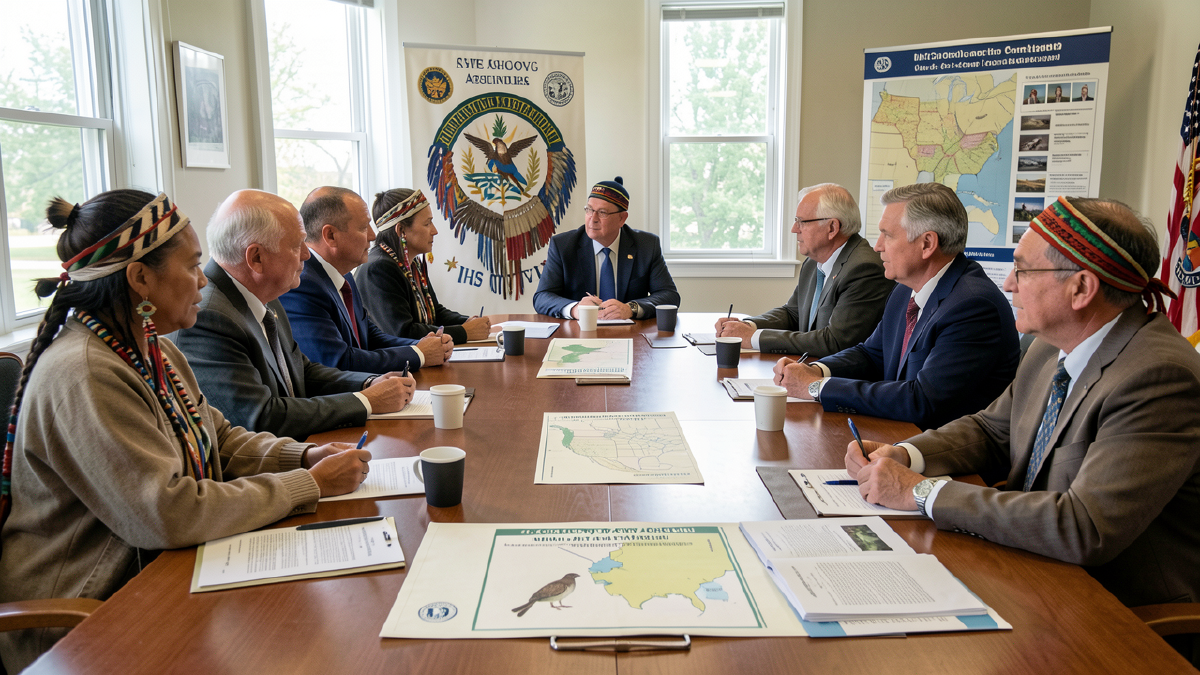
Reservation unemployment rates frequently range from 40 to 80 percent. Subsistence hunting, fishing, and gathering provide economic value without generating employer pay stubs. Tribal governments exercise data sovereignty that prevents state agencies from unilaterally accessing employment or health records. Verification systems designed around formal employment cannot capture Indigenous economic realities, and state administrative systems cannot operate on tribal lands without negotiated consent. These are not implementation complications to be solved within existing frameworks. They are structural incompatibilities between work requirement architecture and the legal, economic, and cultural realities of tribal communities, requiring distinct policy approaches grounded in the government-to-government relationship between sovereign nations.
Constitutional and Legal Framework#
The legal foundation for tribal accommodation rests on federal trust responsibility, treaty obligations, and two centuries of Indian law that create constraints fundamentally different from any other domestic policy domain. The Snyder Act of 1921 formalized federal authority to provide health services to American Indians and Alaska Natives. The Indian Health Care Improvement Act of 1976 declared federal policy to provide the highest possible health status to Indians. Indian Health Service operates as the primary healthcare system for approximately 2.6 million people across 574 federally recognized tribes, though chronic underfunding means per-capita spending remains roughly one-third of Medicare and Medicaid levels.
OB3 includes an automatic exemption from work requirements for individuals eligible for IHS services. This federal exemption recognizes both the trust relationship and practical impossibility of applying standard verification to tribal populations. But the distinction between tribal enrollment (determined by each tribe’s own criteria) and IHS service eligibility (broader, extending to members of federally recognized tribes and descendants in IHS service areas) creates verification challenges. The 100 percent Federal Medical Assistance Percentage for services provided to tribal members through IHS facilities means states have powerful financial incentives to maintain tribal Medicaid enrollment beyond their legal obligations: coverage losses eliminate federal revenue that supports expanded IHS services.
Core Regulatory Choices#
Operationalizing the IHS exemption presents the central challenge. An exemption that exists in federal law but requires extensive documentation to claim is not truly automatic. States must choose between requiring individuals to document IHS eligibility (imposing burden on a population the exemption was designed to protect), requesting IHS eligibility data directly (implicating federal privacy rules and tribal data sovereignty), or building automated identification systems through negotiated data-sharing agreements with tribal governments and IHS.
Data sovereignty constrains every option. State Medicaid agencies cannot access tribal enrollment records, employment data from tribal enterprises, health information from tribal health programs, or participation in tribal social services without negotiated consent requiring tribal council approval. Arizona has developed effective frameworks through decades of relationship-building, but states without existing tribal consultation infrastructure cannot create functional arrangements in months. Historical distrust of government data collection, rooted in forced relocation, boarding school family separation, and termination policies, compounds resistance to information sharing even for ostensibly beneficial purposes.
Tribal administration of work requirements offers an alternative pathway where tribes implement requirements for their own members according to their own designs, paralleling tribal TANF programs. Culturally appropriate qualifying activities could include subsistence hunting, fishing, and gathering providing family food security; participation in traditional ceremonies maintaining community cohesion; care for elders according to traditional responsibilities; and volunteer service to tribal programs. Meaningful tribal administration requires flexibility to define what “work” means in contexts where formal employment is scarce but community contribution is robust. Without this flexibility, administrative authority becomes hollow.
Trust and Burden Framework#
The trust question in tribal contexts operates at the sovereign-to-sovereign level rather than the individual-to-state level. States trusting tribal governments to administer work requirements for their own members respect sovereignty while maintaining federal compliance. States imposing state-defined parameters on tribal administration undermine the government-to-government relationship. The burden distribution is similarly distinct: requiring tribal members to navigate state administrative systems designed without consideration of reservation realities places disproportionate burden on populations facing the most severe structural employment barriers in the country.
The economic context makes this burden particularly consequential. Reservations like Pine Ridge and Rosebud in South Dakota have poverty rates exceeding 50 percent and chronic unemployment above 70 percent. The largest employers on many reservations are tribal governments, casinos, and IHS facilities, which cannot absorb entire working-age populations. Requiring 80 hours of documented monthly work effectively requires relocation away from home communities, and verification systems requiring online reporting assume broadband access that the FCC has documented tribal lands lack at higher rates than any other demographic category.
Interdependencies and Critical Paths#
Tribal sovereignty intersects every other regulatory domain in Series 7. Exemption architecture (7A) must accommodate IHS eligibility verification without imposing documentation burdens the federal exemption was designed to prevent. Verification systems (7B) cannot function through standard employer attestation when subsistence and informal economies predominate. Coordination timelines (7C) must account for IHS facilities operating on federal timelines disconnected from state Medicaid cycles. Delegation frameworks (7D) must treat tribal governments as sovereign partners rather than credentialed vendors. The Navajo Nation, spanning Arizona, New Mexico, and Utah, illustrates the complexity when a single tribal population must navigate three different state Medicaid systems with different waiver provisions.
Alaska Native populations face distinctive circumstances beyond even other tribal contexts. Alaska Native Corporations provide services and employment differing from reservation structures. Remote villages accessible only by air or boat present infrastructure challenges exceeding the most isolated lower-48 reservations. Subsistence activities including fishing, hunting, and food preservation constitute essential economic activity with no analog in hour-counting verification models.
Series 11 Population Accommodations#
Tribal populations intersect with nearly every Series 11 population category. Geographic and digital isolation (11I) affects virtually all reservation communities. Substance use disorders (11C) present confidentiality challenges compounded by small tribal community populations where data aggregation effectively identifies individuals. Veterans (11M) with tribal membership may hold both VA disability ratings and IHS eligibility, requiring coordinated exemption processing. The intersectionality analysis (11L) applies with particular force to tribal members facing simultaneous barriers from structural unemployment, geographic isolation, limited infrastructure, and historical trauma.
Implementation Timeline Realities#
Government-to-government consultation cannot be compressed into administrative timelines. Tribal council approval processes follow tribal governance calendars, not state implementation deadlines. States with significant tribal populations, including Arizona (22 tribes), New Mexico (23 tribes and pueblos), Montana (7 reservations comprising 18 percent of expansion enrollment), and South Dakota (9 reservations), face dozens of individual negotiations that collectively require more time than the eight-month implementation window provides. States beginning tribal consultation after OB3 passage face near-certainty that functional data-sharing agreements and tribal administration frameworks will not be operational by December 2026. The IHS exemption provides federal legal protection, but the administrative infrastructure to operationalize that exemption automatically does not build itself.
Bottom Line#
Tribal populations require policy architecture that states cannot design unilaterally. Sovereignty, federal trust responsibility, data governance, subsistence economies, and structural unemployment on reservations create implementation realities that standard work requirement frameworks cannot accommodate. The IHS exemption provides legal protection, but converting legal protection into administrative reality requires negotiated infrastructure that takes years to build. States that treat tribal accommodation as a technical problem rather than a sovereignty question will produce either coverage losses that violate federal trust obligations or administrative workarounds that disrespect tribal authority.