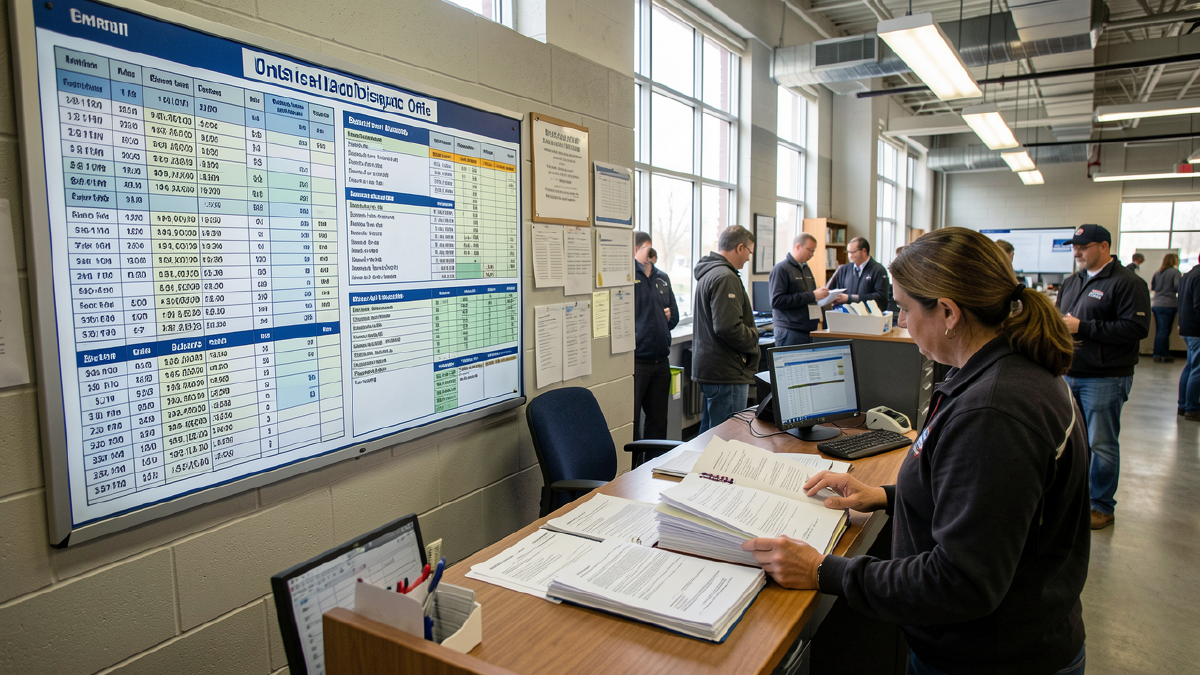
Unionized workers face distinct work requirement dynamics shaped by collective bargaining agreements, seniority systems, and union hall infrastructure
Tony Reyes has been a member of IBEW Local 347 for fourteen years. He’s a journeyman electrician, good at his trade, reliable on the job. The union dispatches him to projects across the region: office buildings, hospitals, manufacturing plants, whatever needs wiring. In good months, he works 160 hours or more. His hands stay busy, his skills stay sharp, and his contributions to the pension fund accumulate steadily.
But construction is cyclical, and winters in the upper Midwest can be brutal for building trades workers. When temperatures drop and outdoor projects pause, dispatch slows dramatically. January brought Tony only 45 hours. February was worse at 32. He picked up some side work helping a friend remodel a kitchen, but that doesn’t show up in any official record. By March, when projects started again, Tony had failed to meet the 80-hour threshold for two consecutive months.
The irony is that Tony’s union tracks every hour he works with precision that would make most HR departments envious. The hiring hall logs each dispatch. The pension fund records each contribution, calculated from hours worked. The health and welfare fund knows exactly how many hours Tony has accumulated this quarter because benefit eligibility depends on it. All that data exists in union systems, carefully maintained for decades.
But no one has connected those union records to Medicaid verification. The state’s work requirement system expects employer attestation, and Tony’s employers change with each project. The general contractor on the hospital job is different from the one on the office building. Neither employs Tony directly; they request workers through the union hall, use them for the project’s duration, and move on. When the state sends verification requests to Tony’s “employer,” the requests go nowhere because there is no single employer to respond.
Tony’s union could verify his hours with a few keystrokes. The infrastructure exists. The data is clean. But the connection between union record-keeping and state Medicaid systems has never been built. Tony loses coverage not because he isn’t working but because the verification architecture was designed for employment relationships his industry doesn’t use.
Union Workers in the Expansion Population#
The intersection of union membership and Medicaid expansion eligibility might seem paradoxical. Unions are associated with good wages, comprehensive benefits, and middle-class stability. How do union workers end up on Medicaid?
The answer lies in understanding which unions have members at income levels qualifying for expansion coverage and how union employment patterns create eligibility periods. Bureau of Labor Statistics data shows approximately 14 million union members nationwide, with union density varying dramatically by sector. Construction, transportation, hospitality, healthcare support, and retail all have union presence alongside wages that can fall within Medicaid expansion income limits, particularly during periods of reduced hours or seasonal downturns.
Building trades unions present particularly clear examples. Journeymen electricians, plumbers, carpenters, and ironworkers earn good hourly wages when they work, often $35 to $60 per hour depending on trade and region. But construction employment is project-based and seasonal. A worker earning $50 per hour who works only 800 hours annually earns $40,000, potentially qualifying for Medicaid expansion in many states depending on family size. During slow periods, monthly income can drop dramatically, creating eligibility windows even for workers with strong annual earnings.
Service worker unions including SEIU and UNITE HERE represent hotel housekeepers, food service workers, janitors, and healthcare support staff whose wages frequently place them in Medicaid expansion income ranges year-round. These workers may have union representation and collective bargaining agreements while still earning too little to afford private insurance and too much to qualify for traditional Medicaid categories.
Retail unions including UFCW represent grocery store workers, warehouse employees, and retail associates. These sectors feature substantial part-time employment, variable hours, and wages that cluster around Medicaid expansion eligibility thresholds. A grocery store worker might be union-represented with contractual wage scales while still qualifying for Medicaid based on actual hours worked and income earned.
Healthcare unions represent nursing assistants, home health aides, and hospital support staff whose wages, despite union premiums over non-union counterparts, often remain in Medicaid expansion ranges. The irony of healthcare workers qualifying for Medicaid based on income from providing healthcare services is not lost on anyone paying attention.
Collective Bargaining Agreement Interactions#
Collective bargaining agreements create structured frameworks for employment that interact with work requirements in distinctive ways. Understanding these interactions is essential for designing verification systems that work for unionized workers.
Hours and scheduling provisions in CBAs specify how work is allocated, but the gap between contractual frameworks and actual hours can be substantial. A contract might guarantee union members first call for available work without guaranteeing that work will be available. Seniority systems determine who gets hours when hours are scarce, meaning junior workers may face chronic hour shortfalls while senior workers in the same bargaining unit maintain full schedules. A union with 500 members might have 200 working full-time, 200 working part-time, and 100 on the out-of-work list, all under the same CBA.
Layoff and recall provisions create predictable patterns of employment interruption that work requirements may or may not accommodate. Union contracts typically specify how layoffs occur (by seniority, by classification, by project) and how recalls happen when work returns. A worker laid off in November and recalled in March experiences a predictable employment gap that has nothing to do with work ethic or labor force attachment. Whether that gap triggers work requirement consequences depends on how states design their verification and exemption systems.
The distinction between contracted minimums and actual hours matters significantly. A CBA might guarantee four hours of pay for any worker dispatched to a job site, but that doesn’t mean the worker accumulates sufficient monthly hours for work requirement compliance. Call-in guarantees, show-up pay, and reporting time provisions protect workers from the worst scheduling abuses while still leaving total hours subject to employer decisions about how much work to offer.
Apprenticeship provisions in CBAs create pathways where workers combine employment with structured training. Union apprenticeships typically involve reduced wages during training periods, creating income that qualifies for Medicaid expansion while the apprentice builds toward journeyman wages that may not qualify. Work requirements treating apprenticeship hours as qualifying activity align with union training structures; requirements demanding documentation of hours separate from training time may not.
Union Halls as Verification Infrastructure#
Union halls represent existing infrastructure that could serve work requirement verification if properly connected to state systems. The irony of building new verification bureaucracies while ignoring existing union record-keeping is significant.
Hiring halls already track dispatch with precision. When a contractor calls the union hall requesting workers for a project, the hall dispatches members based on seniority, qualifications, and availability. Each dispatch is logged: who went where, for how long, at what wage rate. This information flows into pension contribution calculations, health and welfare fund eligibility determinations, and out-of-work list management. The data infrastructure is mature, often decades old, and maintained with care because member benefits depend on its accuracy.
Union benefit funds maintain employment records for purposes directly analogous to work requirement verification. To determine whether a member has worked sufficient hours to maintain health coverage through the union plan, funds track hours across all employers using union labor. A construction worker employed by six different contractors in a quarter has their hours aggregated automatically by the benefit fund. This aggregation is exactly what work requirement verification needs but rarely achieves for non-union workers with multiple employers.
Shop stewards present natural touchpoints for work requirement navigation. Stewards already help members understand their rights under CBAs, navigate grievance procedures, and access union benefits. Adding work requirement navigation to steward responsibilities requires training rather than infrastructure creation. Stewards know their members, understand industry-specific employment patterns, and have existing relationships that make outreach effective.
The connection between union infrastructure and state Medicaid systems requires data sharing agreements, technical integration, and policy decisions treating union verification as equivalent to employer verification. States could authorize unions to submit verification directly, accepting union records of hours worked across multiple employers as documentation that individual employer attestation cannot provide. The barriers are bureaucratic and political rather than technical; the data already exists in usable form.
Multi-Employer Challenges and Union Solutions#
Project-based employment across multiple employers creates verification challenges that unions are uniquely positioned to solve. A worker whose employment involves different employers each month cannot rely on any single employer for verification, but the union that dispatches them to each job can provide aggregated documentation spanning all employment.
The union as intermediary offers an aggregating function that no individual employer can provide. When a plumber works for Contractor A in January, Contractor B in February, and Contractor C in March, no single employer has complete information about their work activity. But the plumbers’ union local has dispatched them to each job and recorded each hour. The union can certify total hours worked regardless of employer, providing the comprehensive verification that work requirements demand.
Verification through union records rather than employer attestation requires states to recognize union locals as credentialed submitters alongside employers. This recognition has precedent in other contexts; unemployment insurance systems already accept union documentation for members in good standing. Extending similar recognition to Medicaid verification simply applies existing approaches to new purposes.
Data sharing agreements between unions and state Medicaid agencies could automate verification for substantial populations. A building trades council representing 50,000 workers across a dozen locals could, with appropriate data sharing infrastructure, automatically report hours to state systems for members who consent. The one-time investment in integration would serve verification needs for all members indefinitely, eliminating manual processes that fail workers whose employment patterns don’t fit standard verification assumptions.
Taft-Hartley multiemployer plans offer particularly promising integration opportunities. These jointly managed health and welfare funds already aggregate hours across multiple employers for benefit eligibility purposes. They have sophisticated data systems, established relationships with contributing employers, and administrative capacity exceeding most individual employers. A Taft-Hartley plan covering 25,000 workers could serve as verification intermediary for all members on Medicaid expansion, replacing thousands of individual employer interactions with a single institutional relationship.
Union Advocacy and Policy Engagement#
Unions are political actors as well as workplace representatives, and their engagement with work requirement policy extends beyond member services to systemic advocacy.
Organized labor has historically opposed work requirements in Medicaid and other public benefit programs, viewing them as punitive policies that harm working people while doing little to increase employment. This opposition reflects both ideological commitments to robust social insurance and practical understanding that verification burdens fall heavily on workers in industries unions represent. Construction workers facing seasonal unemployment, hospitality workers with variable hours, and retail workers with part-time schedules all face compliance challenges that unions understand from representing members in these conditions.
But opposition to policy does not preclude engagement with implementation. Unions that opposed work requirements can still advocate for implementation approaches that minimize harm to members. This advocacy might include pushing for annual rather than monthly hour requirements, recognition of union training hours as qualifying activity, acceptance of union verification in place of employer attestation, generous good cause exemptions for seasonal workers, and grace periods accommodating project-based employment patterns.
Collective bargaining itself offers a venue for addressing work requirement impacts. Unions negotiating new contracts can seek provisions supporting member compliance: employer commitments to provide verification documentation promptly, recognition of union navigators for work requirement assistance, scheduling practices that help members reach hour thresholds, and access to employer-sponsored training that counts toward activity requirements. These contract provisions translate policy into workplace practice.
Union benefit funds present opportunities for coverage continuity that bridge Medicaid eligibility gaps. Some Taft-Hartley health plans are exploring wraparound coverage for members who lose Medicaid due to work requirement non-compliance, maintaining coverage during appeals or while members accumulate hours for reinstatement. This approach treats work requirement compliance as a temporary status rather than a permanent classification, recognizing that workers in seasonal industries will cycle through eligibility periods predictably.
The Labor Movement and the Safety Net#
Union workers subject to Medicaid work requirements occupy a distinctive position in the American political economy. They are workers with collective representation, contractual protections, and institutional support systems that most low-wage workers lack. Yet they are also workers whose industries feature the seasonal employment, variable hours, and multi-employer arrangements that work requirement verification handles poorly.
The infrastructure unions have built over decades to track hours, manage benefits, and support members could significantly improve work requirement implementation if states chose to use it. Hiring halls that dispatch workers to jobs could just as easily report hours to Medicaid systems. Benefit funds that aggregate employment across multiple contractors could provide the consolidated verification that individual employers cannot. Shop stewards who help members navigate grievance procedures could help them navigate work requirement compliance.
Whether this infrastructure gets connected to work requirement systems depends on political choices about implementation design. States can treat union verification as equivalent to employer verification, building integration that serves hundreds of thousands of workers through a manageable number of institutional relationships. Or states can ignore union infrastructure entirely, leaving union members to navigate verification systems designed for employment relationships their industries do not use.
Tony Reyes worked 1,600 hours last year across eight different employers. His union knows exactly how many hours he worked, for whom, and when. The pension fund has the records. The health and welfare fund has the records. The hiring hall has the records. Whether Tony keeps his Medicaid coverage depends on whether anyone decides to connect those records to the systems that determine his eligibility.