Ambient Intelligence and Passive Monitoring
The Home Sensor Landscape
The oldest problem in home-based care for older adults is the interval between when something goes wrong and when anyone finds out. A Medicare beneficiary who falls in her bathroom at 11 PM on a Thursday may not be found until her home health aide arrives Friday morning. The clinical consequences of a long lie — the period spent unable to get up after a fall — are well documented and severe: rhabdomyolysis, pressure injuries, aspiration, and a mortality trajectory that worsens measurably with each hour on the floor. Ambient intelligence is the technology category attempting to close that interval, and in the process accumulating continuous data on the behavioral and physiological patterns that precede the fall in the first place.
The market for home-based passive monitoring has been developing for over a decade. What has changed is the payment environment around it. AHEAD global budgets give hospitals a financial reason to invest in monitoring infrastructure for their attributed populations. FIDE SNP plans with full Medicare and Medicaid risk have a clear financial incentive to prevent the institutional transitions that passive monitoring can help avert. ACOs with downside risk face direct financial exposure from avoidable fall-related hospitalizations. These are not aspirational revenue models — they are concrete financial structures that transform ambient monitoring from a consumer wellness product into a clinical infrastructure investment.
The Technology Landscape#
Passive monitoring for older adults falls across three technology categories that are technically distinct and commercially separate, though they are converging in enterprise deployment.
Motion sensor networks represent the oldest and most widely deployed category. They track presence and movement through passive infrared sensors placed at doorways, in rooms, and in high-activity zones such as kitchens and bathrooms. The analytical value is behavioral: consistent patterns of waking time, meal preparation, bathroom frequency, and daily activity establish an individual baseline against which anomalies — sleeping past a normal rising time, failing to visit the kitchen, spending an unusually long period in the bathroom — generate alerts. The limitation is resolution. Motion sensors tell you that a person entered a room. They cannot tell you whether the person fell, whether they are lying still because they are resting or because they cannot get up, or what their gait looks like. The Essence Group, an Israeli company whose Care@Home platform has the longest continuous clinical deployment record in this category, has operated large-scale senior safety programs with motion sensor networks in the UK, Israel, and the United States.
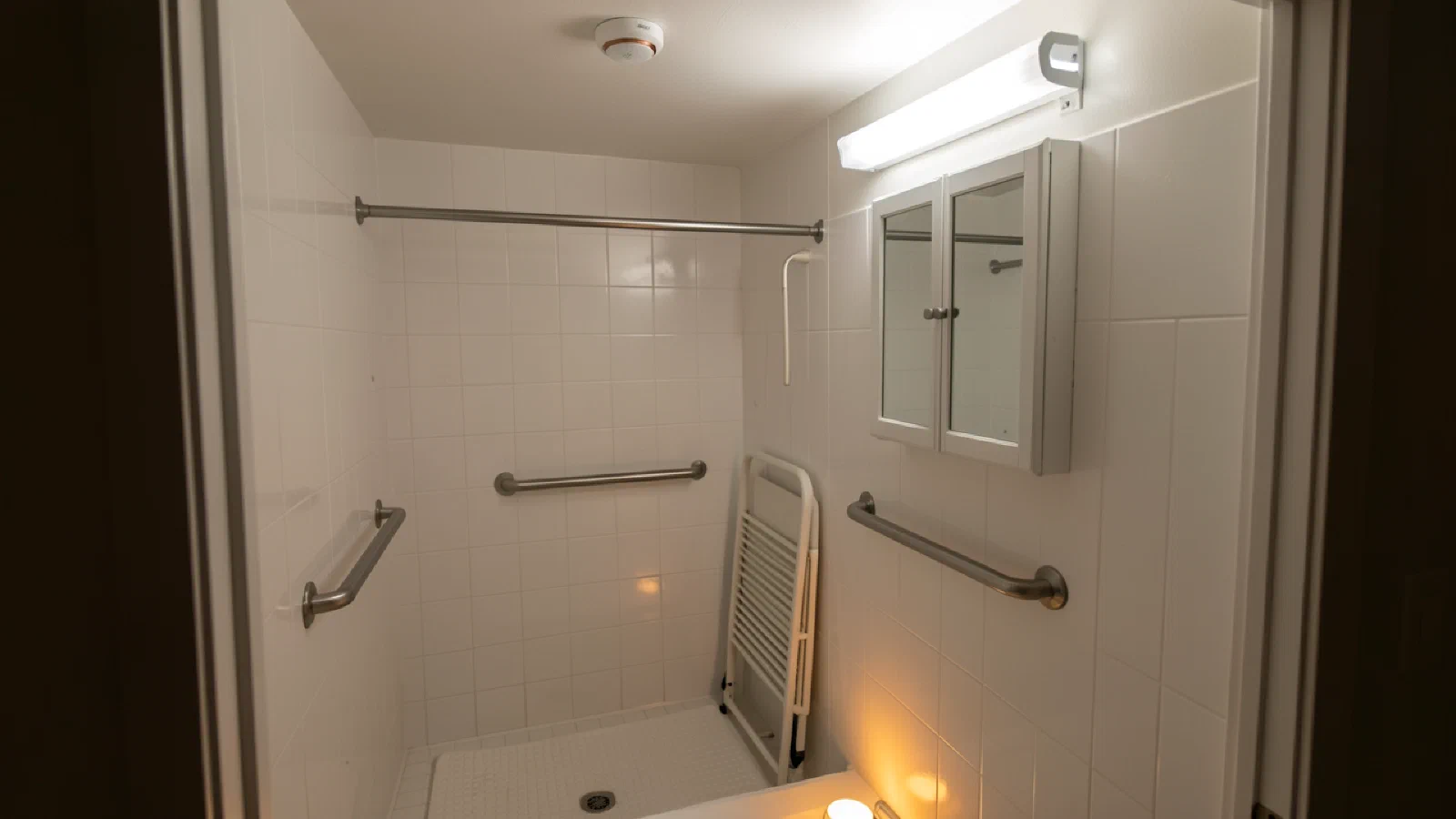
Radar-based monitoring is the technology that has attracted the most clinical attention in the past several years. Vayyar Care, also Israeli-origin, uses wall-mounted 4D imaging radar sensors that detect falls automatically without cameras, wearables, or buttons. The radar technology generates point cloud imaging of the space, operates through steam and in total darkness, and covers an entire room including the bathroom — the location where approximately 80 percent of fall-related injuries occur — without capturing any identifiable image of the person. The privacy-first positioning is not merely a marketing choice. Camera-based monitoring, which offers better sensitivity and specificity for fall detection and gait analysis, faces consistent household resistance from seniors and their families. Radar solves the privacy objection at the cost of somewhat lower resolution. Vayyar Care has deployed across senior living communities in partnership with nurse call system manufacturers including TekTone and K4Connect, and has integrated its fall detection capability with Amazon Alexa Together for the consumer home market.
Smart home platform integration represents the third category, anchored primarily by Amazon’s aging-in-place strategy. Alexa Together adds a family visibility and response layer to the standard Echo device, allowing designated family members to receive fall alerts, conduct drop-in audio checks, and access an activity feed showing when the senior last interacted with an Alexa device. The fall detection feature on Echo devices uses audio sensing rather than radar, which produces a less reliable detection signal than dedicated sensor systems. Apple Watch fall detection has achieved the highest consumer adoption of any wearable fall alert system, with emergency SOS integration that has produced documented rescue events. Medicare Advantage plans have offered Apple Watch as a supplemental benefit in select markets. The MA supplemental benefit contraction cycle that began in 2025 has affected wearable technology benefits alongside other categories, and the clinical case for preserving them within plan benefit designs is stronger than the case for many of the wellness perks that were also cut.
Clinical Evidence: Detection vs. Prediction#
The technology industry conflates fall detection and fall prediction in marketing materials in ways that distort what the clinical evidence actually shows. These are operationally distinct capabilities that current sensor systems achieve to very different degrees.
Fall detection — automatically identifying that a fall has occurred and generating an alert — is a well-solved problem within specific technical constraints. Radar systems and accelerometer-based wearables both achieve detection rates sufficient for clinical deployment, though false positive rates vary substantially by technology and environment. The value of detection is unambiguous: it closes the interval problem, reducing long lie duration when the alert is connected to a monitoring center or a caregiver who responds.
Fall prediction — identifying in advance that a fall is likely to occur — is where the clinical evidence is more carefully bounded. The research base on gait analysis as a fall risk predictor is substantial and consistent: gait speed, stride length, stride time variability, and balance parameters measured continuously in the home environment outperform both clinical assessment instruments and claims-based risk scores in identifying fall risk. A 2024 study in BMC Public Health using gait data from community-dwelling adults over 80 demonstrated that gait parameters produced better fall risk discrimination than standard clinical scales. Longitudinal research using ambient gait monitoring in dementia populations has produced fall risk prediction models with AUROC values in the range of 0.76 using combined gait, medication, and clinical assessment data — meaningful but not sufficient as a standalone clinical decision tool.
The practical constraint on fall prediction is not the model’s performance in research settings. It is the translation gap between a risk score and a clinical intervention. A radar sensor that identifies gait deterioration over a two-week period can alert a care manager that fall risk has increased for a specific patient. Whether that alert produces a medication review, a physical therapy referral, or a home safety assessment depends on clinical workflow, care team availability, and the actionability of the alert within the systems those clinicians use. The monitoring infrastructure is necessary but not sufficient. The clinical workflow that acts on the output is where the prevention actually occurs.
Dementia monitoring represents a distinct application with its own evidence base. Wandering detection — alerting when a cognitively impaired person leaves a safe zone — is the most operationally mature application, implemented in both institutional and home settings. Behavioral pattern monitoring for dementia patients — tracking day-night rhythm disruption, unusual activity timing, bathroom visit frequency changes that may indicate UTI — extends the clinical value of continuous monitoring into condition management rather than just safety response. Vayyar’s clinical documentation notes that behavioral pattern analysis from radar data can identify signs of UTI before clinical presentation, a claim that requires controlled validation but reflects the direction of the research.
Payment Models and the ROI Calculation#
The fundamental commercial challenge for ambient intelligence vendors is that Medicare does not have a billing code for passive monitoring infrastructure. CPT 99454 covers device supply for RPM when the device records physiological data and transmits it on at least 16 days per month. A fall detection radar sensor does not fit that code because it is detecting events and behavioral patterns, not recording a physiological parameter in the sense CMS defines for RPM. Wearable devices that continuously record heart rate or SpO2 can qualify for RPM billing; wall-mounted environmental monitors generally cannot.
The payment models that make ambient monitoring viable are therefore indirect: the technology has to be funded by organizations whose financial structures make fall prevention economically rational, rather than generating its own billing event.
AHEAD creates the strongest structural case. A hospital operating under a global budget is accountable for the total cost of care for its attributed population. A fall-related hip fracture hospitalization for a community-dwelling Medicare beneficiary generates roughly $30,000 to $45,000 in Part A payment — cost that hits the hospital’s global budget. An ambient monitoring deployment across the highest-risk attributed patients that prevents even a modest number of those hospitalizations per year produces a return on investment calculable in the same budget framework. The Maryland hospital experience under the all-payer global budget model, which preceded AHEAD’s national expansion, demonstrated that hospitals with strong budget accountability invested in population health infrastructure including home monitoring in ways that purely volume-based hospitals had no incentive to replicate.
FIDE SNPs carry the same economic logic at the plan level. A dual eligible beneficiary who is institutionalized after a fall generates substantially higher long-term care costs than one who can remain in the community. A plan bearing full Medicare and Medicaid risk across the beneficiary’s total cost of care has a financial case for monitoring technology that averts institutionalization that is larger than the case available to any single-payer entity.
ACOs with two-sided risk in MSSP ENHANCED track or ACO REACH generate savings from avoided hospitalizations that can fund care management investments including monitoring technology. The savings per avoided hospitalization — approximately $9,000 to $14,000 in the shared savings literature for avoidable admissions — provide the ROI denominator for deployment decisions in high-risk populations.
MA supplemental benefits remain the most direct funding pathway for consumer-market ambient monitoring tools. Plans that have categorized fall detection devices as supplemental benefits under the Special Supplemental Benefits for the Chronically Ill framework can fund deployment in enrolled members with qualifying chronic conditions. The benefit contraction pressure from CMS’s tightened supplemental benefit oversight has reduced plan generosity in this category, but the clinical case is distinguishable from pure wellness perks and some plans have preserved it.
Data Quality, Privacy, and Interoperability#
Clinical-grade ambient monitoring data faces the same interoperability problem that every point-solution in the home sensor market faces. A Vayyar radar sensor generates a continuous stream of behavioral and event data that is clinically meaningful. Its clinical value is realized only when that data reaches a care team in a form they can act on, within the workflow systems they use. HL7 FHIR standards provide the data exchange framework. EHR integration — specifically with Epic and Oracle Health, which together represent the majority of health system clinical workflow infrastructure — determines whether alert data from the home environment becomes a clinical record or a disconnected notification on a separate platform.
HIPAA coverage of ambient monitoring data in private residences is not fully settled. A radar sensor in the home of a Medicare beneficiary generates continuous data about that individual’s presence, movement, and behavior. Whether that data constitutes protected health information depends on who operates the monitoring system and whether it is used in connection with healthcare treatment. If a monitoring platform is operating under a business associate agreement with a covered entity that is using the data for care management, the PHI classification and associated safeguards apply. Consumer-grade monitoring devices sold directly to beneficiaries without a provider intermediary occupy a regulatory gray zone that the FTC, not HIPAA, governs — and FTC enforcement of health data privacy in consumer contexts has been active since 2021.
For organizations building ambient monitoring into clinical care infrastructure, the privacy architecture questions are not primarily regulatory compliance questions. They are adoption questions. A wall-mounted sensor in a senior’s bedroom will not be deployed if the senior or their family refuses it, regardless of what HIPAA says. The most durable design principle in this market is privacy-first by default: no identifiable images, no audio recording, no data sharing beyond the explicit care management purpose for which the system was installed.
Related Reading#
MCR-01_08 AHEAD and Geo AHEAD: Geography as a Cost Control Lever