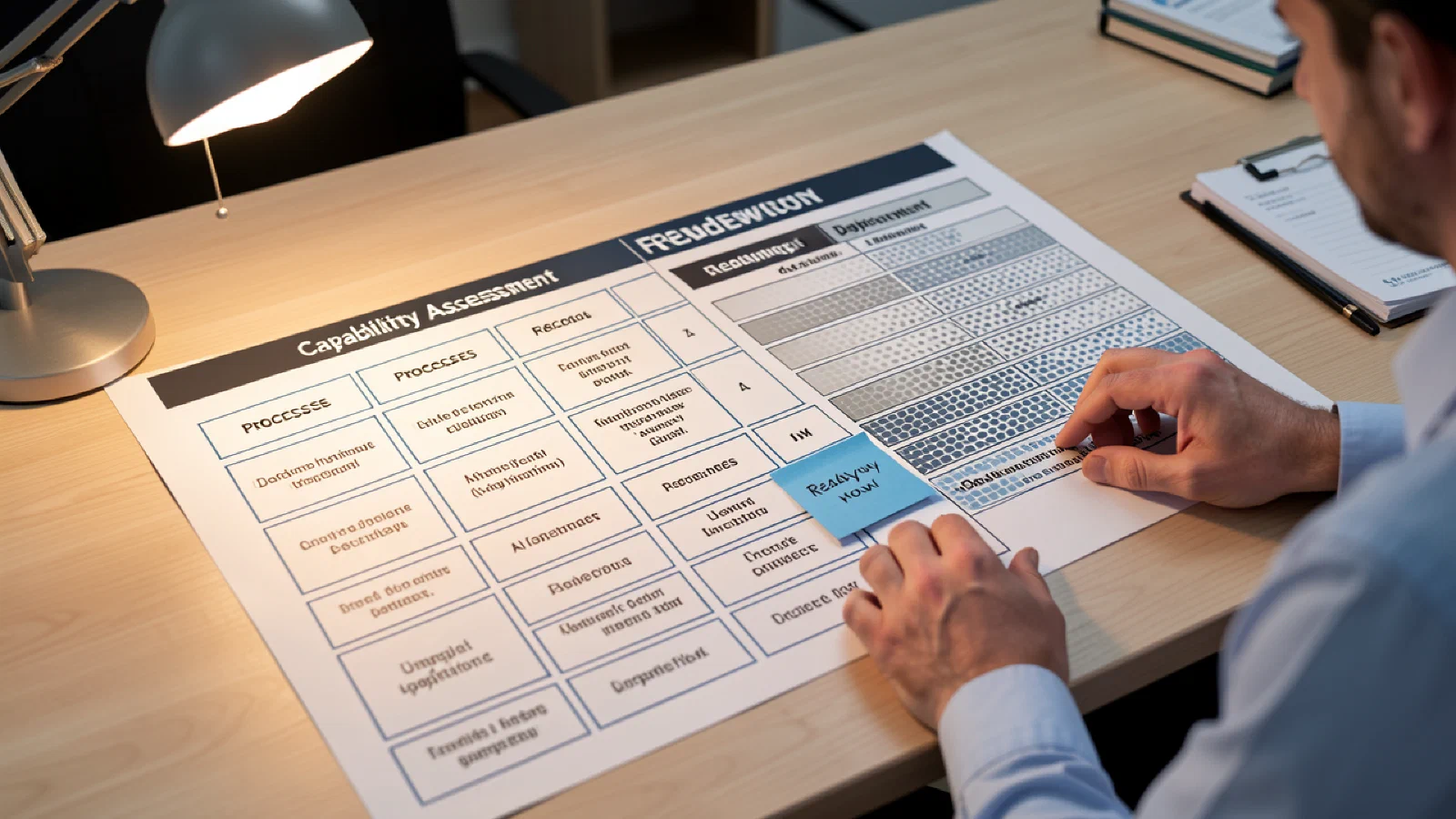
What AI Can Actually Do for TPA Operations Today
The AI conversation in the TPA market has two failure modes. The first is vendor marketing that labels any automation “AI-powered” regardless of whether a model is involved. The second is architecture documents (including FWD.06 in this series) that describe what AI could do in a purpose-built system without addressing what it can do in the systems a TPA is actually running. This article takes each core TPA business process in sequence, gives the honest assessment of what is deployable now, what is buildable with investment, and what remains marketing language ahead of actual capability. The result is a decision framework for a leadership team allocating budget this year and next year.
The Readiness Spectrum#
Every business process below is placed on a three-tier framework.
Tier 1: Deploy now. Commercially available tools or buildable with current models in 3 to 6 months. The capability is proven. The question is implementation, not feasibility. ROI is measurable within one plan year.
Tier 2: Build over 12 to 18 months. The underlying AI capability exists but the domain-specific training data, the integration with existing TPA systems, or the guardrails required for production use in a regulated environment are not off the shelf. Requires investment in engineering with benefits domain knowledge or a technology partner who has both.
Tier 3: Not ready. The vendor pitch is ahead of the capability. The models hallucinate at a rate unacceptable for the use case, the regulatory environment does not permit the level of automation implied, or the training data does not exist. The honest advice is to watch, not buy.
Quoting and Proposal Generation#
Current state: rating lives in an Excel model maintained by one or two people. Proposals live in Word templates. Someone manually transfers numbers from one to the other, formats the document, and emails it. Turnaround is 5 to 10 business days. Transcription errors are common. The process costs $120 to $480 in staff time per group.
Tier 1 (deploy now): LLM-generated proposals from structured rating outputs. The inputs are structured data: rates, plan design parameters, stop loss terms, employer demographics. The output is a professional proposal document in the employer’s language. Current LLMs produce this reliably when the prompt is well-engineered and the data inputs are clean. The AI does not make actuarial judgments. It translates a judgment already made into clear prose and accurate numbers, consistently, without transcription errors, in minutes rather than days. Template-driven proposal assembly with AI-populated fields is the simpler variant: it eliminates the manual transfer step where most errors occur. Time to deploy: 2 to 4 months with a competent team. Off-the-shelf document generation platforms with LLM integration exist.
Tier 2 (build over 12 to 18 months): ML-assisted rating. Models trained on the TPA’s own book of business (claims history, group characteristics, industry and geography factors, stop loss experience) that produce more accurate initial PMPM estimates than manual factor-based approaches. Particularly valuable for groups where demographic data exists but claims history does not. Requires the TPA’s historical data to be clean enough to train on, a prerequisite many TPAs do not meet. Also in Tier 2: automated benefit design simulation, where a model takes employer demographics, benchmarks, and stated priorities and produces a comparison of expected cost, member impact, and compliance risk across candidate designs.
Tier 3 (not ready): fully autonomous quoting without human review. The error rate in current models for complex multi-variable numerical calculations (stop loss premium layered on expected claims with plan-design-specific adjustments) is too high for production use without a human check. The goal is to reduce human effort from production to review, not to eliminate review.
Connection to FWD.03: the quoting cost reduction from Tier 1 alone, from $120 to $480 per group to near-zero marginal cost, is the single largest driver of micro-employer segment profitability.
Eligibility and Enrollment#
Current state: employers send census data in whatever format they have. The TPA manually processes it into the eligibility system. Discrepancies are identified by a human reviewing the data. ID cards and welcome materials are generated from the processed data. Errors in this process (wrong effective dates, misspelled names, missed dependents, terminated members left active) cause more downstream operational pain than any other single process.
Tier 1 (deploy now): document parsing and entity extraction for census data in arbitrary formats. Current AI models can read an employer’s census spreadsheet regardless of column naming conventions, extract the relevant fields, and map them to a canonical member record schema. Multiple vendors offer commercial-grade document AI services. The domain-specific work is defining the canonical schema and the anomaly detection rules. Also Tier 1: automated ID card generation from verified eligibility data, which eliminates a manual production step once the parsing capability produces clean data.
Tier 2 (build over 12 to 18 months): intelligent census reconciliation. Not just parsing the data but understanding it: determining whether a member on the plan but not on the census represents a termination the employer forgot to report, a dependent aging off, or a data entry error, and routing each case to the appropriate resolution workflow. This requires encoding benefits administration domain knowledge into the AI system. The parsing is Tier 1. The judgment layer is Tier 2. Also in Tier 2: life event prediction using patterns in eligibility data (dependent ages approaching 26, employee tenure patterns) to anticipate changes before the employer reports them.
Tier 3 (not ready): fully automated eligibility management with no human review. The consequences of eligibility errors (claims paid for ineligible members, stop loss disputes, compliance violations) are too severe for autonomous processing. The human in the loop is a risk management requirement, not a technology limitation.
Claims Adjudication and Intelligence#
Current state: claims adjudication is handled by the TPA’s core platform. Post-adjudication review for anomalies, fraud, waste, abuse, and stop loss tracking combines automated reports with manual review. Industry benchmarks indicate that modern claims platforms achieve 85 to 95 percent auto-adjudication rates with 99 percent financial accuracy on the claims that pass through (Conduent, “HSP Payer Suite”). The remaining 5 to 15 percent require human intervention, and that percentage rises with plan complexity.
Tier 1 (deploy now): anomaly detection on adjudicated claims. ML models that flag claims with unusual patterns (outlier charges, duplicate billing, unbundling, upcoding) for human review. The training data exists in any TPA with a few years of claims history. Standard supervised learning on tabular data. Multiple commercial vendors offer this capability with reported fraud detection rates of 50 to 90 percent for flagged claims (V7 Labs, “AI in TPA Software”; Igloo Insure). Also Tier 1: real-time stop loss accumulator tracking. Not an AI problem but an automation problem most TPAs have not solved: connecting the claims data feed to accumulator tracking so that attachment point proximity is visible continuously rather than in a monthly report.
Tier 2 (build over 12 to 18 months): clinical rule validation. Models that cross-reference adjudicated claims against clinical guidelines to identify potential inappropriate care patterns (unnecessary imaging, off-label prescribing, care not following evidence-based protocols). Requires clinical knowledge encoded in training data or rules, not just billing pattern recognition. Also Tier 2: predictive stop loss modeling, using claims trajectory data to forecast which groups will approach specific or aggregate attachment points before they do, giving the TPA and employer time to intervene.
Tier 3 (not ready): AI-driven claims adjudication replacing the core adjudication engine. The contractual and clinical logic embedded in adjudication is too complex and too consequential (incorrect adjudication has direct financial and legal liability) for current models to handle without extensive rule-based architecture underneath. As Insurance Thought Leadership observes, AI is changing where human judgment is needed in claims, not whether it is needed. Simple claims see auto-adjudication without an adjuster. Complex claims require more expertise, not less (Insurance Thought Leadership, “The Case for TPAs in an AI Claims Environment”). The intelligence layer sits on top of adjudication. It does not replace it.
Claims Repricing#
Current state: repricing logic (network contract rates, RBP calculations, Medicare-based pricing) is applied between adjudication and payment. Often manual or semi-automated. Multiple pricing methodologies run simultaneously across a single book. Errors are expensive and invisible in standard reporting.
Tier 1 (deploy now): automated Medicare rate lookup and benchmarking against CMS fee schedule files. The files are publicly available, updated quarterly, and machine-readable. Automating the lookup eliminates the manual step where most RBP repricing errors originate. Also Tier 1: repricing audit, an automated comparison of paid amounts against the applicable pricing methodology for each claim. Flags claims where the paid amount deviates from the expected repriced amount. Rule-based, not ML, but it catches the errors that cost real money.
Tier 2 (build over 12 to 18 months): provider dispute documentation generation. Reference-based pricing generates balance billing disputes. The repricing engine needs to produce documentation showing the Medicare benchmark, the plan methodology, and the calculation in a format a provider relations team or attorney can use. This is templated, claim-specific, repetitive, and a natural LLM application. Requires integration with claims data and plan pricing rules.
Tier 3 (not ready): automated provider negotiation for RBP disputes. Provider negotiations involve relationship dynamics, legal judgment, and case-specific strategy. The documentation can be automated. The negotiation cannot.
Member Service and Navigation#
Current state: members call the TPA service center with questions. Service representatives look up plan documents, claims history, and network directories manually. Average handle times are high and consistency is variable.
Tier 1 (deploy now): AI-assisted service representative tools. LLMs that help the human representative find the answer faster by searching plan documents, summarizing claims history, and drafting responses. The human remains in the loop. The AI reduces average handle time and improves consistency. This is not a chatbot replacing the representative. It is a tool making the representative faster and more accurate. Also Tier 1: automated status updates and routine communications (claim status, accumulator progress, ID card requests) handled without human involvement. Rule-based automation that reduces inbound call volume.
Tier 2 (build over 12 to 18 months): member-facing navigation with retrieval-augmented generation architecture. A system that answers member questions by retrieving relevant sections from the actual plan document and generating a plain-language response grounded in the retrieved text. The failure mode (telling a member something is covered when it is not, or citing a provider as in-network when they are not) is serious and requires careful guardrails: confidence scoring, fallback to a human representative when confidence is low, logging and audit of every response. Buildable with current LLM technology. The domain-specific work is building the retrieval layer over the plan document corpus and establishing the guardrail architecture. Not a weekend project. A genuine engineering investment with a 12 to 18 month timeline to production-grade reliability.
Tier 3 (not ready): autonomous member service with no human fallback. The liability exposure of an AI system that provides incorrect coverage information to a member is unacceptable in a regulated benefits environment. The human fallback is a permanent requirement for the foreseeable future, not a transitional one.
Coordination of Benefits and Subrogation#
Current state: the most manual processes in most TPA operations. COB identification relies on member self-reporting. Subrogation identification is manual review of claims for injury-related diagnosis codes. Recovery pursuit is managed with spreadsheets and tickler files. Most TPAs recover far less than they could: recovery rates of 2 to 4 percent of paid claims are typical, which on a $5 million plan year is $100,000 to $200,000 left on the table.
Tier 1 (deploy now): ML-based subrogation candidate identification. A classification model trained on ICD-10 external cause codes (V, W, X, Y series), ER claims with injury diagnoses, and workers’ compensation-adjacent patterns. A model that flags 70 to 80 percent of subrogatable claims automatically and routes them to a human reviewer is dramatically better than manual review of every claim. The training data exists in any TPA with historical subrogation outcomes. Also Tier 1: automated subrogation letter generation. Templated, claim-specific communications generated from structured claims data. Repetitive, high-volume, and a natural LLM application.
Tier 2 (build over 12 to 18 months): COB identification from claims patterns. Models that identify potential dual coverage from claim patterns (underpayment patterns suggesting a primary payer, employment status changes) rather than relying on member self-reporting. Requires claims data with enough dual-coverage historical examples to train on. Also Tier 2: end-to-end recovery workflow automation, from identification through lien filing through recovery receipt, with automated follow-up and deadline management.
Tier 3 (not ready): automated settlement negotiation for subrogation cases. Legal judgment, attorney relationships, and case-specific strategy are not automatable.
Compliance and Reporting#
Current state: compliance documentation (ERISA, CAA, mental health parity, HIPAA) is generated periodically, often at renewal or in response to an audit. Employer reports are periodic data exports. Broker reports are Excel files.
Tier 1 (deploy now): automated employer reporting dashboards. Claims data piped to a visualization layer employers can access on demand. Commercial tools exist (Tableau, Power BI, custom builds). The data integration is the hard part, not the visualization. Also Tier 1: plan document generation from structured plan design inputs. LLM application for producing summary plan descriptions, schedules of benefits, and SBC documents. Templated, regulatory-compliant, accurate. Eliminates the weeks-long document turnaround and the transcription errors that create compliance exposure.
Tier 2 (build over 12 to 18 months): regulatory change monitoring. LLMs that parse new regulations, guidance, and enforcement actions and identify implications for specific plan designs in the TPA’s book. Requires a retrieval layer over the TPA’s plan design database and a regulatory corpus kept current. Hallucination risk (flagging a requirement that does not exist, or missing one that does) requires human review of every alert. But reducing regulatory monitoring from “someone reads the Federal Register” to “the system flags relevant changes for review” is a genuine efficiency gain. Also Tier 2: mental health parity NQTL analysis assistance, where an AI system identifies NQTLs in plan documents and compares them against parity standards.
Tier 3 (not ready): autonomous compliance determination. The liability of an AI system that certifies a plan as compliant when it is not is unacceptable. Compliance ultimately requires human judgment and, for significant questions, legal counsel. AI assists. It does not certify.
The Deployment Sequence#
This article does not prescribe what to build first. It gives the framework for deciding.
Where is the most staff time currently spent? That is where Tier 1 automation has the fastest payback. For most TPAs, quoting and eligibility consume disproportionate staff hours per group, particularly at micro-group sizes.
Where are the most expensive errors? That is where Tier 1 audit and anomaly detection has the highest ROI per dollar invested. Repricing errors and eligibility errors are typically the costliest failure modes in TPA operations, and both are addressable with Tier 1 capabilities now.
Where is the competitive differentiation? Member navigation (Tier 2) and employer analytics are where the TPA’s value proposition is migrating (FWD.05, Shift 3). Investing there is a strategic bet on differentiation, not just a cost reduction play.
What does the micro-employer math require? If the leadership team has decided to invest in the micro-employer segment (FWD.05, Choice C), the quoting, eligibility, and stop loss reporting automation described in this article is not optional. It is the prerequisite for the segment being viable at all (FWD.03, Section 3). The technology cost floor for micro-employer profitability depends on these specific Tier 1 deployments.
The strategic choices in FWD.05 depend on knowing what AI actually delivers. A CEO evaluating Choice A (deepen the core) needs Tier 1 deployments across the board. A CEO evaluating Choice C (micro-employer) needs the specific Tier 1 capabilities in quoting and eligibility. A CEO evaluating Choice E (platform) needs Tier 2 investments in most processes. The architecture in FWD.06 describes where these capabilities live. This article describes what they do and when they are ready. The competitive analysis in FWD.08 depends on whether TPAs can deploy AI faster than HR platforms, insurtechs, and carriers. The readiness spectrum gives the leadership team an honest assessment of their timeline.
How this article connects to others in Blue Gray Matters.
Sources cited in this article.
- Conduent. "HSP Payer Suite: Core Claims Administration." Conduent, 2025, www.conduent.com/healthcare-business-solutions/health-plan-administration/core-claims-administration/.
- Igloo Insure. "How AI Is Transforming Claims Processing for Both Consumer and Back Office Operations." Igloo Insure, 2025, iglooinsure.com/ai-transforming-claims-processing/.
- Insurance Thought Leadership. "The Case for TPAs in an AI Claims Environment." Insurance Thought Leadership, 21 Mar. 2025, www.insurancethoughtleadership.com/claims/case-tpas-ai-claims-environment.
- V7 Labs. "AI in TPA Software: Advancing Insurance Administration in 2025." V7 Labs Blog, 2025, www.v7labs.com/blog/ai-tpa-software-insurance.