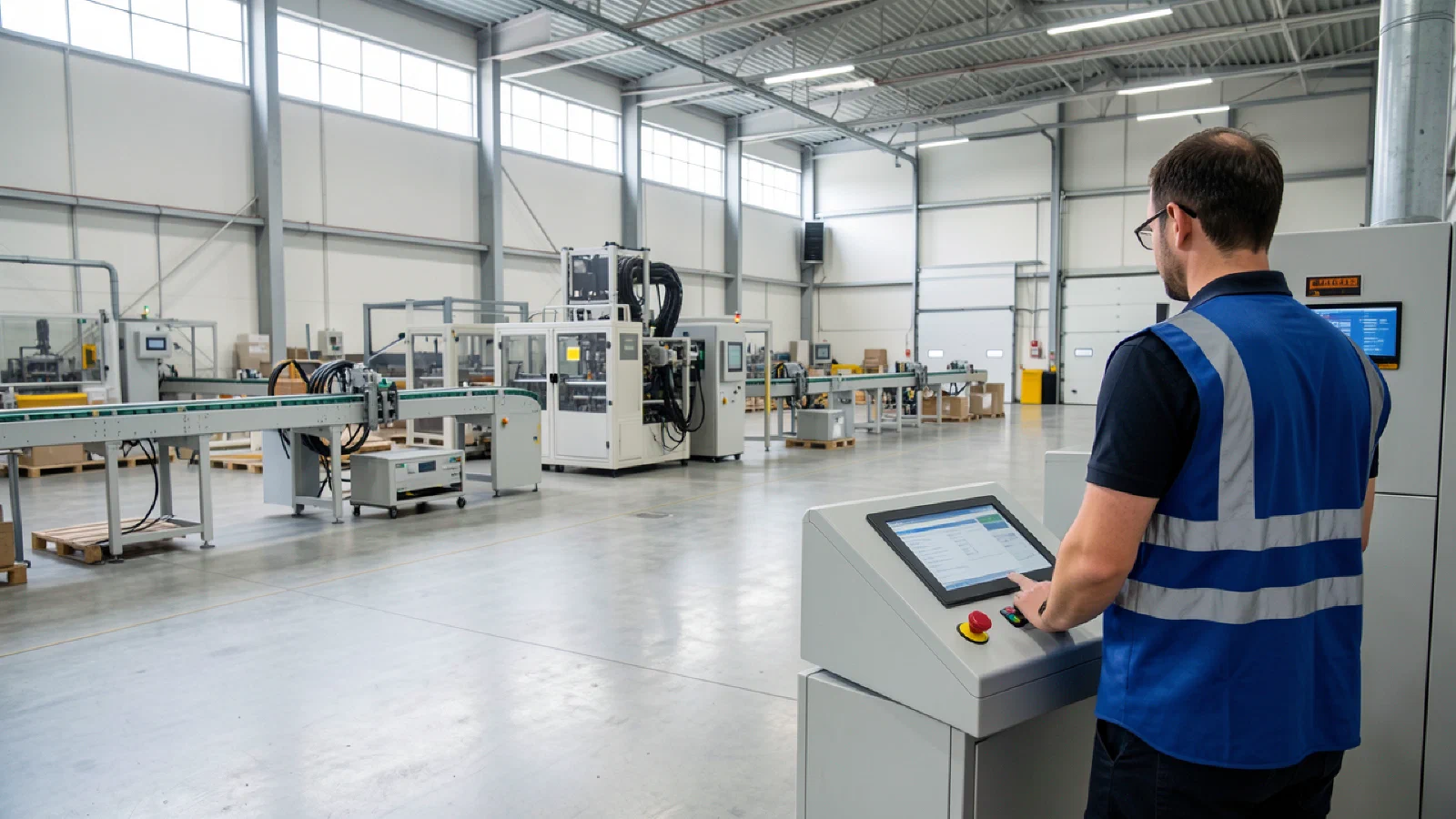
Robotics and the Blue-Collar Parallel: What Automation Means for the Industries Level Funded Serves
LFP-12.03 | Sharp Analysis | Series 12: The AI Disruption
The AI disruption to employment is a white-collar story in the near term. Generative AI tools are restructuring knowledge work now, in ways measurable through occupational employment data and business formation statistics. The coverage consequences for professional services workers are arriving in the current plan year.
Robotic automation in physical industries operates on a longer timeline. The constraints are different: physical systems require capital expenditure, field conditions are variable in ways that challenge robotics, regulatory certification requirements create friction, and labor resistance in organized sectors has slowed adoption. But the directional outcome is identical. Fewer full-time employees per unit of business output. Workforces that shrink toward or below the viable threshold for group health coverage. The employment relationships that sustained level funded groups in construction, landscaping, manufacturing, and food service are under the same structural pressure as knowledge work, on a five-to-fifteen-year lag.
For a TPA whose book of business is concentrated in the blue-collar industries where level funded adoption has grown, the robotics timeline is the relevant planning horizon. The disruption is not immediate. It is foreseeable, and its trajectory is visible in the data.
Automation in the Level Funded Industries#
Construction is the industry where level funded adoption has grown most substantially among blue-collar employers. It is also an industry where automation technology is advancing across multiple functions, though adoption is uneven and concentrated in larger commercial projects.
Autonomous grading and excavation equipment is operational and expanding beyond pilot projects. Drone site surveying that previously required survey crews is now standard practice in larger commercial construction. Robotic concrete finishing, rebar tying, and bricklaying systems are in commercial deployment. Modular and prefabricated construction, which reduces on-site labor requirements by shifting work to controlled factory environments, is growing as a share of construction activity. These changes reduce the labor intensity of construction operations without eliminating the workforce. A commercial construction project that previously required 35 workers may require 22 using a combination of autonomous equipment and human operators managing those systems. The employer remains. The group size for coverage purposes has contracted.
Landscaping and grounds maintenance represents a significant segment of the level funded market, particularly for the 10-to-35 employee range of regional landscaping companies. Autonomous commercial mowing equipment is commercially available and in active deployment. GPS-guided spray application systems reduce the crew requirements for fertilization and treatment operations. A landscaping company that employed 15 workers to operate conventional mowing and maintenance equipment may employ 9 or 10 when those workers manage autonomous systems rather than operating equipment manually. The group falls from clearly viable to marginal for level funded underwriting.
Manufacturing has the longest history of industrial robotics adoption, and the IFR World Robotics Report 2024 documented an operational stock of 4.28 million industrial robots in global factories as of 2023, a 10% increase year over year (International Federation of Robotics, World Robotics 2024). The United States has a robot density of 295 units per 10,000 manufacturing employees, placing it tenth globally, with the intensity concentrated in automotive, electronics, and food and beverage production. The expansion into smaller-scale manufacturing is the development most relevant to the level funded market: collaborative robots, or cobots, designed to work alongside human operators rather than replace them entirely, are now priced and configured for small and mid-size manufacturers. A 20-person metal fabrication shop or a 25-person food processing operation can now acquire cobot systems that reduce headcount per unit of output by 15% to 30% over a technology refresh cycle.
Warehousing and logistics automation has accelerated most visibly at scale, in the Amazon-style robotic fulfillment centers that have set the benchmark for the sector. The effect on mid-size warehousing and distribution operations, the 50-to-150 person distribution centers that serve regional supply chains and fall within the level funded market, is materializing through autonomous pallet moving systems, automated sorting equipment, and AI-directed inventory management. A regional distribution operation that employed 80 people five years ago may employ 55 today managing a combination of human and automated systems.
Food service automation is the most uneven across the category, with adoption concentrated in quick-service chain operations and the penetration into independent and regional food service limited by the cost structure of smaller operations. Automated food preparation, robotic coffee and beverage service, and self-service kiosk systems for order taking are operational across chain formats. The coverage consequence for independent and regional food service employers is indirect in the near term but directional: chain adoption sets the labor productivity benchmark that independent operators face competitively, and independent operators respond by reducing labor costs, including headcount, to remain viable.
The Workforce Composition Change#
In each of these industries, automation does not eliminate the workforce. It changes the workforce composition in ways that affect coverage viability.
The pattern in every sector is a shift from higher proportions of manual laborers to higher proportions of equipment operators and maintenance technicians. Fewer low-skill positions, more positions requiring the technical capacity to operate and maintain automated systems. This shift has two coverage implications. First, the employees who remain after automation adoption may earn more than the workers they replaced, because operating sophisticated equipment commands higher compensation than performing the manual tasks it replaced. Higher-earning employees are more interested in and more able to afford their share of group coverage costs.
Second, and more consequential for coverage viability, total headcount per employer declines. The employer that previously employed 30 people now employs 18. The one employing 18 now employs 11. The one employing 11 now employs 7, which is below the threshold where most stop loss carriers are willing to provide competitive coverage quotes, and below the 10-life floor where actuarial stability degrades sharply (see LFP-02.08). The employer’s revenue may be unchanged or higher. The workforce that generated group coverage eligibility has shrunk.
A third change is the emergence of a new workforce category in automated operations: the contract maintenance worker. Automated equipment requires regular maintenance, calibration, and servicing. In many adoption models, that maintenance is performed not by workers employed by the company operating the equipment, but by service technicians employed by the equipment vendor, the automation systems integrator, or a specialized maintenance contractor. These workers are not on the employer’s roster for group coverage purposes. Their employer is the service company, not the manufacturer or distributor using the automated line. The employment relationship that might have generated group coverage is externalized to a different employer.
The Timeline Difference#
The robotics adoption timeline in physical industries is slower than the AI adoption timeline in knowledge work for reasons that are structural, not merely economic.
Capital expenditure is the first constraint. Software tools like generative AI platforms are accessible to small businesses at subscription cost, measured in hundreds or low thousands of dollars per month. Robotic equipment requires capital investment measured in tens to hundreds of thousands of dollars per unit, plus installation, integration, and training costs. Small and mid-size employers in construction, landscaping, and manufacturing make that capital commitment over years and through financing cycles, not through a subscription decision.
Environmental variability is the second constraint. Physical work environments present conditions that are substantially harder for robotic systems to handle than the controlled settings of large manufacturing facilities. Construction sites have uneven terrain, variable weather, and constantly changing layouts. Agricultural and landscaping environments have irregular plant material and soil conditions. Food service environments have variable ingredient characteristics and handling requirements. Robotic systems designed for these environments require more sophisticated sensing and adaptation capabilities than factory floor systems, which have generally operated in controlled, predictable conditions.
Regulatory requirements impose a third constraint. Autonomous construction equipment operating on public roads or job sites requires safety certification from OSHA and compliance with site-specific safety plans. Autonomous vehicles in logistics face licensing requirements that vary by state. The regulatory pathway for commercial deployment of autonomous systems in physical environments is slower than for software tools.
Labor organization is a fourth factor in specific sectors. The building trades unions in construction, the United Auto Workers in manufacturing, and the Teamsters in logistics and warehousing have negotiated provisions around automation in collective bargaining agreements. The International Brotherhood of Electrical Workers, the Operating Engineers, and several other trades have, at various points, bargained for language governing the pace of automation adoption or the retention of specific job classifications as automation expands. These provisions do not stop automation, but they slow the pace of workforce composition changes in organized operations.
The slower timeline does not change the direction. It changes when the coverage consequences arrive. The knowledge worker displacement documented in LFP-12.02 is producing coverage gaps in the current benefit year. The blue-collar automation displacement will produce coverage gaps on a 5-to-15-year horizon in the industries the level funded market most directly serves. A TPA whose book includes 40 construction companies, 25 landscaping firms, and 20 regional manufacturers is watching the average group size in each employer category drift downward on a timeline that is foreseeable from current adoption data.
The Specific Coverage Implications#
The coverage implications of blue-collar automation follow the same structural logic as white-collar AI displacement but arrive through different mechanisms.
Group size contraction is the primary mechanism. As employers in level funded industries automate, their headcount per unit of output declines. Groups that were solidly in the viable range for level funded coverage drift toward the margins. The 22-person construction crew that was a clean level funded candidate becomes a 13-person crew where stop loss underwriting is possible but actuarially strained and where the administrative cost per member is substantially higher. The economics of the level funded arrangement become less favorable for the employer and less profitable for the TPA and stop loss carrier at the same time.
Worker displacement creates a second mechanism. The workers whose positions are eliminated by automation do not disappear from the labor market. They become independent contractors, join smaller non-automated operations, or move to different industries. In each of those transitions, the probability of accessing group coverage declines. The construction laborer whose employer automated from 30 workers to 15 may have been among the 15 retained, or among the 15 displaced. The displaced workers form a population that is more economically vulnerable than the displaced white-collar professionals in LFP-12.02 and less equipped to navigate the individual insurance market.
Vendor employee externalization creates a third mechanism specific to automated industries. As maintenance and servicing work is absorbed by equipment vendors and specialized contractors, the employment base at the operating company shrinks while the employment base at service companies grows. Service company employees may or may not be covered by group plans, depending on the size of the service operation. The net effect is a restructuring of who employs whom, with unpredictable effects on group coverage distribution.
The TPA Perspective#
For a TPA serving blue-collar employers, the robotics adoption timeline is visible in existing client data. A construction company book from five years ago, repriced and re-underwritten today, will show average group sizes that have drifted downward in many cases. The companies that have adopted autonomous or semi-autonomous equipment have done so for economic reasons and will not reverse course. The trend is directional and durable.
The response options for the TPA are constrained. The stop loss underwriting parameters that define the viable group size threshold are not set by the TPA. They are set by stop loss carriers responding to actuarial variance at small group sizes, a structural reality examined in LFP-02.08. The TPA cannot change the math of variance at 8 lives versus 18 lives. What it can do is anticipate the trajectory of its book and invest in product and pooling structures that extend the viable range downward, whether through TPA-organized stop loss pools, simplified underwriting models, or partnerships with carriers willing to underwrite smaller groups at the cost of higher per-member premiums.
The alternative is to watch the bottom of the book shed clients as group sizes fall below viability, accepting book contraction as the automation wave progresses through the industries they serve. That is a defensible choice but not a growth strategy.
The blue-collar and white-collar automation patterns arrive on different timelines and through different mechanisms. They produce the same structural outcome: a level funded addressable market that is narrowing from the bottom as the employment units the product was designed to serve become smaller.
How this article connects to others in Blue Gray Matters.
Sources cited in this article.
- International Federation of Robotics. *World Robotics 2024: Industrial Robots*. IFR, Sept. 2024, ifr.org/worldrobotics/.
- International Federation of Robotics. *World Robotics 2025: Industrial Robots*. IFR, Sept. 2025, ifr.org/worldrobotics/.