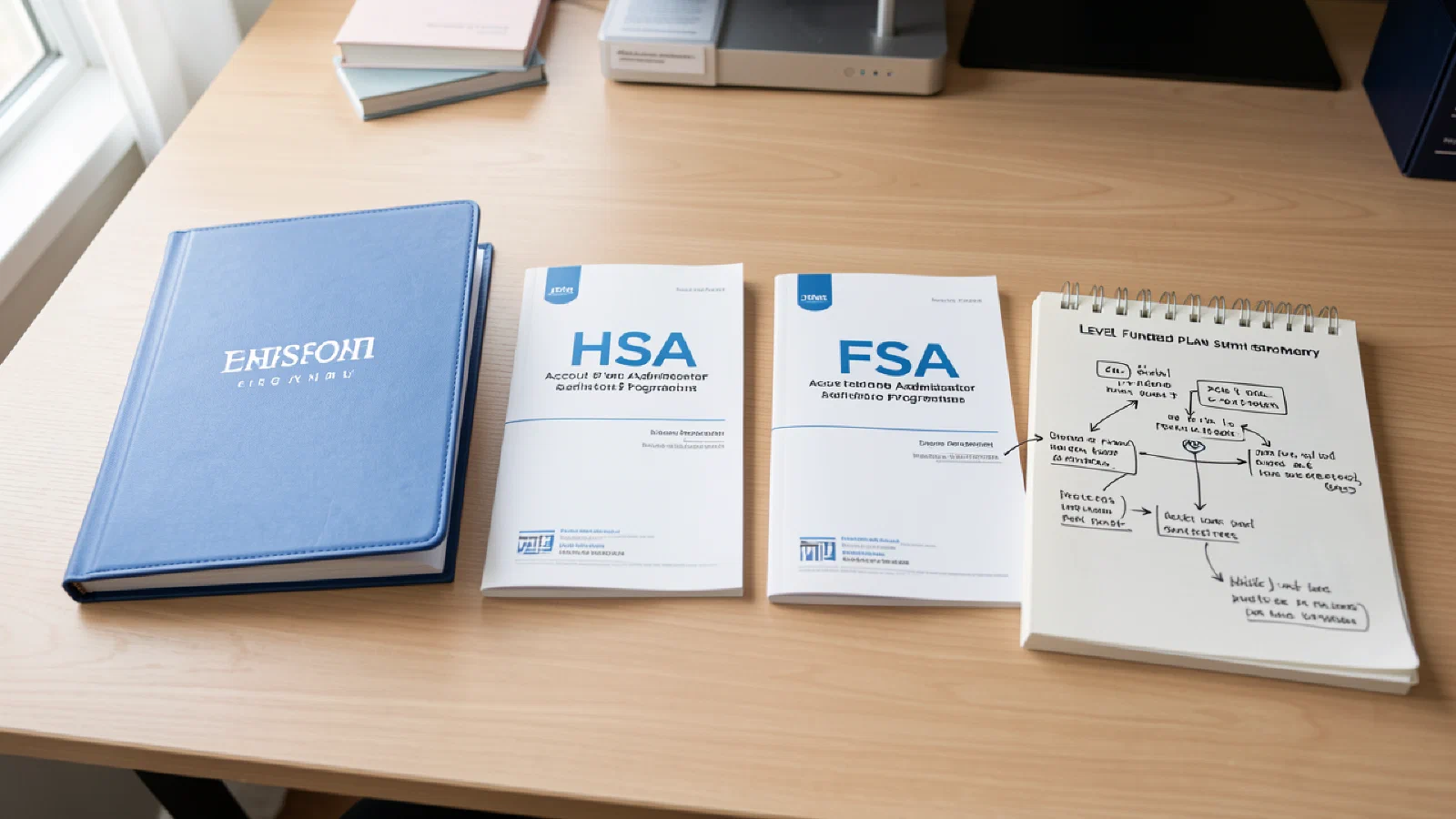
HSA, HRA, and FSA Integration: Tax Advantaged Structures and Their Interaction With Level Funded Plan Design
HSAs, HRAs, and FSAs are tax advantaged structures that interact with level funded plan design in specific ways. The interaction creates both opportunities and traps. Most brokers treat tax advantaged accounts as standalone products rather than as structural components of the plan design. The employer who designs the interaction produces better combined economics for the plan and the member. The employer who adds these accounts without considering the interaction may create compliance problems or miss optimization opportunities.
The Three Structures and Their Rules#
The Health Savings Account is the most tax advantaged savings vehicle in the federal tax code. The HSA requires a qualifying high deductible health plan meeting IRS parameters for minimum deductible and maximum out of pocket expenses. For 2026, the minimum deductible is $1,700 for individual coverage and $3,400 for family coverage. The maximum out of pocket limit is $8,500 for individuals and $17,000 for families.
The HSA provides triple tax advantage: contributions are pre tax, growth is tax free, and withdrawals for qualified medical expenses are tax free. Contribution limits for 2026 are $4,400 for self only coverage and $8,750 for family coverage. Individuals age 55 or older can contribute an additional $1,000 catch up amount. The account is owned by the employee and is fully portable. The level funded plan design must qualify as an HDHP for members to be HSA eligible.
Recent legislative changes have expanded HSA compatibility. The One Big Beautiful Bill Act made three changes effective January 2026: bronze and catastrophic ACA Exchange plans now qualify as HSA compatible HDHPs, telehealth pre deductible coverage is permanently allowed, and direct primary care arrangements no longer disqualify individuals from HSA participation. IRS Notice 2026-5 confirms that DPC arrangements meeting specific criteria regarding scope of services and maximum fees, not exceeding $150 per month for individual or $300 per month for family coverage, are compatible with HSA eligibility.
The Health Reimbursement Arrangement is employer funded only. The employee cannot contribute. The HRA reimburses employees for qualified medical expenses according to the plan document. The employer controls the design, funding level, and rollover rules. The HRA is not portable; the employer retains unused funds when the employee leaves. The HRA can coexist with any plan design, including HDHP, and provides flexibility that the HSA does not.
The Flexible Spending Account is employee funded through salary reduction on a pre tax basis. The FSA is subject to use it or lose it rules, with limited carryover or grace period options available. A general purpose FSA cannot coexist with an HSA. A limited purpose FSA covering only dental and vision expenses can coexist with an HSA, as can a post deductible FSA that provides reimbursement only after the HDHP deductible is met.
The HSA Opportunity and the HDHP Design Requirement#
For a level funded employer, designing the plan as an HSA qualifying HDHP produces several advantages.
The employer can contribute to the member’s HSA, which reduces the effective cost sharing burden while maintaining the high deductible structure that produces favorable stop loss terms and claims fund economics. An employer contributing $1,500 to each employee’s HSA on a $3,000 deductible plan is effectively providing a $1,500 deductible plan from the member’s perspective while maintaining a $3,000 deductible plan from the stop loss perspective.
The member builds a health savings asset that is portable and grows tax free. Unlike an HRA, which the employer controls, the HSA belongs to the member. This is a retention tool: the member accumulates an asset that has value beyond the current employment relationship. Members who understand the HSA as an investment vehicle rather than a spending account treat it differently, funding it to the maximum and using other funds for current medical expenses when possible.
The plan’s claims fund benefits from the higher deductible. Fewer small claims flow through the level funded arrangement, which improves the likelihood of surplus. The stop loss attachment point reflects the higher deductible, producing favorable premium terms.
The design challenge is that the level funded plan must meet IRS HDHP requirements precisely. The minimum deductible and maximum out of pocket limits change annually. Embedded versus aggregate deductible design for family coverage has specific IRS rules: a family HDHP may set a per person embedded deductible, but that embedded deductible cannot be lower than the family minimum of $3,400 for 2026. If any individual’s deductible within a family plan falls below that threshold, the plan loses HDHP status and members lose HSA contribution eligibility.
A plan design change that inadvertently falls below the HDHP minimum deductible disqualifies all members from HSA contributions for the plan year, an error with significant member tax consequences.
Employer HSA Contribution Strategy#
The employer’s approach to HSA contributions is itself a design decision. Three strategies produce different outcomes.
No employer contribution leaves the HSA entirely to the employee. The member funds the HSA through payroll deduction, captures the tax benefit, and builds an asset over time. This approach is simple but misses the opportunity to use HSA contributions as a cost sharing mitigation tool. A member facing a $3,000 deductible with no employer HSA contribution may avoid care due to cost concerns.
Partial employer contribution at 50 percent of the deductible effectively cuts the member’s first dollar exposure in half while maintaining the high deductible plan structure. An employer contributing $1,500 to each employee’s HSA on a $3,000 deductible plan is effectively providing a $1,500 deductible plan from the member’s perspective. The employer contribution costs $1,500 per employee per year but produces better care engagement and potentially lower downstream claims from deferred care.
Full employer contribution at 100 percent of the deductible eliminates first dollar exposure for the member while maintaining the high deductible structure for stop loss and claims fund purposes. This is expensive but may be appropriate for high income professional services firms competing for talent against employers offering low deductible traditional plans.
The timing of employer contributions matters. An employer who deposits the full contribution at the start of the plan year gives the member immediate access to funds for care. An employer who contributes monthly or quarterly creates cash flow that may not be available when the member needs care early in the plan year. The start of year deposit is more employee friendly but requires the employer to front the full contribution.
The HRA as a Plan Design Tool#
The HRA is the most versatile and underutilized tax advantaged tool in level funded design. Three configurations demonstrate the range.
A deductible only HRA funds reimbursement for deductible expenses only. This effectively reduces the member’s out of pocket exposure while maintaining the plan’s high deductible for stop loss and claims fund purposes. The plan looks like a $5,000 deductible to the stop loss carrier. It looks like a $2,000 deductible to the member if the HRA covers $3,000. The employer controls the funding and retains unused amounts, unlike the HSA where employer contributions become the member’s property.
A first dollar HRA funds broad medical expense reimbursement. This is more generous but more expensive and less strategically targeted than a deductible only design.
An income adjusted HRA sets different funding levels by employee class, providing more support to lower income employees who face the greatest cost sharing burden. This addresses the equity problem discussed in Series 06: the plan design is the same for everyone, but the HRA funding adjusts the effective cost sharing by income. A management employee earning $120,000 receives no HRA funding. An hourly employee earning $40,000 receives $2,000 in HRA funding. The plan design is identical; the effective cost sharing differs.
The income adjusted HRA is the most architecturally interesting configuration because it uses the HRA to solve a population problem within the level funded structure rather than requiring a different plan design. The IRS permits class based HRA design with specific rules about permissible distinctions. Compensation based distinctions are generally permissible if applied consistently.
The FSA Interaction and Common Traps#
The general purpose FSA cannot coexist with an HSA. An employer that offers both a general purpose FSA and an HDHP with HSA to the same employee class creates a disqualifying event for HSA eligibility. This is the most common trap, and it happens when benefits administration treats the FSA and the HSA as separate products without considering their interaction.
The limited purpose FSA covering only dental and vision expenses can coexist with an HSA. For employers who offer bundled or carved out dental and vision, the limited purpose FSA provides a tax advantaged way for members to pay dental and vision cost sharing while maintaining HSA eligibility.
The post deductible FSA, which provides reimbursement only after the HDHP deductible is met, can coexist with an HSA. This configuration is less common but available for employers who want to provide additional tax advantaged reimbursement beyond the HSA limits.
These rules are technical and frequently misunderstood by brokers and employers. A plan design error that inadvertently disqualifies HSA eligibility has real tax consequences for every affected member. The member who contributed to an HSA while ineligible faces income inclusion and a 10 percent penalty on excess contributions.
Closing#
Tax advantaged accounts are plan design tools, not standalone products. The broker who presents HSA, HRA, and FSA as separate benefits the employer can add is treating them as accretion. The broker who designs the interaction between the HDHP, the HSA, and the HRA to optimize combined economics for the employer and the member is practicing architecture.
The income adjusted HRA is the most underutilized design tool in level funded because it solves the cost sharing equity problem within the plan structure. A low income employee facing a $5,000 deductible may avoid necessary care because of cost. The same employee facing a $2,000 effective deductible after $3,000 in HRA funding may engage with care appropriately. The plan design is unchanged. The HRA makes the difference.
The HSA expansion under the One Big Beautiful Bill Act creates new opportunities, particularly the DPC compatibility that allows employers to layer direct primary care into an HSA qualified plan without disqualifying members from HSA contributions. This removes a barrier that had previously complicated the DPC integration discussed in 11.04.
The employer who treats these structures as design components rather than add on products will produce better outcomes for both the plan and the members.
How this article connects to others in Blue Gray Matters.
Sources cited in this article.
- Fidelity. "HSA Contribution Limits 2025 and 2026." Fidelity Investments, Aug. 2025.
- Internal Revenue Service. "Publication 969: Health Savings Accounts and Other Tax-Favored Health Plans." IRS, 2025.
- Internal Revenue Service. "Notice 2026-5: Guidance on OBBBA Changes to HDHP and HSA Rules." IRS, Dec. 2025.
- Keenan. "IRS Announces 2026 HSA and HDHP Limits." Keenan, May 2025.