The Mobile Workforce Insight: Why This Series Is Not About Medical Tourism
A reader arriving at a series titled “The Cost Management Frontier” expects generic advice: negotiate better rates, use telehealth, implement wellness programs. This series is not that. The structural insight that controls everything else is that the emerging level funded workforce is geographically mobile in ways that create cost arbitrage opportunities unavailable to a geographically fixed workforce. The TPA that understands this distinction has access to a different set of cost management tools than the TPA that does not.
The Misread This Preface Prevents#
The standard cost management conversation in employer health benefits assumes a workforce anchored to a metropolitan hospital market. Employees live within commuting distance of their employer. They have established relationships with local providers. Their scheduled procedures occur at whichever local facility their network includes, and the plan pays whatever the negotiated rate happens to be. Under these assumptions, cost management means negotiating marginally better network rates, steering members to slightly cheaper in-network options, or hoping telehealth reduces some volume of in-person visits. The savings are incremental. The strategies are familiar.
This series breaks from that frame. The cost management strategies available to a TPA serving a mobile workforce are qualitatively different from the strategies available to a TPA serving a geographically fixed one. A fractional CFO who works from Bozeman, Montana, can recover from an elective knee replacement in Monterrey, Mexico, as easily as at a Bozeman facility. A remote software architect whose employer is headquartered in San Francisco but whose work requires only a laptop and an internet connection can schedule a dental implant procedure in Tijuana and fly home to Portland the following week. Their plans are paying full freight at US urban hospitals when accredited international facilities charge 50 to 80 percent less for the same procedures using the same implants from the same manufacturers.
Who the Mobile Workforce Is#
The populations described in Series 06 and Series 12 include workers whose professional arrangements make them geographically unconstrained: fractional executives (CFOs, COOs, CMOs) who serve multiple clients from any location, remote knowledge workers whose employers are location-agnostic, senior entrepreneurs whose businesses do not require physical presence, and AI-augmented professionals who have become one-person departments capable of delivering work that previously required teams.
The data on this population’s scale is clear. The Bureau of Labor Statistics reported that approximately 22 percent of US workers teleworked at least part-time in 2025, representing over 32 million people. Gallup surveys through early 2025 found that among workers whose jobs can be performed remotely, 78 percent work either hybrid (52 percent) or fully remote (26 percent). Workers aged 35 to 44, the demographic most likely to need elective orthopedic and other scheduled procedures, show the highest remote work adoption at 27.4 percent. The technology sector leads at 67 percent remote participation. These are not marginal populations. They are a structural feature of the post-pandemic labor market.
The fractional executive market specifically has topped $5.7 billion globally with 14 percent annual growth. LinkedIn profiles mentioning fractional roles increased from 2,000 in 2022 to 110,000 by early 2024. The number of fractional executives doubled from 60,000 in 2022 to 120,000 in 2024. Among them, 72.8 percent have 15 or more years of experience. These are senior professionals with the financial resources and schedule flexibility to travel for medical care when the savings justify it.
What Mobility Makes Possible#
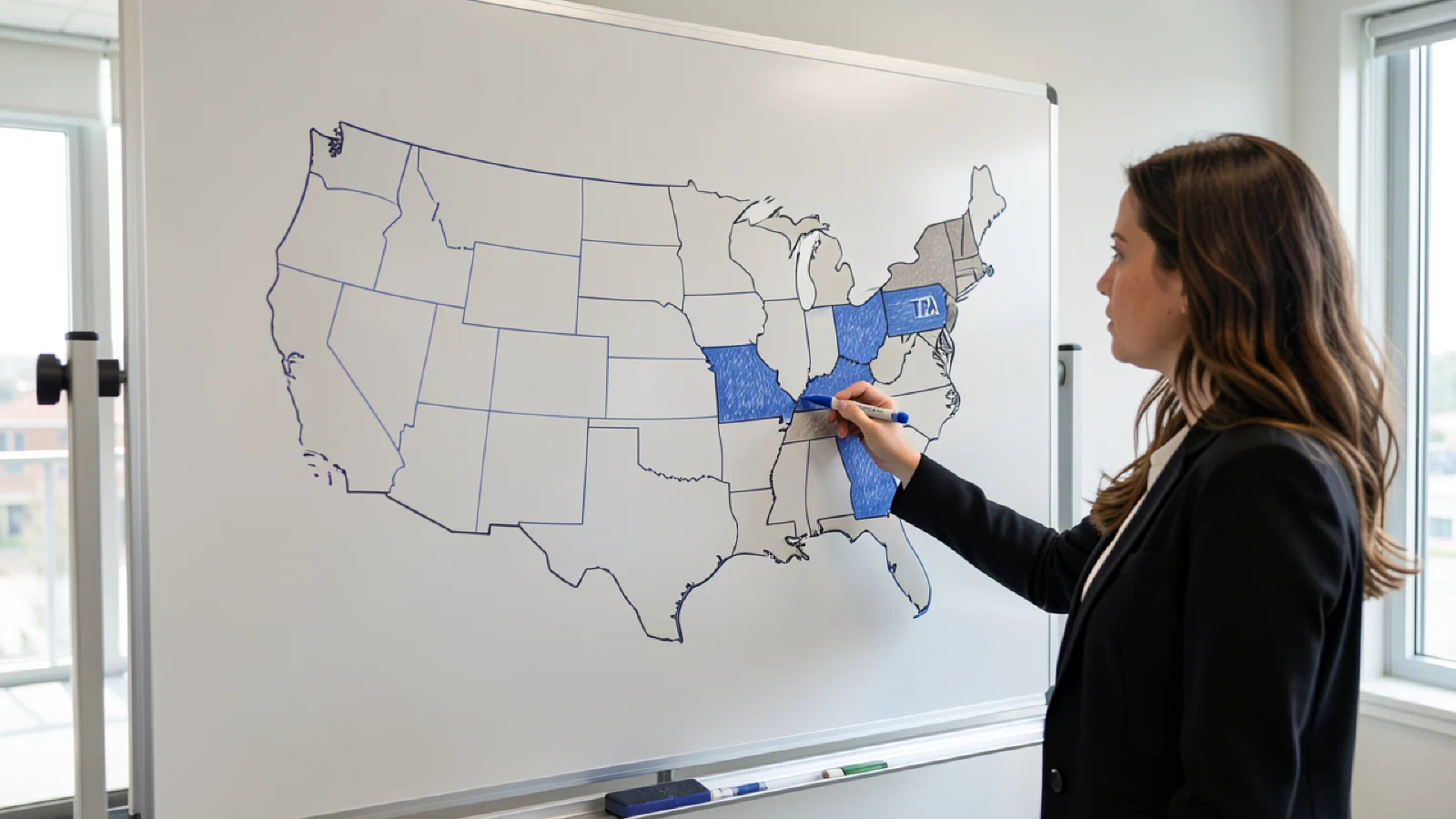
Three cost management strategies become viable when the workforce is mobile. First, domestic steering to lower-cost rural hospitals and independent ambulatory surgery centers for scheduled procedures. The RAND Hospital Price Transparency Study found that in 2022, employers and private insurers paid, on average, 254 percent of what Medicare would have paid for the same services at the same facilities. State-level variation ranged from under 200 percent of Medicare in states like Arkansas, Iowa, Massachusetts, Michigan, and Mississippi to above 300 percent in California, Florida, Georgia, New York, South Carolina, West Virginia, and Wisconsin. Within states, the difference between 25th and 75th percentile hospitals represents a 45 percent potential reduction in hospital spending. Ambulatory surgery centers averaged 171 percent of Medicare prices compared to hospital outpatient departments at substantially higher rates. A mobile worker can choose the lower-cost domestic option; a geographically anchored worker often cannot.
Second, cross-border care at JCI-accredited facilities in Mexico, Costa Rica, Colombia, and elsewhere. Total knee replacement in Mexico costs $10,000 to $15,000 compared to $35,000 to $50,000 in the United States. Dental implants run $750 to $1,200 in Mexico versus $3,500 to $5,000 in the US. Even including travel, lodging, and a recovery companion, the total cost is often less than the deductible and coinsurance a member would pay at a US urban hospital. Mexico has approximately nine JCI-accredited hospitals. Facilities like Médica Sur in Mexico City hold JCI accreditation and membership in the Mayo Clinic Care Network. Hospital Galenia in Cancun performs procedures using the same FDA-approved implants from manufacturers like Stryker, Zimmer Biomet, and DePuy Synthes that US hospitals use. For appropriate procedures on appropriate patients, the quality evidence supports the cost arbitrage.
Third, international pharmacy purchasing from licensed Canadian pharmacies. Canadian pharmacy prices for brand-name drugs run 30 to 80 percent below US prices. For a mobile worker managing a chronic condition with expensive maintenance medications, the savings justify the complexity. The legal landscape is uncertain (federal law technically prohibits importation, but enforcement against personal use has been minimal), and several states have enacted or authorized importation programs. A TPA that serves a mobile, high-cost-drug population has cost management options that a TPA serving a geographically fixed workforce does not.
Every article in this series builds on this insight. The strategies are not theoretical. They are operational. They require infrastructure: care coordination, travel logistics, complication protocols, benefit incentive design, claims adjudication rules. Building that infrastructure is the TPA’s work. The preface exists to ensure the reader understands what kind of series this is before arriving at the first article.
How this article connects to others in Blue Gray Matters.
Sources cited in this article.
- Frak Conference. *State of Fractional Industry Report 2024*. Frak Conference, 2024.
- Gallup. "Global Indicator: Hybrid Work." Gallup, 2025, www.gallup.com/401384/indicator-hybrid-work.aspx.
- Joint Commission International. "JCI-Accredited Organizations." Joint Commission International, 2025.
- RAND Corporation. *Prices Paid to Hospitals by Private Health Plans: Findings from Round 5.1 of an Employer-Led Transparency Initiative*. RAND Corporation, RR-A1144-2-v2, 2024.
- Robert Half. "Remote Work Statistics and Trends for 2026." Robert Half, 2026.
- U.S. Bureau of Labor Statistics. "Labor Force Statistics from the Current Population Survey." BLS, 2025, www.bls.gov/web/empsit/cpseea41.htm.
- Vendux. "Fractional Sales Leadership Report 2024." Vendux LLC, 2024.